





Hellenes | ||
|---|---|---|
|
Greek Colonies
|
Greeks
|
Athenians
|
|
Macedonians
|
Spartans
|
Thebans
|
|
Thessalians
|
Rhodians
|
Epirotes
|
|
Aetolians
|
Cretans
|
Imperial Macedonians
|
European Barbarians | ||
|---|---|---|
|
Thracians
|
Getae
|
Illyrians
|
|
Paeonians
|
Odrysians
|
Bessi
|
|
Dentheletae
|
Triballi
|
Taulantians
|
|
Dardanians
|
Celts
|
Celtiberians
|
Anatolians | ||
|---|---|---|
|
Bithynians
|
Lydians
|
Cappadocians
|
|
Phrygians
|
Paphlagonians
|
Colchians
|
|
Pisidians
|
Carians
|
Lycians
|
|
Ionians
|
Armenians
|
Pamphylians
|
Iranians | ||
|---|---|---|
|
Persians
|
Hyrcanians
|
Arachotians
|
|
Medes
|
Sagartians
|
Cissians
|
|
Caspians
|
Bactrians
|
Sogdians
|
Magna Graecia | ||
|---|---|---|
|
Etruscans
|
Samnites
|
Apennine Peoples
|
|
Campanians
|
Lucanians
|
Apulians
|
|
Romans
|
Bruttians
|
Italiots & Sicilians
|
Semites | ||
|---|---|---|
|
Arabs
|
Hebrews
|
Babylonians
|
|
Phoenicians
|
Assyrians
|
Syrians
|
Steppe Nomads | ||
|---|---|---|
|
Scythians
|
Sarmatians
|
Massagetae
|
|
Parthians
|
Saka
|
|
Africans | ||
|---|---|---|
|
Nubians
|
Egyptians
|
Libyans
|
|
Carthaginians
|
||
Indians | ||
|---|---|---|
|
Indians
|
Gandharans
|
|
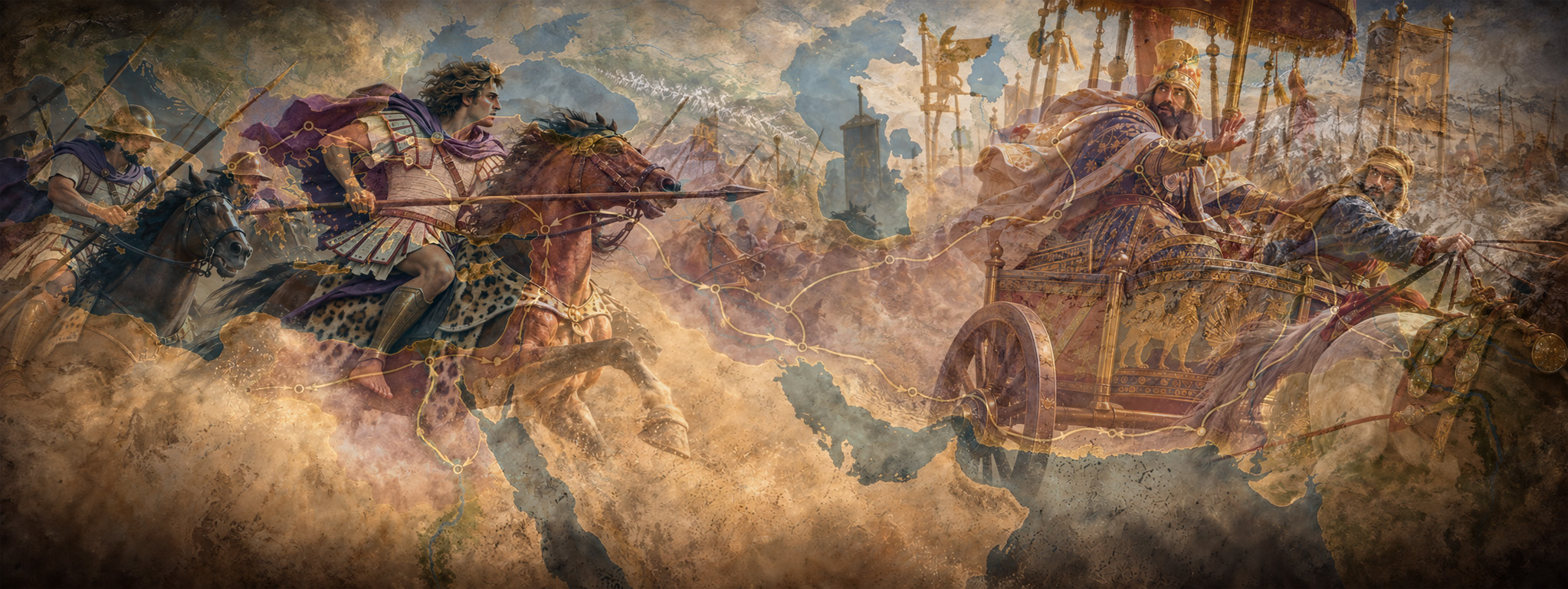
Alexander the Great
From the wooded valleys of the Balkans to the great rivers of India, the fourth century BCE is an age in which no frontier seems secure. Greek cities defend their independence, Macedonian kings forge a new kind of army, and the Persian Empire draws on the soldiers, wealth and experience of peoples spread across an immense territory. Beyond its provinces lie the horsemen of the steppes, the kingdoms of the Nile and the powers of the western Mediterranean. Alexander's expedition will connect these worlds through conquest, resistance and uneasy alliance.
The kingdom that learned to survive
The story begins before Alexander. When Philip II takes the Macedonian throne in 359 BCE, his kingdom faces dangerous neighbours, rival claimants and the memory of a disastrous defeat. Military reform, diplomacy, marriage alliances and access to new revenues gradually transform this vulnerable monarchy into a leading power. The sarissa-bearing phalanx becomes one part of a combined army: cavalry, selected infantry, archers, slingers and mobile troops have different jobs, and victory depends on bringing them together at the right moment.
At Chaeronea in 338 BCE, Philip defeats the armies of Athens and Thebes. The settlement that follows brings much of Greece into a league under Macedonian leadership, but political submission does not erase hostility. When Philip is murdered in 336 BCE, his young successor inherits both an extraordinary instrument of war and a kingdom whose enemies are watching for weakness. Before he can cross into Asia, Alexander must secure the northern approaches and confront revolt in Greece. His destruction of Thebes in 335 BCE makes the price of resistance unmistakable.
An empire worth defending
The Achaemenid Empire is no empty stage awaiting a conqueror. Its roads, royal centres, provincial administrations and local dynasties connect societies with their own interests and military traditions. Darius III commands resources Alexander cannot simply match. Persian and Median nobles, Anatolian horsemen, Greek mercenaries, eastern cavalry and contingents from the Near East can fight within the same royal host. Satraps may also defend their own provinces, hire troops and conduct campaigns far from the Great King's immediate presence.
Alexander crosses the Hellespont in 334 BCE. The Granicus opens the way into western Anatolia; Issus in 333 BCE puts the royal armies face to face. Neither victory settles every local struggle. Cities must choose whether to negotiate or resist, fortresses can hold roads long after a field army has passed, and Persian naval power threatens the Aegean. The campaign turns south, through the coastal strongholds of Phoenicia and Gaza, before Alexander enters Egypt in 332 BCE. Siegecraft, supply and access to ports matter as much as the spectacular cavalry charge.
Beyond the decisive battle
At Gaugamela in 331 BCE, Alexander defeats Darius again. Babylon, Susa and Persepolis bring the conqueror into the political and economic heart of the empire. Yet the fall of capitals does not make the new order secure. Darius's death in 330 BCE changes the contest from a struggle against the Great King into a fight over who may inherit his authority. Former enemies become governors or recruits; former allies question the ambitions and customs of their king.
In Bactria and Sogdiana, resistance exposes the limits of a battle-winning army. Rivers, mountain strongholds and mobile opponents make occupation a different problem from conquest. An enemy need not stand before the phalanx to threaten a garrison, a convoy or a local ally. The frontier of the steppes offers another kind of battlefield, where pursuit can become a trap and a victory may secure only the ground beneath the army's feet.
In 326 BCE, the campaign reaches the Punjab. Alliances with local rulers coexist with fierce resistance, and the battle against Porus at the Hydaspes brings elephants, cavalry, infantry and a difficult river crossing into the same struggle. At the Hyphasis, Alexander's soldiers refuse to march farther east. The return journey, including the passage through Gedrosia, reminds every commander that an army can survive its enemies and still be broken by distance, exhaustion and supply.
A world larger than one conqueror
Alexander dies in Babylon in 323 BCE. His conquests leave no simple or lasting settlement. Commanders, royal relatives, local dynasts, cities and provincial elites must decide what to defend, whom to obey and whether the moment has come to seek independence. The first struggles of the successors grow from the armies and political tensions of Alexander's lifetime; later Hellenistic institutions should not be projected wholesale into his campaigns.
This setting covers the rise of Philip, the campaigns of Alexander and the immediate crisis of succession. Its fifty-eight faction entries preserve the breadth of the original army collection. They represent cities, regional populations, dynasties, tribal communities and different stages of a royal army, rather than fifty-eight equivalent sovereign states. Some are directly involved in the conquests; others belong to the surrounding world and support contemporary regional campaigns or explicitly imagined encounters.
Choose your place in the struggle
The Hellenes include rival city-states, island communities, Greek settlements and the Macedonian armies. They bring citizen traditions, mercenary service, cavalry aristocracies and conflicting ideas of freedom into the same military world.
The peoples of the European Balkans occupy the approaches to Macedonia and the Danube. Thracian and Illyrian communities can appear as opponents, allies or recruits. Their wars are about routes, royal authority, local rivalries and control of the frontier, not simply an undifferentiated invasion from the north.
The Anatolian peoples stand between the Aegean, the Black Sea and the imperial interior. Persian administration, local dynasties and Greek cities overlap. Their forces make provincial resistance, mountain warfare and the defence of communications as compelling as the great royal battles.
The Near Eastern and Punic peoples, grouped under the inherited collection heading Semites, include Phoenician ports, Mesopotamian populations, communities of Judaea, Arab groups and Carthage. This is a collection category, not a single alliance. Carthage remains a western Mediterranean power, not a kingdom conquered by Alexander.
The Egyptians, Nubians and Libyans connect the Nile valley to its southern and western neighbours. Egyptian struggles against Persian rule, frontier expeditions, garrisons and local politics offer campaigns beyond the familiar march of the Macedonian army. Alexander did not conquer the kingdom of Kush.
The Iranian peoples and their imperial neighbours provide the geographical and military depth of the Persian world: Persians, Medes, Armenians, eastern provinces and communities known through uneven ancient testimony. A royal army, a satrapal host and a local defence force need not resemble one another.
The steppe peoples bring mounted warfare to the edges of settled empires. Names such as Scythian, Saka and Massagetae describe changing and sometimes overlapping groups. The Parthian entry belongs here by the organisation of the original collection, but represents the region in Alexander's age, not the later Arsacid Empire.
The Indian and Gandharan factions open the eastern end of the campaign. River systems, fortified settlements, local kings and their alliances shape the fighting. India is not one enemy kingdom, and the armies Alexander encountered cannot stand for the entire subcontinent.
Command a royal expedition, keep a city independent, defend a mountain road or hold together a coalition whose members do not share your ambitions. The field may be a plain outside a great capital, a wooded valley, a river crossing or a gate in a distant frontier town. Your army is only one part of the struggle. The question is what its victory will allow you to preserve, change or claim.