



Freedom | ||
|---|---|---|
|
Everspring
|
Sylvara
|
Thornwild
|
|
Hillfolk
|
Steelhalls
|
Stoneward
|
|
Albian
|
Brightkeep
|
Vlandor
|
|
Wildmen
|
Storrhold
|
Arboryn
|
|
Mirelm Haven
|
Wardens of Velan
|
Wraiths of Halgaroth
|
Power | ||
|---|---|---|
|
Dreadhold
|
Shadowspire
|
Ashmarsh
|
|
Gryndor
|
Darkholm
|
Grimstone
|
|
Dunes of Qarath
|
Corsairs of Draxis
|
Far Qarath
|
|
Greyhills
|
Ironwatch
|
Outlaws
|
|
Malgar
|
Steppes Clans
|
Dawnsun Empire
|
Chronicle of the Reign of Might's World
The Ages of Myth and Shadow
In the earliest annals known to sage and song, the world was young and unbroken. Ancient forests whispered with primeval magic, and the first kingdoms of Elves and Dwarves rose in an age of dawn. Yet greatness ever walks hand in hand with calamity. An ancient cataclysm rent the sky – in those days a great mountain, Shadowspire, belched forth fire and ash, sundering climates and turning fair realms to wasteland. In its wake, peoples were set in motion: proud nomads rode west across new continents, and civilizations old and new took root. Thus began the Age of Empires, when mortal ambition grew tall as mountains. The race of Eldrakar – born of human and elven mingling – founded mighty Vlandor, and under its iron rule countless lands were conquered and colonized. For a time, order (unyielding and absolute) reigned, and it seemed the destiny of men was to bow before eternal Eldrakar lords. This was the empire’s gilded Golden Age, when Vlandor’s fortresses crowned the hills and its legions strode across continents unchallenged. But pride begets folly. Far to the north in shadowed mountains, a darkness gathered – Agramon, the Dark Forgemaster, a warlord-king steeped in forbidden sorcery, forged an empire of orcs, trolls, and fell beings amid the iron peaks of Dreadhold. His ambition was nothing less than dominion over life and death, and the clash between Vlandor’s hubris and Agramon’s malice would drown the world in blood.
So dawned the Great War, the calamitous era that sundered the old world. Eldrakar pride led Vlandor to strike first, its knights and battlemages driving deep into the Dark Lord’s realm. Victory seemed within grasp – until Agramon unleashed horrors unforeseen. From the far north thundered the Drakoths, colossal war-beasts twisted by foul sorcery, smashing through unsuspecting defenses. Vlandor’s northern armies were flanked and broken, its splendid cities set aflame by sudden onslaughts from traitor kingdoms and opportunists. In a single turning of the tide, the empire’s arrogance was repaid in ruin. Allies fell or faltered: proud Halgaroth bent the knee to darkness, pirates of Draxis harried the coasts, and even the very dead were reanimated to swell Agramon’s legions. The world plunged into chaos. Yet in this darkest hour, unlikely alliances were born. The free peoples of every land – human Horse Lords and elven kings, stubborn dwarves and even rogue warlocks – set aside old enmities to resist the Night. In the forests, ancients awoke (great walking trees striding forth from Arboryn) to stem the tide of monstrosities. On distant seas, opportunistic corsairs prowled, preying on the vulnerable while the mighty were distracted. The Great War raged for years uncounted in misery, an age of heroism and betrayal both. In the end, Agramon’s onslaught was halted but not destroyed – the Dark Forgemaster was crippled by a masterstroke of treachery, as the Dawnsun Empire turned against him at the decisive moment. Vlandor and its allies prevailed, but at terrible cost. The proud Eldrakar empire lay shattered, its glory ashes on the wind, and the dark citadels of Agramon fell silent though not empty. Thus the Great War ended, and with it ended the Age of Empires. In its place dawned a fragile peace, an Age of Reckoning, in which kingdoms nurse their wounds and none can claim dominion over all. The present era was born from the ruin of the old – a time of hope mingled with lingering despair, where the sins and sorrows of the past still cast long shadows over the days to come.
The Present Age: A Precarious Peace
Now it is the Present Age, an uneasy interlude of rebuilding, rife with tensions that threaten to erupt like wildfire. Though the Dark Lord Agramon was thrown down from his throne of war, his specter yet looms in every fearful whisper. In the blasted highlands of Dreadhold his iron fortress still stands, and foul creatures rally once more under his banner in secret. The free realms know that the peace of today is but a sword’s edge away from new strife. Alliances that once saved the world are now strained by old grudges and new ambitions. Former vassals of the Eldrakar empire taste independence and find it intoxicating, leading to rivalries where once there was fealty. In courts and councils across the continents, kings and queens forge pacts by marriage or steel even as distrust gnaws beneath polite smiles. The geopolitical tapestry is complex and fraying: human monarchs treat with ancient elven lords on one day and repel orcish warbands the next, while dwarven citadels barter precious steel for grain to outlast interminable sieges. Every nation is keenly aware of the delicate balance – one misstep, one betrayal, could plunge all back into all-out war.
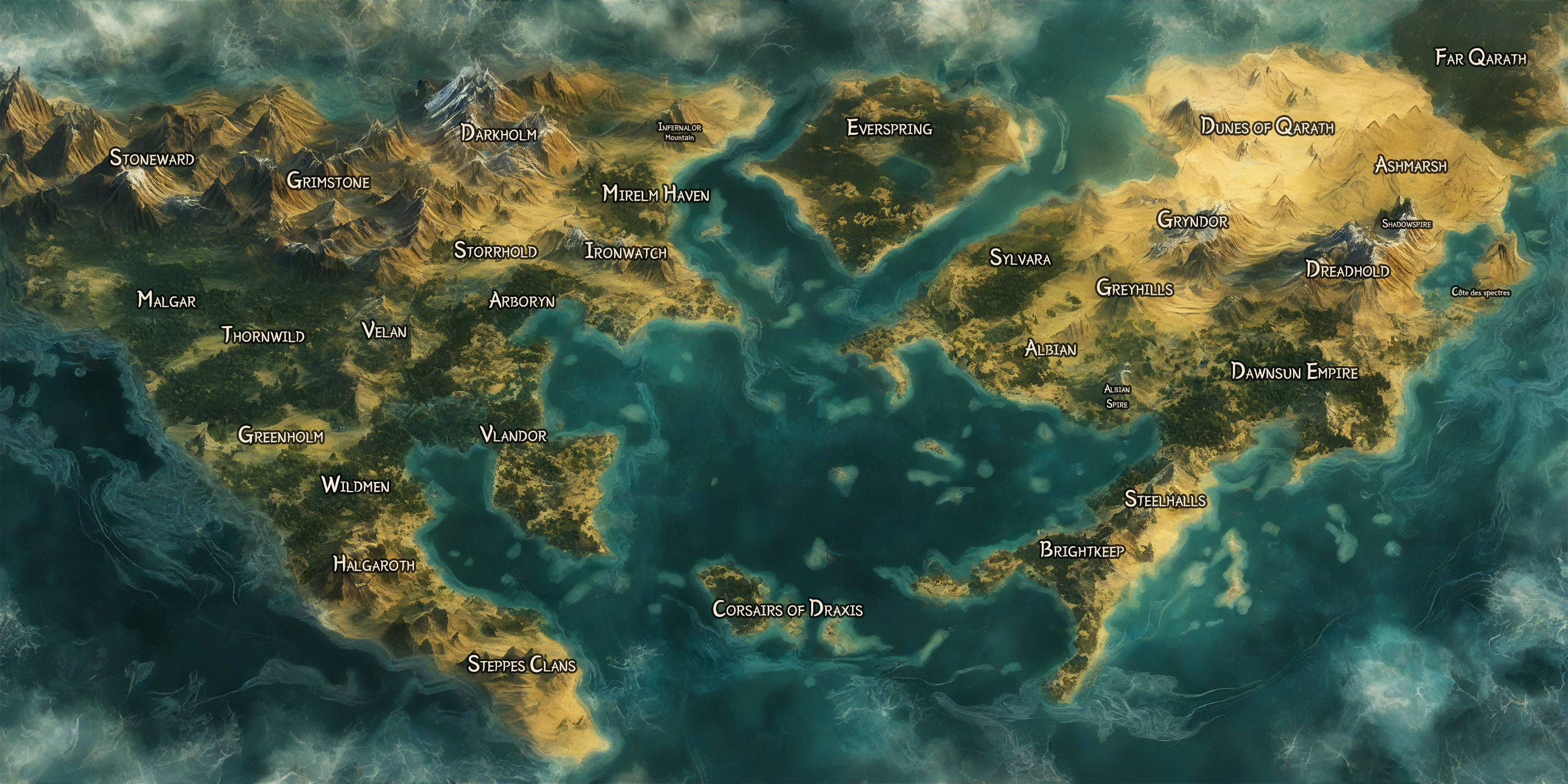
Across the known world, key powers maneuver in a grand game of deception and force. Once united by necessity, they now circle each other warily. On one hand stand bastions of light and law: kingdoms like Albian and Brightkeep, bound by honor and shared sacrifice, or the Horse Lords of Storrhold whose lances keep watch on every horizon. Arrayed against them (openly or in shadow) are the forces of darkness and chaos: the orc warlords in Grimstone’s stolen halls, the necromancer-king brooding in Malgar’s cursed forest, the schemers of Agramon seeking a new path to conquest. Between these poles lie those who walk the gray path – opportunistic powers such as the Dawnsun Empire, which prospered through double-dealing and now wrestles with its conscience, or the free city of Mirelm Haven, which profits from trade even as it arms for inevitable conflict. Tensions run high everywhere. Ancient wounds (like the bitter feud between the Elves of Sylvara and the Orcs of Gryndor) still bleed into skirmishes along their borders. New disputes arise over resources, territory, and vengeance: the outcast legions of Ironwatch fortify their mountain forges, provoking dread and a hungry glint in every neighbor’s eye; the Corsairs of Draxis raid at will, turning friend against friend in their mercenary wake. Even within realms, unity is a brittle thing. Prideful nobles, vengeful priests, ambitious warlords, or restless common folk all threaten to unravel the hard-won peace from within. And all the while, ominous rumors abound – whispers that Agramon’s servants move in distant deserts and jungles, that strange fires flicker again atop Shadowspire, and that perhaps the Great War’s final battle has yet to be fought. Against this backdrop of uncertainty, the world holds its breath. This chronicle now turns to the great realms and factions of each land, that their deeds, strengths, and struggles in this present age may be known to those who seek wisdom. We divide these accounts by the great regions: the Western Continent, the Eastern Continent, and the scattered Islands and Seas beyond. May the reader find illumination in these words, as if guided by an elder sage’s hand over an ancient map, each kingdom and domain laid out with its triumphs and torments.
Eastern Continent
The Eastern Continent is a land of contrasts and conflict, where young kingdoms of men buttress ancient enclaves of elder races, and the scars of the Great War lie heavy on every peak and vale. From the fertile heartlands guarded by a white citadel, to deserts where dunes conceal both treasure and tyranny, to highland steppes ringing with the cries of free warriors – all are bound together by the tenuous peace of this era. Here alliances of necessity clash with cultural pride, and the looming shadow of evil presses from the north and beneath the earth. The following are the major realms of the Eastern lands, each a pillar in the chronicle of this age:
Albian – Realm of the White Spire
Albian is a kingdom of hope born from war, a realm founded in the darkest of times that still shines like a beacon against encroaching night. Its origins lie in the Great War, when Vlandor’s Eldrakar lords established Albian as a distant fortress-colony to guard against Agramon’s darkness. In those days the great Albian Spire was raised – a magnificent citadel of gleaming white stone carved into a mountainside, its peak crowned with ancient magic. From that bastion, Albian grew into a proud and independent kingdom, tempered by centuries of strife. Unlike its imperial parent, Albian embraced a creed of merit over birthright: Eldrakar blood still runs in its noble families, gifting them long life and strength, but any commoner of courage may rise high in Albian’s service. This egalitarian spirit makes Albian’s court both vibrant and turbulent. Knights, mages, and humble soldiers stand side by side as peers in the defense of the realm, yet whispers of discontent snake through the halls – some old Eldrakar-line nobles quietly resent the upstart heroes of common birth, while the common folk remain wary of those whose veins carry otherworldly longevity. King Elenor II, a charismatic warrior-king, strives to balance these forces. He fights at the forefront of battle, wielding the justice and honor Albian prides itself on, even as he must contend with intrigues behind his back.
In the present age, Albian stands at the forefront of the East’s alliances and wars. Its banners fly beside elven ones, for Albian is bound in friendship (and royal marriage) to Sylvara, the enchanted elven kingdom to the south. The queen of Sylvara is wed to Albian’s king, a living symbol of unity between human valor and elven wisdom. Albian also keeps faith with Brightkeep, a fellow descendant of Vlandor’s colonial ambitions. Though Brightkeep’s ways are more rigid, the two realms share history and often swords in the field. Together with the ranger-knights of Velan and other free peoples, Albian has forged a bulwark of light against the shadow. And shadow abounds: on Albian’s northern horizon lies dreaded Dreadhold, the iron empire where Agramon’s dark will still stirs. From those mountains pour orcs, trolls, and fell sorcerers in ceaseless raids to test Albian’s mettle. To the south, the orc realm of Gryndor hungers for Albian’s fertile plains, its warlords ever probing the border with fire and sword. Even the seas grant no respite, as the Corsairs of Draxis strike Albian’s coasts without warning, black sails bringing fire and slaughter to fishing villages and port towns. Surrounded by foes, Albian relies on its stout hearts and strategic position. The land’s geography is kindly – golden wheat fields and green pastures provide ample food, while iron-rich hills and dwarven trade yield steel for its armories. Mountain ranges form natural walls where man-made fortresses (many built in Vlandor’s time) guard every pass. These defenses have been tested in countless sieges and never yet broken, thanks in part to Albian’s famed military orders. The Guardians of the Spire – knights of unflinching loyalty – stand watch at the capital citadel, while the Albian Navy under Admiral Lothar patrols the coasts, having sent more than one pirate galley to a watery grave.
Yet for all its outward strength, peril gnaws within. Albian’s court is not free of corruption: the king’s own steward, Lord Aeric, plays a duplicitous game, smiling in fealty by day while scheming by torchlight to siphon gold and power for himself. Factional rivalries among noble houses simmer just below open conflict, threatening the unity so needed in wartime. Even the kingdom’s shining ideal – that virtue, not high birth, grants glory – carries seeds of discord, as old aristocracy and new heroes jostle for influence. But in spite of these trials, Albian endures as a symbol of resilience. The common folk till their fields and raise their walls with pride, knowing they live in a land where honor still holds meaning. Bards sing of the White Spire’s light seen for miles at dawn, a promise that Albian will not falter. As darkness gathers again on the borders of the East, Albian’s people stand ready, determined that their realm (born in an age of terror) shall never yield to the darkness. The legacy of Albian – of hope rekindled and courage rewarded – burns bright, and so long as its defenders remain true, that light shall not be quenched.
Sylvara – The Enchanted Silver Wood
Sylvara is an elven kingdom of ancient grace, a realm of eternal forest twilight and silver-lit glades where magic suffuses every leaf and stream. Nestled deep in a boundless greenwood, Sylvara appears to outsiders as a tranquil sanctuary untouched by the strife of the world. Indeed, to behold Sylvara is to glimpse a living memory of the elder days: colossal trees with trunks as wide as guard towers, whose leaves shimmer with a faint glow; hidden cities grown from living wood and crystal, murmuring with the songs of druids and enchantresses. Yet beneath this veneer of peace lies a steely vigilance. The Elves of Sylvara have learned through bitter experience that no corner of the world, however lovely, is truly safe from war. The borders of Sylvara have been stained with blood time and again, and its people do not forget. They remember the invasions repelled by arrow and spell, the dark creatures that have prowled at night, and the betrayals even kin can inflict. Long ago, before the Great War, Sylvara fought a vicious conflict with its sister realm, the island kingdom of Everspring – an elven civil war of sorts, born of pride and territorial desire. Though that feud eventually cooled, it left deep scars of mistrust. Only in the crucible of Agramon’s onslaught did Sylvara and Everspring finally set aside their grievances, forging an alliance of necessity to stand against oblivion. Today they share cordial ties (even blood relations among their nobility), yet an undercurrent of unease persists between their courts, a subtle question of which holds preeminence in elvendom’s future.
Sylvara’s geopolitical position is both a blessing and a curse. Insular and well-defended by the dense magical forest, the kingdom long kept outsiders at arm’s length. To the south lies its stalwart ally Albian – years of trade and the recent marriage of Princess Elira of Sylvara to King Elenor II of Albian have bound the two realms closely. This union has ushered in an era of unprecedented cooperation: Albian’s knights patrol alongside Sylvarian wardens at the southern marches, and knowledge flows freely between the White Spire’s mages and Sylvara’s mystic sages. Some Sylvarian elders, however, quietly fear that human influence could dilute their cultural purity, and whisper that Sylvara must ensure it is not eclipsed by Albian’s rising power. To the east of Sylvara lie the Greyhills, home to the hardy Wutan tribes. The elves have little in common with these rough hillmen, yet necessity has opened limited exchange – Sylvara’s artisans trade fine goods in return for the rare herbs and ores the Wutans gather in their windswept hills. Far more perilous is Sylvara’s Eastern flank, which faces the Orcish empire of Gryndor. There, on sylvan borders, all pretense of peace drops: for generations Sylvara has been locked in an unending guerilla war with the orcs of Gryndor. Along the cursed borderlands, Sylvarian archers and rangers melt into the shadows of the trees to waylay orcish warbands, striking hard and then vanishing like ghosts before Gryndor’s heavy troops can retaliate. The very soil of that frontier is charred and battle-scarred, fertilized by centuries of blood. Many an ancient oak there bears the marks of axe and fire where orcish forays tried to hew paths into the forest’s heart, only to be repelled by fierce elven resistance. Sylvara spares no mercy for Gryndor’s raiders – the enmity between these peoples is absolute, fueled by the orcs’ blatant desire to despoil the sacred wood and the elves’ utter refusal to permit even one leaf to fall to their enemy’s hand.
Internally, Sylvara is governed by a balance of tradition and monarchy. King Aelarion, the current High Monarch, is a battle-tested ruler who knows isolation can no longer shield his people. He pushes Sylvara to engage with the wider world carefully, sending envoys to human courts and lending small companies of elf warriors to coalition forces when darkness stirs abroad. This policy is not without controversy – the Council of Elders, Sylvara’s circle of the eldest and most conservative elves, counsels a return to secrecy and total focus on protecting their own borders. But even the elders recognize that the world has grown smaller and more dangerous; the age when Sylvara could hide beneath its canopy is over. And so the kingdom walks a delicate line. Culturally, Sylvara remains exquisitely itself: art and song and the old rituals of the moon are cherished; outsiders may visit only under close guard, and none but elves may dwell permanently in the Silver Wood. At the same time, the elves quietly exchange magical knowledge with Albian’s sorcerers, and they keep a watchful eye on every political shift beyond the trees. Sylvara’s people are proud – perhaps to a fault – and mindful of their role as stewards of a timeless legacy. They view their forest as a living heirloom entrusted to them by the gods or by the world’s very soul. Thus every Sylvarian warrior, from the humblest sentry to the king himself, fights with the conviction that they defend not merely a nation, but the last inviolate sanctuary of ancient wonder in a world steadily coarsened by iron and fire. In Sylvara the very air shimmers with enchantment, and the spirits of the forest are said to walk alongside the elves. As long as those silver trees still stand and elven arrows fly true in their shadow, the Enchanted Realm will remain a bulwark against the tide of darkness – a living reminder that beauty and valor yet endure beyond the age of mortals.
The Greyhills – Land of the Freeborn Clans
In the rugged eastern highlands where knives of grey rock pierce the sky, the Greyhills are a realm of free people who bow to no king. This is a hard land of windswept slopes, deep stony valleys, and moorlands cloaked in mist – a place that breeds hardy folk with iron in their bones. The clans of the Greyhills (calling themselves the Wutans) have dwelt here since time immemorial, scratching out a living by shepherding, hunting, and a bit of furtive mining in the crags. They are humans, but far removed from the feudal courts and manners of lowland kingdoms. Instead they cleave to tribal traditions of honor, vengeance, and fierce independence. Every Wutan child grows hearing the tales of their ancestors’ defiance: how the Greyhills were a refuge for those who fled tyrants and conquerors, a sanctuary never conquered. Indeed, no empire – not Vlandor at its height, nor Agramon’s legions, nor any other – has ever fully subdued these hills. Invaders who march into the narrow passes find only sudden death from above, as agile warriors rain arrows and boulders from hidden perches. Over and over history recorded attempts to pacify the Wutan clans, and over and over those attempts failed. The Greyhills earn their name; the stones themselves seem to reject foreign boots, and the very winds carry the war-cries of free men like an omen of doom for any would-be oppressor.
In the current era, the Greyhills occupy a precarious but proud position among larger powers. To the north of the clans lies the Dunes of Qarath, a great desert, and to the west the forest kingdom of Sylvara. Neither neighbor is friendly. The Qarathian warlord Sahladorn has tried to entrench his influence even into the foothills, but the Wutans have met his advances with guerilla ferocity, ambushing any desert patrols that stray too far from the sands. With Sylvara, relations are tense but not openly hostile – the elves and the Wutans share a mutual disdain yet a mutual respect in trade. Hardy caravans now and then wind through the edges of the hills, swapping Sylvarian herbal remedies and fine craftwork for the Greyhills’ furs, goats, and precious quarried stone. But the cultural gulf remains vast: the elves find the clansfolk brash and uncouth, while the Wutans mutter that the haughty elves would enslave them with honeyed words given the chance. Far more fraught is the southern border, which meets the kingdom of Albian. Albian’s kings have long sought to befriend (or pacify) the Greyhills, seeing in these tribes either valuable potential allies or dangerous raiders to be quelled. Kaedric Wolfslayer, the most respected chieftain of the Wutans, eyes Albian with deep suspicion. He calls Albian “the silver tongue of empire” – believing their offers of alliance and gifts of grain hide an aim to sap the clans’ autonomy. Skirmishes along the Albian–Greyhills border are frequent and fierce. Albian patrols and Greyhill warbands test each other’s resolve: a border fort burns here, a clan village is razed there in reprisal. Neither side commits to full war, but neither will stand down. Ironically, Albian’s knights privately admire the tenacity and guerilla skill of the Wutans, even as the clansfolk respect the Albians’ honorable conduct (for conquerors). There are whispers that in a truly dire war – say, if Agramon’s forces surged anew – these two could find common cause. But for now, old grudges die hard. The Greyhills still remember ancestors lost to Vlandor’s colonial armies ages past, and to them Albian is but Vlandor’s child in different clothing.
Life within the Greyhills is a constant struggle yet deeply free. The Wutan clans feud among themselves as often as they unite. Disputes over grazing land or ancient slights can erupt into brief, raw skirmishes – but when a greater threat looms, a High Moot may be called on the sacred hill of Brann Tor. There, beneath stormy skies, the chieftains drink together from a single ox-horn and settle on a war leader. Unity lasts only until the threat is passed, but in those moments the clans fight as one with terrifying effectiveness. Their warriors favor swift raids and cunning traps; they know every cave and blind trail in their hills. They fight with shortbows, spears, and wicked handaxes, often lightly armored for speed. Freedom is their foremost creed – the very thought of kneeling to an overlord is anathema. Their “kings” are simply the strongest or wisest chieftains whom others choose to follow for a time. Women and men alike participate in decision-making at the village hearth; whoever speaks wisdom earns respect. The clans keep a rugged hospitality too: travelers hardy enough to make it into the interior hills (and who come without an army at their back) may find a surprisingly warm welcome by a clan fireside, plied with goat stew and harsh liquor, and pressed for news of the wider world. But woe betide any who break the clan’s laws or insult their honor – justice in the Greyhills is swift and often administered at swordpoint by the aggrieved party. The Wutans maintain a fierce independence of spirit that many outside envy. They are poor in gold perhaps, but rich in pride and loyalty. Around their bonfires under the stars, they recount epics of ancestors who flung back entire legions, and they sing to the night sky that the Greyhills will never be chained. In this age of uneasy peace, the Land of the Freeborn stands aloof, a wild card in the deck of nations. If ever the world should attempt to yoke them, the attempt will break against the stone of these hills – as it always has. And if ever the world should truly need them, the Wutans may prove to be the unbowed sword arm that turns the tide.
The Dunes of Qarath – Desert Kingdom of Splendor and Strife
Where the rolling grasslands give way to endless golden sands, one finds the Dunes of Qarath – a once-prosperous desert kingdom now caught in the throes of tyranny and rebellion. Qarath’s landscape is both beautiful and merciless: vast expanses of shifting dunes that glow like copper under the sun, broken by occasional lush oases and the stone walls of ancient caravan cities. For centuries, the people of Qarath were famed as resilient survivors and savvy traders. Nomadic clans roamed along the starlit dunes, guided by celestial lore from generations past, and great markets thrived in Qarath City, the capital oasis where spices, silks, and enchanted trinkets from far-off lands flowed like water. Qarath was known as a land of ingenuity – its people mastered techniques to coax life from barren soil, to navigate trackless wastes, and to build harmonious societies bound by clan honor and shrewd commerce. But the present era has not been kind to this desert realm. In recent years, a single warlord-king seized power over Qarath’s fractious clans: Sahladorn, the “Scorpion of the Dunes.” By cunning, force, and black alliance, he united the desert under his iron fist, transforming a land of proud tribes into a coerced kingdom bent toward his will.
Under Sahladorn’s reign, Qarath has entered a dark chapter. Once, the desert’s freedom was legendary – now heavy tribute and fear reign. Sahladorn’s elite warriors, the Ibndorn cavalry, thunder along former trade routes, enforcing harsh new laws and crushing dissent. Caravans that once traveled freely now move under the shadow of taxation and patrol, their profits siphoned to the warlord’s coffers. The despot’s reach even extends into the spiritual heart of Qarath: he has shackled many of the wise desert sages and storytellers, replacing ancient counsel with his own propagandists. Most alarming to many Qarathians is Sahladorn’s pact with Agramon. The Dark Lord’s influence seeps in from the north – from Dreadhold’s foundries come shipments of weapons and grim engines of war, offered in exchange for the desert king’s fealty. With Agramon’s backing, Sahladorn has fortified Qarath City with cruel new devices and augmented his army with fearsome war machines. But this alliance with shadow has poisoned the soul of Qarath. The desert folk have always revered their land as sacred; they see the creeping darkness as an affront to the free winds and starry nights of their heritage. Now the kingdom is riven by resistance. Many nomad clans refuse to bend the knee and have slipped into guerrilla insurgency – striking Sahladorn’s supply lines by night, then vanishing into trackless badlands. In the craggy mountains and caves at Qarath’s fringes, rebels gather: proud chieftains, dispossessed nobles, and even common villagers turned brigands, all plotting to oust the tyrant. The flame of rebellion is fed in secret by figures like Zaraya Delsaran, a half-elven merchant queen who publicly deals in trade but privately funds uprisings to restore freedom. The air in Qarath crackles with tension, like the charged calm before a sandstorm; it is not a question of if open revolt will explode, but when.
Qarath’s relationships with neighboring powers are as turbulent as the desert winds. To the west, beyond stony ridges, lies Sylvara – historically a trade partner, now suspicious of Qarath’s alignment with evil. Sylvarian goods still flow into Qarath’s markets, but the elves quietly bolster border defenses, wary that Sahladorn might let Agramon’s minions use his realm as a bridge to reach them. To the south are the Greyhills: the Qarathian regime maintains only a tenuous ceasefire with the Wutan tribes. Occasional border skirmishes erupt where desert meets highland, fueled by old grudges and Sahladorn’s heavy-handed attempts to tame those hills (attempts met with Wutan arrows for the most part). Perhaps the strangest relationship Qarath holds is with Gryndor to its southwest. The orcs of Gryndor and the humans of Qarath have historically been enemies, yet in recent times Sahladorn has engaged in a cynical dance of diplomacy with them – trading raw materials and iron with the orc forges in exchange for supplies and mercenary aid. This has prevented outright war on that front, but the “peace” is brittle; both sides know any alliance is one of convenience, doomed when it no longer serves their interests. Meanwhile, Sahladorn’s court is rife with intrigue. His alliance with Agramon disgusts many of his advisers and clan chiefs, even those who helped him gain power. Some feign loyalty while secretly corresponding with Albian or Dawnsun emissaries, hoping to find an outside savior for Qarath’s plight. Others plan Sahladorn’s assassination, believing a quick removal of the despot might let the desert breathe free again. Yet Sahladorn’s grip, though slipping, remains fearsome – his secret police and informants lurk in every market and caravanserai, making would-be traitors think twice.
Despite the darkness that has fallen over it, Qarath’s spirit is not easily broken. The everyday folk still pray at dusk to the stars and the ancestral spirits of the dunes, seeking guidance and patience. The caravans still snake across the sands (albeit under armed watch), and the great Oasis City of Qarath still bustles each dawn with camel bells, bartering shouts, and the laughter of children chasing after traders for sweets. But the laughter is muted now, and the eyes of the adults look ever northward with dread. All know that if Sahladorn continues on his path, Qarath may either become a pawn of the Shadow or plunge into the anarchy of civil war. Yet hope glimmers like a desert mirage: the legend of the desert is that when oppression becomes unbearable, the dunes themselves will rise up – as a scouring sandstorm – to swallow tyrants. In whispers around campfires, rebels invoke this legend and call themselves the Desert Storm gathering on the horizon. Whether by nature’s fury or human valor, the Qarathians believe their land will be free again. In this time of twilight for the desert kingdom, the question remains: will Qarath’s next chapter be one of liberation and a return to enlightened trade and culture, or will the dunes run red with the final blood of its freedom fighters? The answer lies buried in the sands, awaiting the day the storm breaks.
Gryndor – The Orcish Forges of Conquest
South of Sylvara’s gentle woods and Albian’s well-tilled fields lies Gryndor, a land where the sky is black with smoke and the earth trembles under the march of armies. Gryndor is an orcish realm driven by conquest and industry, an empire of hammer and anvil as much as tooth and claw. Its landscape is a stark contrast to its northern neighbors: blasted badlands and sooty plains dotted with towering forges and factories. The very air is thick with ash from countless smog-choked forges – for Gryndor’s pride and power rest on its unequaled capacity to craft engines of war. Orc smiths (and enslaved goblin laborers) toil day and night stoking the great foundries, churning out jagged swords, ironclad wagons, siege towers, and other instruments of devastation. This relentless production feeds Gryndor’s war machine, which is perhaps the largest and most fearsome in the Eastern Continent. Warlord chieftains govern its regions, each pledging obedience to the Overking of Gryndor in exchange for authority to raid and pillage. Among themselves, these orc lords compete fiercely for status – victory in battle and the amount of territory ravaged are the currency of honor in Gryndor. It is a brutal, martial society where might makes right and the weak are quickly subjugated or slain. And yet, for all its savagery, Gryndor has a grim order: the warlords obey strict hierarchies, and the forges run on precise schedules. In Gryndor, war is not chaos but a craft, a grand and terrible industry.
Gryndor’s ambitions are boundless and blunt: it seeks to conquer, to consume, to expand its dominion wherever its armies can march. Diplomacy is almost alien to Gryndor’s culture; the orcs see negotiation as a stalling tactic of the weak. They prefer to communicate in the language of intimidation. Naturally, this puts Gryndor at odds with nearly every neighbor. To the north, Sylvara’s forest realm has for centuries been a target of Gryndor’s aggression – the rich timber and hidden enchantments of Sylvara are an alluring prize, if only the orcs could hack their way through the vengeful trees and elusive elves. Warbands from Gryndor constantly probe Sylvara’s defenses, both on land and at sea. They burn the fringes of the forest when they can, though they rarely keep the ground gained for long before elven counter-strikes drive them back. The coast between Sylvara and Gryndor is a theater of continual skirmish as well, with Gryndor’s ironclad ships clashing against Sylvara’s swift elf-craft. To Gryndor’s southwest lies Albian, another perpetual foe. The orcs of Gryndor covet Albian’s fertile farmland and seek revenge for past defeats at Albian hands. They mount bloody raids into Albian’s border villages whenever possible, and only Albian’s vigilant fortifications prevent deeper incursions. Gryndor knows that Albian (especially allied with Sylvara) is a formidable opponent, so outright full-scale invasion has been held off while Agramon’s status is uncertain. But the warlords stockpile arms for the day they believe Albian is sufficiently weakened or distracted – on that day they intend to strike hard and claim the “green country” for Orc-kind.
Interestingly, Gryndor’s southern border is the relatively calm one; it abuts the region of Ashmarsh (poisoned swamps and wastes) which is inhabited by scattered orc tribes technically loyal to Agramon. Gryndor sees them not as enemies but as distant cousins or even pawns – indeed, the Overking occasionally bullies those tribes into sending tribute or troops by invoking Agramon’s name. East of Gryndor lie the Dunes of Qarath, and there the dynamic is one of uneasy opportunism. Gryndor and the Qarathian regime have engaged in sporadic trade, as mentioned, swapping metals and tools for provisions. Each distrusts the other deeply, but as long as Sahladorn rules Qarath and cooperates with Agramon (and by extension, tolerates Gryndor’s envoys), an outright Gryndor-Qarath war is unlikely. Gryndor’s warlords prefer to focus on the more “glorious” enemies to their north. Within Gryndor itself, internal tensions simmer beneath the surface of unity. The Overking (a title seized by whichever chieftain can cow the rest) must constantly watch for insurrection. Orcish society respects strength above all; if a warlord perceives the Overking to be faltering, they will challenge him in ritual combat or even outright civil war. Some orc generals grumble that endless forging and skirmishing are not enough – they thirst for a great conquest to rival the legends of Agramon’s age. Others, more pragmatic, worry that attacking all fronts could lead to Gryndor’s collapse if met by a grand alliance of enemies. Thus far the more aggressive voices dominate, spurred on by the ceaseless production from Gryndor’s forges which practically demands to be used.
Culturally, Gryndor is brutal but not chaotic. There is a twisted honor in their ranks; cowardice is the greatest sin, and cunning stratagems in war are admired (so long as they lead to victory). The orcs revere Agramon not so much as a spiritual figure but as the ultimate warlord – many of the older generation served in his legions and carry tales of his fearsome presence. They dream of the day he rises fully again so they might ride under his banner to ultimate conquest. In the meantime, Gryndor’s smith-priests stoke great furnaces and chant war hymns to the rhythm of anvils, invoking whatever dark powers or ancestors might lend strength to their steel. Gryndor is like a smoldering volcano of war, its peak ever belching smoke, its lava flows occasionally pouring down in destructive sorties. All the Eastern lands keep wary eyes on this volcano, knowing one day it may erupt in full fury. When that day comes, the hope of the free peoples lies in their unity and valor – for Gryndor will neither ask quarter nor give it.
Brightkeep – Kingdom of the Shining Fortress
On a rocky peninsula jutting into the stormy seas stands Brightkeep, a kingdom renowned for its gleaming fortresses, chivalric knights, and steadfast loyalty to ancient traditions. Brightkeep’s capital is the namesake citadel: a towering castle of white stone perched on sea cliffs, its banners snapping in salty winds, nicknamed the Shining Fortress. This realm was born from the same lineage as Albian – founded during Vlandor’s colonization efforts – but whereas Albian embraced new ideas, Brightkeep remained the most loyal scion of the Eldrakar empire. Even after the empire’s fall, Brightkeep’s people (especially its nobility) took pride in preserving the pure Eldrakar bloodlines and the rigid social order of old. It’s often said that if one wishes to see what Vlandor’s golden age was like, one need only walk the streets of Brightkeep’s cities: Eldrakar lords in ornate armor riding at the head of processions, human commoners bowing respectfully, and a general air of feudal discipline permeating everything.
Brightkeep’s society is highly stratified. The Eldrakar elite form the ruling class – long-lived families that trace their ancestry to Vlandor’s highborn settlers. These families hold the duchies, command the armies, and monopolize high offices. They uphold a strict code of honor and courtly conduct, prizing valor, courtesy, and loyalty (at least among themselves). Humans in Brightkeep, while not enslaved or maltreated, are distinctly second-class citizens. They can attain moderate ranks (such as becoming a knight or officer) but rarely are they granted true noble titles or voice in governance. There is, however, a culture of noblesse oblige – the Eldrakar lords see it as their sacred duty to protect and provide for their human subjects. And indeed, many human peasants and townsfolk in Brightkeep are proud of their homeland’s stability and martial prowess; they view the Eldrakar rule as just and protective, especially given the dangers beyond the kingdom’s borders. Brightkeep fosters a spirit of chivalry and devotion. The Bright Lancers, Brightkeep’s elite cavalry knights, are famed across the continent. They charge into battle in shining armor, lances lowered under sunburst pennants, embodying the kingdom’s resolve. Brightkeep’s navy is likewise formidable – its coastal position has made it a seafaring power, with the Bright Fleet patrolling aggressively to keep pirates and enemy armadas at bay. Admiral Belarion, scion of an old Eldrakar house, leads that fleet with a blend of brilliance and arrogance, ensuring Brightkeep’s coasts are among the safest for merchant ships in these uncertain times.
Geopolitically, Brightkeep occupies a strategic position on the Eastern Continent. It controls a peninsula that extends toward key trade routes, and inland it borders potentially hostile territories. To its north and east lie the lands of the Dawnsun Empire – a relationship that is fraught with tension. Brightkeep and Dawnsun were never openly at war (both were Vlandor’s allies during parts of the Great War until Dawnsun’s famous betrayal), but now Dawnsun’s expansionist and duplicitous tendencies worry Brightkeep constantly. They share a rugged border where Brightkeep’s rangers and Dawnsun’s frontier legions glare at each other across mountain passes. Skirmishes are rare but there is an ongoing cold war of espionage and fortification.
Brightkeep has fortified its northern frontier heavily, stationing one of its great lords, General Haradan – an enormously wealthy but cunning Eldrakar – to oversee defenses there. Haradan’s presence, along with naturally difficult terrain, has so far deterred Dawnsun from any rash aggression. To Brightkeep’s west is the vast ocean separating it from the Eastern Continent; Albian and Sylvara lie across that sea. Brightkeep and Albian share friendly terms, even if philosophically they differ. King Aranthor of Brightkeep and King Elenor of Albian fought side by side against Agramon, forging bonds of respect. However, Aranthor remains a staunch traditionalist, while Elenor flirts with egalitarian ideas – this has caused some wariness. Brightkeep did not join Albian’s royal marriage alliance with Sylvara, for example; Aranthor politely declined any suggestion of marrying off his heirs to “woodland aristocracy.” Nonetheless, Brightkeep and Albian stand allied against any resurgence of darkness. They coordinate naval patrols against pirates and jointly respond to crises when needed.
One crucial alliance for Brightkeep lies beneath its feet – with the Steelhalls, the dwarven kingdom that exists under the Brightkeep Mountains. After the goblin rebellion and the fall of Darkholm, the surviving dwarves fled and established Steelhalls as a new subterranean refuge within Brightkeep’s domain. Brightkeep’s kings offered them sanctuary in exchange for fealty. Now, the dwarves of Steelhalls pay homage to Brightkeep’s crown, but in practice they are semi-autonomous and vital partners. They supply Brightkeep with unparalleled weaponry, master-crafted armor, and siege engines. In return, Brightkeep’s protection allows the dwarves to thrive and focus on their crafts safe from outside threat. It is a mutualistic relationship built on respect – Eldrakar knights toast to King Durnir Ironhand’s health in their feasts, and dwarven miners carve statues of King Aranthor in their halls. This alliance proved decisive during the Great War and remains a cornerstone of Brightkeep’s strength.
Internally, Brightkeep faces subtle undercurrents of change despite its rigid structure. A few exceptional humans have risen high in service (Captain Tharion of the rangers is one example – a mere human who earned the grudging respect of Eldrakar nobility through skill and loyalty). Each such case plants the seed of possibility in the populace that perhaps virtue, not blood, can define one’s station. Younger generation Eldrakars, having seen the empire fall, sometimes quietly question whether adaptation is necessary. These are minority voices for now; most of Brightkeep’s leaders remain staunchly convinced that preserving the old ways is key to their survival and identity. There are also whispers of court intrigue: Lord Torvan, an influential noble, reportedly harbors dreams of making Brightkeep even more isolationist and pure, to the point of undermining alliances he deems “corrupting”. It is said he has corresponded in secret with like-minded reactionaries in Albian’s court (such as Lord Aeric) to manipulate politics for his vision. King Aranthor, while principled, is aging, and such vultures circle should his will falter.
In Brightkeep’s daily life, honor and service are drilled into every citizen. Children of commoners might aspire to become squires or attendants in a great house, seeing it as a noble calling. Festivals celebrate martial prowess – jousting tournaments are common, partly sport and partly training for war. The people have a deep pride in Brightkeep’s unbeaten record against the forces of darkness; not once did Agramon’s banners breach their capital’s walls. They maintain that the Shining Fortress has never dimmed. And indeed, in the late afternoon sun, the white-gold stone of Brightkeep’s castle still glitters defiantly. As threats gather anew in the world, Brightkeep stands as a stalwart bulwark, its swords sharp, shields raised, and hearts pledged to honor. The challenge it faces will be whether a bastion built on the ideals of yesterday can adapt to the battles of tomorrow without cracking. For now, Brightkeep’s resolve is unshakable – like a lighthouse on a storm-tossed coast, shining bright to guide and guard, even as the tempest of change roars around it.
Steelhalls – Fortress of the Exiled Dwarves
Deep beneath the mountains that anchor Brightkeep’s peninsula, hidden from the prying eyes of the surface world, lies Steelhalls, the subterranean bastion of the dwarves in exile. Steelhalls is more than a single city – it is a network of caverns, mines, foundries, and halls carved into the living rock, a last refuge of a proud people nearly extinguished. Its story begins with tragedy: during the Great War, the dwarves of old Darkholm (then the greatest dwarf kingdom in the West) suffered a slave uprising in the war’s chaotic aftermath. Goblins and trolls they had long oppressed turned on them, and Darkholm fell in fire and blood. King Durnir Ironhand led the survivors on an arduous journey, wandering under mountain and through dangerous passage until Brightkeep offered them sanctuary in unused deep caverns below its mountains. There, they established Steelhalls – named to signify strength forged from their suffering. Steelhalls is a kingdom carved from exile. Its population is small compared to the dwarf realms of old, but every citizen is fiercely dedicated to ensuring the survival of their culture. They tunneled out a grand central hall, supported by massive stone pillars wrought with runes of protection. Around this they built an industrious society: smithies whose anvil rings echo night and day, mushroom farms and fisheries in underground lakes to sustain them, and snug residential quarters where dwarven families live and pass down lore.
The alliance with Brightkeep shapes much of Steelhalls’ existence. Nominally, Steelhalls is within Brightkeep’s domain, and King Durnir pays homage to King Aranthor. In practice, the dwarves govern themselves and maintain their own militia, while supplying Brightkeep with the fruits of their labor. Mutual benefit is evident: Steelhalls gets protection (Brightkeep would rally to defend the dwarven halls if ever they were directly threatened) and access to surface trade routes for goods they cannot mine or grow. Brightkeep in turn receives unmatched dwarven weaponry and engineering prowess. The knights of Brightkeep ride to battle in the finest plate armor forged in Steelhalls’ fires, and the castle walls of Brightkeep have been reinforced with ingenious dwarf-crafted mechanisms and trapdoors. In council, King Durnir’s voice carries weight with Brightkeep’s rulers, for they know the dwarves’ loyalty is a cornerstone of their strength. Still, Steelhalls fiercely guards its internal autonomy. They follow their own laws and customs under the mountain. King Durnir is a stern but just ruler who maintains the old dwarven traditions of clan governance (each major clan has a say in a council advising him). Dwarven society here emphasizes unity like never before – having survived near extinction, they have little tolerance for the petty clan feuds that once colored dwarf politics. As one dwarf saying goes, “In Steelhalls, every dwarf is your brother, or we all perish.”
Steelhalls is characterized by an interesting duality of hope and bitterness. The dwarves are thankful to have Steelhalls at all – a safe home where their children can grow up without fear of goblin shackles or dragon fire. They have poured their talent and passion into making it a worthy heir of their ancestors’ halls. The forges of Steelhalls produce exquisite work, from axes that can cleave stone to delicate filigree jewelry that Brightkeep’s noblewomen covet. There is a sense among the dwarves that they must prove to the world (and perhaps to themselves) that they are still the greatest craftsmen under heaven, despite their reduced circumstances. On the other hand, grief and vengeance run deep. Many still mourn the loss of Darkholm and kin who died there. The memory of their goblin slaves’ uprising is a point of shame and fury. Some dwarves thirst to reclaim their old cities now occupied by goblin freeholds or orcish squatters. This desire for vengeance is a divisive issue in Steelhalls. King Durnir preaches caution: Steelhalls is not yet strong enough to wage any wars of reconquest, and he prioritizes securing what they have. But a faction of hot-blooded dwarves, including some veteran warriors and younger firebrands, speak in taverns of “retaking our birthright.” They point to Stoneward’s example (the northern dwarves who still hold their kingdom) and ask why Steelhalls should accept being mere guests under human protection forever. So far this rhetoric has not boiled over, but it represents a future challenge.
The present challenges facing Steelhalls, aside from emotional scars, include the typical dangers of subterranean life. The deep places hold forgotten threats. There are rumors of tunnels leading far below Steelhalls that the dwarves have sealed off – gates engraved with warnings about Nameless Deep things. Some miners whisper of distant clattering in the dark, as if something still knocks from below. There is also the risk of underdark creatures (like packs of pale spiders or cave-ins caused by seismic quakes). The dwarves have superb engineering and have dealt with each incident swiftly, but each one reminds them how precarious life in exile can be.
Nevertheless, Steelhalls has begun to flourish quietly. Its population, though small, is growing as dwarven couples have large families to rebuild numbers. Trade with Brightkeep and even Albian (via Brightkeep’s ports) has made the dwarves modestly wealthy in resources – much of Brightkeep’s gold flows right back into dwarf hands for fine goods. With wealth comes influence: dwarven envoys have significant pull in Brightkeep’s court, and by extension in any coalition Brightkeep is part of. This gives the dwarves indirect say in wider world affairs. For instance, they lobby Brightkeep to support any campaigns against goblins or orcs, in hopes that one day the conditions will be right for them to reclaim Darkholm.
In summation, Steelhalls stands as a monument to dwarven resilience. These halls of exile ring with hammers and songs, not despair. Walk through the Central Forge-Hall at shift change and you’ll see hundreds of dwarves marching out, faces smeared with soot but heads held high, singing ancient working chants that reverberate off the vaulted ceilings. They have made a sanctuary out of sorrow, a fortress out of failure. In the saga of the Eastern Continent, Steelhalls may be small, but it is vital – a reminder that even when fate is cruel, a proud people can forge a new destiny with their own two hands (and maybe a very sturdy hammer).
Western Continent
Where the West is a land of emergent kingdoms and wild frontiers, the Western Continent bears the weight of elder empires and the scars of ancient glory. Here lie the heartlands of the Eldrakar lords, the horse-plains of free riders, and the opulent cities of an empire built on guile. It is a realm where tradition and upheaval walk side by side. The Western powers have seen the rise and fall of Vlandor’s dominion, the betrayal that reshaped the outcome of the Great War, and the fragmentation that followed that war’s end. They now face new dilemmas: how to rebuild or reform, how to confront the lurking shadows from the north, and how to reconcile internal strife born of centuries of rule. The Western Continent’s factions are many and mighty, each with their own realms of influence:
Vlandor – Fallen Empire of the Eldrakars
Once the greatest power in the world, the kingdom of Vlandor now stands as a faded echo of its former self – a lion wounded, proud yet struggling to find its path. Vlandor was the cradle of the Eldrakar race and the nucleus of an empire that spanned continents. In the days before the Great War, Vlandor’s fortresses crowned the mountains and its legions enforced a ruthless peace across countless vassal states. Eldrakar aristocrats, gifted with long life and strength beyond ordinary men, ruled over human subjects in a rigid caste hierarchy. Those were times of order and oppression in equal measure. The Great War, however, broke Vlandor’s back. The war that Vlandor’s rulers instigated out of arrogance turned into a nightmare as Agramon’s counterstroke left the heartland burning. Vlandor’s golden legions were gutted, its frontier colonies declared independence (Albian, Brightkeep, Storrhold, Mirelm Haven – all threw off the imperial yoke when Vlandor could no longer hold them), and even its sacred capital was nearly overrun. By war’s end, Vlandor was a shattered realm, its territory shrunken and its people demoralized. In the generation since, it has struggled to regain stability.
Today’s Vlandor is a kingdom in transition, a realm haunted by its imperial past and uncertain of its future. The geography of Vlandor still inspires awe – fertile plains cut by broad rivers, guarded by a spine of mountains to the north (the Velan Mountains) and deep forests (like Arboryn) along its fringes. These natural defenses served it well in ages past, but now many lay beyond its reduced borders. Vlandor’s current king, Valtherion IX, is an Eldrakar veteran of the Great War. He remembers the day his banners flew over half the world, and he also remembers the humiliation of defeat. King Valtherion presides over a court rife with debate. On one side stand the Traditionalists: elder Eldrakar nobles who believe Vlandor must reclaim its “manifest destiny” to rule, by sword if necessary. They whisper that the vassals’ rebellion at the war’s end was a temporary fluke and that the lesser kingdoms (Albian, Brightkeep, etc.) will fall back in line once Vlandor shows strength. On the other side are Reformists: a faction of younger nobles and humans in administration who argue that the old ways led to ruin. They urge reforms – loosening the caste system, granting more rights to human citizens, forging true alliances instead of vassalage. These divisions sometimes spill into open conflict in the royal council chambers. Notably, the Eldrakar race itself is dwindling. Many of the immortal (or extremely long-lived) Eldrakar lords died in the war or have since succumbed to despair and weariness. Those that remain often lack heirs. Humans now form the bulk of Vlandor’s population and even its army. Tension arises as more humans clamor for positions of influence that were once automatically reserved for Eldrakar. The old nobility sees this as an erosion of Vlandor’s identity; the human bourgeoisie sees it as justice long overdue.
Militarily, Vlandor remains potent but cautious. The core of its army – the famed Vlandorian heavy infantry and remnants of Eldrakar knightly orders – still exists, but morale and numbers have diminished. Vlandor’s generals focus on defense these days: fortifying the remaining borders and ensuring the kingdom itself is secure from any fresh threats from the north (like Agramon’s Dreadhold) or rebellious neighbors. They conduct exercises but avoid provocation. One notable issue is Vlandor’s relationship with its former vassals. The likes of Albian and Brightkeep were once colonies or protectorates; now they are independent states, some arguably stronger than Vlandor at present. Officially, Vlandor has made peace with their sovereignty – trade routes are reopened and diplomats exchanged. But pride is a hard thing to swallow. Some of Valtherion’s councilors secretly draft contingency plans for how to bring those realms to heel should the opportunity arise (for example, if Brightkeep were weakened by war with Dawnsun, or if Albian’s alliances falter). Conversely, Vlandor fears them too. It knows if it oversteps, they might form a coalition against it. Indeed, Brightkeep and Albian maintain a wary watch on Vlandor’s recovery, uncertain if it will return to imperialist ambitions. So far, King Valtherion has opted for reconciliation – sending gifts on Albian’s king’s coronation, for instance – but also making subtle shows of force like holding grand military parades to remind neighbors that Vlandor is not toothless.
Internally, unrest simmers in pockets. In border provinces and outlying towns, banditry (some led by remnants of Vlandor’s own disillusioned soldiers) has risen. The so-called Outlaws of Ironwatch – a growing power in the Ironwatch Mountains to the north, led by Rumon the Pale – include many ex-Vlandorian fighters who lost faith in the crown. They now threaten Vlandor’s northern frontier with raids, essentially turning Vlandor’s own steel against it. The king deals with such problems with mixed success; he has negotiated amnesty for some outlaws and cracked down on others. Additionally, the common folk of Vlandor carry a lingering resentment from centuries of second-class status under Eldrakar rule. The Great War’s devastation somewhat united them with their lords in suffering, but now that peace has returned, the old inequities are in sharp relief. Tax protests, religious sects preaching equality, and even small revolts have occurred, though none have yet gained widespread traction. Vlandor’s state religion – a pantheon that venerates order and hierarchy – is challenged by new cults of martyr-heroes from the war who champion the lowly.
In sum, Vlandor is a study in contrasts: mighty yet weak, arrogant yet insecure, old yet forced to change. Its banners still depict the silver gryphon of Eldrakar nobility, but that gryphon is moulting, unsure if it can take to the skies again. Some sages believe that for Vlandor to truly prosper, it must let go of its imperial past and forge a new identity as just one kingdom among many. Whether its proud people (and especially its Eldrakar elite) can accept that is another matter entirely. The coming years will likely see Vlandor at a crossroads: it will either be renewed (through reform or a bold resurgence of power) or it will crumble further, perhaps to be carved up by hungrier neighbors. For now, the kingdom endures, like an old warrior king on his throne – crown tilted, sword in hand, gazing over a realm that no longer matches the one in his memory.
Stoneward – The Last Dwarven Kingdom
In the far northwestern highlands of the Western Continent, where mountains claw at the heavens and frigid winds howl through granite spires, lies Stoneward, the final bastion of the Dwarves’ once-great dominions. Here the peaks stand like grim guardians; within their roots, the forges and halls of Stoneward delve deep, lit by the glow of molten metals and the lanterns of a dwindling but determined folk. Stoneward is known as “the Last True Dwarven Kingdom” – a poignant title, for it was not always so. Long ago, the dwarves ruled many kingdoms beneath the mountains. But their pride met a dire reckoning in the wake of the Great War. One by one, the other dwarven strongholds fell: some consumed by internal strife (such as the famed Darkholm, where enslaved goblins and trolls revolted after the war), others conquered by outside forces. Stoneward alone endured, weathering every storm. Unlike its cousins, Stoneward did not face a slave uprising (having never kept such slaves) nor did it bend the knee to any empire. Instead, it fortified itself, evolved its society, and stubbornly refused to fall, though enemies clamored at its gates.
Today, Stoneward stands in a state of perpetual siege, embattled but unbroken. On nearly every side, foes surround it. To the south, beyond a range of jagged hills, lies the haunted forest of Malgar, where a spectral necromancer-king (once a disciple of Agramon) rules over undead legions. To the west and southwest sprawls Grimstone, a fallen dwarf realm now infested by orcish warlords and twisted sorcerers. Stoneward’s proud dwarves find themselves assailed by both these dark forces at intervals – the orcs of Grimstone launch assaults seeking to plunder Stoneward’s treasures and mines, while the undead of Malgar press against its southern fortifications in endless waves of unholy abominations. Indeed, Stoneward’s war is two-fronted, and yet strangely aided by the hatred between its enemies. Grimstone’s orcs and Malgar’s undead despise one another and will not cooperate. The orc chieftains refuse to bow to Drelkar the Lich (the ruler of Malgar) and often skirmish with his skeletal armies over territory; this rivalry has been a boon to Stoneward, for it means the dwarves face each foe separately rather than a united onslaught. Stoneward’s High King, a stout and savvy dwarf who bears the centuries-old burden of his people, has become a master of defensive strategy. The dwarves have constructed an ingenious network of fortifications in the high passes – turreted keeps connected by hidden tunnels and elevated causeways. Whenever Grimstone’s orc hordes muster to attack, dwarven engineers trigger avalanches or collapse tunnels to blunt their advance, then counterattack with heavily armored phalanxes on terrain of the dwarves’ choosing. Against Malgar’s undead, Stoneward employs a different tactic: runesmiths and priests of the dwarf-gods have warded the southern gates with enchantments of purity and flame, such that the walking corpses recoil from the very stones. Still, the battles are endless and exhausting. Every year, fewer dwarves remain to hold the walls, and each victory is bought at a dear cost in lives. The halls of Stoneward echo with songs of mourning as much as songs of triumph.
Within the kingdom, the dwarves have undergone a significant cultural transformation. The old ways of strict clans and inflexible traditions have softened out of sheer necessity. Where once a dwarf’s caste or family trade was set in stone, now adaptability is key. A blacksmith might be called to bear arms as a warrior; a noble’s son might learn the miner’s craft if a tunnel collapse kills those who once mined. This melding of roles has created a populace that is versatile and united. They call themselves the Unbroken, believing that as long as one dwarf of Stoneward still draws breath, their civilization endures. The society is not without its tensions, however. A faction among the dwarves yearns to reclaim their lost cousins’ halls – to mount an expedition to Grimstone and drive the orcs out of those sacred dwarf-built fortresses, or to purge Malgar’s cursed woods and perhaps refound the lost elven realm of Thornwild that once existed there. The more conservative voices, including the King’s closest advisors, counsel focus on defense: Stoneward’s duty is to survive, not spend lives chasing glories of the past. This debate percolates in taverns and war councils alike. Many a young dwarf, hearing heroic sagas of ancient kings, feels the tug to go on the offensive and restore what was lost. For now, caution prevails, but it is a careful balance between hope and realism.
Stoneward’s alliances beyond the mountains are limited but vital. To the far east, across treacherous peaks, they maintain a hidden trade route with the human Horse Lords of Storrhold (smuggling fine dwarf-forged weapons out in exchange for food and medical supplies). They also have discreet contact with Velan’s Wardens – an order of warriors from an Western mountain realm – who have sent a handful of volunteers to aid Stoneward’s defense, remembering the friendship their ancestors held with dwarves. These foreign allies are few, but their presence bolsters morale, reminding the dwarves they are not wholly forgotten by the world of light. Still, fundamentally Stoneward stands alone in its corner of the world. Every dawn the watch-fires are lit on its battlements, every dusk the great gates are barred, and the dwarves ready their axes and crossbows once more. Their life is a grinding, never-ending war of survival – yet they would have it no other way. In their hearts burns a fierce pride: they are the last unfallen sons of the mountain, keepers of a legacy of craftsmanship and courage that spans millennia. And if they are fated to stand at the end of all days against an overwhelming horde, then they will stand laughing in defiance, hurling oaths and axes at the enemy until the very rocks crumble around them. Stoneward lives up to its name – a ward of stone against the tide of darkness, unmoving, unyielding. As long as dwarf songs echo in its deep halls and the forge-fires burn, the line of Duraz (as they call their ancient folk) remains unbroken, a testament that even in a world of fleeting kingdoms, some fortresses of honor never fall.
Grimstone – The Orcs’ Fell Throne of Rebellion
Where once proud dwarf lords reigned in vaulted halls of stone, now there is Grimstone, a kingdom of orcs built upon the ruin of dwarven glory. Grimstone occupies the mountainous region just west of Stoneward. In ages past, this was part of the same dwarven realm – rich in mines and impregnable fortresses carved into the rock. But after the Great War, chaos took root. The enslaved goblins and trolls of those dwarf holds rose up in a bloody revolution, slaughtering their masters and sending the survivors fleeing. The dwarven strongholds became charnel houses, and into this power vacuum swarmed the orcs, ever eager for new territory. Led by opportunistic warlords, bands of orcs claimed the abandoned dwarf cities, painting their once-gilded halls with crude warpaint and desecrating ancient sculptures. Thus was Grimstone born – not an intentional nation, but a patchwork of orcish clans squatting in the skeleton of a dead dwarf kingdom. Over time, under constant pressure from Stoneward in the north and oversight from Agramon’s emissaries, Grimstone’s orcs organized themselves into a rough federation. They crowned their own “Orc-King” in open defiance of Agramon’s orders to continue serving him. Indeed, Grimstone’s very existence is a rebellion against Agramon: these orcs chose independence from the Dark Lord’s command during the aftermath of the Great War, reasoning that their strength was enough to carve out a kingdom of their own.
Grimstone today is a fractious and brutal realm, defined by constant tests of strength and the eerie fusion of orc culture with the remnants of dwarf civilization. The great fortress-cities – like Karak Darkhelm and Deepdelve – still stand, but their furnaces now smelt steel for orc chieftains and their grand halls ring with the snarls of warg riders instead of dwarf song. The orcs have not the skill to maintain all that the dwarves built; many finely-carved pillars lie broken, and wondrous mechanisms have fallen silent for lack of knowledge. But Grimstone’s inhabitants make up for any loss of craft with sheer ferocity. The forges still produce weapons aplenty (though cruder than before), and by raiding and scavenging the orcs have amassed considerable armaments. Malgaroth – one of Agramon’s mightiest surviving lieutenants, an orc general – once tried to bring Grimstone back under Agramon’s dominion. He commanded them to expand their conquests southward in service of building a new dark empire, but the orc clans of Grimstone flatly rejected him. They crowned a local warlord as their king and declared Grimstone free of all overlords. Malgaroth, furious, cursed them and returned to Dreadhold, swearing that one day Agramon’s wrath would subdue these traitors. Ever since, Grimstone’s orcs have been isolated from the overarching plans of the Dark Forgemaster – they are too independent, too headstrong to ally or coordinate with other evils. This ironically provides some relief to their enemies: Grimstone’s hostility is focused primarily on Stoneward (to take more dwarf treasures and settle grudges with the Unbroken) and on Malgar (their hated neighbor to the south). The orcs loathe the undead forces of Malgar’s lich-lord Drelkar. In their eyes, Drelkar is an abomination who usurped a portion of their potential territory (the forest that became Malgar) and, worse, he is a servant of the hated Agramon whom they renounced. Grimstone warbands skirmish with Malgar’s undead constantly in the shadow of the Thornwild forest’s southern edge. Neither side gains much ground – the orcs’ living might against the undead’s tireless hordes results in bloody stalemate – but this feud keeps both from overwhelming Stoneward, as noted.
Within Grimstone, strength and fear rule. The Orc-King maintains power only by keeping the strongest clan chiefs in line through duels or by granting them first pick of loot from raids. Challenges to authority are frequent; a chief who fails spectacularly in battle might be eaten (literally) by his rivals at a victory feast. Shamans and witch-doctors hold a modicum of sway, interpreting the will of the chaotic orc gods and casting curses on those who displease them. Interestingly, bits of dwarf culture have oddly seeped into Grimstone life. Some orcs have taken to hoarding gold and gems in the old dwarf manner, and a few even sport piece-meal dwarf armor scavenged from the crypts. A kind of cargo cult mentality exists: the orcs know the dwarves had secret sources of power (like the runes on their gates), so they mimic rituals without fully understanding them – painting dwarf runes on their war drums or taking dwarf names in mockery. All of this enrages Stoneward’s dwarves, naturally. But the orcs feel it proves they have supplanted their enemies, body and soul. Grimstone’s land is harsh; farming is nearly impossible in the rocky heights, so the orcs rely on hunting the native beasts, fungus farming in the deep caverns, and most of all on raiding for supplies. Outlying human and elven settlements, or even caravans skirting the edges of the region, are ambushed for grain, livestock, and slaves. Many goblins and a few hapless humans toil as slaves in Grimstone, forced to mine or stoke fires until they collapse.
As an entity, Grimstone is dangerous precisely because it is unpredictable and unallied. Unlike Agramon’s more disciplined legions, Grimstone’s hordes strike when their bloodlust dictates. A particularly bold orc chief might gather a great host and attempt a massive raid into civilized lands with little warning, not as part of any grand strategy but simply to appease the war-gods with carnage. Conversely, should an external invasion threaten Grimstone, the infighting orc clans could swiftly unite (temporarily) to present a ferocious defense. For the free peoples of the West, keeping Grimstone contained is a priority second only to watching Dreadhold itself. If ever the orcs of Grimstone were to align with Agramon again, or coordinate with Gryndor’s forces, the combined strength could be devastating. Thankfully, their pride and quarrels keep such a union distant. Grimstone is a thorn in the side of all who seek peace – a nest of snakes biting at any nearby heel. But it also inadvertently serves as a buffer zone, its turbulent presence preventing Malgar’s undead or Agramon’s agents from easily moving through those mountains. Thus, in the strange calculus of this age, even a kingdom of villains like Grimstone has its place. Grimstone’s orcs care nothing for that; they live only for the next battle, the next feast of triumph. In their minds, they have claimed the birthright denied them during Agramon’s war: they sit on thrones of cracked stone and bone, under smoky torches in the halls of kings, and call themselves lords. Let the dwarves weep and the humans curse – Grimstone’s answer is the ring of hammer on iron and the drumming of war, echoing through halls that will never know peace again.
Thornwild – The Ailing Elven Forest
At the westernmost edge of the known world lies Thornwild, an ancient forest kingdom now caught in a nightmare struggle for survival. Thornwild was once a realm of sylvan beauty rivaling even Sylvara – a vast woodland of colossal blood-oaks and whispering pines, home to an Elven people who claimed descent from the earliest forest spirits. It was called the Emerald Crown of the West, a land where the boundary between the mortal and fey realms was gossamer-thin. In its heart stood cities grown from living trees and crystal grottos where elders communed with elemental sprites. But those days have passed into legend. Thornwild’s story took a tragic turn with the rise of Malgar, the Shadowrealm of the Necromancer-King, which now encroaches upon what was once Thornwild’s domain. Drelkar the Spectral Warlock – a lieutenant of Agramon who turned on his master to pursue immortality – chose Thornwild as the site of his dark rebirth. In the final throes of the Great War, he betrayed the living, conducted dread rituals in secret, and when his mortal body failed, he rose as an undying lich amid Thornwild’s sacred groves. That was the doom of the forest. With Drelkar’s transformation, a blight spread like cancer: trees withered into blackened husks, animals twisted into undead predators, and the very soil soured. The southern reaches of Thornwild fell under what is now known as Malgar, the cursed domain of undeath. The elves of Thornwild fought tooth and nail to contain this horror. They gave battle beneath sunless canopies against hordes of shambling corpses that had once been their kin. Ultimately, they halted Drelkar’s advance but could not reclaim the tainted land. Thus Thornwild today is a kingdom cut in half – its northern part still held (barely) by the living elves, its southern part a nightmarish wasteland under Malgar’s rule, where once-beautiful glades are now graveyards of moss-covered bones.
The elves of Thornwild are beleaguered yet unyielding. They have maintained their line roughly along an ancient river that flows west-east; north of that “line” life persists, south of it the dead walk. The forest itself fights alongside its people – the elves are masterful animists, able to stir the trees to entangle intruders and call woodland spirits to harry Malgar’s forces. Yet Drelkar is cunning and patient. Each year, especially in winter when life energy ebbs, the undead press a little further, and the elves must cede inches of ground or lose warriors in holding it. Thornwild’s King, Aelthorn Oakenshield, has ruled for many centuries, but the trials of war weigh heavily upon him. He is wise and cautious, preferring defensive strategies and preservation of what remains of his realm. In contrast, his daughter (known as the Thorn Queen by her people) is impassioned and bold. She urges more aggressive action, daring strikes into Malgar to perhaps slay Drelkar once and for all and cleanse the forest. This division in philosophy has not yet broken out into outright conflict – father and daughter love each other and both love Thornwild – but among the people, factions quietly form. Some support the King’s conservatism, grateful that his patience has kept them alive this long. Others, often younger elves who have known only war, whisper that bolder leadership might reclaim their lost sanctuaries and avoid a slow death by attrition. Still, under immediate threat, Thornwild’s elves remain unified in purpose: they will not abandon an inch more than they must, and they will exact a heavy toll for every tree corrupted by Malgar’s foul touch.
Thornwild’s plight has garnered sympathy and aid from abroad, albeit limited by distance and politics. The kingdom shares no direct border with the human lands of the south, but word of their struggle has traveled through elven networks. Sylvara, their kin to the West across the sea channel, has sent a few volunteer warriors and relief supplies (for all that Sylvara has its own problems). Everspring’s elves, too, have dispatched emissaries and some enchanted seeds said to help regrow blighted earth. Even Albian has extended a diplomatic hand, offering sanctuary to refugees. However, Thornwild’s culture highly prizes its homeland; refugees are few, for most would rather die on Thornwild soil than live as exiles elsewhere. No aid has been enough to turn the tide, only to slow the decay. There is also an undercurrent of guilt in elven relations toward Thornwild – some recall that, long ago, Everspring’s imperial ambition led to conflict with Thornwild, weakening it and perhaps making it vulnerable to Drelkar’s emergence. Now the cosmic scales have turned and Thornwild pays the price. In practical terms, Thornwild’s elves have adapted their warfare in unique ways. Lacking the numbers of the undead, they focus on quality and speed. Elite ranger cadres slip behind enemy lines to assassinate Malgar’s necromancers (cutting the puppet strings of many undead at once). They employ guerrilla tactics much like Sylvara does against orcs: sudden ambushes, lightning-fast raids, then disappearance into secret glens known only via druidic paths. Every fallen elf is a devastating blow, for new children are rare in wartime, and immortality is no boon when slain by unnatural means. Therefore, Thornwild fights cleverly to minimize casualties, even if that means surrendering ground to avoid encirclement.
Culturally, Thornwild clings to what it can of its heritage. They still hold seasonal rites in the deepest intact groves – albeit now these rites are guarded by armed sentinels. They still produce art and music, though their songs have grown mournful, lamenting the loss of half their realm. The once bustling city of Lothlindel, carved into the heart of a thousand-year oak, now sits near the frontline; it has become a fortress-city, its leaves forever autumnal from Malgar’s influence. The elves there have learned to make weapons of what was once purely an artistic craft – their woodcarvers now shape arrow shafts and spear hafts as often as sculptures. A great many of Thornwild’s creatures, such as treants and forest drakes, have been killed or corrupted. But a few remain allies: a venerable treant called Grandfather Moss still patrols near the border, and a family of emerald dragons once bound to the forest’s welfare reportedly sleeps in a cavern, awaiting the direst need. Thornwild’s alliance with Stoneward is de facto, if not formal – the dwarves and elves share intelligence about Malgar’s moves (for Drelkar threatens them both), and there have even been joint operations where dwarf cannons and elf sorcery combined to annihilate a particularly large undead horde. Old prejudices between dwarf and elf have faded in the face of this common nightmare. Thornwild’s survival strategy is, in some ways, endurance. They trust that Malgar’s power, being unnatural, will eventually wane or that some greater alliance of free peoples will intervene. Until then, they fight day by day, keeping hope alive in each green shoot that breaks through corrupted soil. Thornwild’s saga is a sorrowful one, yet not without courage. It is said that in the depth of night, King Aelthorn walks to the edge of the blighted zone and there plants a single acorn in the ash, whispering a prayer that one day a new tree will grow where death now reigns. Such is the spirit of Thornwild: though surrounded by doom, they plant seeds of renewal, believing the dawn will come when their forest is whole once more.
Malgar – The Shadowrealm of the Necromancer-King
Malgar is a name spoken in dread hushed tones, a cursed shadowland where life and death are entwined in grotesque parody. Once, the verdant elven woods of southern Thornwild stood here, but Malgar has utterly transformed it. Now, a pall of eternal twilight hangs over the land. The trees that still stand are warped and blackened, their limbs twisted like grasping claws. A sickly luminescence glows from fungal growths on rotting trunks, casting eerie light on the perpetual mist that cloaks the forest floor. This is a place where the veil between the living and the dead has been torn, and the dead hold dominion. At Malgar’s heart lies Shadowspire, a forbidding obsidian tower rebuilt from an old elven temple’s ruins. It spears upward beyond the forest canopy, crackling with malevolent energy under storm-laden clouds. Here resides Drelkar – once known as Kaelzar in life – the Necromancer-King of Malgar. In ages past, he was a sorcerer who betrayed his allies and gave himself wholly to necromancy, performing unspeakable rites to cheat death. Now he endures as a lich: a skeletal figure wreathed in tattered robes, with green witchfire burning in his eye sockets and a crown of dead thorns upon his skull. Drelkar’s being is fused to Malgar itself; as long as the land remains defiled, he cannot be truly destroyed by ordinary means. Under his undying rule, Malgar is essentially an empire of the undead. The Spectral Host – legions of skeletal warriors and phantom knights drawn from ages of fallen soldiers – obey his every command. Among them are orc and human dead raised from battlefields, and even damned elven spirits bound unwillingly to his cause. Supplementing this host are fearsome abominations conjured or created by Malgar’s dark magic: plague-ridden dire wolves, towering flesh golems stitched from corpses, clouds of venomous specter bats, and other nightmares that defy simple description.
Malgar’s society, if it can be called that, is built on fear and sorcery. The living inhabitants are few and live in desperation: small pockets of enslaved humans or elves kept alive as cattle to feed vampires or to serve as experimental subjects for foul magical research. Some corrupted orcs (the Dread orcs who still venerate Agramon’s fallen empire) have thrown in their lot with Drelkar, acting as mortal enforcers and slavers in exchange for promises of power or undead immortality later. But even these collaborators know they walk on a razor’s edge – one misstep or sign of weakness and Drelkar will have them flayed and turned into mindless zombie servants. Betrayal and paranoia permeate Malgar’s hierarchy. Drelkar actually encourages competition among his lieutenants; he finds that a touch of ambition in his Death Knights and lich-apprentices yields more creative cruelty. Thus, plots and counterplots simmer in the dark of Shadowspire: lesser necromancers scheming to usurp each other’s standing, Death Knights dueling spectrally for favor, and spymasters twisting facts to curry Drelkar’s approval. Yet none truly challenge him, for his power is absolute in this land. Malgar’s borders are a locus of unending conflict. To the north, as discussed, the elves of Thornwild fight a desperate war to prevent Malgar from devouring the rest of their forest. To the north-west lies Stoneward, whose dwarves Drelkar views as a tantalizing source of craftsfolk – he covets the dwarves’ ability to fashion war machines and wonders what necromantic engines they could build under his thrall. But the dwarves thus far repel any Malgar incursions with fierce resistance and holy wards. East of Malgar lie the vast plains of human lands (Storrhold and Vlandor far beyond), but between Malgar and those lies the Sacred Forest of Arboryn – a neutral but powerful ancient forest. The Ancients of Arboryn and Drelkar have a sort of silent enmity; Malgar’s influence does not extend into Arboryn’s holy woods easily, as the living forest resists undeath. For the time being, Drelkar seems content to consolidate in Thornwild’s ruins rather than provoke Arboryn or push into big human territories. Perhaps he deems it strategic patience; perhaps he relishes tormenting the elves personally most of all.
Malgar’s relationship with Agramon is complex. Drelkar was once Agramon’s disciple but abandoned him, seeking personal ascension to lichdom. Now effectively an independent dark power, Drelkar has no love for his former master’s orc armies. In fact, he likely views Agramon’s remaining servants as rivals. The feeling is mutual: Agramon’s loyal orcs in Grimstone and Dreadhold call Drelkar a treacherous corpse and would destroy him if they could. However, as long as Agramon himself is weakened and biding time, a direct confrontation between Malgar and Dreadhold hasn’t happened. It might, though, if ever Agramon returns to full strength or if Drelkar attempts to expand far enough to challenge Agramon’s grander schemes. Thus Malgar sits in a dark equilibrium: allied with no one, feared by all, content for now to fester and build power. Drelkar spends his days (and endless nights) delving ever deeper into necromantic lore. Rumors say he seeks a way to command the souls of Ancients, or to perfect a blight that could kill a forest entirely in days. Others whisper he hunts for artifacts left from before the cataclysm, items that could amplify his magic a hundredfold.
For the free peoples, Malgar is a horror that cannot be ignored. Thornwild’s messengers beseech other nations for help in containing the blight. But with global tensions high, few armies can be spared to march into a cursed wood. Many leaders quietly hope Malgar’s evil might stay confined if they just keep their borders strong. It is a dangerous hope – like ignoring a spreading rot in one’s leg, thinking it won’t reach the heart. The sages say that if Malgar is not defeated, eventually Drelkar will reach forth beyond Thornwild. The dead do not tire, and the Necromancer-King’s ambition is undying as well. Should he find the opportunity, an era of dusk could fall over all lands, with Malgar’s gloom spreading like ink in water. Yet Malgar is also not invulnerable. The source of its power – the unholy sustenance of undeath – is unnatural, and the world itself seems to resist it in subtle ways. Each spring, Thornwild’s surviving druids manage to reclaim a glade or two, showing that Malgar’s corruption can be rolled back at the edges by renewal and hope. And Drelkar, for all his might, is bound to his phylactery (the magical vessel anchoring his soul). If some daring heroes could find and destroy it, the entire malignant realm might collapse like a puppet with its strings cut. So hope remains. Thin as a sunbeam in the dark, but present. For now, Malgar broods – a grim monument to what happens when the lust for power defies death itself. In these chronicles it serves as a reminder that not all evil wears a mortal face; some is the very antithesis of life, a corruption that must be cleansed lest the world itself become a tomb.
Storrhold – Realm of the Horse Lords
Across the sweeping plains and rolling hills of the West rides the host of Storrhold, the kingdom of the famed Horse Lords. Here, the sky is a wide-open dome of blue and storm, the earth a patchwork of golden grass and rich soil, unbroken by city walls save for a few stout fortresses placed at strategic points. Storrhold is a relatively young kingdom forged from an ancient way of life – it was once a land of nomadic clans, the Storr clans, who roamed freely until the expanding might of Vlandor brought them under partial subjugation. Yet the spirit of those clans was never broken. Proud riders and chieftains became feudal lords and knights in name, but in their hearts, they remained bound to the traditions of honor, mobility, and fierce independence that had always defined them. The result is a kingdom quite unlike the others: Storrhold has lords and a king, yes, but they rule from horseback more often than from any throne. Its settlements are largely military encampments or pastoral villages; only a few trade towns dot the rivers. The true strength of Storrhold lies in its people and horses, not in stone cities or wealth. Every noble of Storrhold – and many a commoner – is a master rider, and their cavalry armies can appear over the horizon like a sudden tempest, strike, and vanish before an enemy can react.
Storrhold’s society balances tribal heritage with feudal structure. Generations ago, when Vlandor’s empire was expanding, the Eldrakar cleverly chose not to crush the Horse Lords outright (for that would have been costly). Instead they offered a treaty: Storrhold’s greatest clan chiefs could keep their lands and titles if they swore fealty to Vlandor. Some agreed, some resisted – ensuing battles produced heroes and martyrs on both sides – but eventually an accord was struck. A unified Storrhold kingdom emerged under an Eldrakar-approved king, yet one who was himself of Storr blood, thus acceptable to the clans. Vlandor’s fall after the Great War allowed Storrhold to assert full independence without firing an arrow. In the current day, Storrhold’s King (Cynric) is an aging but wily leader, descended from the ancient Storr kings. He presides over a fractious assembly of warlords (the great lords of Storrhold) who respect strength and reputation above lineage. This means in Storrhold’s court, a proven battlefield commander from a lesser house can have more clout than a blue-blood noble with little combat experience. Laws in Storrhold are simple and customary; many disputes are settled by ritualized combat or by the verdict of a council of elders in each clan. The common folk (who are mostly horse breeders, herders, and free farmers) are fiercely loyal to their local lords and consider themselves part of that lord’s clan in all but blood. Honor, kinship, and loyalty form the triad of virtues in Storrhold. To break an oath or betray a guest are among the worst crimes.
Militarily, Storrhold is swift and deadly. Its fabled horsemen can cover vast distances in short times. Light cavalry archers of Storrhold can encircle and harass, while heavy cavalry – the famed Helmguards – thunder in with lances for the decisive blow. In battles during the Great War, the Horse Lords proved their mettle by cutting off Agramon’s supply lines at Everspring’s behest, raiding far behind enemy lines to starve the dark legions. That earned them great esteem. In the present, however, Storrhold is in a precarious position: it is a land encircled by threats. To the west, across its grasslands, lie the orc-held mountains of Grimstone; vicious orc warbands frequently test the western border, and Storrhold’s riders must remain ever vigilant against those incursions. To the north, beyond a dark forest called Darkholm, roam savage human warbands and monsters; periodic raids from those untamed northmen keep Storrhold’s northern forts busy. To the east, perched in the Ironwatch highlands, Rumon the Pale’s Outlaw kingdom is a dire new menace: though no all-out war has erupted yet, everyone knows that Ironwatch and Storrhold eye each other for control of the open plains between them. Rumon’s growing war machine in Ironwatch stands like a thundercloud on Storrhold’s horizon, and border clashes between Storrhold patrols and Outlaw scouts have already drawn blood. To the south lies Arboryn, the ancient forest, which is neutral territory. Storrhold has a pact of respect with Arboryn (they send emissaries with offerings and avoid trespassing the forest’s heart). The Horse Lords thank the Ancients of Arboryn for being a buffer between them and Vlandor to the far south-east. Still, the litany is clear: Storrhold is surrounded, a fact not lost on its warlords.
Internally, politics revolve around the question of ambition. Some lords, like the hawkish warlord Eofric, argue that Storrhold should preemptively expand – conquer Ironwatch before it conquers them, push west to crush Grimstone’s orcs, even perhaps move south if Vlandor shows weakness. They dream of building an empire to rival old Vlandor, with the Horse Lords as rightful rulers of the plains and beyond. Others, more traditionalist, urge that Storrhold remain as it is – a free warrior society, content with its current borders and focused on defending them. They fear that conquest would erode the very freedoms and honor code that make Storrhold unique; they point to the king’s aging and worry that an ambitious successor could lead them into ruinous wars. King Cynric himself is said to be conflicted: he knows war is likely inevitable (Ironwatch in particular may force his hand), but he hopes to keep Storrhold’s identity intact. He convenes councils of his lords frequently, trying to forge consensus or at least ensure disputes are aired with words and not swords. So far, a delicate unity holds. The king’s charisma and history (he’s a veteran of many battles and personally saved several lords’ lives in skirmishes) maintain enough respect to avoid open civil strife. But quietly, succession intrigue simmers as well – Cynric’s heir is a relatively young and untested son, Eadric, whom not all lords are eager to follow. Figures like Eofric might challenge Eadric when the time comes, which could plunge the nation into a bloody internal contest at the worst possible time.
Culturally, Storrhold is rich in oral tradition. Around campfires, riders tell tales of ancestor heroes and sing deep-throated songs that can be heard rolling over the grass at night. They celebrate victories with great feasts under the open sky, during which horses are just as honored as human warriors (some horses have names remembered in legend as keenly as the riders they carried). The connection between a Storrhold rider and their steed is profound – they treat their mounts as beloved companions, almost extensions of their own spirit. It’s said that when a Horse Lord dies, their horse often whinnies mournfully for days and in some cases refuses any other rider, so bonded were they in life.
In summary, Storrhold stands at an edge of decision in this new era. Will it charge forward into a future of conquest and empire-building, or hold fast to the old ways of independence and clan honor? All while holding at bay enemies from every cardinal direction. For now, the realm of the Horse Lords remains unbroken: its riders still answer every alarm horn, its fortresses stand ready, and its king still rides at the head of his hosts when danger looms. The world watches Storrhold much as one watches a coiled steppe lion – will it leap, or will it merely growl and guard its own? Only time (and the will of the Horse Lords themselves) will decide that fate.
Arboryn – The Ancient Forest Sanctuary
Between the domains of men lies Arboryn, a vast and sacred woodland that has stood inviolate since time out of mind. Arboryn is not so much a political faction as a living remnant of the primordial world – a forest realm where nature’s magic reigns and outsiders tread at their peril. Stretching along the southern border of Storrhold and shielding the approaches to Vlandor’s heartland, Arboryn serves as a natural barrier and a place of deep mystery. Towering trees, older than many civilizations, weave a near-impenetrable canopy. Their roots form twisting labyrinths carpeted in moss and glowing fungi. The very air in Arboryn is different: heavy with the scent of ancient oak, tingling with faint emerald light motes that dance in sunbeams. Few mortals venture far into this forest and return unchanged. For within Arboryn dwell the Ancients – colossal tree-like beings, guardians and perhaps souls of the forest itself. These walking trees are as old as myths, rarely stirring from their silent vigil. Alongside them dwell the Gorathians of Arboryn, a lizardlike people adapted to the woods, with bark-like scales and an attunement to the forest’s rhythms. The Gorathians of Arboryn are distinct from their desert kin; they live in harmony among the roots of the great trees, acting as emissaries and protectors for the Ancients. They hunt only what the forest permits and take only fallen wood for their needs.
Historically, Arboryn remained neutral and untouched by the squabbles of men. When human kingdoms warred around it, the forest simply stood, enigmatic and inviolate. That changed during the Great War. As Agramon’s armies threatened to envelop the world, even Arboryn felt the taint of corruption seeping toward its borders. A host of twisted war-beasts (the Drakoth legions) attempted to pass through Arboryn’s northern edge to flank Vlandor. In that moment, the Ancients made a fateful choice: they awakened for war. The forest itself rose to defend the balance of life. Ancient oaks marched alongside Gorathian hunters in an event now legendary: the March of the Walking Groves. They met the Drakoths in battle, roots and vines entangling the monstrous invaders, crushing them slowly but relentlessly. The victory was symbolic as much as strategic – it was as if the spirit of the world itself had taken arms against the Darkness. After that, Arboryn was respected and almost venerated by the free peoples. Vlandor and Storrhold both honored the forest’s borders, treating it as sacred ground, and sending respectful emissaries with gifts rather than any troops or loggers. Arboryn returned to its old neutrality after the war, the Ancients falling back into long slumber. But the memory of their wrath lingers in living memory.
In the present age, Arboryn stands as a haven and a bulwark, but not without new challenges. While no kingdom dares march an army into Arboryn, threats have arisen in subtler forms. The Outlaws of Ironwatch, specifically the orcish Kragar factions under Rumon’s not-quite-tight control, have increasingly encroached on Arboryn’s eastern fringes. They seek lumber for Ironwatch’s forges, viewing the forest as mere resource. To Arboryn, this is sacrilege. The Gorathians of Arboryn have taken to shadow-war against these trespassers: a Kragar logging party goes missing here, a camp found strangled by vines there. It’s not open war, but a series of escalating skirmishes in the deep glades where no human sees. Rumon the Pale, the ruler of Ironwatch, does not condone the Kragars’ provocation – he knows Arboryn is dangerous to anger – and he tries to redirect them to alternate wood sources via trade with Mirelm Haven. But the Kragars are hard to control, and their hunger for fuel grows with Ironwatch’s war industry. So the tension builds. The Ancients have not yet awoken fully, only small forest spirits and guardian treants have made localized retributions. But many fear (or hope, depending on the side) that if Arboryn is pushed too far, the full wrath of the forest will erupt again: the trees themselves going to war to expel the despoilers.
Arboryn’s position in human politics is unique – essentially, it abstains. There is no king of Arboryn to treat with, no envoy to send letters to. Those who wish to respect Arboryn simply do so by leaving it be, aside from ritual offerings. Storrhold sends an annual procession to the forest edge with horses and grain as gifts to the forest spirits (and indeed, Storrhold’s horses graze near Arboryn, believing the closeness to impart vigor). Vlandor’s reduced might means it too avoids any thought of exploiting Arboryn’s wood as it once might have. Some human commoners living near the forest’s outskirts even partake in small druidic cults paying homage to Arboryn, believing it a living deity or at least home to such.
For the Gorathian tribes of Arboryn, life continues as it has for millennia – in quiet symbiosis with nature. They are the closest thing to a “faction” representing the forest’s will. They hunt, forage, and live in stilt-houses woven among tree roots, careful never to harm a living tree. They sometimes trade rare forest herbs or fruits to neighboring villages in exchange for metal tools (since they do not mine). But largely they keep to themselves, acting as wardens. Their warriors, lithe and camouflaged with mud and leaves, patrol on soft footfall, watching for any sign of “the rot” (their term for any dark influence entering Arboryn). In the Great War they allied with the Ancients to fight Agramon’s beasts; now they quietly continue that fight on a smaller scale against the Kragar orcs. They and Rumon’s more disciplined forces have no quarrel, interestingly – Rumon even attempted diplomatic contact with the Gorathians to apologize for the rogue loggers, though communication was minimal. It is the ruder orc bands that cause friction.
Looking forward, Arboryn remains a wild card. If the forces of darkness attempt another sweep across the world, Arboryn could again become an unexpected ally of the light, a living fortress that bars the way. Conversely, if greedy powers try to carve it up for resources, they may find themselves facing an enemy no siege tactics can overcome – for how does one conquer a forest that moves, an enemy that is the land itself? The wise tread carefully regarding Arboryn. Sages counsel that the forest’s patience, though vast, is not infinite. As one old Storrhold druid said, “Beware, for the trees have long memories, and the forest does not forgive.” Arboryn today stands in tranquil ancient vigilance, a green and inscrutable power in the heart of the West, awaiting the day it may need to rise once more to remind the world that it, too, is alive.
Ironwatch – The Outlaw War-Machine
High in the jagged Ironwatch Mountains, in the ruins of what was once a distant Vlandorian industrial fortress, a new and foreboding power has taken root. Ironwatch is a realm of exiles and renegades, a kingdom of outlaws forged by the will of one man – Rumon the Pale, a traitor archmage of Vlandor – and the swords of countless disaffected warriors, mercenaries, and monsters. Where once Ironwatch was just an abandoned fortress left to rust after the Great War, now it is a teeming den of industry and rebellion. Rumon the Pale, himself a former member of Vlandor’s Vhalan sorcerer council who lost faith in the old order, has declared Ironwatch a sanctuary for all who reject the laws of kings and emperors. Thus, under his banner gather the unwanted: deserter soldiers, rebellious peasants, disenfranchised minor nobles, escaped slaves, half-orc brigands, and the fierce Kragar orc clans (a contingent of orcs originally loyal to Agramon who refused to serve him further and wandered as freebooters). Together, they are welding into a formidable force.
Ironwatch’s location is naturally defensible – perched among narrow passes and high cliffs, with old Vlandorian walls reinforced anew. Rumon has used his sorcery and strategic cunning to turn it into a war machine state. He reopened the ancient forges and mines, letting the fires of industry burn anew. With the help of dwarf and human blacksmiths who fled here for
various reasons, Ironwatch now produces weapons at a rate rivaling even Gryndor’s forges. The forces of Ironwatch are collectively called the Forged Legion. They include human cavalry and pikemen (veterans from a dozen armies wearing mismatched gear but fighting with deadly professionalism), orc berserkers from the Kragar tribes who delight in the plunder Rumon promises, gnoll skirmishers and goblin sappers in the hundreds, and even a few warlocks and necromancers who found in Rumon a leader tolerant of their dark pursuits as long as they serve him. It is said Rumon even welcomes Drelkar’s outcasts – undead or dark sorcerers who fell out with the Malgar lich and fled – though if so, they keep a low profile in his ranks. Rumon’s rule is an interesting blend of iron discipline and charisma. He is a man of conscience in a twisted sense – he truly believes he is building a society free of the hypocrisy and oppression of the old kingdoms. Within Ironwatch, he enforces a code: no murdering your fellow outlaws, spoils of war are shared equally, strength earns respect but cruelty to the innocent is frowned upon (for pragmatic reasons if nothing else). Traitors are executed mercilessly, but loyalty is rewarded with promotion regardless of race or origin. This has created a sort of rough equality in Ironwatch’s ranks. An orc and a human can fight side by side without the prejudice seen elsewhere, bonded by the sense that both have been wronged by others and now claim their own destiny. “Freedom through power” might sum up their ethos.
Ironwatch’s emergence is a direct threat to all neighboring realms. To the north lies Storrhold’s open plains, which Ironwatch eyes greedily as both a route to the sea and a rich land to pillage. Thus far, actual war hasn’t erupted, but Storrhold and Ironwatch forces skirmish and posture at the foot of the Ironwatch Mountains frequently. Each is trying to secure control of the Outlaw Plains (a swath of contested grassland) without committing to a full-scale battle yet. To the south-east of Ironwatch sits Vlandor – Rumon’s original homeland and the empire he feels betrayed by. Vlandor, much reduced, nonetheless harbors a burning hatred for Rumon specifically (for he stole valuable artifacts when he defected, and he embodies the worst treason to them). They would love to crush Ironwatch, but right now they lack the strength, and ironically fear pushing Storrhold into allying with Rumon if they try to march through Arboryn or around. So an uneasy frozen conflict persists. To Ironwatch’s west are Darkholm’s chaotic regions and beyond those the Grimstone orcs; those relationships are fluid – sometimes Ironwatch hires Grimstone orcs as auxiliary shock troops with promises of loot, other times they clash with them over spoils or clan blood-feuds. Grimstone’s orc king despises that some of his kin (the Kragars) follow Rumon, seeing it as a slight, but so far hasn’t launched any campaign to reclaim them, being busy with dwarves and Malgar.
One of Ironwatch’s most notable internal dynamics is Rumon’s attempt at psychological warfare. Knowing his outlaws are outnumbered by foes, he uses subterfuge and fear to level the field. He has a man called Zarvek the Whisperer – formerly a diplomat of Storrhold – who has become Rumon’s minister of misinformation. Zarvek sends spies and spreads rumors in enemy territories: exaggerating Ironwatch’s strength, hinting that any attack on Ironwatch will trigger sabotage or uprising within the attacker’s own lands, etc. These tactics have successfully sowed distrust among Storrhold’s lords (some think perhaps a faction of their peers might side with Rumon) and made Vlandor paranoid to the point of suspecting each other of collusion with outlaws. Thus, Ironwatch’s shadow looms larger than its actual forces, stalling coordinated efforts to crush them.
For all its strength, Ironwatch is not monolithic. The alliance of outlaws is inherently volatile. Rumon holds them together with vision and reward, but if he falters or a big defeat occurs, it could collapse into infighting. The Kragar orcs, for instance, follow Rumon because he promises battle and shares plunder, but they chafe under any restraint. Some of Rumon’s human captains wonder if they’re trading one autocrat for another. Rumon himself, perhaps due to a remnant of his conscience, sometimes clashes with the more bloodthirsty among his lieutenants. There are whispers that one of his own sub-commanders might betray him in future if they feel he’s not ruthless enough (some rumors name a brutal orc warlord under him, or a cunning human ex-general, as possible usurpers). At the moment, however, his leadership is secure – he’s delivered nothing but success: the Ironwatch forges hum, their raids reap gold and supplies, and none of their neighbors have dared to attack in force yet.
Ironwatch stands as a dark reflection of what the world’s downtrodden can become. In one sense, it’s a cautionary tale to rulers: treat your people well, or they may flock to a charismatic rebel and return as your doom. In another sense, it’s a tragedy – a once noble ideal of equality and freedom twisted by violent methods and endless war-making. If unchecked, Ironwatch could ignite conflicts across the West and perhaps even attempt to carve out a “new empire” on the bones of Storrhold or Vlandor. If destroyed, it might become a martyr legend that inspires future rebellions. For now, perched in its smoky mountain stronghold, Ironwatch sharpens its swords and bides its time, forging the weapons of the next war in its red-hot forges and waiting for the opportune moment to strike and secure the dominion its followers believe is their destiny. As the sages would say, a pot of water left on the flame will either boil over or evaporate – Ironwatch is near the boiling point.
Islands and Seas
Beyond the sprawling mainlands, the world of Lords of Might is girdled by oceans teeming with peril and speckled with isles that harbor both refuge and danger. The Islands and Seas have their own pivotal factions, whose sails and sorcery tie together the fates of continents. Here roam pirates whose very names spur nightmares along every coast, an elven sanctuary hidden in mist and legend, and a cosmopolitan floating city where gold outweighs any flag. Though physically detached from the great continents, these insular realms exert influence disproportionate to their size – through trade, through trickery, or through terror.
Everspring – The Eternal Refuge of the Elves
Far across a narrow sea from Sylvara’s shores lies the island kingdom of Everspring, an elven realm steeped in antiquity and magic so deep that time itself seems gentler there. Everspring is often called The Eternal Refuge, for it was where an ancient line of high elves retreated long ago, seeking solitude to perfect their arts and govern themselves away from the strife of men. The island is crowned by the Silver Crown Mountains, whose peaks glisten with enchanted snow visible from a week’s sail away. Lush forests blanket much of the land, and crystal-clear rivers feed into shimmering lakes rumored to be gateways to the Fey. The capital city, Alandar, is built around the base of a single colossal tree (the Eldertree of Everspring) that is said to have bloomed continuously for thousands of years, its petals falling and renewing in an unbroken cycle – hence the name Everspring. This land has an aura of timeless grace. The wind whispers through leaves seemingly with voices of the ancestors, and every stone in the path might have been laid by an elf artisan centuries before the human tribes learned writing.
Everspring’s people are elves of a proud and somewhat isolationist bent. They were once more warlike – in ages past, they attempted to extend dominion beyond their island. Indeed, Everspring and Sylvara fought a bitter war long ago, with Everspring’s fleets and dragon-mounted knights trying to conquer Sylvara’s mainland forest. The war ended unresolved and left enmity that only began healing when the Great War against Agramon forced them onto the same side. When Agramon threatened the world, Everspring’s elves realized even their splendid isolation could not shield them from an all-consuming darkness. So they reluctantly allied with Sylvara and others, and King Thalathar of Everspring played a crucial strategy: he called upon Storrhold’s horse lords to help cut off Agramon’s supply lines, showing a willingness to cooperate for the greater good. This earned Everspring some goodwill and they, in turn, recognized virtues in their former foes. Now, Everspring maintains close if formal ties with Sylvara – the two elven realms share blood through marriage and hold annual conclaves to ensure old grievances do not resurface. Still, it is an uneasy peace; Everspring remains somewhat aloof, and some in Sylvara’s council harbor suspicions that Everspring’s high elves still consider themselves superior to their woodland kin.
Geopolitically, Everspring holds a unique position: it is effectively impregnable by sea (its navy, though not large, is entirely composed of magic-wielding mariners and some tame sea-dragons; no armada risked assaulting it since an infamous Vlandorian attempt centuries ago ended in typhoons and illusions driving the fleet to wreck). It also sits on the crossroads of trade between East and West. Mirelm Haven, the great merchant city at sea, lies to Everspring’s west and is its vital trading partner. Elven ships from Everspring carry fine crafts, spell-scrolls, and wines to Mirelm Haven, and in turn bring back exotic goods and intelligence from the wide world. This commerce has made Everspring wealthy without diminishing its secrecy – they keep foreign merchants confined to a harbor enclave on a smaller satellite isle, ensuring the sanctity of their main island. Beyond Sylvara and Mirelm Haven, Everspring largely shuns involvement with others. They send observers (but rarely active participants) to broader councils like those occasionally held among allied kingdoms. The current ruler, King Aelarion II, is measured: he believes Everspring must watch the world and intervene only with precision when fate demands it. Everspring’s Council of Elders, a body of the oldest elves, often reinforces caution – they remind all how their prior aggression nearly doomed their kind to endless war with Sylvara; they say Everspring’s role is to be the keeper of elven knowledge and the hand that moves only when absolutely necessary. This philosophy means Everspring intervenes in world events like a grandmaster moving a chess piece: rarely, but decisively. For instance, it was Everspring’s envoys that brokered the initial truce between Brightkeep and Dawnsun after the Great War, subtly preventing further bloodshed so all could rebuild (a fact known to few).
Internally, Everspring is harmonious but not without tension. Aelarion’s granddaughter, Princess Idril, is said to have a more adventurous spirit and argues that the time of hiding is past – that Everspring should be a guiding light in the world, not a hidden candle. The conservative Elders push back, fearing entanglement and the loss of their unique culture. There’s also a faction of warriors, veterans of the Great War, who feel their prowess is wasted patrolling an island no one dares attack, while evil stirs elsewhere. These undercurrents are subtle, expressed in polite debate and gentle poetry at court, but they exist.
Culturally, Everspring is the height of refined elven arts. Its music can bring tears even to a dwarf’s eye, and its sculptors craft marble so delicately it almost lives. Magic is woven into daily life: lanterns glow with captured starlight, gardens bloom in sculpted patterns year-round, and even the simplest home has a little enchantment to keep it warm and clean. The Everspring elves view themselves as custodians of ancient wisdom – libraries of scrolls that predate human kingdoms line their white stone towers. They practice a gentle, nature-aligned magic, not unlike Sylvara’s, but also excel in high spellcraft: illusions, healing, and defensive wards. Notably, Everspring’s sages have long been trying to foresee the world’s fate; some say King Thalathar had prophetic dreams that guided his wartime decisions. If any have an inkling of a coming doom or salvation, it might be Everspring’s star-gazers and dream-walkers.
In sum, Everspring stands as an emerald jewel in the sea, shining with the very best of elvendom yet shadowed by its own past and pride. Its future likely hinges on how it navigates the present age: will it remain a sheltered paradise, slowly fading in relevance? Or will it answer the call of the world and step forth, an ageless warrior-mage to help shape the coming era? The world can only watch the distant glow on the horizon that is Everspring and wonder – when the final battle between light and dark comes (as many feel it will), shall Everspring’s ships and sorcerers appear at the eleventh hour, turning the tide? Or shall they hold back until the storm passes, emerging to either greet a dawn or mourn a dusk? In the meanwhile, the Island of the Silver Crown keeps its own counsel beneath the ancient tree, serene and inscrutable as the very stars above.
Mirelm Haven – City on the Waters
In a calm bay where a great river meets the sea floats a marvel of human ingenuity and mercantile ambition: Mirelm Haven, the City on the Waters. Mirelm Haven is not literally afloat in its entirety (it has foundations on a river delta), but significant portions of the city rest on mighty wooden platforms and chained barges, giving it an ever-shifting, floating quarter. The city is a free port and trading republic, renowned as the neutral meeting ground for all nations. Its skyline is a hodgepodge – elegant spires of Eldrakar design from a bygone era share space with domed bazaars imported from Dawnsun’s style, and warehouses sprawl like slatted beasts along the docks. Lanterns of every color festoon its canals and boardwalks, making the nights a festival of lights reflecting on water. Mirelm Haven’s people are a melting pot: one can see dwarf merchants haggling with elf envoys, desert nomads swapping furs with northern raiders, even the occasional orc selling curios under watchful guard. The prevailing ethos here is simple – gold is king, trade is life.
Historically, Mirelm Haven was once a colony of Draxis (the Corsair archipelago), established to facilitate piracy-sanctioned trade (a “pirate haven” essentially). Over time it grew independent, especially when it deftly maneuvered between the rival powers of Vlandor and others. At one point, Vlandor laid siege, but Mirelm Haven opted to become a vassal by treaty rather than conquest to preserve itself, yielding trade concessions to Vlandor in exchange for autonomy. After Vlandor’s collapse, Mirelm Haven declared full independence, styling itself a merchant republic. It is governed by a Council of Elders – not elders by age, but the richest guildmasters and ship captains. They elect a governor from among themselves as an executive, though he can be removed anytime by the council. This fluid oligarchic democracy ensures that whoever currently holds wealth has a say in rule, aligning governance closely with the city’s mercantile pulse.
Mirelm Haven’s influence is extensive despite its singular city status. It is the keystone of international trade. The Coastal Trade Lanes between Vlandor, Albian, Brightkeep, and other states all run through Mirelm Haven’s markets. As such, all nations treat Mirelm Haven with a mix of dependence and suspicion. They need it for commerce – be it to acquire dwarven steel, elven silks, or foreign spices – but they know Mirelm’s true loyalty is to profit alone. The city maintains a formidable navy of its own (funded by tolls and taxes on trade). Not as militarily mighty as a warfleet of a kingdom, but skilled and numerous enough to deter pirates and bully smaller craft. Indeed, Mirelm Haven has a complex relationship with the Corsairs of Draxis. The city owes its origins partly to pirates turned “privateers” with letters of marque, and even today Corsair ships sometimes covertly fence their plunder in Mirelm’s markets. Officially, Mirelm Haven condemns piracy; unofficially, it ensures its defenses are such that the Corsairs target others instead, and it takes a cut by buying stolen goods cheap. Lately, however, Corsair boldness is rising and some in Mirelm fear Draxis might attempt to dominate the city again. The Corsairs see Mirelm Haven as a “lost jewel” they once controlled and occasionally make moves to intimidate the city council. So far, the cunning politics of Mirelm keep them at bay – playing pirates and kingdoms against each other diplomatically.
Mirelm Haven’s diplomacy is pragmatic. It has a treaty of friendship with Storrhold, providing loans and arms in exchange for grain and protection for trade caravans on land. It keeps a cold but steady trade relationship with Ironwatch (fearful of that rising power, but also selling them things they can’t make themselves at high prices while covertly aiding Storrhold to keep Ironwatch in check). It remains neutral in other disputes, always offering itself as the “marketplace for all”. Some call Mirelm Haven the “City of Coin and Masks” – for many a spy or deal is made in its taverns where allegiance is as fluid as the ale. The city itself is full of intrigue: each major foreign power likely has agents here vying to influence the council. On the council, factions form and dissolve based on profit and external bribes. Currently, Governor Aldric, a self-made merchant prince, rules – he is shrewd and has steered the city to growth, but rumors say he’s entangled in debt to a Dawnsun banking syndicate which could sway his decisions. There’s also Seraphis Valora, a charismatic Eldrakar noblewoman without official power but huge cultural influence in Mirelm (she preaches a sort of spiritual path for exiled nobility and war-weary folk). Figures like her ensure Mirelm Haven isn’t purely about money, giving some soul to the place; she organizes charity for refugees who wash up here from conflicts, for example.
Culturally, Mirelm Haven is cosmopolitan to the extreme. One can hear ten languages in a single bazaar. Festivals from disparate lands are celebrated: one week might see a Sylvarian autumn rite performed by visiting elves on a decorated barge; the next, an orcish food fair hosted by semi-civilized Grimstone traders. The city has no overarching religion or tradition of its own – it’s all imported and blended. If anything, mercantile ethos is the culture: children aspire to be traders or sailors rather than knights or wizards. The highest virtue is cleverness, the most derided sin stupidity (especially in financial matters). Yet, Mirelm Haven’s folk are also survivors; many are refugees or second-chancers from places destroyed or persecuted. So there’s an undercurrent of camaraderie in diversity – they jokingly call themselves “The Motley Fleet” all sailing in the same city-ship. When external threat looms (like a pirate fleet, or a Dawnsun intimidation squad), they’ve been known to unite fiercely – even gangs and rival guilds form a militia on the docks to defend their golden home, because if Mirelm falls, they all lose.
In essence, Mirelm Haven is the world’s marketplace and meeting ground, crucial to commerce and diplomacy. It stands at the nexus of East and West, neutral yet subtly influential. Its challenge will be navigating the stormy seas of the coming era – if widespread war erupts again, maintaining neutrality and profit will be walking a razor’s edge. But if anyone can do it, it’s the cunning merchants of Mirelm Haven, who can sell sand in a desert and buy water from a mermaid. As long as ships sail and people desire what they do not have, Mirelm Haven shall thrive, “rich as a dragon’s hoard and as slippery as an eel,” as one admiring pirate described it.
Corsairs of Draxis – Scourge of the Southern Seas
On the high seas and scattered tropical isles far to the south, the Corsairs of Draxis reign in blood and plunder, their black sails and crimson flags a herald of terror wherever the waves reach. The Corsairs are not one single island or port – they are a confederation of pirates centered around the Archipelago of Draxis. Draxis itself is a rugged cluster of volcanic islands fringed with hidden coves and treacherous reefs. Once it was a legitimate if minor kingdom that dealt in seaborne trade and even issued letters of marque to privateers. But over time, ambition and greed corrupted it. The privateers usurped control, the ruling council was either killed or became puppets, and piracy became not just tolerated but the very law of the land. Now Draxis is essentially a pirate kingdom – its harbors (like the infamous Black Cove on the main island) are safe havens for pirates to refit and revel, and no honest merchant or foreign navy dare approach uninvited.
The Corsair culture values one thing above all: freedom – twisted to mean freedom to take what one can by strength or cunning. Loyalty is to the crew and captain, and even that lasts only as long as the grog and gold keep flowing. Yet under the current pirate lord, Tharnak the Pillager, the Corsairs have something of a united purpose. Tharnak is a towering half-orc with a flair for dramatic violence and surprising charisma; he managed to do the impossible and forge the squabbling pirate captains into a cohesive force (mostly by defeating or executing those who refused, and inspiring the rest with prospects of endless plunder). He dreams of carving out a true pirate empire, not just raiding coasts but holding and ruling coastal cities. Already under his reign, the Corsairs reached a pinnacle during the Great War – while all nations fought Agramon, the Corsairs preyed on their ships and sacked weakened ports, growing fabulously wealthy. By war’s end, Draxis was stronger than ever, flush with loot and equipped with captured vessels.
Currently, the Corsair fleet remains the scourge of the seas. Hundreds of ships, from swift sloops to captured galleons, prowl trade lanes. They have hidden anchorages up and down the coasts; often a coastal town might secretly be paying tribute to Tharnak to be spared, effectively extending his influence onto the mainland. Efforts by coalitions (like Albian’s navy under Admiral Lothar or Brightkeep’s fleet) to eliminate the Corsairs have had limited success – the archipelago’s waters are treacherous to invaders and the Corsairs strike unexpectedly then vanish into open sea. Also, Corsairs operate opportunistically: they sometimes work as mercenaries. For instance, during the Great War, some Corsair factions were effectively paid by Dawnsun to harry Vlandor’s supply lines, which they happily did. In the current uneasy peace, everyone eyes them warily. Brightkeep and Albian maintain patrols, but you can’t guard every ship everywhere. Mirelm Haven is perpetually negotiating – rumor says they outright bribe Tharnak to steer his raiders towards other targets.
Intrigue within the Corsairs is cutthroat. Kaldarion, an Eldrakar renegade admiral, commands a disciplined splinter fleet (the Crimson Armada) challenging Tharnak’s dominance. He sees himself as a more refined ruler of the waves, considering Tharnak a brute. Their rivalry has nearly come to open war within the archipelago; thus far neither can quite get the upper hand, and some whisper it might come to a deadly duel at some point. Then there’s Mordran, a human agent from Qarath who has infiltrated Corsair ranks to manipulate them to his employer’s ends. Mordran is cunning and has gained influence as a quartermaster for Tharnak, secretly steering the Corsairs to attack Sahladorn’s enemies (and indeed, incidents suggest he succeeded in pushing some pirate raids against Dawnsun and Brightkeep that aligned with Qarath’s interests). If discovered, his life would be forfeit, but thus far he plays his double game well. Among the Corsair captains is also Karissa the Bloodtide, a sorceress of weather magic who commands her own ship; she’s fiercely loyal to Tharnak now, but her growing power causes speculation she might vie for leadership eventually. So the leadership of the Corsairs is a volatile mix – ambition and betrayal are as common as drinking rum.
Despite their cruelty, the Corsairs have a sort of devil’s camaraderie. They live hard and celebrate harder; the taverns of Draxis are places of roaring shanties, brawls, and extravagant debauchery. They have their own code (the Pirate’s Code), which, while not exactly honorable, at least establishes rules like how loot is shared, and “no killing your fellow crew on board ship” (save it for land, presumably). Many pirates are former navy sailors from other lands, driven to piracy by war’s economic ruin or injustice. They often justify their life saying “The world’s lords are just pirates with crowns – at least we’re honest about taking what we want.” Indeed, the Corsairs view themselves as equal-opportunity plunderers. They have no ideology or racial bias – an orc and a human stand by each other if on the same crew, and they’ll rob an elven galley as readily as an orcish treasure caravan. In a twisted way, one could see them as a force that checks any one nation from controlling the seas entirely.
The future of the Corsairs depends on how the world’s powers address them. If left unchecked, Tharnak might grow bold enough to actually seize and hold a mainland city (some suspect he has eyes on coastal Dawnsun ports or perhaps the rich but undermanned Albian colonies on remote islands). That would effectively birth a Pirate Kingdom on land, something unprecedented and deeply alarming to all nations. Conversely, if internal rivalries topple Tharnak or if a grand coalition navy finally gathers, the Corsairs could be shattered – though likely not eliminated entirely. Many a times have rulers proclaimed the end of piracy, only for the black sails to reappear with the next tide. As long as greed and daring live in human hearts, the Corsairs of Draxis will likely endure in some form, forever the wolves of the sea, answering to no lord but their own hunger for gold and glory.
Thus concludes this chronicle, scribed by the hand of Aravel Quillborne, Sage of the White Spire, in the year of the Quiet Moon. Each kingdom and faction herein stands poised on the knife’s edge of destiny. The histories of ages past weigh upon them – the bitter scars of war, the oaths of alliance, the thirst for vengeance, and the hope for renewal. The present era is a fragile weave of triumphs hard-won and conflicts unresolved. Yet hope remains, bright as the morning sun on Albian’s Spire, enduring as the stone of Stoneward, and fluid as the sea that connects us all.
May this chronicle serve those who read it – be they humble traveler or high king – as a guide and a warning. For the world of Lords of Might turns on the deeds of both great and small. In these pages we have seen grandeur and folly, unity and strife. The future chapters await quill and sword alike. Go forth, reader, with eyes open and heart resolved, and perhaps you shall have a hand in shaping the fate of this age that is still being written.
In the language of the ancients: “May the light of wisdom illuminate your path, and may you add your own valorous verse to the never-ending epic of our world.”Rumors from far far away.
The map is a lantern, not the dawn.What our atlases omit, our harbors sometimes hear. Coins not of our mints, spices without our names, and tales with the salt of far voyages reach the White Spire all the same. Thus we do not pretend the world ends where our parchment frays; there are continents and archipelagos whose seasons and star-lists are their own—far enough that their quarrels do not yet trouble our councils, near enough that their rumors find our quills.
From those horizons comes whisper of a craft unknown—or scorned—among many of our present realms: the harnessing of tamed thunder. In those outer marches, smoke-bannered walls answer in iron speech; at a trigger’s kiss, sparks drive lead with the certainty of prayer. Let it be recorded: what is commonplace abroad may be miracle—or heresy—at home.
As for the peoples themselves, our pilots and factors offer only glimpses, sworn under seal: mountain leagues whose citadels breathe soot and rune-light, where anvils wake the thunder and stone remembers every oath; broad, fog-cold lowlands where ranks move like wheat before the wind and morning drills to a measured crack; an under-road market the sun has never seen, where furtive whiskers count plague by hidden bells and wagons whisper without horses; moon-kept courts that drink from chalice and tide alike, with pale sails that furl without breath; and steaming stair-forests where scaled cohorts march by constellations older than our scripture while obsidian falls like rain. We name none of these outright; the Spire records only what returns twice by different tongues.
Edict of the Council: these Notices of the Horizon shall be issued by degrees, as ships make safe return. Each notice will bear maps, measures, customs, bestiaries, and the manners of their war, then be bound into the Codex. Thus, when at last banners from beyond our charts take the field before our eyes and stand within our musters, they shall not fall like meteors from a blank heaven. Their shadows will have preceded them, and the Chronicle will have left a place for their names.