






Spartans
The king who would not submit
While Alexander pursued the Persian king, Agis III prepared a war in Greece. Sparta had refused to join the settlement Philip imposed after Chaeronea. Its strength was diminished, but its royal house still possessed a name that could gather men and encourage resistance. Agis sought Persian assistance, recruited soldiers and looked for allies willing to challenge the Macedonian position while the main army was far away.
The attempt ended near Megalopolis in 331 BC. Wounded in the fighting, Agis continued to resist and died as his army was defeated. The scene belongs to a recognisably Spartan tradition of endurance, but the campaign around it reveals a more complicated country than the image of an invincible phalanx. The Sparta of Alexander's age had lost an empire and much of the territory that had sustained it. Its leaders were trying to recover room to act in a world that had learned how to defeat them.
The Eurotas and the communities of Lacedaemon
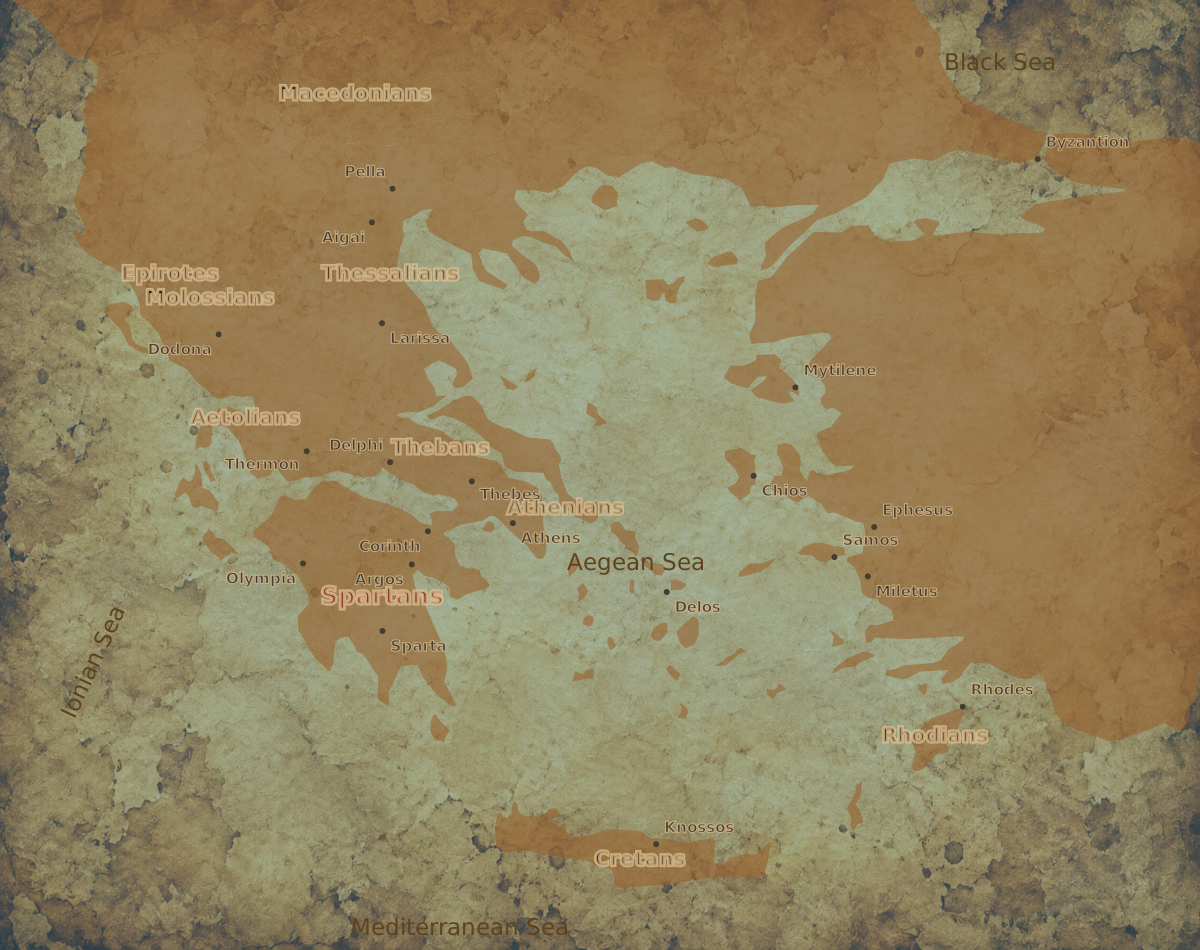
Sparta stood in the valley of the Eurotas, with the mountain mass of Taygetus rising to the west. The landscape joined farmland, settlements and routes towards the rest of the Peloponnese. For centuries the power of the Spartiate citizen body had rested on a much wider population. Perioikic communities supplied soldiers and participated in the economic life of Lacedaemon, while helots cultivated land under coercive dependence.
The citizen's freedom from ordinary agricultural labour was therefore supported by people who did not share his political position. The need to preserve that order shaped Spartan choices at home and abroad. A long expedition, an invasion or a defeat could threaten the structure on which the famous military way of life depended.
The full citizen body was also small and becoming smaller. Wealth, inheritance and the requirements of membership could exclude men from the status their ancestors had held. Aristotle saw the concentration of property and the shortage of citizens as grave weaknesses. A reputation earned by earlier generations could not replace the men needed to fill a battle line.
Learning to stand together
Spartan education made obedience, endurance and competition public concerns. Boys grew up under supervision that reached beyond the household, and adult citizens were bound into common practices and mess groups. Praise and disgrace mattered because they were administered within a community whose members knew one another. Military courage was expected to be visible, remembered and judged.
Xenophon admired the institutions he associated with Lycurgus. His account describes ordered movement, officers who understood their responsibilities and soldiers able to carry out commands. The strength of the army lay in trained relationships. A formation could move, change direction and respond because command was distributed through men who knew what their place required.
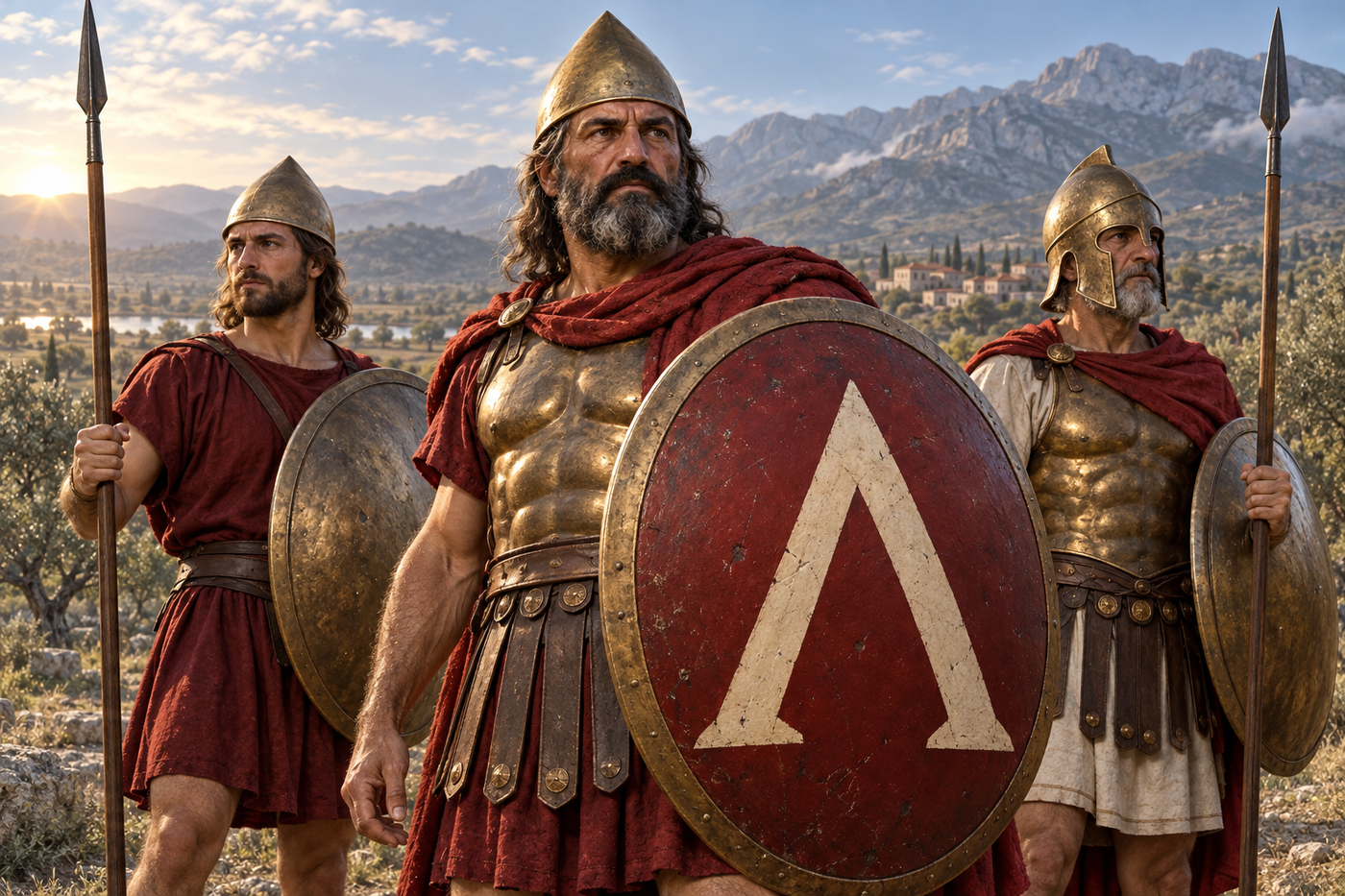
Spartan appearance reinforced that impression. Xenophon associates the soldiers with scarlet clothing and bronze shields, and he describes the care taken over their hair before battle. The effect was deliberate: men preparing themselves to face danger under the eyes of their companions. Their equipment protected bodies that remained vulnerable to exhaustion, missiles and mistakes.
Kings under the gods and the law
Sparta maintained two hereditary royal houses, whose kings possessed religious responsibilities as well as military authority. Campaigning involved sacrifice and attention to signs. The king approached battle within a sacred order that gave his leadership meaning and also placed obligations upon it. Divine favour mattered to men whose lives depended on a decision to advance.
Royal authority existed alongside the elders and the ephors. A commander might be famous far beyond Sparta and still face criticism or restraint at home. The political system could support long service and continuity, but it did not remove rivalry or the need to persuade. The careers of its kings show men negotiating expectations as well as issuing orders.
Stories of Lycurgus gave these institutions the authority of an ancestral settlement. They explained why Sparta differed from other cities and why its people should preserve demanding customs. The force of that tradition became especially important when the country's actual circumstances changed. Fidelity to the past could inspire endurance, while making an unwelcome adjustment harder to accept.
Agesilaus and the reach of Spartan power
Agesilaus II spent much of his long reign pursuing opportunities beyond the Eurotas valley. In Asia Minor he campaigned against Persian forces and acquired the prestige of a king able to carry Spartan arms abroad. War in Greece recalled him. The authority Sparta exercised after the Peloponnesian War had provoked resistance among powers that had once helped defeat Athens.
His career shows the attraction and strain of maintaining supremacy. Armies required money, allies and repeated intervention. Victories could enlarge commitments without removing the grievances that produced the next war. A ruler celebrated for personal simplicity might still preside over a system whose demands were burdensome to neighbours and dangerous to its own future.
At Lechaeum in 390 BC, Iphicrates' peltasts demonstrated that Spartan infantry could be defeated when caught without appropriate support. Javelin attacks and controlled withdrawals punished repeated efforts to force a close fight. The army's reputation remained powerful, but effective opponents were learning to exploit the conditions in which its strengths could not decide the contest.
Leuctra and the loss of Messenia
The greater rupture came at Leuctra in 371 BC. Thebans under Epaminondas defeated the army of King Cleombrotus, who died in the fighting. The concentration of Theban strength against the Spartan position produced losses the citizen body could ill afford. The defeat also changed what other communities believed was possible. A power whose authority had seemed entrenched could now be resisted.
The invasion of the Peloponnese that followed carried the crisis close to Sparta itself. Epaminondas helped establish an independent Messenia, taking away territory and labour on which Spartan power had long depended. The fortified city of Messene embodied a new political reality. For Sparta, recovering the lost country became a cause that obstructed acceptance of settlements others were prepared to make.
Agesilaus defended the homeland, but could not restore the old supremacy. The struggle left the monarchy seeking resources wherever it could find them. Late in his life he went to Egypt to command hired troops, bringing the fame of a Spartan king into the contests of Egyptian rulers. The money promised for his service mattered to a state whose needs exceeded its diminished means.
The old king in Egypt
Plutarch tells how Egyptians eager to see Agesilaus were surprised by an elderly man of unimpressive appearance, resting by the shore in plain clothing. The contrast served the reputation for Spartan austerity, but the campaign itself depended on a veteran's judgement. Rival claimants sought his troops and experience because they could change the outcome of a war.
Agesilaus shifted his support from Tachos to Nectanebo, presenting the decision in terms of Sparta's interests. His skill helped the latter secure power. The episode combines reputation, calculation and the uncomfortable obligations of paid service. A king who had once hoped to liberate Greeks in Asia was now working abroad to obtain resources for his own country.
He died on the return journey. His life had encompassed the height of Spartan supremacy and the struggle to preserve a reduced state. The traditions he embodied remained influential, but the circumstances in which they had to operate had changed beyond recognition.
Agis builds another coalition
By Alexander's reign, Sparta retained the will to resist Macedonian leadership. Agis III travelled into the Persian sphere to seek help from commanders whose own fortunes were threatened by Alexander. The resources he obtained were limited, but useful. He also operated in the contested world of Crete, where control and recruitment could support a larger plan.
The prospect of resistance in Greece depended on timing. Alexander was campaigning far away, while Antipater had to guard the Macedonian position in Europe. Agis could hope that a sufficiently broad rising would stretch those resources and encourage others to join. His army included hired soldiers as well as Lacedaemonian and allied contingents. The attempt to restore freedom of action required more than the surviving Spartiate levy.
Antipater gathered the forces to meet him. At Megalopolis, the coalition faced an army able to withstand its attack and bring superior resources to the contest. Diodorus describes severe fighting and Agis' final resistance after he had been wounded. The king's death gave the defeat a heroic centre, but did not prevent its political consequences. Macedonian supremacy survived the challenge.
A reputation that outlived supremacy
Sparta's fourth-century history gives its courage a demanding setting. Its soldiers could fight with discipline and resolution while their state lacked the resources needed to recover its former position. Its kings could display personal endurance and still make choices that prolonged an unwinnable struggle. The loss of Messenia, the shrinking citizen body and the rise of Macedonia imposed limits that bravery could not simply erase.
Yet the same history explains why Sparta continued to command attention. Agesilaus' experience could influence a succession in Egypt; Agis' royal name could gather a coalition against Macedon. The country remained a political and military actor because its leaders and soldiers kept acting upon the traditions they had inherited. Their story is the effort to make an extraordinary reputation serve a much harsher present.
Sources
Ancient accounts
- Xenophon, Constitution of the Lacedaemonians.
- Xenophon, Hellenica IV.5, and VI–VII.
- Aristotle, Politics II.9.
- Plutarch, Life of Agesilaus.
- Diodorus Siculus, Library of History XVII.62–63.
Historical studies and reference works
- “Sparta as Victor”, The Cambridge Ancient History.
- Nicholas Sekunda, The Ancient Greeks, Osprey Elite 7.
- François Sabbathier, Dictionnaire pour l'intelligence des auteurs classiques grecs et latins, notice “Lacédémone”.