






Ritolia Rise from the Chaos of Invasion
Ritolia was not one of the great expeditionary houses that descended upon Damocles with a complete state, a stable hierarchy, and a carefully prepared colonial project. It was born in fire, panic, and improvisation. During the first phase of the Imperial invasion, many of the noble fleets that reached the surface found themselves isolated from central command after catastrophic losses in orbit. Communications were shattered, transport capacity ruined, and carefully drafted plans rendered meaningless within days.
Across Tohei and the neighboring regions, dispersed imperial detachments were cut apart by local coalitions who knew the land, controlled supply routes, and struck with far greater coordination than the invaders had expected. Small aristocratic hosts disappeared in mountain passes. Landing zones were overrun before fortifications could be completed. Rival imperial commanders blamed one another while native forces closed in. What had been announced as a swift conquest threatened to become a humiliation.
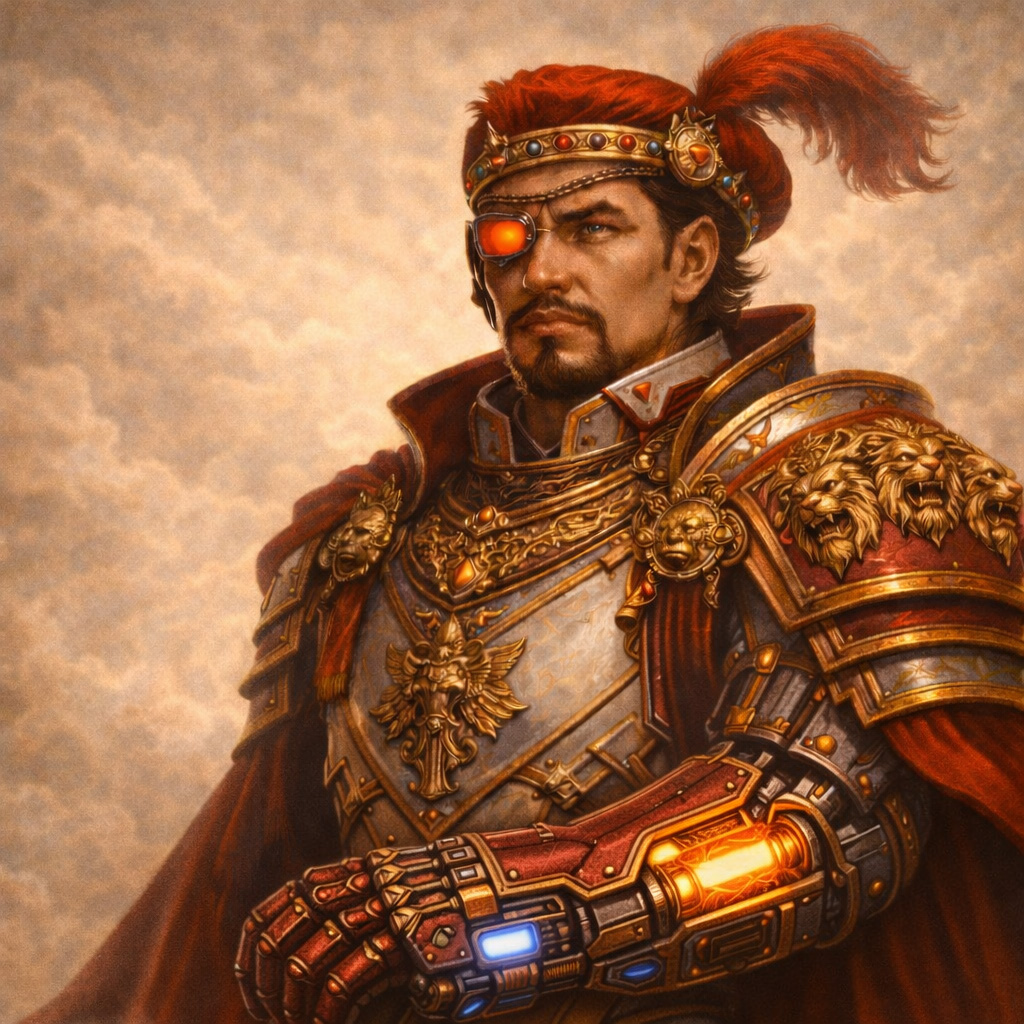
It was in this chaos that a single leader emerged, Ruggiero Valdieri, then a warlord of secondary rank with neither the largest fleet nor the oldest lineage. What he possessed was something rarer: the ability to impose unity upon men who trusted no one and hated one another almost as much as they hated the locals. He gathered the surviving radical factions, executed officers who refused common command, absorbed broken contingents into new formations, and reorganized scattered survivors into a disciplined war state.
Where others still dreamed of restoring the original invasion plan, Valdieri understood that Damocles would not be conquered through ceremony. It would be conquered through concentration of force, ideological clarity, and terror used with purpose. Under his banner, isolated noble retinues became regiments. Personal feuds were suspended or settled by firing squads. Supply was centralized. Recruitment widened. Civilian populations suspected of aiding resistance were made examples of. The massacres that horrified even some imperial rivals became, in Ritolian memory, the acts that saved the conquest from collapse.
The new state took the name Ritolia, less a traditional clan than a fusion of clans remade into something harsher than any of them had been alone. Its nobles retained titles, but power increasingly belonged to those who served the machine effectively. Birth still mattered, yet obedience, discipline, and utility mattered more than before.
From the beginning, this origin shaped every layer of Ritolian identity. Because it was born surrounded by enemies, it glorified vigilance. Because it was forged from disorder, it worshiped command. Because mercy had seemed dangerous in its first days, it learned to distrust compromise. Other powers on Damocles inherited traditions. Ritolia inherited emergency, and never truly left it behind.
Doctrine of Iron Integration
If Palter sought to govern conquered lands through institutions and incentives, and the Swolfs through negotiated hierarchy, Ritolia chose another path entirely. Its rulers concluded that rebellion was not caused by hardship, but by the survival of alternative loyalties. As long as local identities, native elites, old customs, or rival faiths remained strong enough to inspire obedience, war would return sooner or later. Therefore peace required not accommodation, but replacement.
This belief became known informally as the Doctrine of Iron Integration. Its logic was brutally simple: kill one hundred now rather than ten thousand later. Burn one rebellious town so that ten others submit without resistance. Destroy a bloodline once rather than hunt its descendants for generations. To outsiders, such policies appeared monstrous. To Ritolia, they were mathematics.
In practice, Iron Integration combined massacre and administration in equal measure. Defiant settlements were eradicated or deported. Hostages were taken from notable families and raised under state supervision. Children from conquered populations entered ideological schools where native languages and traditions were discouraged or forbidden. Mixed labor colonies redistributed survivors into controlled communities where lineage, memory, and local solidarity could be dissolved over time.
The regime also understood that fear alone decays if not renewed. Punishment therefore had to be visible, rapid, and exemplary. Roads displayed cages of executed rebels. Public tribunals condemned entire networks rather than individuals. Military victories were followed by ceremonies in which surviving elites swore loyalty before the symbols of the state. Submission was not enough; it had to be seen.
Yet Ritolia did not view itself as merely cruel. In its own ideological language, it was a civilizing force performing necessary surgery on a fractured continent. Disorder, tribal rivalry, religious fanaticism, and cultural impurity were treated as diseases. Harshness became virtue because it promised a future without endless insurgency. Many citizens raised inside the system sincerely believed that their ancestors had suffered so later generations would inherit unity.
This doctrine also explains the hatred Ritolia reserves for its rivals. Palter, by preserving local allies and tolerating layered identities, is seen as weak and dangerously sentimental. The Swolfs, masters of balance and negotiated allegiance, are regarded as cynics who prolong division for advantage. Kento and the older native houses are dismissed as relics living from prestige they no longer deserve.
For two centuries the Doctrine of Iron Integration has shaped law, education, military practice, and family life. It has given Ritolia internal cohesion unmatched by many enemies. It has also ensured that wherever Ritolia rules, memory itself becomes a battlefield.
The Great War with Palter
For all its ferocity, early Ritolia remained an unfinished state. Vast territories had been subdued, rival imperial factions broken or absorbed, and native resistance bloodily repressed, yet beneath the surface the new regime was still fragile. Garrisons were overstretched, supply systems uneven, provincial loyalties uncertain, and many recently conquered populations obeyed only because fear was still fresh.
It was at this moment that the leadership made the decision that would define the next two centuries: the surprise attack on Palter.
To Ruggiero Valdieri and his war council, the logic seemed sound. Palter was growing stronger through industry, alliances, and competent administration. If left alone, it might become too entrenched to challenge. Better to strike early, seize key corridors, shatter confidence in the republic, and absorb its productive regions before a northern coalition could fully form. In theory, it was a war of prevention. In practice, it was a gamble launched before Ritolia had secured its own foundations.
The first phase was a success. Ritolian armored columns and assault infantry smashed through frontier positions, overran secondary strongpoints, and pushed deep into contested zones before full mobilization could begin. Several border settlements fell in days. Panic spread through regions that had known tension for years but not open breakthrough. For a brief moment, it seemed that ruthless momentum would triumph once again.
Then the war changed character.
Palter did not collapse. Local reserve structures activated faster than expected. Engineers transformed retreat lines into layered defenses. Supply depots that should have been captured were found empty or sabotaged. Roads were cratered, bridges mined, rail stock withdrawn in orderly sequence. Even more damaging, Palter enjoyed support networks far beyond its formal borders. Merchant houses, local auxiliaries, and sympathetic communities, including some within territories Ritolia believed pacified, began feeding intelligence, shelter, and material to the defenders.
What had begun as a rapid offensive became a grinding struggle of attrition. Every kilometer gained cost more than the last. Occupation troops were diverted to rear security. Ambushes multiplied. Counterattacks struck exposed spearheads. Palter artillery, once fully deployed, turned open advances into slaughter grounds. The invaders discovered that conquering territory was easier than holding a hostile population while still winning at the front.
As losses mounted, the myth of inevitability cracked. Rival factions inside Ritolia blamed one another. Some conquered provinces wavered. Border enemies who had feared Ritolia began to sense weakness. Had the war continued unchecked, the state itself might have fractured under military exhaustion and internal revolt.
It was then that the Swolfs intervened. Publicly, they acted as guarantors of stability and preventers of mutual ruin. In reality, they ensured that neither Palter nor Ritolia emerged dominant enough to threaten the wider balance of power. The conflict was halted before decisive destruction could fall on Ritolia.
No event shaped modern Ritolian memory more deeply. Palter became the enemy that denied destiny. The Swolfs became the power that stole victory and denied honorable defeat alike. Since then, every generation has been raised on one promise: the war was interrupted, not ended.
Rebirth Through Population Warfare
The defeat taught Ritolia a lesson more painful than battlefield loss: courage and brutality were not enough. The state had lacked the human depth to sustain long war, occupation, and reconstruction simultaneously. It could conquer quickly, but not replace losses quickly enough. It could terrorize populations, but not always transform them before new crises emerged. If Ritolia wished to rule permanently, it needed more people, and it needed those people to be loyal before they could think otherwise.
From this realization came the second founding of the regime: population warfare.
Demography became a strategic priority equal to artillery and steel. The state reorganized civil life around growth, discipline, and inheritance. Veterans received reproductive privileges, land grants, and social status tied to family size. Women deemed politically reliable or genetically valuable were directed toward unions considered beneficial to the nation. Marriage ceased to be merely personal. It became administrative.
Conquered and assimilated populations were folded into this system in stages. Some were offered advancement through service, provided they abandoned local identities. Others were dispersed, renamed, and reclassified over generations until ancestral memory faded into rumor. Children entered schools where imperial language, martial values, and state mythology replaced native traditions. The objective was not simply obedience, but cultural replacement so complete that future generations would defend the system that erased their origins.
This process was often justified through the ideal of the New Imperial Man, a population purified of provincial weakness, tribal fragmentation, and inherited hesitation. Whether descended from old nobles, frontier settlers, or absorbed locals mattered less than usefulness and ideological conformity. Blood remained important, but loyalty was the final measure.
Selective natalism also carried a harsher face. Those considered politically suspect, socially deviant, chronically disloyal, or physically unfit could be excluded from privileges granted to favored families. In poorer districts, pressure rather than law often decided who married, who reproduced advantageously, and who disappeared into labor service. Official records spoke of efficiency, health, and cohesion. Private memory spoke of fear.
The results transformed Ritolia. Two centuries later, it fields a far larger population than the fragile war state that nearly collapsed. Its armies draw from deep reserves. Its factories never lack hands. Its youth are raised from childhood in discipline, grievance, and the expectation of future struggle. The regime that once conquered by shock now endures by scale.
Yet even success carries tension. Some older lineages resent dilution behind slogans of unity. Some assimilated families rise high enough to question why purity matters at all. And beneath the proud rhetoric of the New Imperial Man remains an uncomfortable truth: a state built to erase identities must constantly fear the return of memory.
Economy of Isolation and Permanent Mobilization
Ritolia commands one of the largest populations on the continent, controls vast productive territories, and maintains armies capable of shaking entire frontiers. Yet for all this apparent strength, its economy carries a structural weakness that every serious rival understands: isolation.
Since the end of the great war with Palter, the regime has never enjoyed the diplomatic networks available to its enemies. Trade partners remain limited, foreign expertise rare, and technological exchange heavily constrained by distrust. Neighboring powers fear Ritolian expansion too much to empower it openly, while distant actors see little advantage in strengthening a state whose ambitions are transparent. Thus Ritolia possesses scale without fluidity, manpower without trusted markets, determination without broad access.
As a result, much of its industrial base still relies on systems inherited from the invasion era. Their machines are old, heavy, rugged, and designed for a civilization that expected continuous support from a galactic empire that never returned. Foundries still operate on durable but inefficient methods. Vehicle platforms are repeatedly modernized around aging chassis. Weapons remain dangerous through mass production and battlefield familiarity rather than elegant innovation. Nothing is truly obsolete if it still kills, but many things are no longer optimal.
Where Palter pursues precision engineering and incremental technological recovery, Ritolia compensates through volume, standardization, and ruthless maintenance culture. Spare parts are recycled across generations of equipment. Civilian industry is structured to convert rapidly into war production. Labor battalions can be redirected by decree. Agricultural quotas are linked to military planning. Consumption is managed not by comfort, but by necessity.
The state’s extreme centralization is both burden and advantage. Corruption exists, black markets survive, and local commanders hoard resources when they can, yet in moments of crisis the regime can still redirect food, fuel, metals, and manpower faster than many freer rivals. What other states negotiate, Ritolia orders.
This has produced a society accustomed to austerity. Citizens grow up with ration logic, patriotic shortages, and the belief that sacrifice is normal life. Civilian inconvenience is framed as contribution. Delayed housing becomes strategic patience. Lower living standards become proof of moral seriousness. Entire generations have been taught that comfort softens nations before enemies destroy them.
Still, the gap with its rivals widens in subtle ways. Better optics, smarter logistics software, more efficient engines, advanced medicine, and adaptive manufacturing increasingly favor neighboring powers. Ritolia can still overwhelm through mass and will, but each decade raises the cost of compensating for technological stagnation.
Its economy therefore functions like its armies: formidable, durable, and dangerous, yet always spending tomorrow to dominate today.
Religion, Legitimacy, and the Fear of Imperial Return
Ritolia does not rule by force alone. It rules through a story about history, purity, and judgment. According to official doctrine, Damocles was never meant to become a patchwork of hybrid customs, mixed bloodlines, local cults, and improvised political experiments. It was meant to be brought fully into the order of the Supreme Empire. Everything that followed isolation was deviation.
From this belief emerges one of the regime’s most powerful claims: if communication with the Empire is ever restored, many of the existing powers of Damocles may be condemned as heretical. Clans that blended with native elites, adopted local religions, tolerated cultural fusion, or abandoned imperial orthodoxy could face punishment, purges, or annihilation. Ritolia therefore presents itself as the only major state that preserved the essential line of imperial continuity.
This message serves several purposes at once. It justifies hostility toward rivals who embraced hybridization. It transforms demographic engineering into sacred duty. It recasts expansionist war as preparation for the rightful return of lawful authority. Most importantly, it gives ordinary citizens a reason to endure hardship beyond revenge or fear. They are told they are not merely surviving difficult times, but guarding civilization itself.
Religious life within Ritolia is tightly supervised. Traditional imperial rites, civic ceremonies, ancestor cults of the conquest generation, and state doctrine have fused into a controlled public faith. Temples honor discipline, sacrifice, fertility, martial virtue, and obedience to historic destiny. The founder is revered almost as a sleeping saint of conquest. Fallen soldiers are remembered not simply as dead, but as contributors to the unfinished unification of Tohei.
At the center of this ideological order stand figures such as Father Domenico Varesi, chief theologian of the regime, whose sermons blend scripture, demographic statistics, military necessity, and apocalyptic warning in equal measure. To believers, he speaks difficult truths. To critics, he clothes state policy in sacred language.
Yet beneath the certainty of doctrine lies ambiguity. No one knows what the distant Empire has truly become. It may be stronger than legend, weaker than memory, transformed beyond recognition, or gone entirely. Even if it returned, no one can say whether it would reward Ritolia’s zeal or consider it another provincial mutation born of isolation.
Some educated elites understand this uncertainty perfectly well. But they rarely challenge the myth openly, because usefulness can matter more than truth. The fear of imperial return disciplines rivals, binds citizens, and gives suffering meaning. Whether prophecy or propaganda, it remains one of the strongest pillars of the state.
Thus Ritolia lives under the shadow of a judgment that may never come, and draws power from preparing for it every day.
The Frozen Founder and the Dream of Final Victory
No figure dominates the political imagination of Ritolia more completely than Ruggiero Valdieri, the warlord who forged scattered invaders into a state and prevented imperial defeat from becoming total disaster. To other nations he is remembered as a butcher, conqueror, and architect of mass terror. To Ritolia he is the Father of Continuity, the man who imposed destiny upon chaos when weaker leaders would have died in confusion.
Age eventually reached even him. Wounded repeatedly, worn by campaign life, and no longer able to command in person, Valdieri faced the one enemy he could not execute. Yet the regime he created could not allow so central a symbol to die like an ordinary ruler. His passing might have opened succession struggles, ideological fragmentation, or the dangerous thought that history moves on from founders.
The solution became one of the defining myths of the state. Rather than burial, Valdieri was placed in stasis within a sealed monumental chamber beneath the capital. Official doctrine teaches that he does not sleep in defeat, but waits in reserve. His body is preserved, his command merely paused until the proper hour. Children are brought to swear oaths before his sanctum. Officers salute the chamber before taking senior command. Political leaders govern not after him, but in his name.
The current supreme ruler, Cassiano Valdieri, descends directly from the Founder and derives immense legitimacy from that bloodline. Yet inheritance alone is never enough under the shadow of a living ancestor who is not dead. Cassiano must constantly prove that he is worthy to act as steward of unfinished conquest rather than a pale substitute for greatness. This has made him patient, severe, and deeply attentive to signs of weakness among neighboring powers.
Nowhere is this obsession sharper than in relation to Palter. For generations, Ritolian intelligence circles have nurtured a conviction that Palter secretly retained advanced regenerative sciences lost elsewhere on Damocles. Public evidence is thin, contradictory, or fabricated, but belief persists because it is politically useful and emotionally irresistible. If Palter can heal what others cannot, then Palter has stolen not only advantage, but history itself.
From this belief emerges the dream of final victory. Conquer Palter, seize its laboratories, recover the hidden sciences, awaken Ruggiero Valdieri, and resume the interrupted war from a position of restored strength. In that narrative, every frontier clash, every arms program, every demographic sacrifice becomes part of a single unfinished campaign stretching across centuries.
Whether the Founder could truly be revived matters less than what the dream accomplishes now. It binds old veterans to young recruits, justifies hatred, and turns future war into sacred inheritance. So long as Valdieri sleeps beneath stone and steel, Ritolia can claim that its greatest hour has not yet passed.
Military Doctrine and Armed Forces
If Palter is feared for disciplined defense and engineered endurance, Ritolia is feared for pressure without exhaustion. Its military system was designed not to fight elegant wars, but to break enemies through sustained violence, political intimidation, and the acceptance of losses that would paralyze softer states.
The backbone of the armed forces is mass infantry. Drawn from a large and heavily mobilized population, these formations vary in quality but not in ideological conditioning. From youth, citizens are taught that service is honor, sacrifice is normal, and hesitation kills nations. Even second-line troops often display a stubbornness that surprises more technologically advanced opponents.
Above them stands a hard officer corps shaped by frontier service, internal purges, and political scrutiny. Promotion rewards aggression, endurance, and results under pressure. Failure can end a career, while boldness, if successful, is celebrated as proof of revolutionary vigor. Embedded within many formations are political commissioners or state delegates tasked with maintaining morale, loyalty, and doctrinal discipline.
Ritolia’s armored arm remains dangerous despite technological lag. Many vehicles are built on old invasion-era designs repeatedly upgraded with local solutions, reinforced plating, improvised optics, and simplified battlefield systems. They are often less refined than Palter equivalents, but numerous, easier to repair in rough conditions, and employed in massed concentrations intended to overwhelm sectors through repetition and weight.
Artillery is central to offensive operations. Siege guns, rocket batteries, and heavy bombardment groups are used not only to destroy defenses but to terrorize rear areas, depopulate resistant zones, and create humanitarian collapse before ground assaults begin. In Ritolian doctrine, civilian panic can be as valuable as a breached bunker.
Security battalions and rear-area pacification forces form another essential pillar. These units suppress unrest, guard transport corridors, screen occupied populations, and hunt infiltrators. Ritolia understands that war does not end at the frontline. Control of villages, roads, and memory itself is part of military success.
Operational doctrine favors momentum. A breakthrough must be widened immediately, reserves pushed forward before defenders recover, propaganda spread before facts stabilize, collaborators armed before resistance reorganizes. Where Palter seeks to make every captured kilometer defensible, Ritolia seeks to make every lost kilometer unrecoverable through speed, fear, and exhaustion.
This approach has weaknesses. It consumes lives rapidly, strains supply systems, and can stall catastrophically against layered defenses. Yet when rivals appear divided, complacent, or politically hesitant, few powers on Damocles are more dangerous. Ritolia does not need perfect tools to win. It needs an enemy who believes there will be time later.
The Named Figures
Supreme Marshal Cassiano Valdieri is the current ruler of Ritolia and direct descendant of the Founder. Cold, disciplined, and patient to the point of cruelty, he lacks the theatrical charisma of his ancestor but possesses something equally dangerous: endurance. Cassiano believes history rewards those who remain ready longer than their rivals. He has spent years strengthening reserves, refining command structures, and waiting for fractures inside the northern camp. To supporters, he is the guardian of unfinished destiny. To critics, he is a man so focused on the perfect moment that he may mistake waiting for strategy.
Imperator Ruggiero Valdieri, preserved in stasis beneath the capital, remains the sacred center of the regime. Officially he still lives in suspended command, sleeping until victory requires his return. His image appears in schools, barracks, factories, and public squares. Entire careers are built on claiming fidelity to his legacy. Whether relic, corpse, or future sovereign, he remains the most politically useful figure in the state.
Minister Serafina Contarini oversees population policy, civic education, and the long demographic project of the New Imperial Man. Brilliant, feared, and relentlessly methodical, she thinks in generations rather than election cycles or campaigns. Under her authority, schools became ideological foundries, family policy became statecraft, and census archives became instruments of power. She rarely speaks in public, yet millions live according to systems she designed. Many whisper that if Cassiano rules the present, Serafina engineers the future.
General Matteo Orsini commands major frontier armies facing Palter and has become the voice of those who demand immediate war. A veteran of border escalations and punitive offensives, he despises strategic caution and considers every year without invasion a gift handed to the enemy. Among soldiers he is admired for personal courage and blunt honesty. Among administrators he is feared as the kind of man who would burn ten years of planning in ten weeks of glory if given the chance.
Doctor Luciana Ferretti directs military modernization programs tasked with extracting new power from old machines. With limited access to foreign research and outdated industrial platforms, she has built a reputation through ruthless practicality. She does not dream of elegant breakthroughs, only systems that can be produced at scale, repaired in mud, and survive artillery fire. Her workshops are responsible for many of the upgrades that keep aging Ritolian armor relevant. She often says that perfection is a luxury for nations not preparing for war.
Father Domenico Varesi is the chief theologian of state orthodoxy and guardian of imperial purity doctrine. A gifted orator with a scholar’s memory and a prosecutor’s instinct, he turns uncertainty into conviction. In his sermons, low birth becomes noble through sacrifice, hardship becomes sacred duty, and compromise becomes moral decay. He is beloved by zealots, tolerated by pragmatists, and quietly feared by everyone who knows how quickly doctrine can become accusation.
Ritolia Today
Ritolia stands today as one of the most dangerous contradictions on Damocles. It is technologically aging yet militarily formidable, diplomatically isolated yet internally cohesive, feared by its neighbors yet sustained by the certainty that fear itself is proof of relevance. Many states possess armies. Few possess a population raised from childhood to believe that unfinished war is the natural condition of life.
Its factories produce vast quantities of reliable if aging weapons. Its academies train officers for offensive momentum and political control. Its schools shape identity as carefully as its arsenals shape steel. Its border regions live in permanent readiness, where mobilization plans matter more than harvest festivals and every family knows someone in uniform.
To Palter, Ritolia is the enemy that never accepted defeat. To the Swolfs, it is the destabilizing force that must be contained but never ignored. To smaller clans, it is both threat and cautionary tale: a power capable of crushing neighbors, yet so rigidly committed to struggle that peace itself becomes suspicious.
Inside the regime, three clocks now tick at once. Cassiano waits for weakness among rivals. Matteo Orsini demands that weakness be created by force. Serafina Contarini reshapes future generations who may one day judge both men obsolete. Above them all, the Founder sleeps in perfect silence while others claim to interpret his will.
Ritolia’s greatest strength is unity of purpose. Its greatest weakness may be that purpose itself. A nation built for revenge can struggle to recognize victory. A state forged in emergency can mistake permanent mobilization for health. A people taught to expect final war may someday discover that history rarely grants endings so clean.
Yet none of this makes Ritolia less dangerous. On the contrary, it makes the state harder to predict. It may launch conquest in pursuit of destiny, or wait decades in disciplined preparation. It may fracture under the weight of its own doctrine, or harden further through crisis. What no serious observer doubts is this: if the northern balance ever fails, Ritolia will move.
It was born from the chaos of invasion. It still believes the conquest only paused.