






Macedonians
The kingdom Philip refused to lose
Philip II took power in 359 BC with enemies pressing upon a shaken kingdom. His brother Perdiccas III had died fighting the Illyrians, and the defeat had destroyed a large part of the Macedonian army. Rival claimants looked towards the throne. Paeonian attacks and the ambitions of neighbouring powers made delay dangerous. The empire later associated with his son began with a much narrower problem: whether Macedonia could survive.
Philip answered through persuasion, diplomacy and relentless preparation. He made agreements when he needed time, gathered soldiers and improved their organisation, then struck when circumstances favoured him. The army he created became an instrument of royal power unlike anything Macedonia had previously sustained. Alexander inherited that instrument, along with officers, alliances and a generation of men accustomed to following the king through difficult campaigns.
The plain, the uplands and the royal house
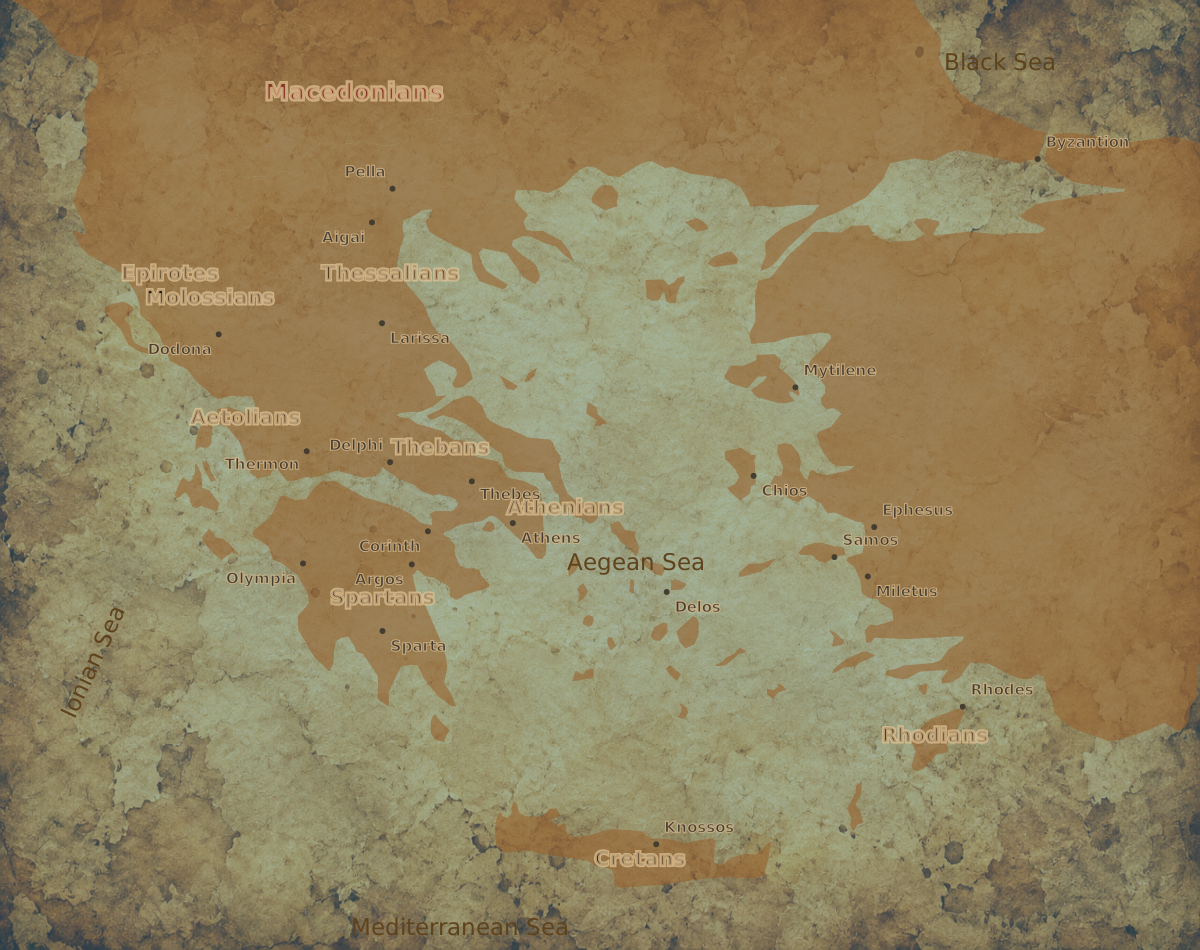
Macedonia joined fertile lowland country to upland districts whose ruling families had their own traditions and connections. Rivers opened routes towards the sea, while passes led into territories contested with Illyrian, Paeonian and Thracian neighbours. Bringing these regions into a more durable royal structure gave the monarchy access to people, horses and resources that could sustain expansion.
The Argead kings traced their descent to Heracles through the royal house of Argos. That ancestry placed their authority within the heroic stories of the Greek world. At Aigai, royal ceremonies and burials gave the dynasty a setting of its own. Pella developed as a major centre of court life and administration, while Aigai retained profound significance for the family and the kingdom.
Royal power was personal as well as institutional. The king rewarded service, arranged marriages, welcomed companions and dealt with men whose families mattered. The palace banquet could display favour and bring leading figures close to the ruler. The same intimacy carried danger: rivalry, resentment and the ambitions of powerful households could turn the court into a place where the future of the kingdom changed suddenly.
Soldiers made dependable
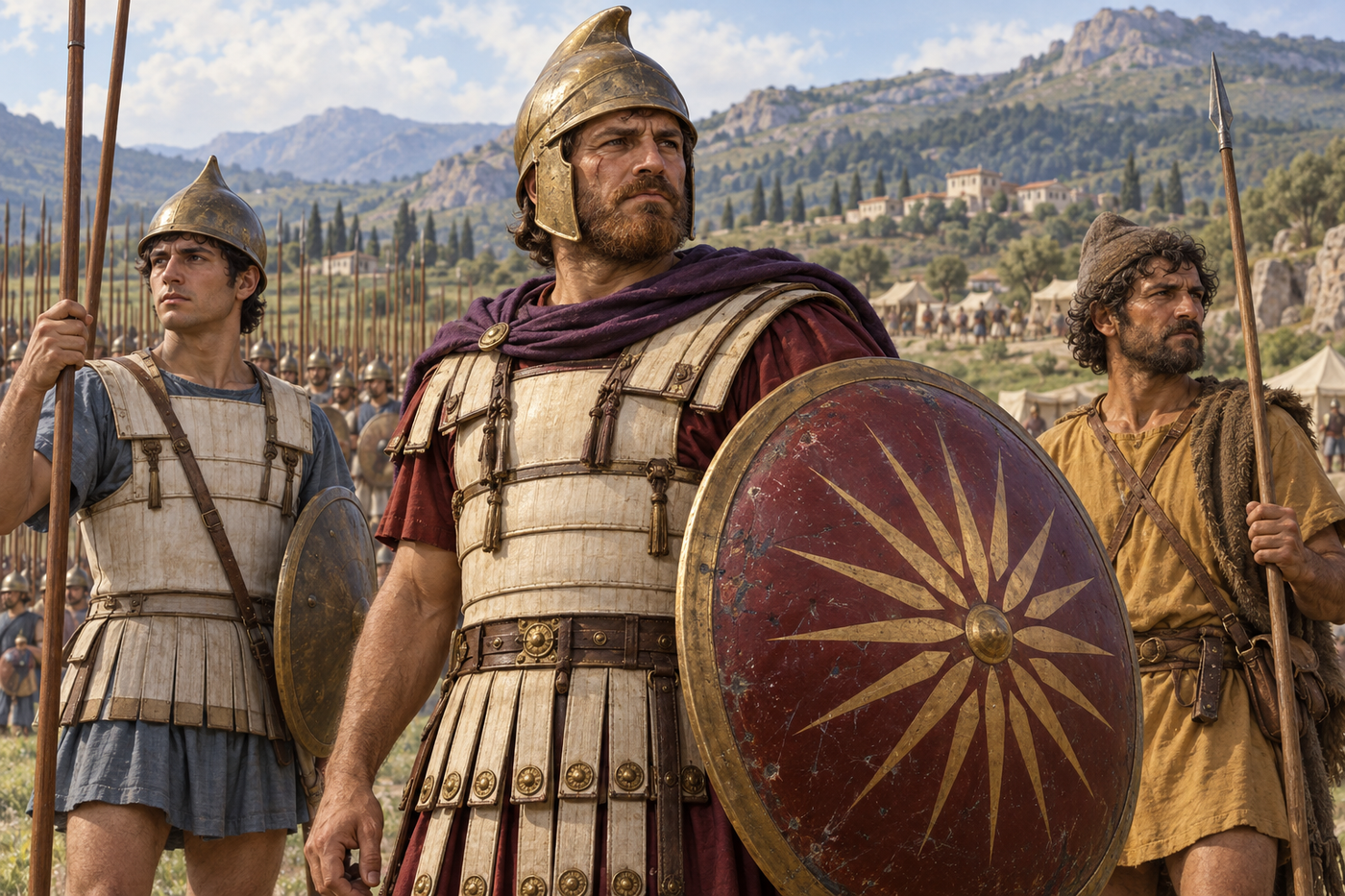
Diodorus places Philip's military preparations at the beginning of his recovery. The king assembled his men, encouraged them and reorganised their equipment and formation. The long sarissa became the characteristic weapon of the Macedonian phalanx. Its effectiveness depended on trained bodies acting together, maintaining order and presenting an enemy with several ranks of spearpoints.
The weapon demanded more than physical strength. Men had to move without breaking the formation on which their protection depended. Officers needed to transmit commands, and soldiers had to respond despite noise, fear and uneven ground. Repeated preparation made the phalanx a force the king could use within a larger plan. Its strength was greatest when other troops helped preserve the conditions in which it could fight effectively.
Philip's early victories gave this preparation consequences beyond the drill ground. In 358 BC, he subdued the Paeonians after the death of their king, then defeated Bardylis and recovered the Macedonian towns held by Illyrian forces. The monarchy had passed from immediate danger to renewed initiative. Success could attract loyalty and resources, allowing the next campaign to begin from a stronger position.
The king and his Companions
Cavalry gave Macedonian kings another way to decide a battle. The mounted Companions belonged to the close relationship between ruler and leading followers. Their horses, weapons and standing marked them out, but service required exposure to danger. A king who led a charge made his own courage visible and invited the men around him to share both the risk and the honour.
Alexander repeatedly used this relationship in battle. His presence at a decisive point could focus the attack, while the possibility of his death placed the whole enterprise at risk. At the Granicus, the struggle around him became a violent contest at close quarters. The young king's survival depended on the men who fought beside him, including Cleitus, who intervened when Alexander was threatened.
The army's success rested on more than the royal cavalry. Thessalian horsemen, other mounted contingents, archers and javelinmen supplied different capabilities. The hypaspists appear repeatedly in operations demanding selected infantry near the king. Men from neighbouring regions could become indispensable through skills suited to difficult ground, rapid movement or the demands of a particular mission.
Walls were another kind of battlefield
Philip's expansion brought him into repeated conflict with fortified cities. Taking a town required engineers, materials, labour and the ability to maintain pressure. Siege operations widened the range of skills on which royal warfare depended. A king who could defeat an army but could not enter its strongholds would struggle to turn victory into lasting control.
Artillery and siege equipment therefore belonged within the same military transformation as cavalry and the phalanx. Their use called for specialists who could construct, maintain and operate machines under dangerous conditions. Alexander carried this experience into Asia, where walls, harbours and difficult approaches repeatedly required a different answer from a charge in the open.
At Tyre, the sea itself became part of the engineering problem. The long effort to reach and reduce the island city demanded causeway construction, ships, machines and repeated adaptation. Such operations reveal an army able to keep fighting while changing the form of the contest around it.
Philip's last triumph
By 338 BC, Philip confronted an alliance of Athens and Thebes at Chaeronea. His victory established a supremacy he could express through the League of Corinth. The coming expedition against Persia offered a common purpose under Macedonian leadership. The king had transformed the balance of power in Greece and was preparing to carry his ambitions across the Aegean.
He never led that invasion. In 336 BC, during celebrations at Aigai, Philip was assassinated. The death came at a moment intended to display dynastic confidence and royal magnificence. It left Alexander facing the same brutal fact that had confronted his father: succession was an opportunity for enemies unless the new king could act quickly enough to prevent it.
Alexander secured his position and moved to obtain recognition beyond Macedonia. In 335, he campaigned in the Balkans, crossed the Danube and confronted revolt near Pelion. The army's controlled movements under pressure there showed the value of the discipline Philip had cultivated. The subsequent destruction of rebellious Thebes warned the Greek cities against testing the new king in the same way.
Across the Hellespont
In 334 BC, Alexander crossed into Asia. The expedition carried the ambitions of the Macedonian court, the resources of allied and hired contingents, and the accumulated experience of Philip's commanders. It also carried a religious and heroic imagination. At Troy, Alexander honoured the world of Achilles, placing his campaign within stories that had helped form his understanding of fame.
The Granicus brought the first major confrontation with the Persian forces of Asia Minor. The river crossing and the fighting on its banks tested the king's cavalry and the support behind it. Victory opened routes into the region, but it did not settle the war. Garrisons, sieges and the response of local communities would determine what the army could hold after the first dramatic success.
At Issus in 333 BC, Darius III met Alexander in person. The narrow battlefield limited the Persian deployment, while pressure on different parts of the line made coordination essential. Alexander's attack on the right and the struggle elsewhere belonged to the same battle. The flight of Darius gave the victory its political force: the Great King himself had been driven from the field.
Gaugamela and the reach of the army
The decisive confrontation in 331 BC took place on ground chosen and prepared for Darius' much larger concentration of forces. Alexander's army faced cavalry threats, chariots and pressure extending beyond its flanks. It had to keep moving and preserve enough order to exploit an opening. The phalanx supplied weight, but the outcome depended on how the parts of the army worked around it.
Alexander led the attack towards the Persian centre while other Macedonian and allied formations fought for their own survival. The pressure on Parmenion's wing made victory something more complicated than a single triumphant charge. Units had to resist, pursue, turn or recover while reports crossed a battlefield whose different struggles did not unfold at the same pace.
Darius fled, and the road to the great royal centres lay open. Babylon, Susa and Persepolis brought the conquerors into contact with the wealth and machinery of Achaemenid rule. An army raised from Macedonia and reinforced by its neighbours now stood at the centre of an enterprise whose demands were growing far beyond the purpose with which many soldiers had begun.
Honour, endurance and the distance from home
Campaigning made claims upon every part of a soldier's life. Marches, watches, hunger, wounds and the care of equipment lay between the battles later remembered by name. Rewards and advancement gave service a future, while companionship helped men endure its immediate hardships. Royal gifts could acknowledge courage and bind the recipient more closely to the king.
Success also changed the relationship between ruler and army. Alexander's ambitions expanded with the territory he conquered. His soldiers had reasons to be proud of what they had achieved and reasons to wonder how much more would be demanded. The companions and veterans who made victory possible were people with memories, grievances and expectations of their own.
The Macedonian achievement began with Philip's refusal to accept a collapsing kingdom and Alexander's determination to carry its power farther. It depended on leaders able to organise and inspire, and on soldiers capable of turning those intentions into action. The resulting army could cross rivers, force passes, reduce cities and defeat kings. Its most remarkable resource was the ability to bring so many different skills to bear under a common command.
Sources
Ancient accounts
- Diodorus Siculus, Library of History XVI.2–4.
- Arrian, Anabasis of Alexander I–III.
- Plutarch, Life of Alexander.
Archaeology and inscriptions
- Hellenic Ministry of Culture, Aigai: palace, royal cemetery and theatre.
- IG II³ 1, 318 / RO 76, treaty with Philip II.
Historical and military studies
- N. G. L. Hammond, “Training in the Use of a Sarissa and its Effect in Battle, 359–333 B.C.”, Antichthon 14 (1980), 53–63.
- Nicholas Sekunda, The Army of Alexander the Great, Osprey Men-at-Arms 148.
- François Sabbathier, Dictionnaire pour l'intelligence des auteurs classiques grecs et latins, notice “Macédoine”.