






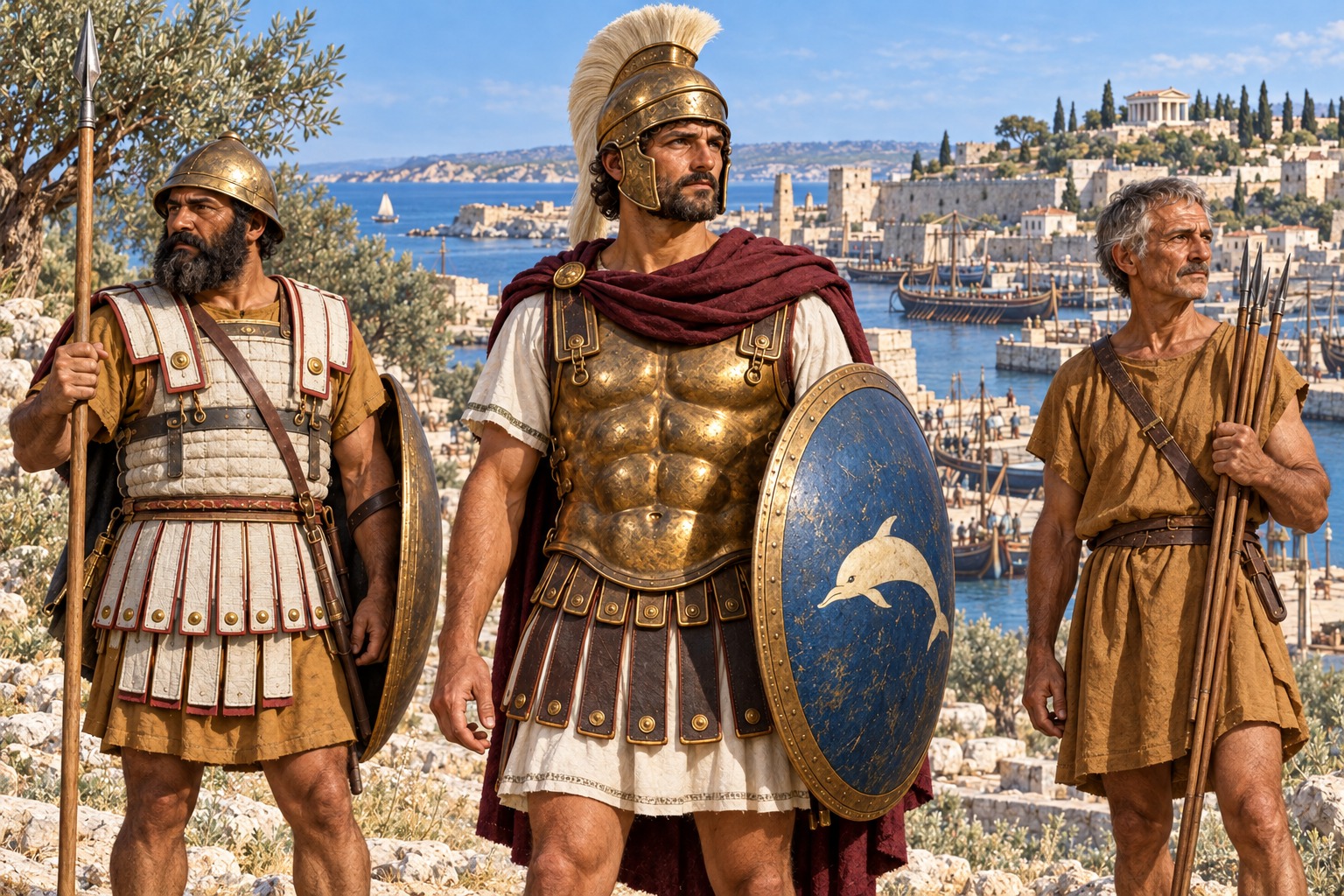
Italiots & Sicilians
Across the gulfs of southern Italy and the strait of Messina, Greek cities watched the same sea without sharing the same destiny. Their harbours received merchants, exiles and armies; their walls sheltered communities determined to remain masters of their own affairs. While Alexander marched east, the struggle for these western shores continued beneath the standards of men whose ambitions could fill a city, an island, or an empire.
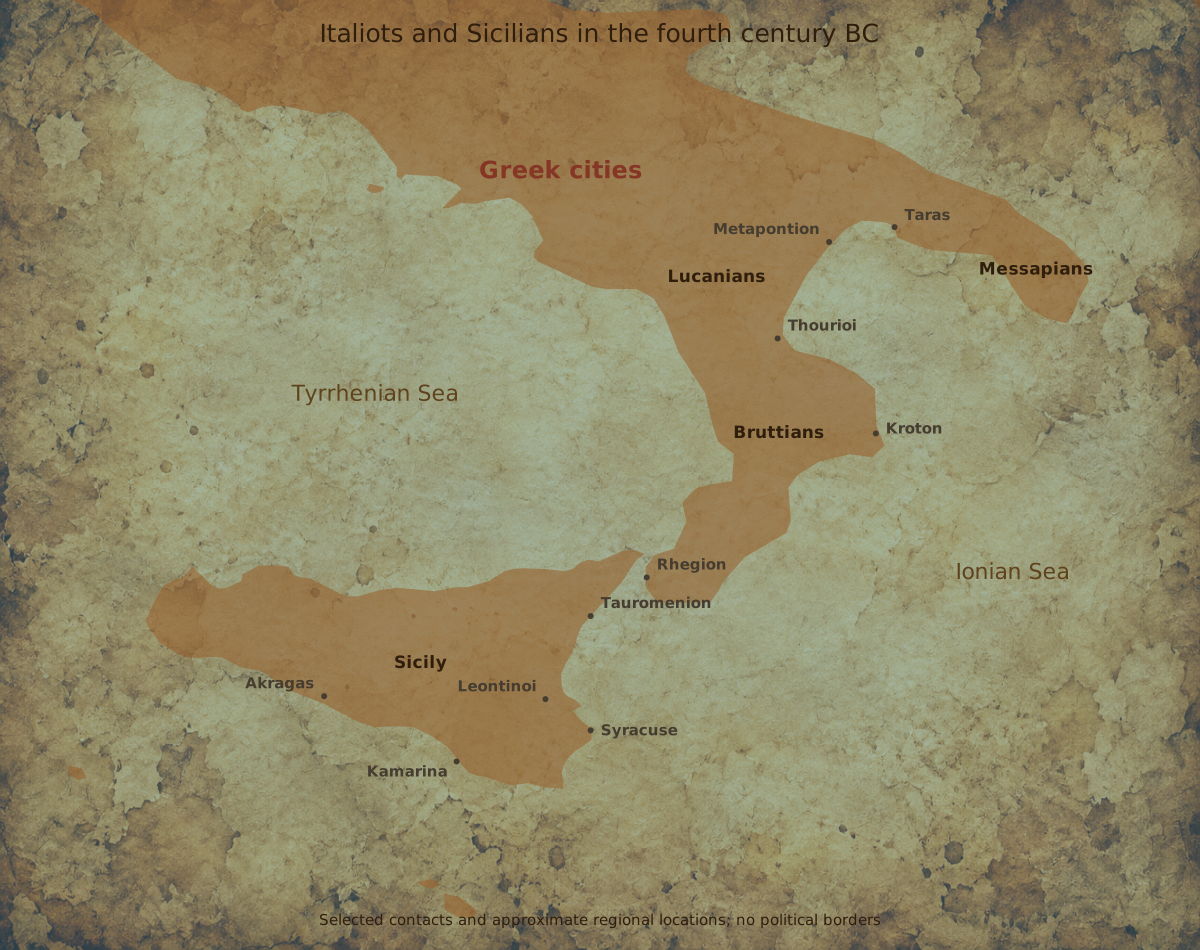
The sea joined these settlements more readily than the land. A voyage could carry a message from Taras to Corinth, a commander from the Peloponnese to Sicily, or a cargo of grain towards markets beyond the horizon. Inland, roads climbed through hills and narrow valleys where a coastal city's influence became less certain. Greek farmers, local communities and neighbouring peoples lived close enough to trade, intermarry and dispute the same ground. The frontier was rarely a clean line. It was a contested landscape of fields, grazing land, strong places and obligations.
In southern Italy, Taras possessed the advantages of an exceptional harbour and the confidence of a wealthy civic tradition. Metapontion, Thourioi, Kroton and Rhegion had their own memories, interests and enemies. They could appeal to a shared Greek identity without agreeing on which city should lead. An assembly of neighbouring cities offered a means of common action, but every decision still had to survive local rivalries. Independence was precious precisely because help from a stronger neighbour might become another form of dependence.
Archytas embodied a particular vision of that civic world. Remembered as both a Pythagorean thinker and a repeatedly elected commander, he belonged to a tradition in which authority could rest on public trust as well as wealth or military following. Learning did not stand outside political life. The same community that listened to arguments about order and proportion also required decisions about ships, alliances and war. His Taras was not the later city already familiar with Roman conquest, but a power negotiating the opportunities and dangers of a changing Italy.
Beyond the cultivated coast, Lucanian, Bruttian and Messapian strength could not be dismissed as a distant disturbance. Pressure on the Greek cities made assistance from overseas attractive. Yet the arrival of a renowned commander never erased the interests of those who had invited him. Archidamos III of Sparta fought in Italy for Taras and died near Manduria in 338. A few years later Alexander the Molossian crossed from Epirus. His name belonged to another royal adventure unfolding while his nephew, Alexander of Macedon, was overturning the Persian Empire.
The Molossian's successes brought him into the affairs of several Italian peoples, but military achievement did not guarantee obedience from the cities he had come to defend. Disagreement with Taras exposed the strain within the partnership. His attempt to shift the meeting place of the Greek communities towards Thurian territory revealed how quickly a common enterprise could become a contest over leadership. At Pandosia his expedition ended in disaster. The mountains and rivers of Italy had proved as decisive as the reputation carried across the Adriatic.
Sicily possessed an even sharper concentration of wealth and danger. Syracuse's harbours and the fortified island of Ortygia offered extraordinary strength to whoever held them. That strength could defend a community or sustain a tyrant against it. Citizens might find themselves divided between rival claimants, while men paid to protect the walls decided which master could best maintain their service. A change of ruler was therefore more than an event in a palace: it could alter the safety of households, the ownership of land and the future of exiles waiting abroad.
Dionysios II inherited a formidable position from his father but never made it secure for himself. Dionysios II lost Syracuse, returned from exile, and recovered power before another struggle narrowed his rule to Ortygia. His opponents were not a single movement united by a shared future. Hicetas of Leontinoi could present himself as a protector while pursuing his own supremacy. Carthage, meanwhile, possessed the ships, resources and western Sicilian connections to intervene whenever the balance offered an opening.
Into that fractured world came Timoleon. Sent from Corinth with a small force, he could not rely on numbers alone. Access to a harbour, the welcome of a friendly city and the moment chosen for an attack could decide whether his expedition survived. Tauromenion gave him a foothold; success at Adranon helped transform an uncertain landing into a growing cause. Syracuse's future was contested street by street and position by position, with rival Greek forces and a Carthaginian fleet all seeking advantage.
Victory over Carthage at the Crimisus gave Timoleon more than captured equipment and military renown. It created room to rebuild political life. The return of exiles and the arrival of settlers helped restore communities exhausted by fighting and displacement. Such renewal demanded land, security and confidence that another faction would not immediately overturn the settlement. The promise of freedom had to become something that a family could inhabit: a house occupied again, fields worked again, and a city whose laws could outlast the strongest man's immediate wishes.
The religious landscape made belonging visible. Temples, festivals and ancestral rites connected citizens to the places they defended. In Sicily, Demeter and Kore stood close to the fertility of the land and the hopes attached to its recovery. Timoleon's expedition was accompanied by traditions of their protection. At Syracuse, the familiar imagery of Arethusa and dolphins linked water, place and civic memory; across the strait, Tarentine images looked towards a different local past. Shared gods did not make every sanctuary interchangeable. A city's rites belonged to its own community and its own remembered experience.
War gathered men whose loyalties were equally varied. Citizen infantry stood beside hired soldiers; cavalry gave wealthy communities reach beyond their walls; light troops contested difficult ground that rewarded knowledge and speed. Campanian settlements in Sicily were military and political actors in their own right. They could seek help from Greek neighbours or make arrangements with Carthage. They were not simply a nameless reserve waiting to serve whichever city summoned them. Their decisions formed part of the struggle for the island.
At the end of the century, Agathocles gave that struggle another direction. Rising through Syracuse's conflicts, he seized power in 317 and turned military command into personal rule. Defeat in Sicily did not confine his ambitions to the defence of the city. In 310 he carried an expedition to Africa, confronting Carthage close to home while danger remained behind him. The crossing joined the fate of Syracuse to a wider contest around the central Mediterranean. It also showed how much could depend on the resolve of an army far from the harbour that had sent it.
These cities never became a single western Greek kingdom. Their history was made through changing partnerships, foreign interventions and renewed assertions of local freedom. A Corinthian liberator, a Spartan king, a Molossian conqueror and a Syracusan tyrant could all become central to the same shores without serving the same purpose. Their campaigns belong to different moments in a crowded century. What joins them is the struggle to determine who would command the harbours, defend the countryside, and speak for communities that had no intention of surrendering their place in the Greek world.
Sources
Strabo, Geography, VI.1–3, for the cities of southern Italy, Taras and its foreign commanders; Diogenes Laertius, VIII.79–83, for Archytas; Diodorus Siculus, XVI.66–82 and 88, for Timoleon, Syracuse and Archidamos, XIX.106–110 and XX.3–18 for Agathocles and the African expedition; Plutarch, Timoleon; Livy, VIII.17 and 24, for Alexander of Epirus. Ancient accounts were written from different perspectives and do not provide a single contemporary description of all these communities.