






Celtiberians
When Alexander crossed into Asia, the highlands of eastern Iberia belonged to another struggle for land, standing and influence. Along the upper rivers of the interior, communities fortified their settlements, honoured their dead and measured the power of a household in fields, livestock, horses and armed companions.
The country above the rivers
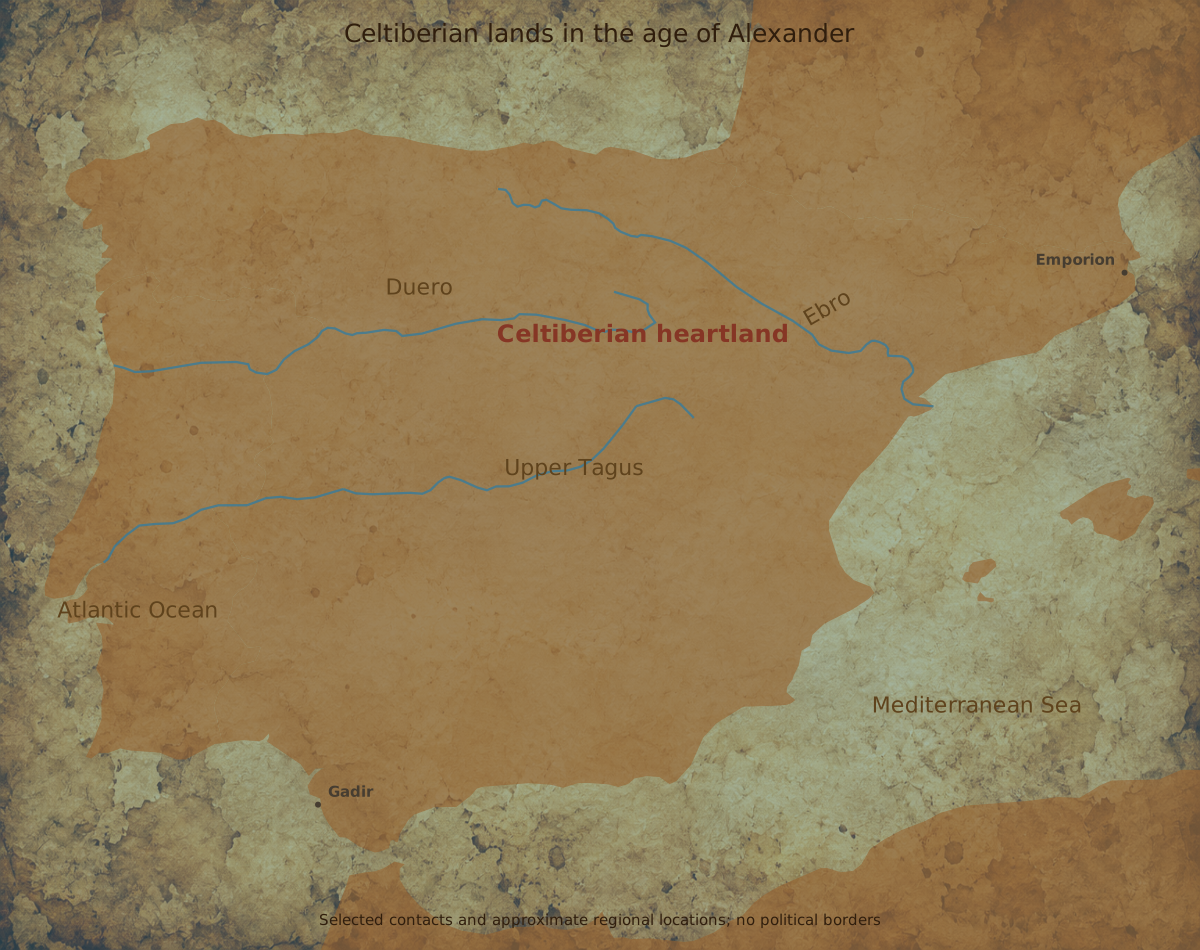
The eastern Meseta was a country of plateaux, upland basins and ridges cut by river valleys. The upper Duero, Tagus and Jalón connected settlements whose inhabitants looked towards different horizons. One route led deeper into the interior; another descended towards the Ebro and the more densely connected worlds beyond it. Hills separated neighbours, but crossings and passes repeatedly brought them together.
Life depended on making use of these contrasts. Cultivated ground sustained crops, while pastures supported animals that represented food, labour and movable wealth. Woodland provided fuel and material for building. The balance varied from place to place, giving neighbouring communities reasons to exchange what they produced and reasons to dispute access to it.
A settlement above a valley offered a view of movement through the surrounding country. Its defences expressed the determination of the people inside to retain control of their homes and resources. They did not remove the need to work outside the walls. Fields, herds and routes remained exposed, and an enemy could threaten a community without first forcing an entrance into its houses.
The homeland that would become known as Celtiberia developed around these connections. It was not an empire organised from a single centre. Local communities possessed their own interests and relationships, while shared forms of equipment, burial and craftsmanship linked them across the highlands. Their common world was made through repeated contact, not through an order that made every settlement obey the same ruler.
A homeland taking shape
The centuries before Alexander had already changed the interior. Settlements and cemeteries mark the growth of communities whose identities were rooted in the eastern Meseta and the Iberian mountain system. Connections with neighbouring regions carried objects and techniques into this country, where local makers and patrons selected what served their needs.
The resulting culture was neither an isolated survival nor a simple transplantation from beyond the Pyrenees. Its Celtic connections belonged to a distinct Iberian setting. Households and communities developed their own traditions through their relationship with the land and with one another. The broad name Celtiberian would later become familiar to Mediterranean writers, but the world it described had a history older than those accounts.
During the fifth and fourth centuries BC, some families acquired the resources to distinguish themselves more sharply from their neighbours. Weapons, ornaments and horse equipment placed with the dead reveal an increasingly visible language of rank. The standing of an armed man could be proclaimed after death through objects that had required considerable skill and wealth to obtain.
Such distinction had consequences among the living. A household able to maintain horses and equip fighting men possessed resources that could be used in a dispute, an alliance or a campaign. Its influence depended on relationships with others, not simply on owning an impressive sword. Authority had to be recognised by the people whose cooperation made it effective.
The people beside the graves
The cemeteries of places such as Aguilar de Anguita, Alpanseque and Carratiermes preserve some of the strongest traces of this early society. Cremation transformed the body before the remains and accompanying objects entered the grave. The ceremony gave the community a way to mark a death and establish how the person would be remembered.
Weapons made military identity visible. A spearhead, sword or shield fitting could associate the dead with the obligations and prestige of an armed life. Horse equipment added another distinction. Other graves carried fewer objects or different kinds of possessions, revealing a community whose members were not all commemorated in the same way.
The choice of what to place in a grave belonged to the living. They decided which objects should accompany the dead and which relationships should be made visible. A rich burial therefore expressed more than the possessions of one individual: it also declared the resources and memory of the people who honoured that person.
Those declarations had a public force. A prominent household could demonstrate that its standing had not ended with the death of one member. Weapons and ornaments connected a lost life to the continuing community. Around the cemetery, the distinction between grief, duty and the preservation of family honour could be difficult to separate.
The work behind a warrior's weapons
Iron equipment depended on skilled labour long before it reached a battlefield. Makers had to obtain and work metal, prepare fittings and produce an object that could survive use. A weapon represented access to that labour as well as the material from which it was made. Its value was not confined to decoration.
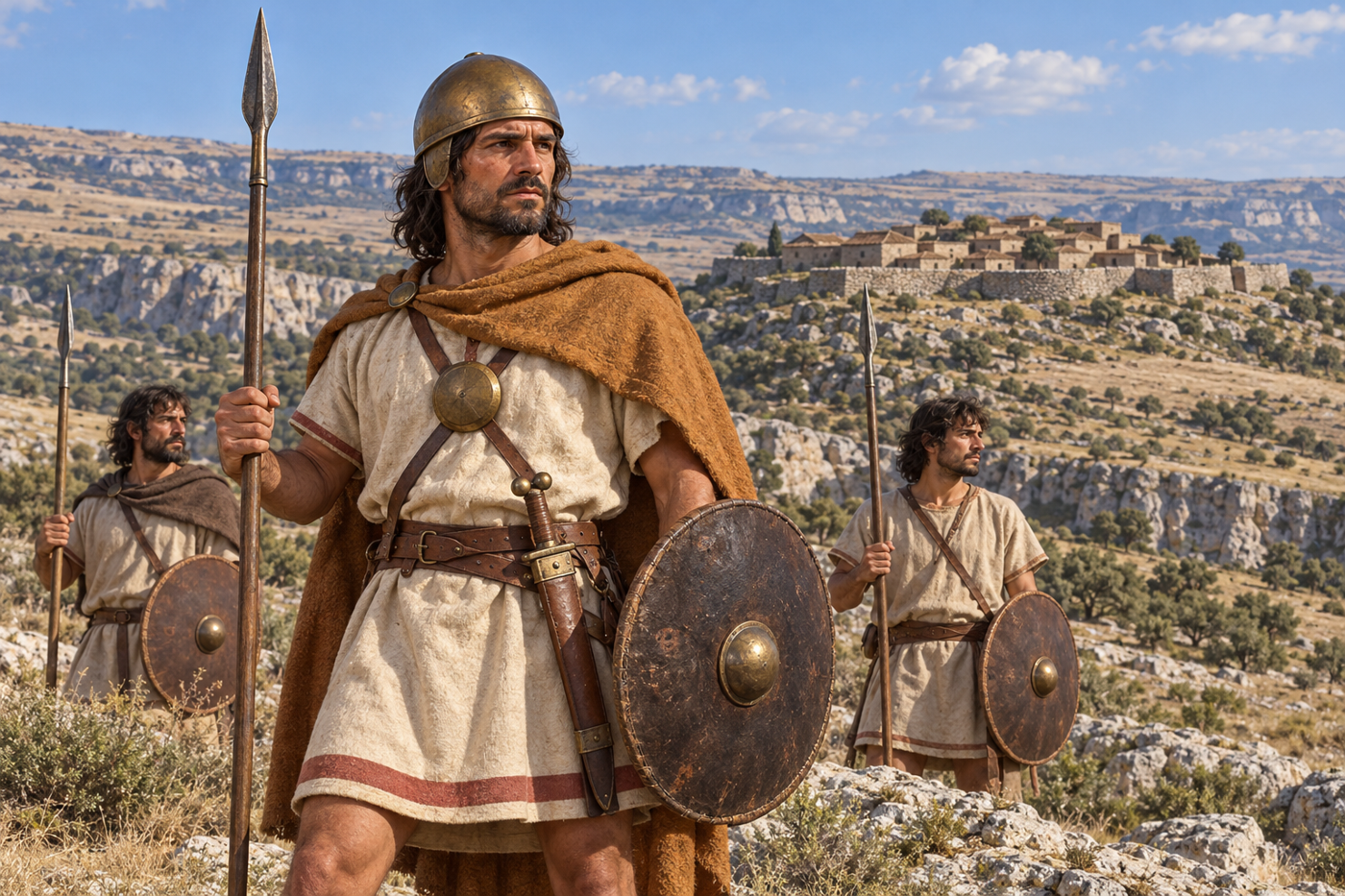
Spears gave armed men reach and could serve in a body defending an approach or advancing against an opponent. Short straight swords, including forms with antenna-like terminals on the hilt, belonged to the distinctive traditions of the interior. Shields joined wood and other materials to metal fittings, providing protection that required judgement and movement from the man carrying it.
Costly protection could mark out a prosperous warrior, while simpler clothing and equipment served others. The people assembling for a campaign did not lose the differences of wealth and experience they possessed at home. A leading man's appearance could proclaim his standing, but his safety still depended on the men beside him and on the decisions that brought them into danger.
Combat was only part of military service. A force needed provisions, information and routes through country where a delay could matter. Men could be called to watch an approach, protect animals, accompany a leader or hold ground while others moved. The ability to remain together under those demands was a form of strength less visible than an ornamented weapon but no less necessary.
Horses and the reach of a household
A horse widened the space within which a man could act. Riders could travel between settlements, observe an enemy or reach a threatened place more quickly than men on foot. Their movement connected communities and gave influential households a means of making their presence felt beyond the immediate neighbourhood.
Maintaining that advantage demanded resources every day, whether a campaign was being fought or not. Grazing, care and training belonged to the animal's value. Losing a horse could therefore mean losing both wealth and the means of continuing a particular kind of service.
The importance of mounted men did not make infantry a lesser concern. Homes, stores and defended approaches could not all be protected by riders moving through the countryside. The army's strength came from combining what its members could contribute. A prosperous household might provide a striking mounted figure, but the community still required men willing to hold their place on foot.
Belonging, belief and obligation
The dead reveal one part of a sacred world whose ceremonies also belonged to the living. The handling of remains, the placing of possessions and the continued use of burial grounds gave relationships with ancestors a material form. A community occupied a landscape of remembered lives as well as fields and paths.
Much later, Strabo described Celtiberian households celebrating through the night at the full moon in honour of an unnamed deity. His account offers a glimpse of collective ceremony in a later age, when Mediterranean observers had become more closely acquainted with the interior. It does not give a name to every earlier god, but it preserves the importance of worship shared by households and neighbours.
For the fourth-century communities, sacred obligations were part of belonging to a place and a people. The risks of conflict extended beyond those carrying weapons. A defeat could expose families, property and the places in which the dead had been entrusted to the community. Fighting for a settlement meant defending the relationships that made it home.
Before the great wars of the interior
The famous conflicts with Rome lay in the future. Numantia's destruction in 133 BC would give the resistance of the interior a lasting place in Mediterranean memory. The communities of Alexander's lifetime lived more than two centuries before that siege, with their own local ambitions and dangers. Their story was not yet organised around the arrival of a Roman army.
They inhabited a peninsula connected to Mediterranean trade and warfare without being governed by its eastern kings. Goods and practices could move far beyond the people who first produced them. News might travel through many hands, while the next dispute over a route, a herd or an ally remained more immediate than victories won across the sea.
What gave the highland world its strength was the depth of those local attachments. Communities could endure because they knew how to sustain themselves, remember their dead and bring armed men together when their interests were threatened. Their leaders sought influence in a country where a household's standing had to be demonstrated and a neighbour's cooperation could never be assumed.
The Celtiberian warrior of the fourth century belonged to that living landscape. Behind his shield stood the work of makers and farmers, the resources of his household and the expectations of the people who would receive him if he returned. His war began with those obligations, long before distant historians gave his homeland a place in the story of conquest.
Sources
- Alberto J. Lorrio, Los Celtíberos, Universidad de Alicante / Biblioteca Virtual Miguel de Cervantes.
- Alberto J. Lorrio, Les Celtibères : archéologie et culture, Études celtiques33,1997,pp.7–36.
- Alberto J. Lorrio, Élites guerrières et ethnogénèse des Celtibères,2006,pp.26–36.
- Strabo, Geography III.4.16.
- Rafael Treviño Martínez, Rome’s Enemies (4): The Spanish Armies, Osprey Men-at-Arms180.