






Romans
In 340 BC, Rome fought men who knew its language of command and much of its way of war. The Latin allies were neighbours, relatives and former comrades. Victory would not simply save the city from an invasion: it would determine who had the authority to organise their shared world.
A republic on the Tiber
Rome's strength began with a position in central Italy, not with a destiny already accepted by its neighbours. The Tiber connected inland routes to the coast. The surrounding land sustained households whose military service and political standing helped define the community. Latin towns, Etruscan cities and the peoples of the inland hills stood within reach of its armies and could threaten its interests in return.
The city had grown through conflict, settlement and the incorporation of outsiders. Its ruling families cultivated memories of ancestors who had held office and saved the community in moments of danger. Such memories gave public service a powerful personal attraction. A successful command could increase the standing of a house, while a disgrace might endure long after the soldiers responsible had died.
Public authority was nevertheless more than the possession of one family. Magistrates received commands, the Senate shaped policy and citizens participated in political assemblies. Competition among leading men took place inside institutions whose authority they needed. The end of a consul's year did not necessarily end the war his decisions had helped to create.
The struggles between patricians and plebeians belonged to this same military society. Access to office and recognition within the community mattered to men whose households supplied its armies. In the fourth century, the widening of political opportunity altered the ways in which ambition could be pursued. Rome's capacity to draw on its people depended on bargains at home as well as victories abroad.
The war among allies
The Latin communities had their own claims to standing within the system of common warfare. They were not simply a reserve of obedient manpower. The demand for a different relationship with Rome challenged who could speak for the alliance and how authority should be shared.
The Latin War brought these disputes into the field. The Roman consuls Titus Manlius Torquatus and Publius Decius Mus became central figures in the memory of 340 BC. Their stories offered later generations two formidable images of command: obedience enforced even at the expense of family, and a leader's life surrendered for the survival of the army.
Livy tells how Manlius ordered the execution of his own son after a victorious but forbidden single combat. The episode made the discipline of the army more binding than a father's affection or a young warrior's glory. Whether heard with admiration or horror, it insisted that private courage could endanger a public undertaking when it challenged the authority under which the army fought.
The story of Decius turns on a different sacrifice. Through the rite of devotio, the consul dedicated himself and the enemy to the powers below and rode into the opposing force. Roman tradition gave the survival of the army a sacred price. His death was remembered as an act in which magistracy, religion and personal resolve became inseparable.
These narratives belong to the Romans' own reckoning with the demands of war. They expressed the fear that an army might break, the need for unquestioned action at a decisive moment and the terrible cost that command could impose. Their force does not depend on treating every detail as a report written beside the battlefield.
Making victory endure
The settlement of 338 BC transformed the political map around Rome. The defeated communities did not all receive the same terms. Some were incorporated more closely; others retained local institutions while entering relationships that narrowed their freedom to act. Colonies placed bodies of settlers at points important to Roman security.
This variety was a source of strength. Rome could demand service and loyalty without requiring every community to occupy an identical position. Privileges could reward cooperation; restrictions could prevent a defeated alliance from reforming on its former terms. The relationship between towns was increasingly arranged through Rome rather than independently of it.
The consequences extended into Campania. A local aristocrat could gain by loyalty to Rome, even when neighbours resented the same obligations. Agreements offered protection and access to a stronger partner. They also gave Roman commanders reasons to intervene when a community's internal politics appeared to threaten the security of the wider network.
Thus victory produced more than captives and a triumph. It created new commitments that would require further campaigns to defend. Rome's expanding strength was built from these obligations, but each addition also opened another place in which an opponent could challenge it.
Citizens in the ranks
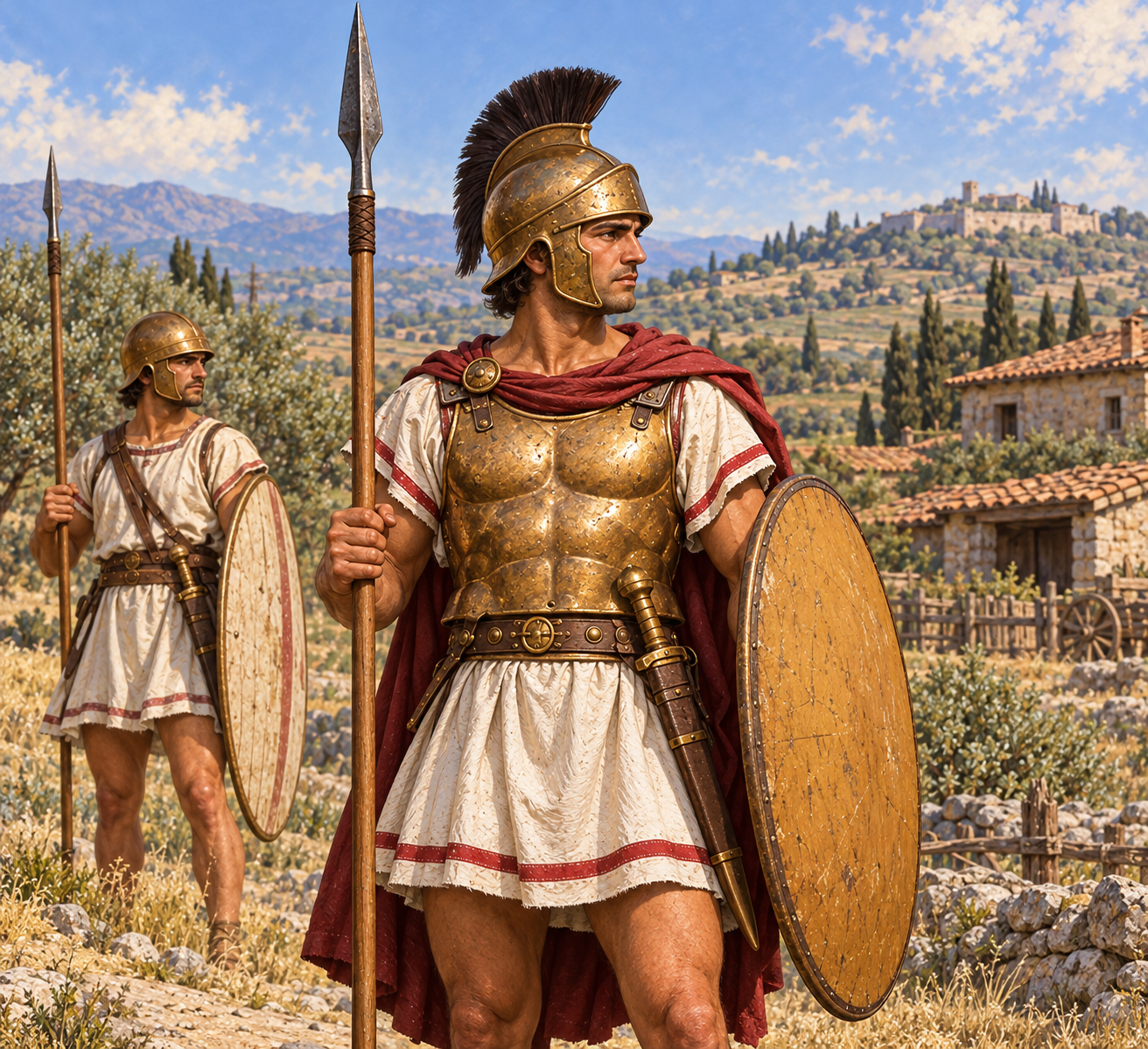
The army of the later fourth century drew on citizens and on the communities tied to Rome. Means and experience affected the equipment a man could bring and the role he could perform. Infantry carried shields, spears, javelins and swords; helmets and body protection reflected resources as well as changing military practice. Horsemen added mobility and the standing of those able to maintain a mount.
Livy's account of the Latin War describes hastati, principes and triarii, giving the army depth and a sequence of commitment. The organisation developed across time as Roman forces fought different enemies on different ground. The reserve embodied a practical and moral resource: men who had not yet been committed could stabilise a battle that the forward troops had failed to decide.
Discipline held these parts together. A commander had to control movement, preserve order during an advance and prevent the pursuit of individual glory from dissolving the collective effort. Camping, marching and obtaining provisions consumed much of a soldier's service. The work that made a battle possible was often less celebrated than the act that won it.
For the men in the ranks, defeat threatened more than reputation. Captivity, the loss of equipment and the exposure of their homeland were immediate possibilities. Even a successful campaign kept households away from labour and placed demands on those who remained. The republic's military power was carried by families whose resources were not inexhaustible.
Auspices and the authority to act
Roman commanders operated within a religious order in which the favour of the gods had to be sought and acknowledged. Auspices, sacrifices and vows accompanied public action. A magistrate's command was exercised by a man whose relationship with the community included duties towards the divine.
Religious authority could also become a weapon in disputes among leading men. An unfavourable sign might delay an action; a neglected obligation might help explain disaster. These were serious matters in a society that understood public security through its relations with the gods. The importance of the rites also made their interpretation politically consequential.
The army shared that world. The standards, camp, vows and lawful commands around which soldiers gathered gave collective action a public shape. Victory could be celebrated as evidence that discipline, courage and divine favour had met. Defeat demanded an explanation and often a renewal of the obligations thought to have been broken.
Defeat in the passes
War with the Samnites exposed the limits of Roman strength. In 321 BC, the consular armies were trapped at the Caudine Forks and forced to surrender. The catastrophe could not be answered by a display of individual bravery. The enemy controlled the exits, and the commanders had lost the freedom to choose their next movement.
The humiliation of the yoke remained a wound in Roman memory. More difficult still was the political meaning of the agreement made under compulsion. Rome disputed the settlement, separating the undertakings of commanders from obligations accepted by the state. Renewed warfare showed that even surrender did not supply a settlement both sides would allow to endure.
Lucius Papirius Cursor and Quintus Fabius Rullianus belong to the generation that fought through these reversals. Their remembered rivalry and achievements place command inside a world of personal ambition, religious argument and repeated military demands. The republic could produce formidable leaders without making relations among them harmonious.
While Alexander fought in Asia
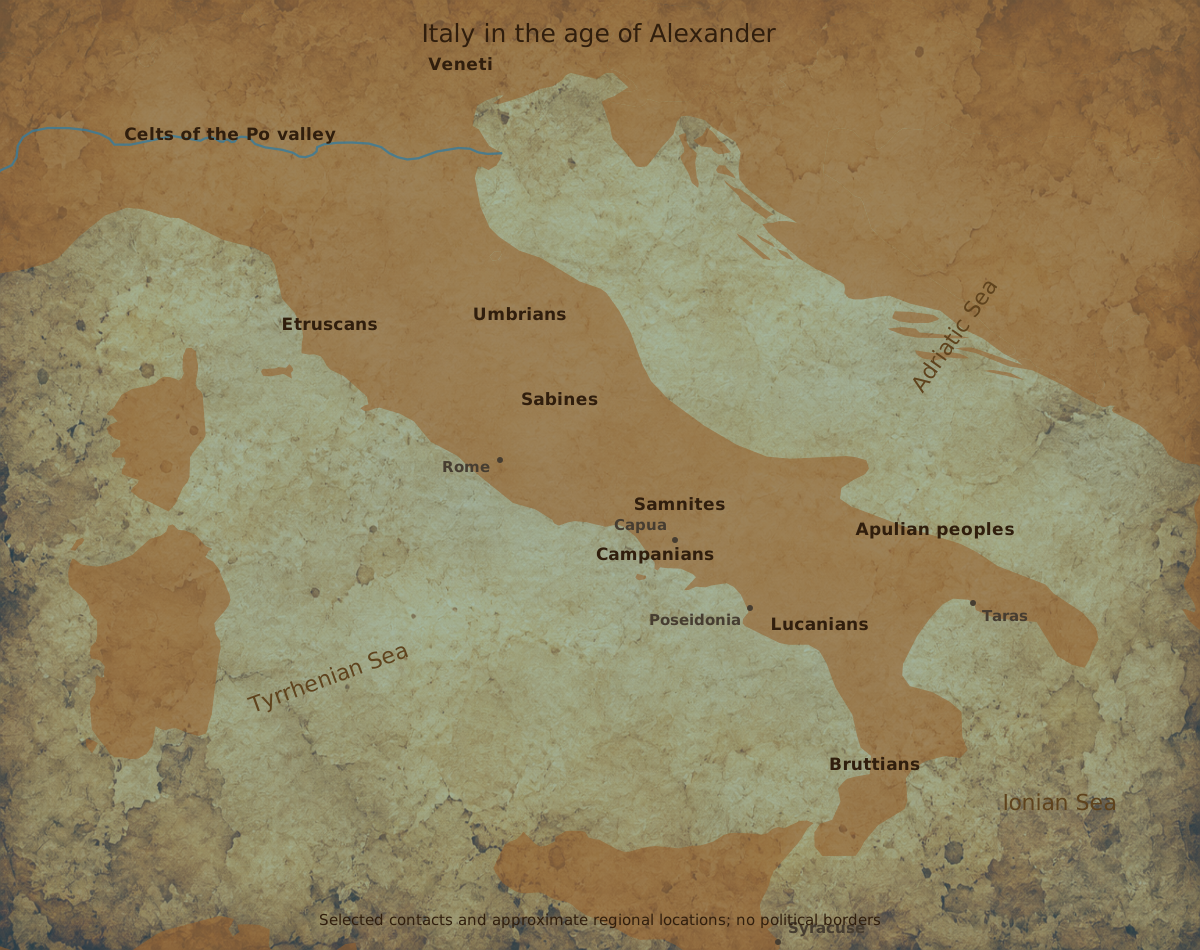
Rome did not confront Alexander the Great in battle. Livy's later speculation about such a contest measures how large the Macedonian king had become in the imagination of Roman history. The actual wars of the republic were being fought over Campanian towns, Samnite routes, Apulian allies and the approaches to Etruria.
Those campaigns were immense in consequence even without an encounter between the two powers. Alexander of Epirus had already shown that a Greek king might enter the struggles of Italy. The possibility of outside intervention existed beside the more immediate danger of a defeated neighbour returning with new allies.
By the end of the fourth century, Rome had become much harder to overthrow than it had been at the beginning. It could absorb losses, raise further armies and preserve a network of relationships across repeated crises. None of that made its eventual domination visible as a certainty to the soldier marching towards the next pass. The republic's future was being made through decisions whose price was paid in the present.
Sources
- Livy, History of Rome VIII: Latin War, Campania and Alexander of Epirus.
- Livy, History of Rome IX: Caudium, Etruria, Umbria and the later Samnite campaigns.
- Nicholas Sekunda and Simon Northwood, Early Roman Armies, Osprey Men-at-Arms283.