






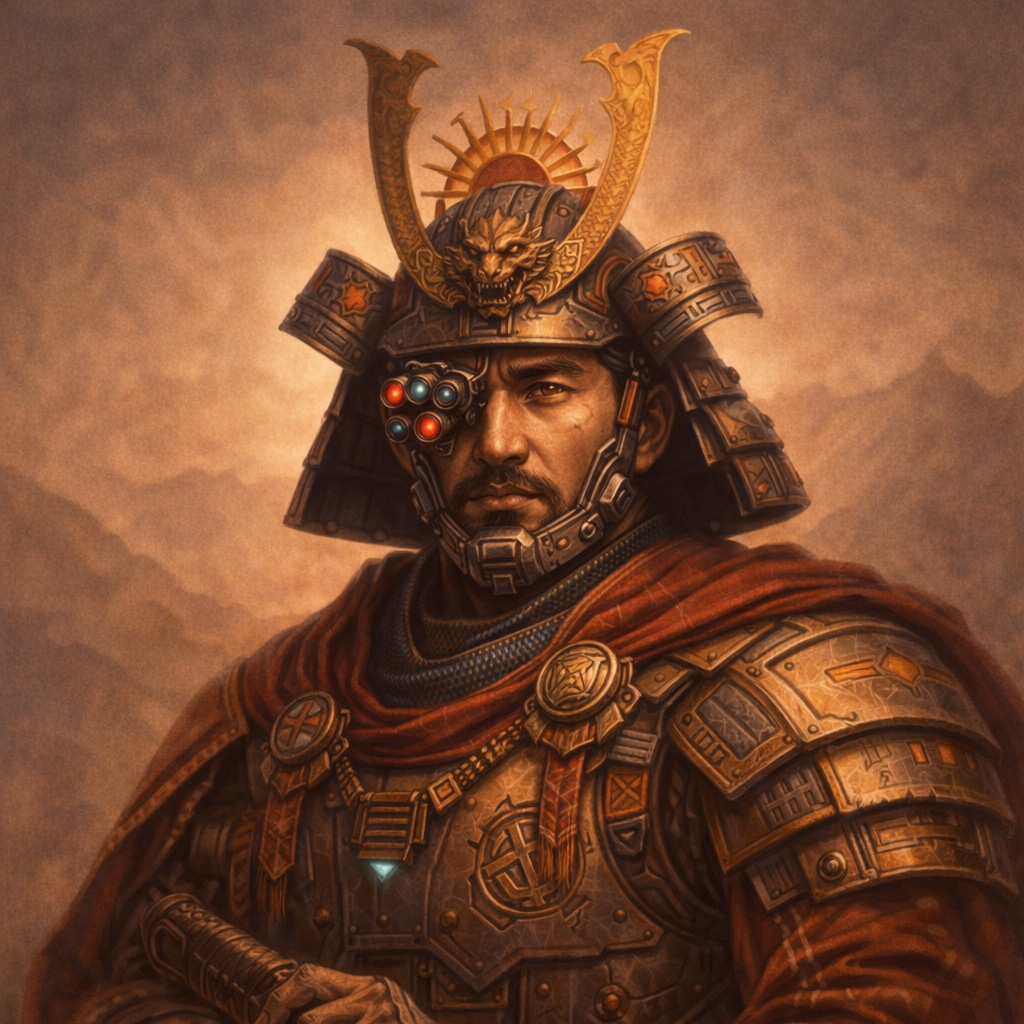
Kento, Respect and Honor
Among all the clans of Damocles, one voice carries farther than the rest, a clan whose leaders have, over millennia, embodied wisdom and bravery, often to the point of ultimate sacrifice. The Kento have never built their authority on brute force or coercion, but on the respect they inspire. Their rulers have cultivated wisdom and justice since the earliest days, when mankind still lived upon Wanyue. They intervene in disputes between clans only after deep reflection, seeking the most just decision rather than the most expedient one. It is in moments of great consequence, when the fate of the world hangs in the balance, that their voice is most awaited.
Origins
More than 10,000 years ago, when men fought alongside the elves on Wanyue to repel the orcish hordes sent by Agron, a portion of the nomadic clans began to settle in the northern territories that had been reclaimed. They never fully abandoned their way of life and regularly rode south to repel renewed orc invasions beside their brethren. Over time, the southern clans became known as the Confederation of the Serpent, for they rode great reptiles into battle, while the northern settlers became the Confederation of the Wind, venerating the Wind Dragon. Much later, some descendants of the first group founded Heaguk, while most of the Tohei clans descend from the second.
Numerous legends recount the wars of Wanyue. Many celebrate the exploits of Kento nobles who supposedly saved the world several times, uniting the clans against mortal threats and slaying Agron in desperate and epic battles. These tales, though rooted in historical truth, have been magnified and romanticized over centuries. The Kento have always avoided exploiting their privileged moral position. As a result, many other Damoclean clans claim descent from companions of those legendary heroes. The kings of Heaguk, for example, assert that they descend from the eldest son of a great Kento leader from the Wanyue wars, drawing prestige from that lineage.
The Conquest of Tohei
When the portals opened and mankind reached Damocles, they were forced to fight the beastmen who had taken control of the northern regions of the planet. Some were friendly, many were hostile. Following the vision of Kento leadership, the Confederation of the Wind pushed its expansion eastward and seized the fertile lands of Tohei, while other clans quarreled over the western territories.
The conquest was arduous. Supply lines were often cut and victory frequently uncertain. Though technologically inferior, the beast-kingdoms could field warriors both more numerous and physically stronger. One episode remains legendary. A Kento prince was captured by northern Tohei beastmen. During his captivity he seduced a local princess and persuaded her kingdom to join his clan. Because of this exploit, the Kento Daimyo are sometimes called Those Who Rode the Beast, a reference both to their ancestors who slew Agron from dragonback and to their own beast-blooded heritage.
Over millennia, beastmen ancestry diluted into the northern Tohei population, especially within the Kento. In certain mountainous regions, where that lineage remains stronger, towering horned warriors of immense strength are still born.
Erosion
After the conquest, the clan remained politically active for thousands of years. Its role in shaping Damocles’ institutions was crucial. Those same institutions prevented major planetary wars until the Imperial invasion. Locally, however, the Kento gradually lost territory to rising clans and old rivals. They might have disappeared like many ancient houses of Wanyue had they not possessed exceptional prestige.
Though wise and respected, the Daimyo often succumbed to rigid conservatism. They missed commercial and technological opportunities in the name of stability. When foreigners arrived, the Kento were slow to accept the new religion and consistently banned trade with smugglers, fearing it would draw the wrath of the Supreme Empire. History proved them correct, but they remained poor while other clans grew wealthy. They lost what little influence they still held over the southern islands.
The Imperial Invasion
When the Great War erupted, the Tohei clans turned naturally toward the Kento, hoping that a miracle would rise once again from this declining house and save their world as in the old legends. The invaders’ catastrophic orbital losses gave Tohei a chance, and even more important was the fragmentation and disorganization of Imperial command.
The capital was relocated to Tohama. Kenzo, then a young Daimyo, led both his own army and the northern Tohei clans who had urgently joined his alliance. While dozens of other clans fell, his coalition held, but time was against them. Kenzo understood that if the war dragged on, western Imperial forces would eventually reach Tohei. The Confederation of the Wind would fall along with millennia of tradition. His support for smaller clans, his efforts to curb Ritolia’s eastern expansion and to prepare Mori defenses in the north drained the last reserves of Kento strength.
Kenzo chose diplomacy. He sought the destruction of extremist Imperial factions, the survival and dignity of the Wind clans still standing and a swift return to peace. He approached the Swolfs, who had conquered northern territories without massacre or needless brutality. Practical and long-term minded, the Swolfs had rallied more clans than they had fought. An alliance formed. The Swolfs provided Imperial legitimacy and protection from rival invaders, while the Kento provided historical legitimacy and eased the integration of indigenous clans.
Once agreements were sealed, a heterogeneous army of Imperial nobles and clan warriors swept through Tohei, exterminating maximalist Imperial factions and crushing clans who rejected Imperial authority, often fanatics of the Celestial Peace. The Kumaguchi alliance proved hardest to convince. Strengthened by pre-war commerce, they had expanded during the invasion. After failed attempts to turn other clans against Kento and several skirmishes, they too submitted. The most brutal chapter of the campaign was the destruction of the buccaneers’ army, highly motivated and well equipped.
Current Geopolitics
Kenji, the current Daimyo and great-grandson of Kenzo, inherited hope alongside his name, which he shares with the clan’s greatest heroes. Though guided early by wise advisors, his controversial marriage at over ninety years of age to a young Swolf princess divided even his own family. Some see rapprochement with the Swolfs as desperate survival, others fear a fatal trap. Once enough blood ties are forged and Kento legitimacy erodes, the Swolfs may dismantle the clan while claiming to be its rightful heirs.
Kenji’s reign saw renewed influence over the Free Islands and military modernization. Yet the Kento, never fervent adherents of the Celestial Peace, struggle as religious zeal rises again in Tohei and lose influence among minor clans. Tsunomon, stabilized during the war, now asserts increasing independence and covertly funds island buccaneers. This erosion during the latter part of Kenji’s reign may fall to his heir to correct.
The Heirs
Kento longevity technologies, though inferior to Imperial genetic engineering, are considered the finest in Tohei. But Kenji is not eternal. Kentaro, the eldest son, is a respected warrior with real battlefield experience against the buccaneers. Now commander in chief, he improves equipment, tactics and training. For him, politics is a balance of power and only military strength can secure the clan’s position.
Kenichiro, second in succession, is a capable administrator focused on sustaining trade and the economy despite military strain. Unlike Kentaro, he favors normalization and closer ties with the Swolfs. The army sees him as a potential traitor, while merchants see him as hope for a peaceful and prosperous Kento.
Tetsuko, the youngest, was long despised by his father. Physically frail yet intellectually sharp, he is a gifted strategist. Though valued by his brothers for his counsel, he was never considered an heir. He deeply resented his father’s remarriage and now wanders among the lands of men.
Within the clan itself, Kenji’s marriage to Lady Leonora is far from unanimously accepted. She is not truly appreciated by Kenichiro and is openly despised by Tetsuko. Leonora, however, is deeply committed to her role. She is fully aware that she represents a crucial asset in the rapprochement between her clan and the Kento. She knows that her destiny may determine the future of Damocles itself. Her primary objective is to bear a new heir, one who would seal the alliance and reinforce the prestige of her own lineage.
Political and identity challenges
Born from a minor branch of the clan, Masaru Ishidate holds a far more pragmatic vision. From a young age, he understood that power no longer resides solely in honor or the sword, but in the control of flows, goods, resources, transport and credit. While his initial rise was largely due to his proximity to circles of power and the support and intelligence he drew from them, he has since become an exceptional merchant and industrialist, particularly in the fields of transportation and armaments. These industries stand behind the military renewal of the Kento. Certain prohibited programs have even been maintained for decades, awaiting the day when a major conflict shatters the regulations that prevent their widespread deployment. A subtle logistician and skilled politician, he works as much for his personal interests as for those of the Kento.
A warrior-monk and heir to the oldest traditions of the Confederation of the Wind, Shigure no Raizan believes that the alliance with the Empire saved the body of the clan but killed its soul. He is a formidable fighter and serves as weapons master to the clan’s officers. He strives to preserve and transmit Kento values in an era when everything has already shifted. Though he poses no direct threat to Kenji, the traditionalist ideals he embodies run counter to the Daimyo’s policy of alliance and openness. Yet any attempt to remove Shigure no Raizan would amount to admitting that the clan has indeed lost its soul.
Though less powerful than the Swolfs, Kumaguchi, Ritolia or Palter, the Kento maintain strong alliances. Kenji’s daughter is married to the head of Clan Mori, and his own marriage ties him to the Swolfs. Few clans would dare attack Kento directly for fear of staining their own honor. Yet they face formidable rivals, particularly the Kumaguchi, and among the buccaneers the Kento are hated without measure.
The clan now lives through a troubled age, one of many it has endured throughout its long history. Some believe that it will finally fall. They forget that the Kento are not merely a clan, they are the very soul of Tohei. And the Damocleans know that when the world stands once more at the edge of the abyss, a great leader will rise from the Kento to guide them to victory.