






Athenians
A city that would still argue with kings
News of Alexander's death reached a city that had spent years living beneath the shadow of his power. In 323 BC, Athens chose to act. Money, ships, envoys and soldiers were committed to another attempt to recover Greek freedom. The decision was bold, but it came from a community whose response to defeat had never been simple resignation. Even after Chaeronea, Athenians had continued to build, train, debate and prepare.
The Athens of Alexander's lifetime was still a democracy with formidable resources and an extraordinary memory of its own achievements. Its citizens could look up to the Acropolis, walk among public dedications and hear speakers summon the victories of their ancestors. Those memories could sustain courage or sharpen disagreement. The question was how to defend the city that existed now, with the means it actually possessed, against a king whose victories seemed to keep enlarging his power.
Athena's city and its country
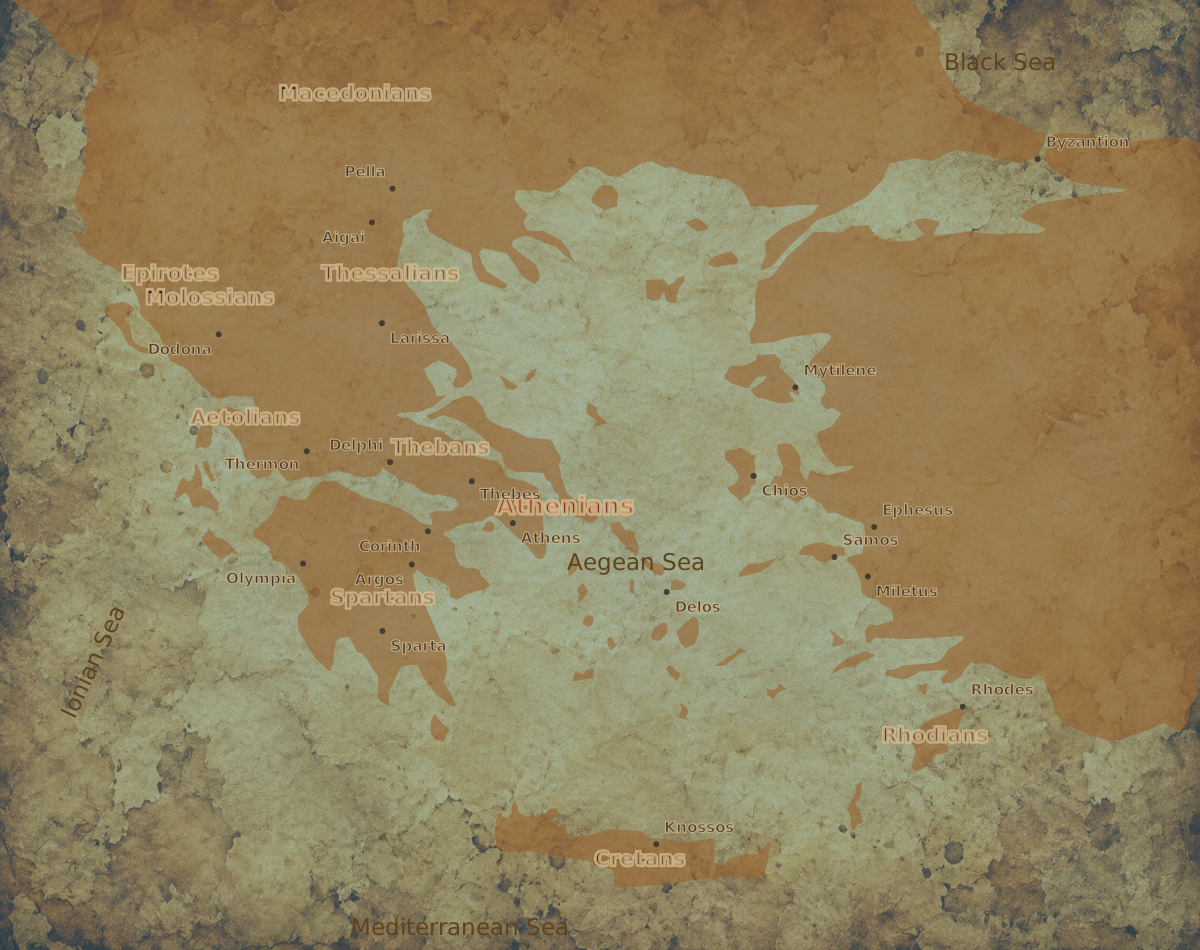
Athens stood within Attica, a country of cultivated plains, hills, coastal settlements and routes guarded by strong points. Its citizens belonged to local communities, the demes, whose names followed them into public records. Political life drew these men together at the urban centre, but their obligations and livelihoods extended across the territory. The defence of Attica meant protecting farms and crossings as well as walls.
The Piraeus connected that country to the sea. Ships brought grain and other necessities, carried soldiers and envoys, and made distant friendships matters of immediate survival. A city with access to the sea could recover from dangers that would isolate an inland opponent. It also had to pay for crews, maintain vessels and preserve the routes on which it depended.
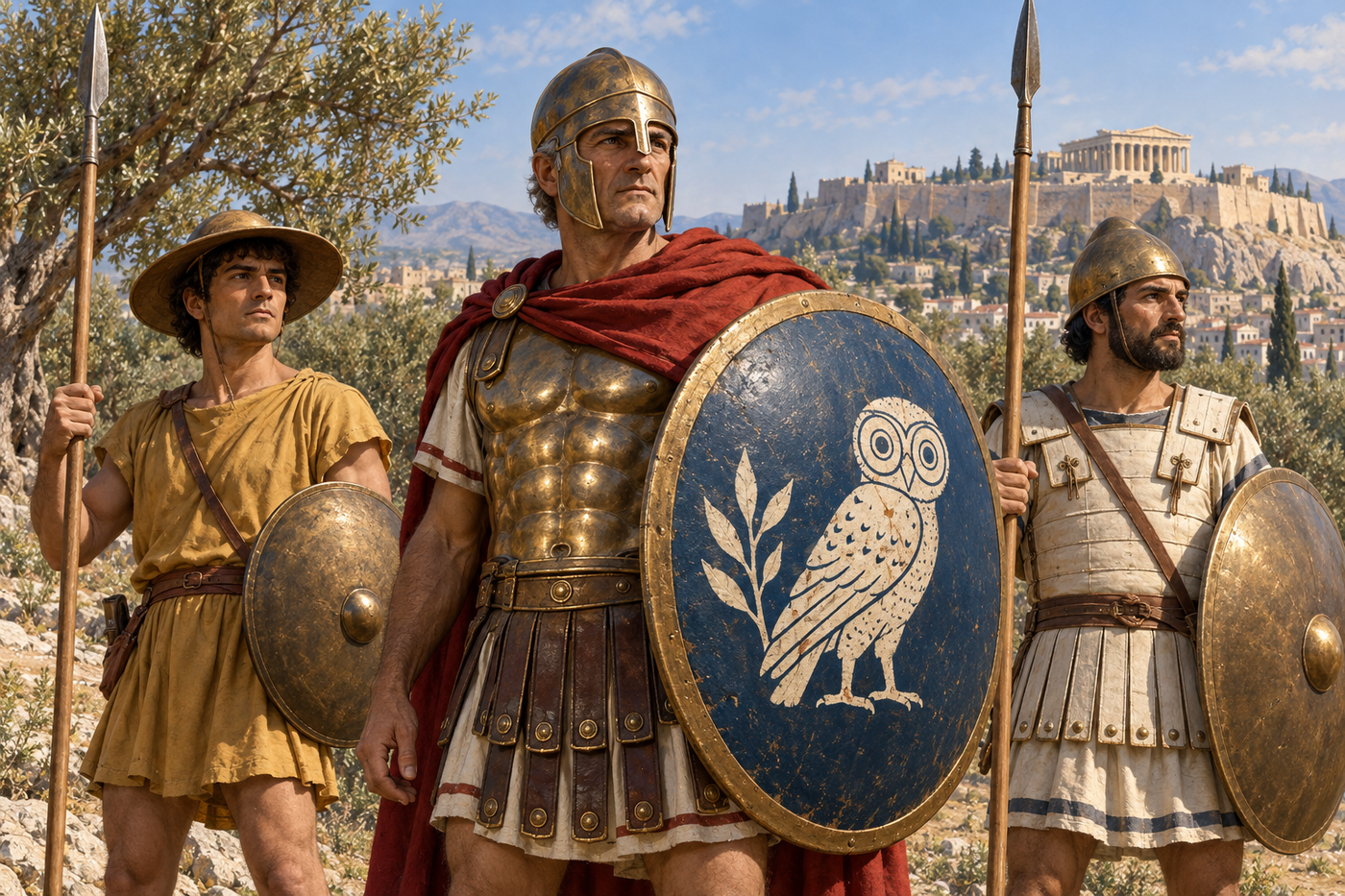
Athena presided over the city's public identity. Her image and the owl familiar from Athenian silver travelled widely, carrying a recognisable sign of the community into foreign hands. The Panathenaic festival brought worship, procession and civic display together. The gods belonged within the public world that citizens defended and argued over, rather than standing apart from its finances, buildings or military duties.
The democracy after its empire
The defeat of 404 BC had cost Athens its fifth-century empire and exposed it to the violence of the Thirty. The restoration of democracy in 403 became another powerful memory: the community had recovered its institutions after civil conflict and foreign-backed rule. During the fourth century, it rebuilt naval influence and returned to the diplomacy of the major Greek powers.
Assemblies decided policies that generals had to carry out. Courts examined accusations and accounts; public honours rewarded service and made expectations visible. A speaker needed to persuade fellow citizens who could remember failures, question expenditure and demand results. Political disagreement could be bitter because it concerned decisions whose consequences reached the fleet, the harvest and the safety of families.
The system also relied on people beyond the citizen body. Resident foreigners worked and traded in the city; enslaved labour sustained households and production. Military and commercial activity linked citizens to a much wider population. The democracy's public ideal of shared responsibility existed within this unequal and densely connected society.
Demosthenes and the danger from the north
Demosthenes made resistance to Philip II the central cause of his public career. His early life had taught him the importance of speaking effectively: after losing his father, he fought to recover an inheritance mishandled by guardians. Later tradition dwelt on the labour through which he overcame difficulties of delivery. The mature orator turned that hard-won skill towards persuading Athens that Philip's advances demanded action.
His opponents did not have to admire Philip to fear the cost of confronting him. Campaigns required money and cooperation; cities had their own grievances and priorities. Demosthenes argued that delay allowed the Macedonian king to choose the next crisis. His political challenge was to turn warnings into ships, troops and allies before the opportunity disappeared.
The alliance with Thebes in 339/8 BC was a striking success. Two cities with a history of rivalry agreed to face Philip together. Their defeat at Chaeronea was therefore a military disaster and a judgement upon a great political gamble. Athens had committed citizens and prestige to the attempt to stop the king, and now had to secure its survival in the settlement that followed.
Lycurgus prepares for another day
After Chaeronea, Lycurgus became a leading figure in the management of the city's resources. His programme joined military readiness to the visible dignity of Athens. Revenues, ships, weapons and public buildings belonged to a common effort to make the community capable of acting again. The city could acknowledge an unwelcome balance of power while strengthening the means on which a future decision might depend.
The honours later voted to Lycurgus remembered repairs and new construction for the fleet, stores of arms and missiles, and work on the shipsheds and arsenal. They also celebrated the theatre of Dionysus and the Panathenaic stadium. War and festival required different forms of expenditure, but both expressed the conviction that Athens remained a community worth serving.
This activity gave the years of Macedonian supremacy a character easily lost in a story told only through battles. Athens was not merely waiting. Men administered funds, supervised work and held office under scrutiny. Young citizens learned their duties. Political leaders argued over how much could safely be attempted while Alexander was alive.
The young men on the frontier
The ephebes provide a particularly close view of that preparation. Inscriptions from the years following 334/3 BC name groups of young men, their officials and the honours they received for discipline. The men of the tribe Cecropis were praised for obeying their supervisor and doing what the laws required. Military service entered the public record through names and conduct, not simply through a distant victory.
The Constitution of the Athenians describes training in weapons and service in the forts. The young men learned skills associated with different kinds of fighting and became familiar with the territory they would defend. Their passage into civic responsibility linked physical preparation to the authority of elected supervisors and the expectations of their fellow citizens.
The oath preserved at Acharnai makes those expectations vivid. The soldier must respect his sacred weapons, stand by his companion and defend the homeland and its sanctuaries. Gods and the boundaries of Attica witness the commitment, alongside grain, vines and olives. The promise brought the great language of citizenship down to the landscape on which life depended.
Infantry, horsemen and the harbour
Athenian military strength had several faces. Hoplites defended the line; lighter troops could move and fight where a close formation struggled; cavalry watched approaches and threatened an exposed opponent. Generals had to combine these resources with hired soldiers when a campaign required experience or numbers beyond an immediate citizen mobilisation.
The sea remained decisive. The Piraeus contained the infrastructure of naval power, and the ability to put ships into service depended on years of administration and maintenance. A naval defeat could threaten far more than the vessels lost in it. It could undermine the city's access to supplies and its freedom to maintain a war ashore.
Political leaders therefore had to judge the relationship between land operations and maritime security. A field army might win while the strategic position worsened elsewhere. The final struggle against Antipater would make that danger painfully clear.
Living beside Alexander's victories
The destruction of Thebes in 335 BC brought the risks of revolt terribly close. Athens had to negotiate while Alexander demanded action against prominent opponents. Demosthenes' position became dangerous, and the city faced the choice between protecting its political figures and exposing itself to further pressure. The episode showed how limited freedom of action could become when a king stood nearby with a victorious army.
During the Asian campaigns, Athens followed events whose outcome could alter its own prospects. Greek soldiers served Alexander and his enemies. Persian resistance might offer room for manoeuvre; another Macedonian victory could close it. The continuing debate was not simply between courage and fear. It concerned the moment at which hope could be converted into a viable coalition.
Alexander's death transformed that calculation. Leosthenes had access to experienced soldiers, and Athens helped bring a wider alliance into being. The new war began with success. Antipater was defeated and confined at Lamia, giving the struggle the name by which it would be remembered.
The last gamble of a generation
The death of Leosthenes during the siege cost the coalition its leading commander. Reinforcements changed the Macedonian position, while the naval war turned against the Greeks. The fighting at sea and the arrival of fresh armies gradually eroded the early advantage. A struggle that had begun with Antipater trapped behind walls ended with the allies unable to impose the decision they needed.
After the defeat at Crannon in 322 BC, negotiations brought a harsh settlement to Athens. A Macedonian garrison occupied Munychia, and political participation was restricted by a property qualification. Thousands lost the civic position they had held under the democracy. Demosthenes fled and died while avoiding capture.
The result marked the end of an extraordinary generation of resistance and preparation. Its history includes eloquence and misjudgement, financial care and military courage, public building and desperate war. Athenians had continued to act because the city's freedom was more than a memory to be admired. It was a claim they expected their own decisions to preserve, even when the power confronting them seemed overwhelming.
Sources
Ancient accounts
- Plutarch, Life of Demosthenes.
- Aristotle, Constitution of the Athenians, especially 42.
- Diodorus Siculus, Library of History XVIII.8–18.
- Arrian, Anabasis of Alexander I.7–10.
Inscriptions
- AIO 871, decree honouring Lycurgus of Boutadai, 307/6 BC.
- IG II² 1156 / RO 89, honours for ephebes, 334/3 BC.
- RO 88, military oaths from Acharnai.
Historical studies and reference works