






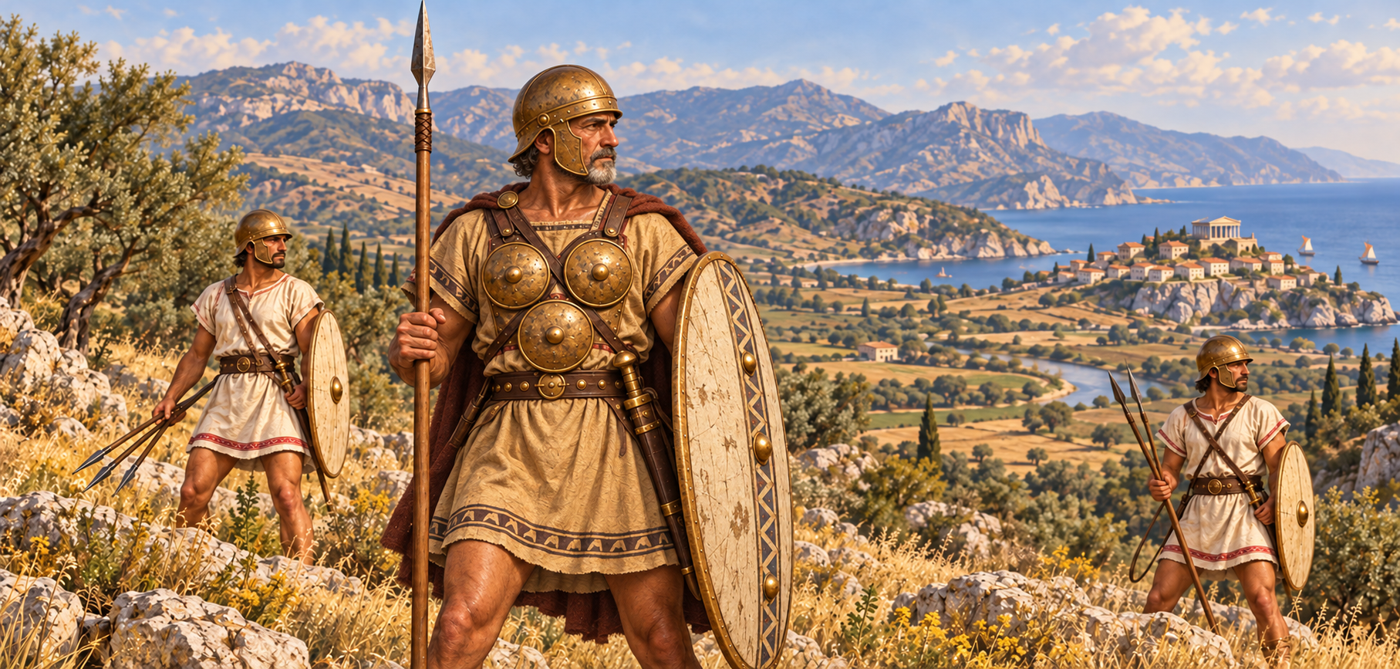
Lucanians
Around 331 BC, Alexander of Epirus died while trying to escape his enemies near Pandosia. The king who had crossed the sea to defend the Greek cities had found allies and adversaries among the same inland peoples. His last campaign revealed a southern Italy in which loyalty, exile and local ambition could overturn the victories of a royal army.
From the mountains to the Greek cities
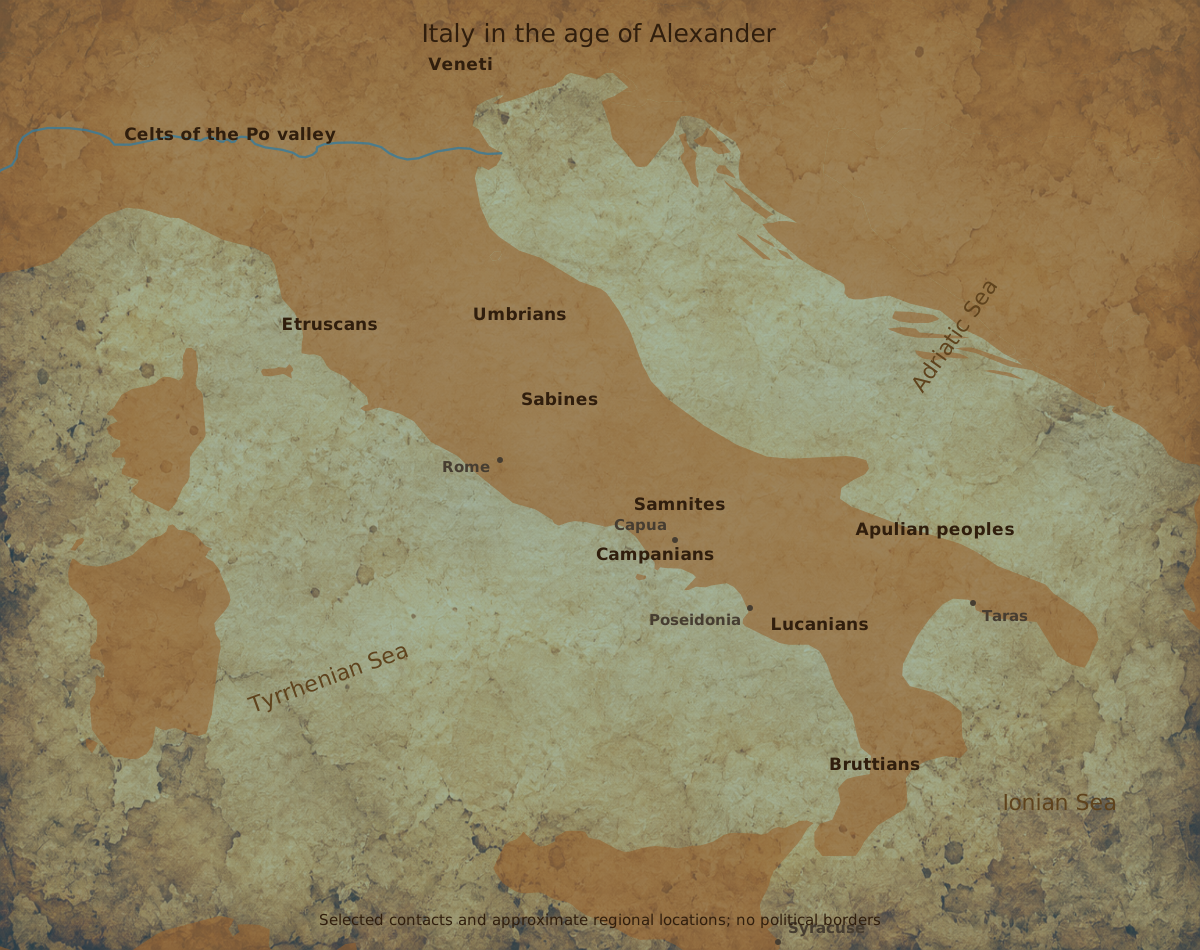
Lucania occupied a broad country between the Tyrrhenian and Ionian sides of southern Italy. Its uplands, valleys and cultivated basins opened towards Greek settlements on the coasts. The routes descending from the interior did not merely lead to targets for raiding. They connected communities to markets, agricultural land, ports and the prestige of an established urban world.
During the fifth and fourth centuries, Lucanian power expanded through this landscape. Greek authors explained its growth through movement from the north and the displacement or subjection of earlier populations. On the ground, the result was a varied society. New political identities developed among people whose ancestry, language and ways of life did not begin from one uniform point.
At Poseidonia, known in its Lucanian phase as Paistom, the change can be seen particularly clearly. The great temples remained part of a living town. Greek objects and religious forms continued to matter while Oscan-speaking people participated in civic life. The city's history was not a simple replacement of civilisation by outsiders: institutions, families and cultural practices were being contested and reshaped.
Farther inland, settlements and defended heights connected the people who controlled the approaches to the plains. Local power could be based on land, the ability to gather armed men and relationships among leading families. The wider name Lucanian did not extinguish those local centres of loyalty. A common enemy might unite them, but the same conflict could also divide them.
The painted world of Paistom
The fourth-century tombs around Paistom preserve a society unusually visible in colour. Armed riders return in triumph, women receive them, and contests or funeral ceremonies honour the dead. Weapons, horses and fine dress proclaim the standing of the person commemorated. These scenes belong to families who wanted their achievements and expectations to endure beyond a lifetime.
The horseman was a figure of distinction. His return with captured equipment expressed victory in a form that a household and its neighbours could recognise. The image connected the success of the warrior to the people waiting to receive him. Military honour was therefore also a claim about family standing and the order of the community.
Other paintings place combat and athletic display beside the funeral. They give the dead a world of action in which prowess is public and remembered. Greek artistic conventions helped form that language, but the patrons used them to express their own social ambitions. An image could be rooted in a shared Mediterranean vocabulary while speaking to a specifically local audience.
The prosperity behind such monuments depended on more than war. Farming, livestock, trade and the work of less prominent households sustained the leading families. The resources required to maintain a horse, commission a painted tomb or equip followers drew on that wider society. In the same countryside, victory could increase a house's wealth and a campaign could destroy the means by which its neighbours survived.
Gods, places and belonging
The sanctuaries of Lucanian country brought religion into contact with territorial and civic life. At Paistom, worship continued to make use of a Greek sacred landscape. A dedication to Zeus Agoraios provides a particularly telling connection between a place of public assembly and religious authority during the Lucanian period. Political change could take place through inherited sacred forms as well as by setting them aside.
Inland cult places served communities whose connections extended beyond a single settlement. Offerings and ceremonies brought people together and gave local belonging a sacred expression. The gods were present in the prosperity of the land, the standing of a household and the success of a dangerous undertaking. A military venture could seek divine favour without becoming separate from the obligations of ordinary communal life.
Public action also depended on human authority. Leading men had to bring their followers into agreement, negotiate with neighbours and decide which ambitions could be sustained. Greek observers sometimes described the political arrangements of inland peoples through categories familiar to themselves. The power that mattered in practice was the ability to make communities act together and to keep them committed when a campaign became costly.
The defeat of Thurii
Greek cities did not stand outside this contest for land and influence. Their fields, roads and allied connections reached into the same country. Competition could lead to treaties, employment and cultural exchange, or to destructive war. The boundary between a Greek city and a Lucanian community was therefore a place of interaction rather than a wall separating two self-contained worlds.
In 389 BC, the army of Thurii suffered a severe defeat in fighting against the Lucanians near Laus. Diodorus places the battle within the wider struggles of southern Italy and the involvement of Syracuse. For the cities of the coast, the result showed that an inland power could defeat a substantial Greek force and threaten the people whose labour sustained the urban world.
The memory of such defeats helped make outside intervention attractive. A city unable to secure its hinterland might invite a king with experienced troops and a reputation for victory. Yet a royal ally arrived with ambitions of his own. Success could change the relationship between protector and protected, especially if the king began to command the loyalties of neighbouring communities directly.
The other Alexander
Alexander of Epirus crossed to Italy in the 330s BC, responding to Tarentine appeals against neighbouring enemies. He was the uncle of Alexander the Great, whose campaigns were then transforming the eastern Mediterranean. The Epirote expedition brought the prestige and striking power of a monarchy into a region where no power had secured lasting supremacy.
Victories and the capture of important towns widened the king's influence. Hostages taken from leading families could help enforce obedience, while local exiles offered knowledge and support. These methods bound his progress to the politics of the peoples he fought. A Lucanian enemy of one ruling group could become a useful follower of a foreign king without ceasing to have interests in Lucanian country.
Near Pandosia, the campaign turned. Livy's account describes heavy rain, flooded ground and separate bodies of troops prevented from helping one another. Lucanian and Bruttian forces exploited the danger. The king's local followers became a further source of uncertainty, and a Lucanian exile killed him as he attempted to cross a river.
The story was remembered through an oracle warning Alexander about Pandosia and the Acheron. Places in Epirus had carried those names; Italy supplied their fatal counterparts. The tradition gave the defeat the shape of an unavoidable destiny, while the campaign itself exposed the risks of divided forces, hostile country and allies whose loyalty depended on changing circumstances.
Armed communities in a changing south
Lucanian forces combined the resources of inland communities and the richer country they had entered. Spears, shields, javelins and swords served men of different means. Mounted warriors could display aristocratic standing, but infantry remained essential to taking and holding ground. The ability to threaten the approaches to a city mattered as much as a victory far from the harvest and the road.
The years after Pandosia did not bring lasting unity. Rome's growing involvement in southern Italy offered another possible ally and another source of constraint. Tarentum continued to pursue its interests; local communities made agreements according to their own dangers and rivalries. Lucanian action could support one external power while resisting another.
Their fourth-century achievement was substantial. They had become a force that Greek cities could not ignore, occupied important settlements and helped defeat a king whose victories had seemed to promise a new order. Their history joins the painted dignity of the returning warrior to the harsher politics that made his success possible: land to be held, neighbours to be persuaded and a homeland whose future no foreign commander could safely take for granted.