






Campanians
The wealth of Campania invited protection and conquest in equal measure. Its cities could feed armies, reward horsemen and draw ambitious neighbours into their disputes. For Capua and the communities around it, the danger was that the ally summoned to preserve their freedom might become the power that defined its limits.
The richest prize in the west
Campania's plains joined fertile volcanic soils to a position between inland routes and the Tyrrhenian sea. Grain, vines and other produce sustained prosperous towns and valuable estates. The country's attractions were visible in its settlements, its sanctuaries and the resources that wealthy families could devote to display. To control a part of Campania was to gain more than a defensible frontier: it was to acquire the means of sustaining further power.
Its communities belonged to overlapping histories. Greek cities on the coast, Etruscan influence inland and the rise of Oscan-speaking populations had created a region whose culture could not be confined to one ancestry. Capua was a great urban centre, but it did not govern every Campanian town. Cumae, Nola and the settlements around the bay followed their own political paths.
The changes of the fifth century had not erased the earlier landscape. In the towns, buildings, objects and sacred traditions could survive while the balance among families and languages shifted. Greek forms of art circulated through communities that did not become Greek poleis. Oscan speech could accompany the use of objects whose makers and imagery belonged to a much wider Mediterranean world.
The countryside was inseparable from this urban wealth. Estates, working households and dependent labour sustained the resources displayed by the leading families. Land provided the means to keep horses, equip followers and take part in civic politics. A city capable of maintaining impressive cavalry also contained people whose security rested on a small holding and a harvest that an enemy could destroy.
A horseman's place in the city
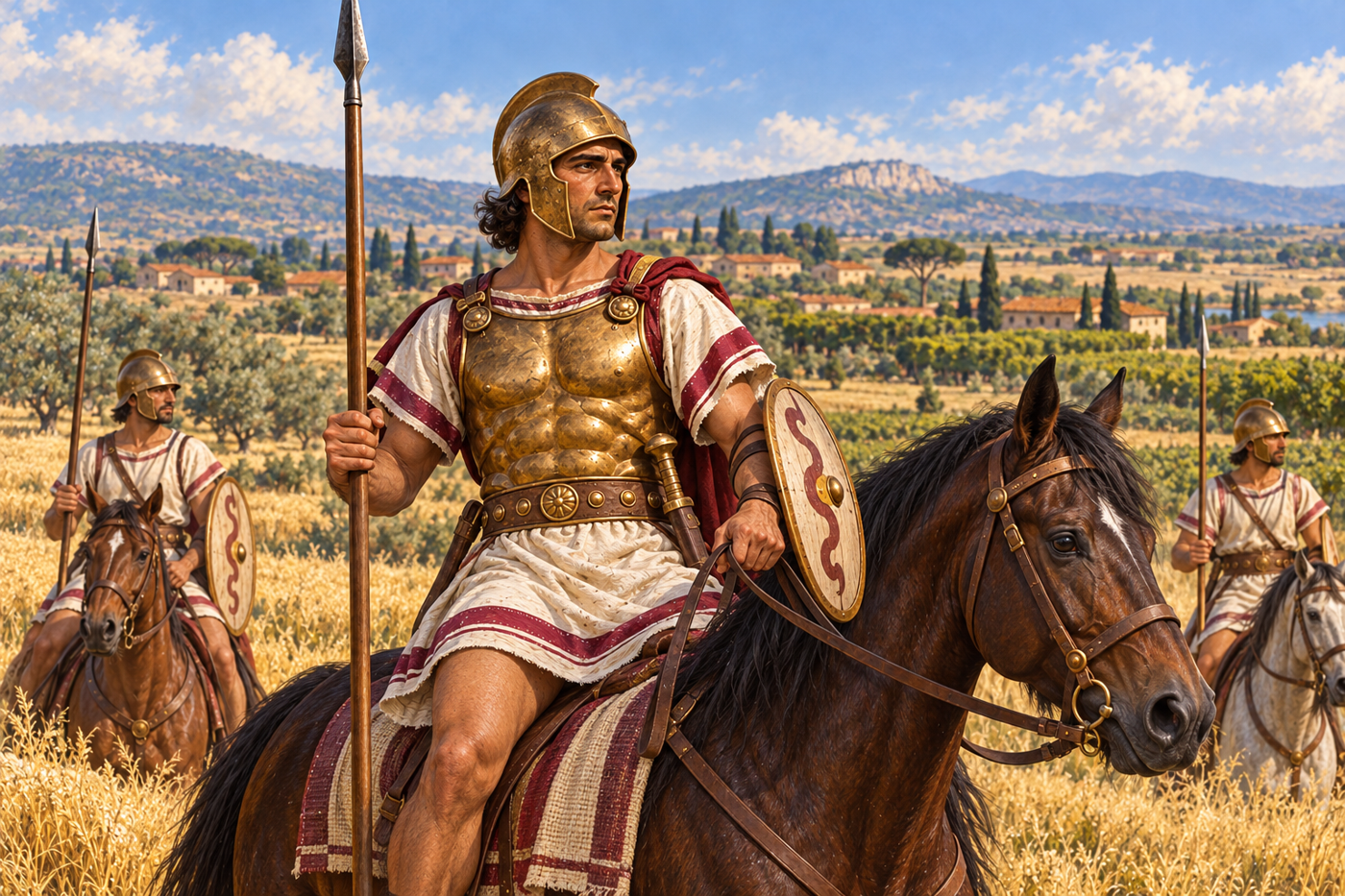
Mounted service was especially prominent in the social world of Campania. A horse required money, food, care and the ability to sustain losses. The rider's decorated clothing, belt, weapons and animal expressed a standing that could be recognised beyond the battlefield. Success in war could reinforce a family's authority at home and open opportunities for service elsewhere.
The horseman's importance did not make the infantry incidental. Towns and estates had to be defended; a line had to hold while mounted men manoeuvred; roads and camps needed protection. Fighting men of different means participated in the same military effort, even when the rewards and prestige were distributed unevenly.
Campanian soldiers also served beyond their homeland. The wars of Sicily offered employment and danger to men accustomed to selling their skill. Diodorus places Campanians among the troops attacking Selinus in 409 BC, long before Alexander's expedition. Foreign service could bring profit and experience, but it also placed soldiers inside the ambitions and quarrels of distant employers.
At home, the relationship between military distinction and public authority was close. Wealthy riders could seek recognition from the city, from an allied power or from both. Their interests did not always match those of their neighbours. The privileges of a successful military group could deepen divisions inside a community that otherwise shared enemies and obligations.
The appeal to Rome
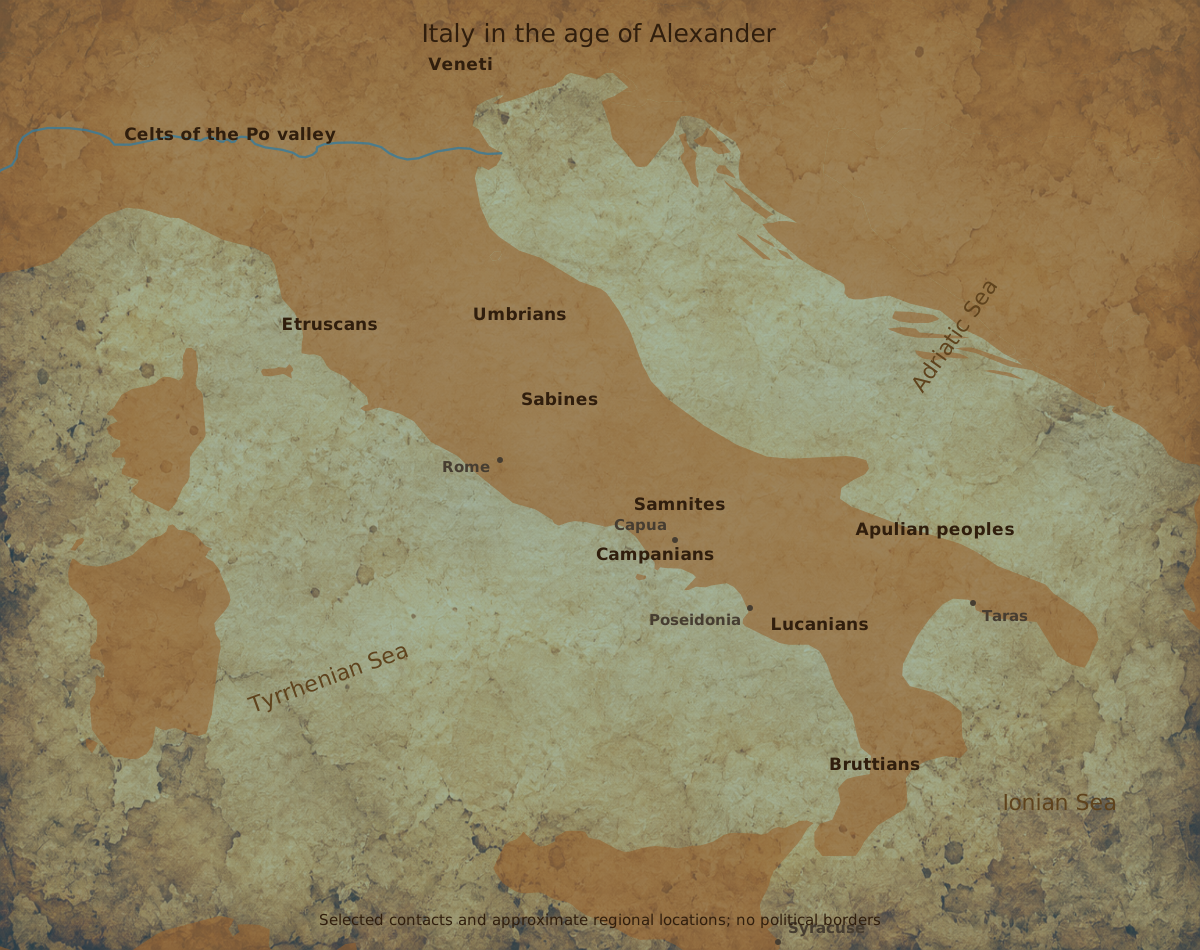
In the middle of the fourth century, Samnite pressure and conflict involving the Sidicines brought Campania into Rome's sphere of intervention. Roman tradition presents the Campanians' appeal as an act of desperate submission, followed by protection against the Samnites. The decision opened a new relationship whose consequences could not be limited to the campaign that had prompted it.
The plain remained a prize contested by local communities and external powers. Samnite leaders had interests to defend there; Roman commanders increasingly treated the security of their Campanian connections as a matter of their own authority. Assistance created obligations, and disagreement over those obligations could turn former partners into enemies.
During the Latin War of 340–338 BC, Campanian participation in the coalition against Rome revealed how little a single appeal for help could settle. The allies fighting together possessed intertwined histories and familiar military practices. Their conflict concerned power within that shared world: who would command, who would provide men and who could make decisions without another community's permission.
The Campanian cavalry did not follow the same course as all the infantry. Livy remembers horsemen who remained loyal to Rome and received rewards for doing so. The episode exposes the political importance of military groups inside the city. What looked like a common war from outside could divide families and orders within it.
Privilege and dependence
The settlement after Rome's victory bound Capua more closely to Roman power. Citizenship without the vote offered a position inside the Roman political order while withholding participation in the assemblies at Rome. Local life did not simply vanish. The difficult question was how far a community could continue to act for itself when its larger obligations were determined elsewhere.
Military service made that question concrete. Men could receive advantages through loyalty to Rome, while neighbours experienced the same relationship as restriction. A local aristocrat might look to Roman support to secure his position. An opponent might seek another alignment, hoping to preserve greater room for independent action.
Religious life remained rooted in the region's communities and sanctuaries. The sanctuary at Hamae, near Capua, belongs to the sacred geography through which Campanians met and expressed collective belonging. Elsewhere, the coexistence of local and Greek traditions gave worship the same variety visible in art and language. Cult provided bonds across communities without producing one authority over the whole plain.
In a prosperous country, civic rivalry could be exceptionally costly. Public office, landed wealth and the command of armed men were closely connected sources of influence. Intervention by an outside power might settle an immediate contest while ensuring that future rivals would also seek help beyond the city.
Naples and the inland struggle
In 327–326 BC, the crisis around Palaepolis and Neapolis helped bring Rome and Samnium into renewed war. Greek civic interests, neighbouring communities and the presence of armed forces combined to make a coastal dispute a matter for the whole region. The settlement with Neapolis created another enduring Roman relationship on the Campanian coast.
For Capua and its neighbours, these events narrowed the space in which local choices could be made without reference to the larger struggle. Rome could approach the region through roads, alliances and garrisons; the Samnites remained capable of threatening the countryside. A city needed to protect itself from both the losses of war and the demands of those promising to prevent them.
By 314 BC, tensions inside Capua again brought Roman intervention. Livy names Ovius and Novius Calavius among the figures implicated in the crisis. Their story is one of accusation, civic faction and external supervision. It shows the vulnerability of a wealthy city's politics when its powerful neighbours considered its loyalty essential to their own security.
Campania's armies belonged to this world of abundance and uncertainty. Their horsemen could be admired and sought after far from home; their cities possessed resources that kings and republics coveted. The people of the plain fought to decide how those advantages would be used, and whether prosperity would sustain independence or make its loss worth an outsider's effort.
Sources
- Livy, History of Rome VIII: Latin War, Campania and Alexander of Epirus.
- Livy, History of Rome IX: Caudium, Etruria, Umbria and the later Samnite campaigns.
- Metropolitan Museum of Art, Campanian hydria with returning mounted warrior, ca.350–320BC,01.8.12.
- Diodorus Siculus XIII.55: Campanians at Selinus.
- François Sabbathier, Dictionnaire, s.v.Campanie.
- Nicholas Sekunda and Simon Northwood, Early Roman Armies, Osprey Men-at-Arms283.