






Apennine Peoples
Across central Italy, mountain ridges separated communities without severing the routes between them. Sabine and Umbrian towns watched armies, traders and herds cross the same valleys. Their independence depended on deciding who might pass, who could be trusted and which obligations would endure when the next army arrived.
A country of connected valleys
The Apennines did not form an empty barrier between the coasts. Cultivated basins, river valleys, wooded slopes and upland pastures sustained communities with their own territories and centres of assembly. A town set above a route could look towards several different worlds: the Tiber valley, Etruria, the Adriatic approaches or the lands farther south.
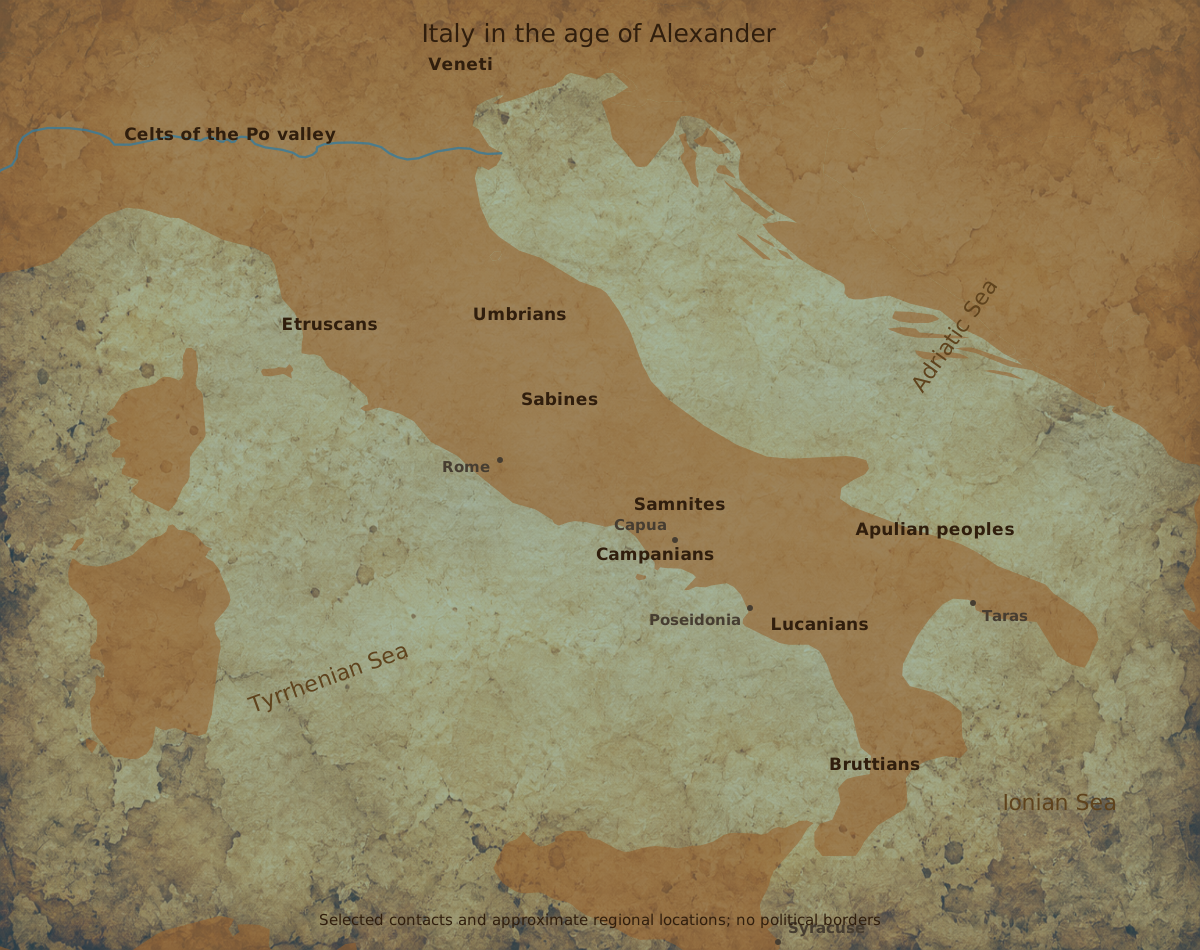
Sabine country lay close to Rome, reaching inland through landscapes that Roman writers would later praise for their livestock and agricultural produce. Umbrian communities occupied much of the central upland world beyond it. Their settlements faced different pressures according to position. The interests of a town near an Etruscan frontier could differ sharply from those of a community whose roads led towards the Adriatic.
There was no single Apennine people speaking with one voice. Sabines and Umbrians possessed distinct traditions and related but separate languages. Even within those broad names, local belonging remained powerful. The land around a settlement, its sanctuary, its leading families and the obligations of neighbouring communities gave political life its practical shape.
Geography made cooperation useful without making it inevitable. A pass protected from raiders might serve several communities; a dispute over land or movement could set those same neighbours against one another. The mountains offered defensible positions, but they also created routes that an enemy could close. Security required more than withdrawing to higher ground.
Wealth that could be carried away
The prosperity of this country was often vulnerable to war. Herds could move between grazing grounds, but they could also be driven off as booty. A field destroyed at the wrong moment could impose hunger long after the invaders had departed. Timber, animals, grain and access to crossings were resources that a campaigning army needed and an inland community could lose.
The movement of livestock connected the hills with lower country. It created relationships among owners, herders and the people whose territories were crossed. Exchange brought objects and habits from beyond the immediate valley. Bronze equipment, pottery and imported goods could signal a household's standing in a community whose resources were rooted in land and animals.
The leading families participated in those wider relationships. Hospitality, marriage and service could link a local notable to neighbours across a political boundary. Such connections offered ways to negotiate a crisis, but they also gave external powers access to local divisions. An alliance with a distant city could help a family against a nearby rival while drawing its community into a conflict it had not chosen.
The soldier's household therefore stood close to the stakes of campaigning. Men who gathered with spear and shield might be defending the fields that fed them, the animals that constituted their wealth or the route through which they sold their produce. The distinction between a political defeat and an economic disaster could be very small.
Sanctuaries and the community
Sacred places helped give this dispersed country coherence. Worship brought people into relationships that outlasted an individual campaign. Offerings, vows and collective rites expressed membership and obligation. The community appearing before its gods was also the community that claimed territory and called men to service.
Iguvium, in Umbrian country, preserves an exceptional later witness to that world. Its bronze ritual tablets, engraved between the third and first centuries BC, describe the activities of a priestly brotherhood and ceremonies concerned with the protection and purification of the community. They record a later stage of Umbrian religious life, but they reveal how closely sacred order could be bound to the identity of a town and its people.
The force of such rites lay in their precision. Words, actions, places and signs mattered. A community did not simply ask for success: it performed the relationships through which success was sought. Those duties gave religious specialists authority while involving the wider body of citizens in the security of their homeland.
For a fourth-century army, divine favour belonged to the same field of concern as provisions and allies. A decision to fight exposed the community to consequences that extended beyond the men in the ranks. Religion gave those risks a language and a set of obligations, without making every inland people part of one common priesthood.
Between stronger neighbours
Etruscan cities had long influenced central Italy, while Roman expansion increasingly reached beyond the lower Tiber. Celtic movements farther north added another force to a world already shaped by local rivalry. For the inland communities, the issue was seldom a simple choice between joining a national resistance and surrendering. Different towns faced different enemies and opportunities.
An agreement with Rome could protect a community against a nearer power. It could also impose expectations of supplies, passage or military support. Resistance might preserve freedom, but it required allies capable of remaining in the field. Neutrality was attractive until one side treated a road, a market or a river crossing as essential to its own security.
The campaigns of the late fourth century made these pressures visible. When Fabius took Roman forces beyond the Ciminian forest in 310 BC, Roman tradition connected his movement with contacts in Umbrian country. Livy tells of approaches to Camerinum and the search for support beyond the immediate battlefield. War was being fought through agreements as well as through the destruction of opposing armies.
In 308 BC, an Umbrian concentration near Mevania brought another answer: armed opposition to Rome's advance. Its defeat did not mean that every Umbrian town had acted together or received the same settlement. It showed how difficult it was for regional resistance to control the pace of events once Roman commanders could move between several theatres of war.
Taking arms for an inland town
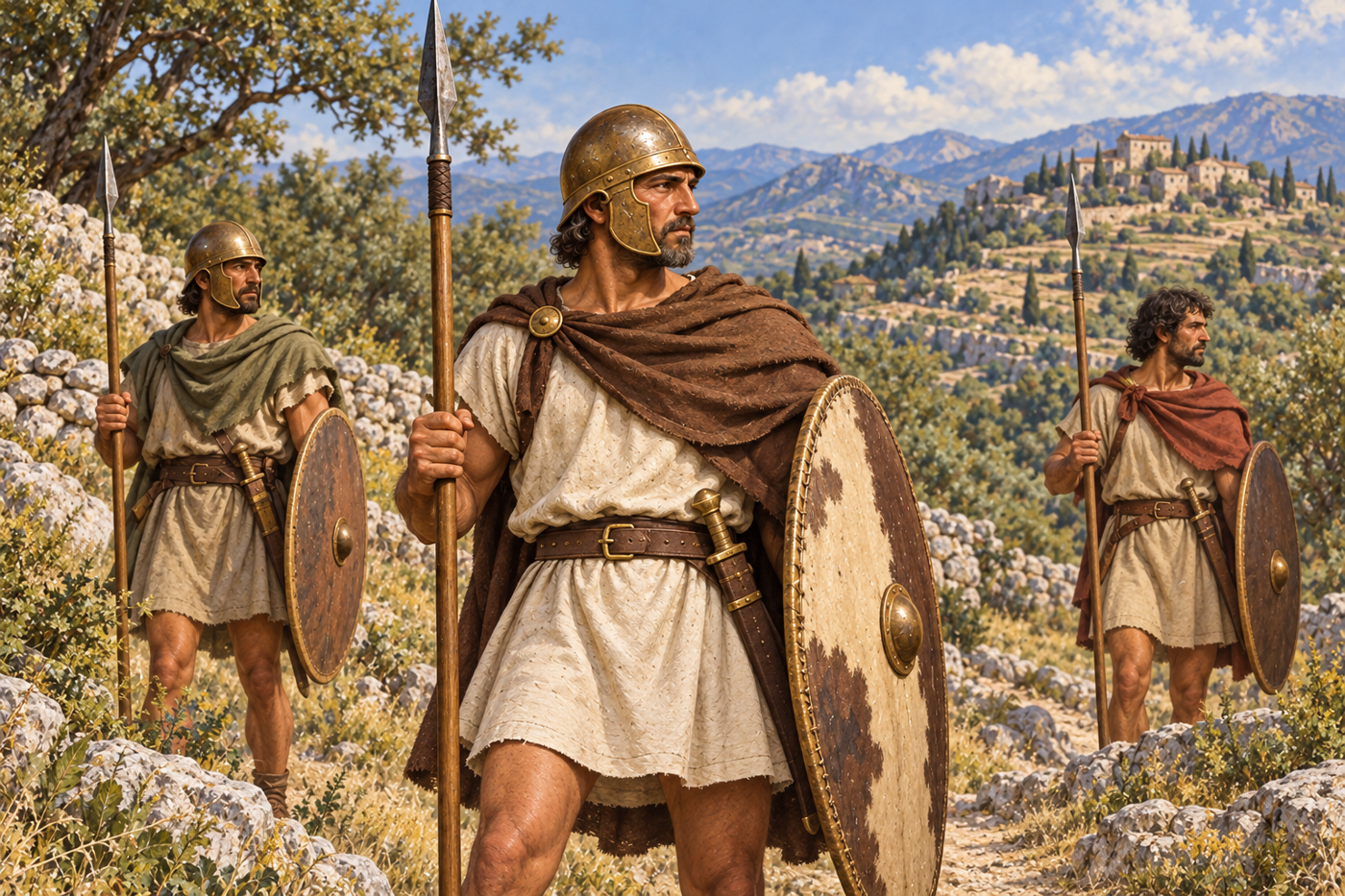
An army raised in these communities depended heavily on infantry. Men with spears and shields could defend an approach or form a body in more open ground, while lighter fighters moved ahead, watched a route or troubled an exposed enemy. The same country offered opportunities for both organised battle and smaller clashes over access and supplies.
Wealth affected equipment and the ability to maintain horses. Mounted men could carry messages, observe movements or support an attack, but the strength of a community could not be measured simply by the splendour of its richest rider. An army also needed men able to guard its camp and keep their place when the first uncertainty gave way to fighting.
Command rested on local authority and the ability to hold a force together. A leader had to judge how long the community could remain away from its work and how far its allies would follow. Success meant preserving the people and resources required for the next season as well as winning the present encounter.
The shrinking space for choice
After Alexander's death, the struggles of Italy continued to widen. The coalition defeated at Sentinum in 295 BC drew several peoples into another attempt to limit Roman power. In 290 BC, Roman conquest brought Sabine communities under a new political settlement. These were later stages of a process that had already changed the choices available to the fourth-century towns.
Yet the communities of the Apennines were never merely the ground across which other peoples marched. Their decisions helped determine routes, alliances and the resources available to a campaign. They could obstruct, assist, resist or bargain. Their power was local, but armies seeking mastery of Italy repeatedly discovered that local decisions could shape an entire war.
Their story belongs to the valleys between the famous battlefields: places where a council had to choose an ally, a household feared for its harvest and a sanctuary gathered a people who still expected to govern their own affairs.