






Samnites
In 321 BC, a Roman army entered the Caudine passes expecting to hurry towards an endangered ally. The roads behind and ahead were closed. On the heights stood the men of Gaius Pontius. For a moment, the struggle for Italy belonged to Samnium.
The land between the seas
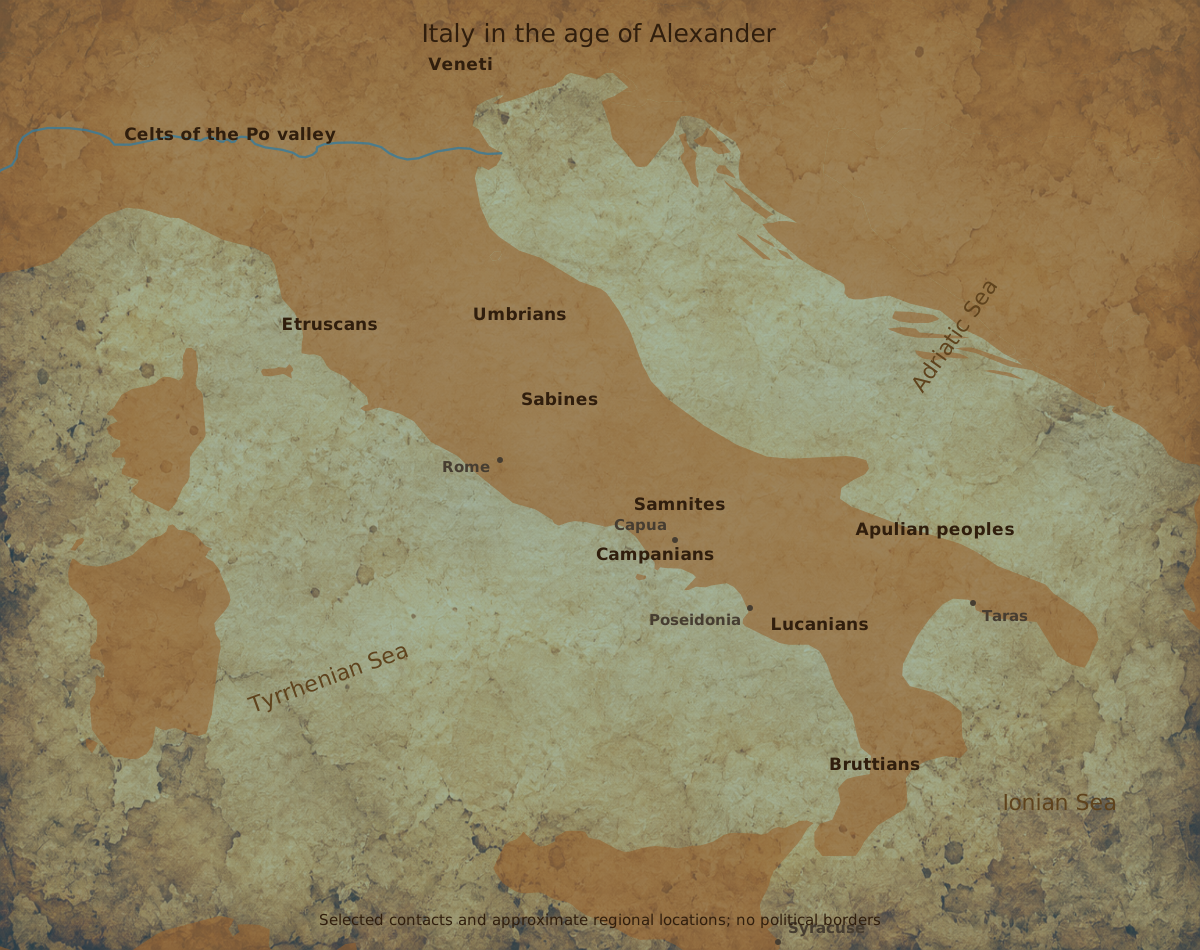
Samnium occupied the uplands of south-central Italy, where routes between the Tyrrhenian and Adriatic sides crossed mountain ridges and descended into fertile basins. Its country offered pasture, timber, farmland and strong positions above the approaches. The people who lived there were not cut off from the plains. Their livestock, trading connections and military ambitions carried them repeatedly towards Campania and Apulia.
The Pentri, Caudini, Hirpini and Caraceni belonged to the wider Samnite world. Communities were bound by related speech, customs, sanctuaries and political connections, but they did not form a monarchy ruled from a single capital. Local settlements and territories retained their importance. Authority had to bring fighting men together without dissolving the interests of the communities that supplied them.
The familiar contrast between rich plains and poor mountains only tells part of their story. Upland basins supported cultivation, while herds represented movable wealth. Control of routes gave a community access to exchange as well as a means of obstructing an enemy. A mountain pass was valuable because people used it: merchants, envoys, shepherds and soldiers all depended on the same connections.
Movement could also change identities. Traditions linked the Samnites and other central Italian peoples through migration and sacred departure. The story of a community sent out under divine guidance expressed a powerful idea: a new homeland could be won without abandoning the obligations that bound a people to its gods. Such traditions gave settlement and expansion a remembered religious purpose.
The lure of Campania
The fertile country around Capua offered wealth on a scale that attracted neighbours from every direction. Samnite involvement there brought them into a shifting contest among local cities, Sidicines, Latins and Romans. Agreements with Rome had existed before the wars that later defined their relationship. Neither side began with an uncontested claim to decide the affairs of the whole peninsula.
What made the relationship dangerous was the widening reach of protection. A town seeking help against one enemy might place itself under the authority of another. An ally's request could carry an army into territory that a rival considered part of its own sphere. Each intervention altered the balance for the next dispute. Local quarrels acquired consequences far beyond the fields in which they began.
The Latin War of 340–338 BC illustrates how unstable these alignments could be. Rome and the Samnites cooperated against a coalition that included Latins and Campanians. Once the fighting ended, Rome's settlement strengthened its hold over central Italy. Former allies did not receive identical terms; obligations and privileges were distributed community by community. The power facing Samnium had become harder to isolate.
During Alexander's campaigns in Asia, another Alexander was fighting in southern Italy. The king of Epirus threatened Lucanian and Bruttian interests after crossing at the invitation of Tarentum. His expedition belonged to the same crowded political landscape in which Samnite leaders made their decisions. Italy contained many armed powers, and no single war explains all their choices.
Men, weapons and the bond of service
Samnite warriors drew their strength from the communities that raised them. Family reputation, the authority of leaders and obligations among neighbouring settlements helped turn local manpower into a campaigning force. The soldier who left his home did not enter a world separate from society. He carried its expectations with him: honour, loyalty, the hope of success and the fear that defeat would expose those who remained behind.
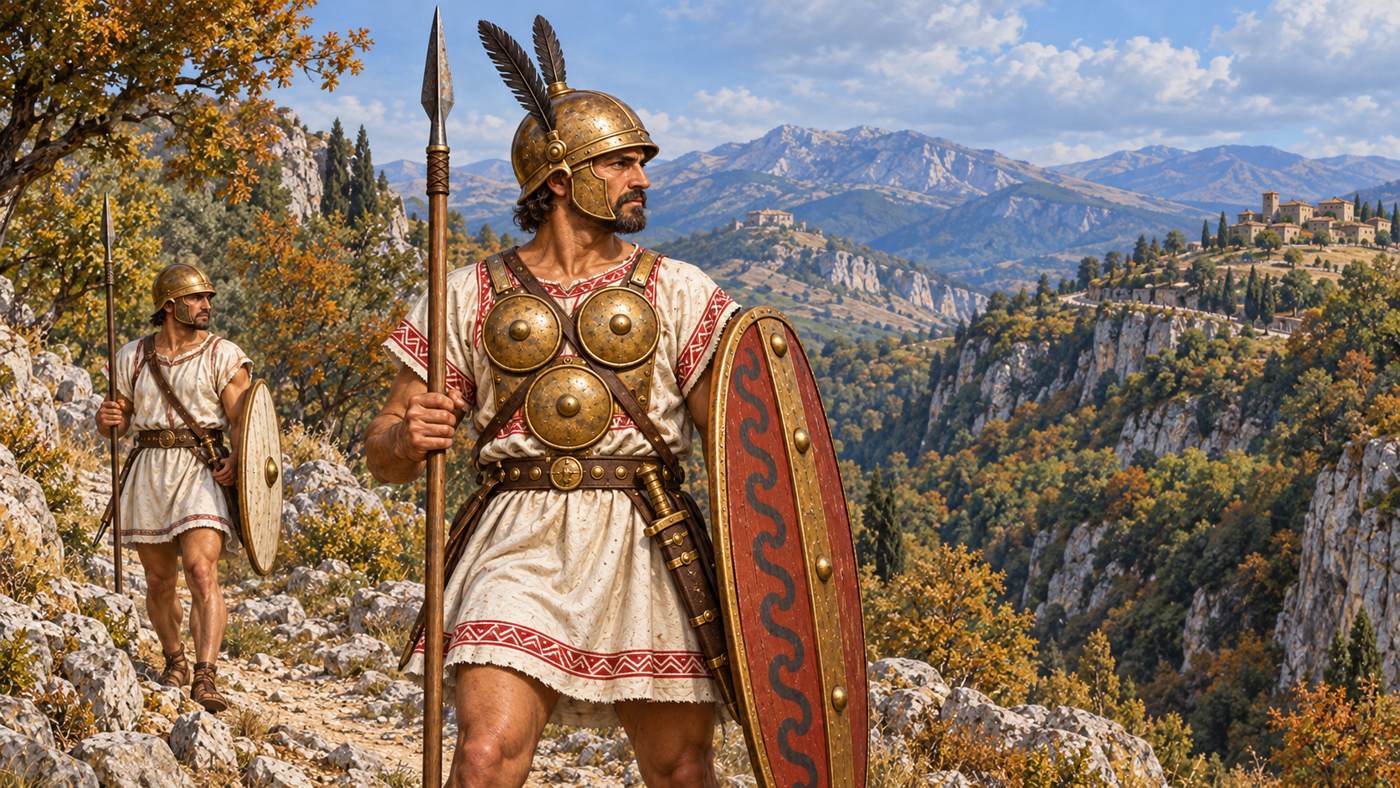
Spears, javelins and swords served alongside shields of different forms. Bronze helmets, broad belts and body protection could display prosperity as well as protect their wearer. Richly furnished graves and the military imagery of southern Italy reveal the prestige attached to an armed man's equipment. The splendour of a leading warrior did not mean that every soldier could be supplied in the same way.
In battle, the varied ground of Samnium demanded judgement. A force might defend a confined approach, attack an exposed column or deploy in more open country beyond the mountains. The Samnites did not defeat their enemies merely by knowing secret paths. They had to assemble armies, maintain alliances and judge when to offer battle. Success required command as much as terrain.
Religion strengthened the seriousness of these undertakings. Vows and sacred obligations made victory more than a matter of private gain. To abandon comrades could threaten the bonds that held an army together. Later Roman accounts give especially dramatic form to Samnite military oaths; beneath the literary hostility remains a society in which collective action could be placed under divine sanction.
The victory at Caudium
The Second Samnite War began in 326 BC, as the struggle over influence in Campania renewed direct conflict. Five years later, Pontius used the route towards Apulia to draw the Roman consuls into a position from which they could not force an escape. In Livy's narrative, false reports of danger to Luceria encouraged haste. The shorter road through the Caudine country promised an answer to an urgent political need.
It delivered the Romans into a trap. Blocked exits and armed men on the surrounding heights made numbers and courage insufficient. To march forward was impossible; to return required overcoming the same obstruction. The importance of the victory lay in that loss of choice. Pontius had brought the enemy to terms without needing to destroy its army in an open battle.
Roman memory dwelt on the surrender and the passage beneath the yoke. Weapons, status and the confidence of victorious soldiers gave way to public humiliation. The episode was remembered as an injury to the whole community. For the Samnites, however, the achievement was political as well as military: they had compelled Rome's commanders to recognise the limits of Roman power.
The settlement did not secure lasting peace. Arguments over the authority of those who had agreed to it allowed Rome to dispute its obligations. Livy gives the story a conflict between personal undertakings and the responsibility of the state. Whatever the precise course of the negotiations, the wider result was clear: even a spectacular Samnite success could not settle the struggle while the rival networks of power remained intact.
A war larger than one victory
The later campaigns ranged across Samnium, Campania and Apulia. Towns, roads and allied communities mattered because they sustained armies and narrowed an enemy's choices. Roman colonies and settlements could hold positions after a field army departed. Samnite forces sought to undo those gains, protect their own country and prevent Rome from deciding the allegiance of the surrounding plains.
In 305 BC, Livy names Statius Gellius among the Samnite commanders, reporting his capture in the fighting connected with Bovianum. The war ended in 304, but the peace did not make Samnium disappear. Within a few years, a new conflict would draw the Samnites into the great coalition that faced Rome at Sentinum in 295 BC.
Those later events should not turn the fourth century into a preface to defeat. Pontius and his contemporaries fought when the balance was still contested. They could outmanoeuvre Roman armies, summon substantial forces and make their neighbours consider alternatives to Roman protection. Their difficulty was to turn repeated resistance into a settlement that Rome could neither evade nor overturn.
Samnium's armies defended more than a stretch of rough country. They fought for access to the plains, the freedom of allied communities and the authority to arrange their own relations with the rest of Italy. At Caudium, they showed how vulnerable an expanding power could be. The wars that followed reveal how much determination was required to keep that power from returning.
Sources
- Livy, History of Rome VIII: Latin War, Campania and Alexander of Epirus.
- Livy, History of Rome IX: Caudium, Etruria, Umbria and the later Samnite campaigns.
- François Sabbathier, Dictionnaire pour l’intelligence des auteurs classiques, s.v.Samnites.
- Nicholas Sekunda and Simon Northwood, Early Roman Armies, Osprey Men-at-Arms283.