






Etruscans
In the age of Alexander, the cities of Etruria still possessed the wealth, the sanctuaries and the fierce civic loyalties of an old Mediterranean power. Their struggle was to preserve a world in which no neighbour could dictate the future of every city.
The country of the cities
The approaches to an Etruscan city passed through a working countryside. Fields and vineyards occupied the better land; farmsteads and estates sustained the families within the walls. Roads connected river crossings, inland markets and the ports of the Tyrrhenian shore. Behind the coast rose a landscape of volcanic plateaux, wooded heights and cultivated valleys. The tombs cut into the rock outside the towns belonged to this same society: the dead received houses of their own beside the roads used by the living.
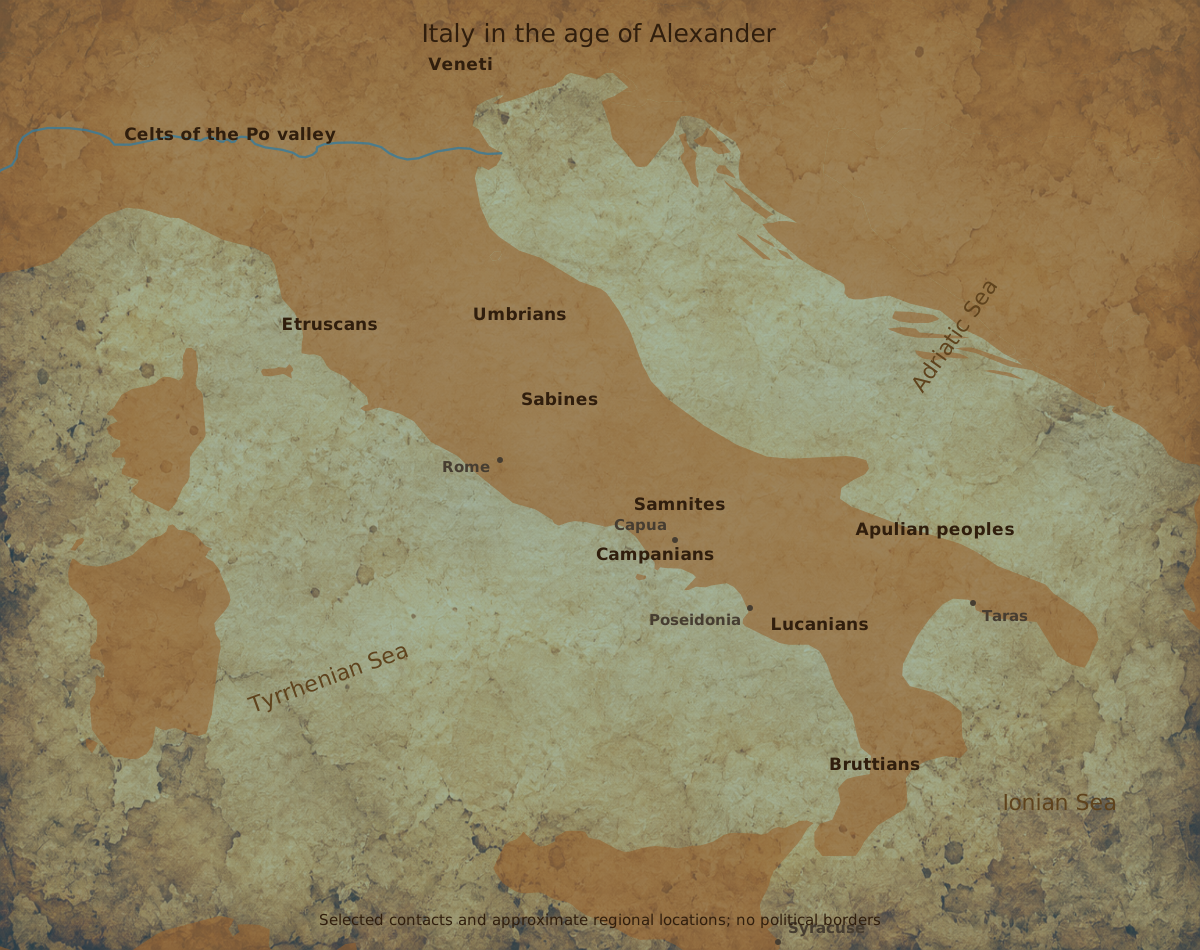
Tarquinii, Vulci, Caere, Volsinii, Clusium and Perusia each commanded a different part of that country. Their inhabitants shared a language, religious traditions and a long history of artistic exchange, but their political loyalties were rooted in particular communities. A decision made at Tarquinii was not automatically an order to Vulci. A war that threatened one city's fields might offer another an opportunity to negotiate, remain neutral or settle an older quarrel.
This independence had helped Etruscan cities accumulate wealth and influence. It also made collective defence difficult. Aristocratic houses measured their authority through land, ancestry, public office and relationships reaching beyond their home city. The interests of a powerful family could connect communities across a frontier; another rivalry could divide neighbours who prayed to the same gods. Etruria was capable of concerted action, but unity had to be made anew whenever danger required it.
An old power under pressure
The fourth century had already overturned much that earlier generations might have taken for granted. Rome captured Veii in 396 BC, bringing a major Etruscan city and its territory under Roman control. Farther north, Celtic expansion transformed the balance of power beyond the Apennines. Etruscan communities could no longer assume that their prosperity would be protected by the strength of an older order.
Yet defeat at Veii did not make the remaining cities passive spectators. Tarquinii fought Rome fiercely during the middle decades of the century. Roman tradition remembered the conflict through scenes of sacrifice, execution and retaliation, giving the war the character of an ordeal in which victory and divine favour were inseparable. Behind those memories lay a brutal contest over land, captives and the ability to intimidate an enemy into accepting terms.
Treaties and truces interrupted these struggles without ending the competition. A city could purchase time, protect a harvest or recover from losses while its neighbours chose a different course. For an Etruscan magistrate, the problem was immediate: how much could be risked in defence of the fields and settlements that sustained the community? To fight might bring ruin. To submit might surrender the freedom that made the city a power in its own right.
While Alexander crossed into Asia in 334 BC, those questions mattered more in Etruria than the distant prospect of Macedonian conquest. The wars of Italy had their own momentum. Rome's growing strength, the movements of northern peoples and the ambitions of neighbouring cities formed a political world whose future remained unsettled.
The living and their ancestors
At Vulci, the late-fourth-century paintings of the François Tomb offer a particularly forceful expression of aristocratic identity. Greek heroic stories share the walls with violent episodes from Etruscan tradition. The past is populated by warriors, rival leaders and acts of deliverance. It gives the family a place in a world where honour must be defended and remembered.
Vel Saties, the tomb's patron, appears in an elaborate mantle beside the small attendant Arnza and a bird. His image joins ceremonial distinction to the authority of a great household. Nearby scenes recall figures such as the Vibenna brothers and Macstarna, binding the family monument to a wider memory of conflict among the cities of central Italy. Greek myth was not simply copied for decoration: it helped express the stature and expectations of the people who commissioned these paintings.
Such monuments were statements addressed to a community as well as provisions for the dead. Banquets, fine clothing, precious objects and armed companions proclaimed the resources of a house. Their splendour rested on the labour of a countryside and on relationships of service and dependence. The social distance between a richly equipped noble and the men who fought beside him could be considerable, even when both defended the same walls.
Religion gave this hierarchy a further dimension. The gods communicated through signs that required skilled interpretation. Divination, sacrifice and the proper ordering of sacred space were matters of public consequence. A magistrate seeking victory needed more than sufficient men: the enterprise had to be undertaken in a relationship with the divine that the community could recognise as legitimate. Religious expertise could therefore stand close to political power without being identical to military command.
Taking the field
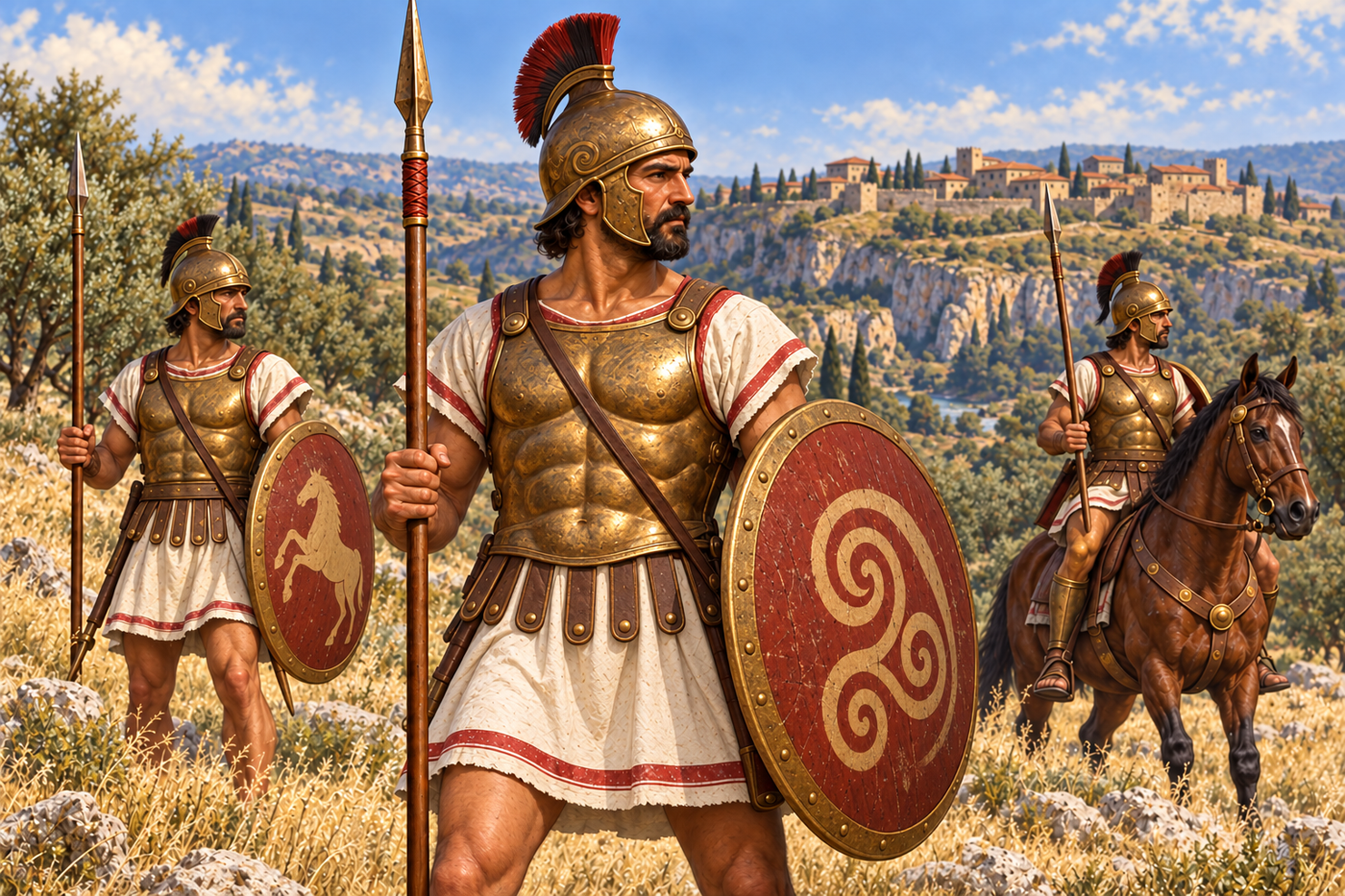
An Etruscan army gathered the strength of its city and territory. Citizens and dependants entered service with equipment shaped by means, local practice and the demands of the campaign. Spears and shields formed the foundation of infantry fighting. Bronze helmets and expensive body armour distinguished those able to afford them; simpler protection served men whose importance lay in holding their place beside their neighbours.
Connections with the Greek world had long influenced arms, art and aristocratic display. Those connections did not erase local habits. Workshops and wealthy patrons selected and adapted what suited them. A costly cuirass, an imported vessel and a scene from Greek epic might belong to the same household, while its members continued to speak Etruscan and hold office in an Etruscan city.
Horsemen gave leading families mobility and visibility. Lighter infantry protected approaches, screened the main body and fought where a closely ordered line could not move easily. Campaigning also meant guarding a crossing, bringing provisions into a threatened town or ravaging the estates on which an opponent depended. A battle in open country was only one way to compel a city to negotiate.
For a coalition, even assembling the army required political work. Each contributing community had interests to protect and losses it could not easily replace. The failure of an ally to arrive, or its decision to seek a separate truce, could change a campaign before the opposing lines met. The independence that gave Etruscan cities their identity remained present inside their armies.
Beyond the Ciminian forest
The renewed wars of 311–308 BC brought Roman forces deeper into the Etruscan interior. Livy's account makes the Ciminian forest a threatening barrier, beyond which an army entered unfamiliar country. The passage of Fabius and his men through that landscape became a story of Roman daring. From the other side, it meant that the distance once separating inland communities from Roman attack could no longer be trusted.
The fighting brought defeats, negotiations and separate settlements rather than the sudden disappearance of Etruria. Cities survived; families adapted; sanctuaries remained active. Some communities would resist again, while others sought security through accommodation. The later conquest of Italy was built through these repeated decisions, not completed by a single inevitable victory.
At the end of the fourth century, an Etruscan host still fought for a living political world: the land around its city, the authority of its magistrates, the graves of its ancestors and the right to decide which obligations it would accept. Its commanders carried the prestige of an ancient civilisation into a struggle whose outcome they could not know.
Sources
- Livy, History of Rome IX: Caudium, Etruria, Umbria and the later Samnite campaigns.
- Museo Nazionale Etrusco di Villa Giulia, The François Tomb.
- Livy, History of Rome V: the capture of Veii.
- Nicholas Sekunda and Simon Northwood, Early Roman Armies, Osprey Men-at-Arms283.