






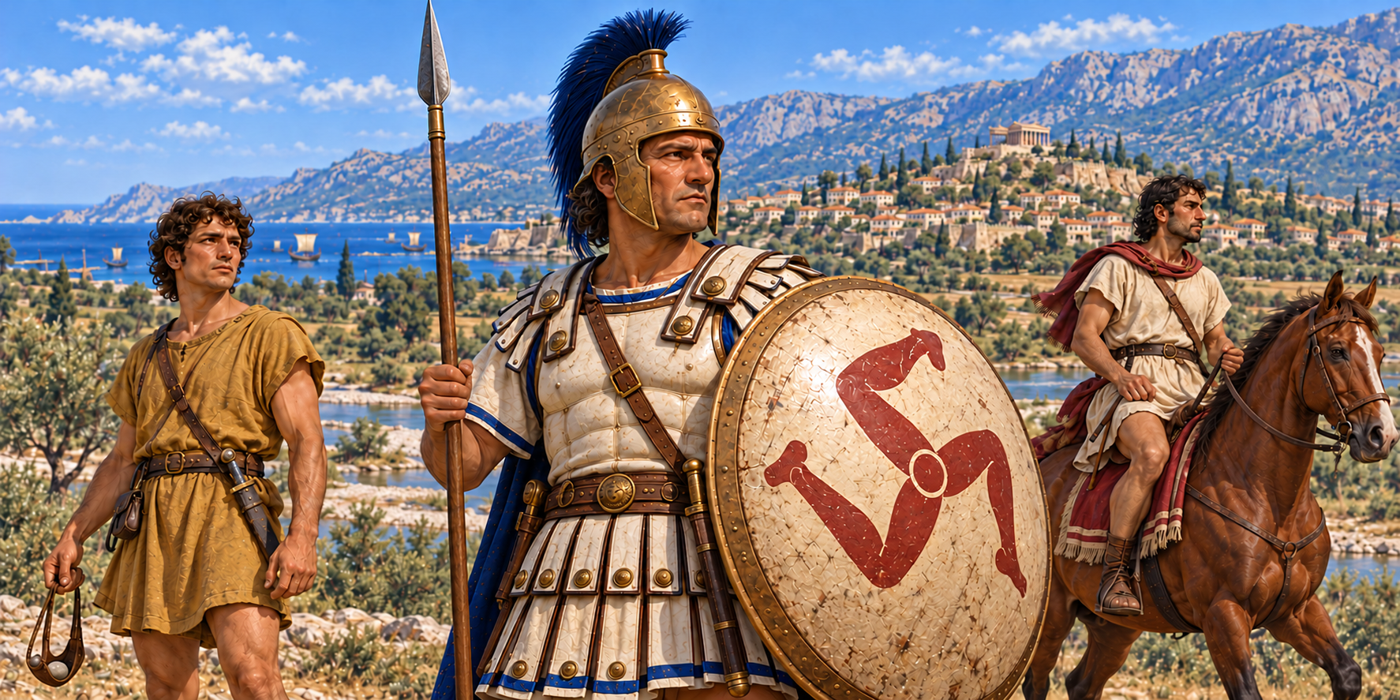
Pamphylians
The cities beneath the Taurus, in the age of Alexander
When Alexander demanded the horses of Aspendos, he was asking for more than animals. Those horses had been raised for the Persian king. To surrender them was to acknowledge that another man could now claim the resources of the city. The Aspendians first agreed, then closed their gates. Alexander turned his army back towards them.
That confrontation belongs to a much longer history. Pamphylia had its own languages, sacred places and memories of heroes. Its cities had watched Persian fleets and Athenian squadrons enter their waters, paid powerful strangers, resisted others and competed fiercely with their neighbours. To Alexander it was a coast to secure. To the people living beneath the Taurus, it was the centre of the world they needed to preserve.
Origins: the country of the wandering seers
The old stories began with the fall of Troy. Calchas, the seer who had interpreted the gods' will for the Greeks, and Amphilochus led wandering survivors towards the southern shores of Anatolia. Other traditions followed Mopsus across the Taurus, carrying his authority into Pamphylia and beyond, towards Cilicia and Syria. The name Pamphylia itself invited the Greek explanation of a land of many peoples. Its beginnings belonged to the great dispersal of heroes after the Trojan War.
These founders gave the cities an ancestry worthy of the Greek world. A community linked to Argos or to the companions of a famous seer possessed a story it could tell to visitors, allies and sacred assemblies. Aspendos cultivated its Argive connection especially strongly. A decree from Argos, preserved at Nemea and belonging to the decades around the end of the fourth century, recognised the relationship and extended civic privileges to Aspendians. Legendary kinship could become a practical bond between communities separated by the sea.
The inhabitants also preserved identities that no simple account of Greek colonisation can contain. Pamphylian was a distinctive variety of Greek, shaped in contact with Anatolian languages and written in a local alphabet. At Side, another language, Sidetic, appeared on coins and inscriptions. The region's cities could belong to Greek networks without becoming interchangeable with Athens, Rhodes or one another. Their local names and habits endured alongside the language of Greek diplomacy.
Territory: a fertile plain between the mountains and the sea
Pamphylia occupied the coastal plain south of the Taurus, between Lycia and Cilicia. Rivers descending from the mountains watered the land and opened routes towards the coast. Behind the plain rose Pisidia, where roads narrowed into difficult passages and a well-placed stronghold could threaten the movement of a much larger army. The sea offered another route out into the Mediterranean, but an army following the shore could find its progress checked by cliffs and weather.
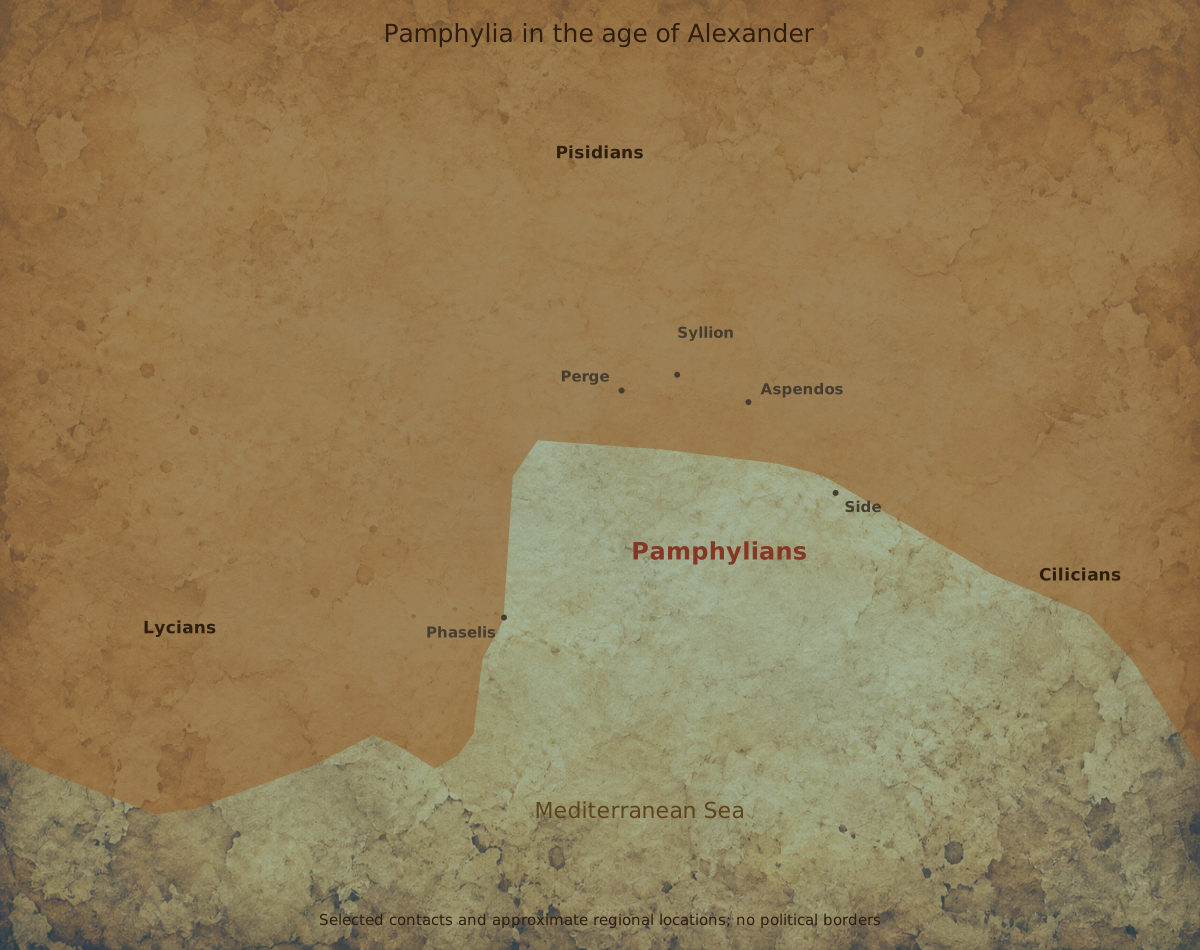
Perge stood inland beside the route of the Cestrus. Aspendos commanded a height near the Eurymedon, with its surrounding settlement spread below. Syllion occupied an imposing elevated position, well suited to defence. Side faced the sea from a peninsula. These settings gave the cities different strengths: access to river traffic, defensible heights, agricultural territories or maritime connections.
They also explain why control of Pamphylia mattered to outsiders. Ships needed places to land, armies needed provisions and rulers wanted dependable routes through the country. For local communities, fields beyond the walls were both the source of prosperity and a dangerous exposure. A fleet could approach with demands for money; soldiers who had already been paid could still take what they wanted from the countryside.
Society: cities with interests of their own
Pamphylia was a country of cities, not a single kingdom speaking with one voice. Their territories, sanctuaries and civic loyalties mattered. A foreign ruler had to deal with particular communities, while those communities judged what a new alliance would mean for their land, their neighbours and their freedom of action. The charge that Aspendos had seized neighbouring territory, raised during Alexander's intervention, reveals ambitions that reached beyond merely surviving an invasion.
The region's silver coinage provides an unusually direct encounter with that civic world. Aspendian staters show two wrestlers on one face and a slinger on the other, accompanied by the three-legged triskeles. The inscriptions preserve the city's local form of its name. These were recognisable statements of identity carried on money that circulated beyond the town itself. Athletic imagery, local speech and exchange belonged together.
Aspendos struck its coins on a weight standard used within the Persian world. Its civic imagery did not disappear under imperial rule. This combination is essential to understanding Pamphylia: participation in an empire could coexist with a city's own public identity. Coins paid soldiers and passed through commercial exchanges, but they also told their users whose silver they held. The slinger, still instantly recognisable today, became a particularly enduring face of Aspendos.
Beliefs: the gods who belonged to a city
Religion helped make a place a community. At Perge, Artemis was the great local goddess, known as Artemis Pergaia. Her sanctuary was already recognised in the coastal tradition represented by the Periplus attributed to Scylax. Strabo later describes its elevated setting near the city and the annual festival celebrated there. The goddess's name carried the name of Perge beyond its territory.
At Side, Athena also had a sanctuary in Strabo's account. The cities shared divine names familiar across the Greek world while maintaining local forms of worship and attachment. To invoke a city's goddess was to invoke the place itself: its sacred inheritance and its claim to endure. The tales of Calchas and Mopsus gave prophecy a place in the remembered beginnings of the region. Men renowned for reading the gods' intentions stood at the opening of its history.
Alexander's own passage would acquire a similar atmosphere. The favourable wind that exposed a route beside the sea could be remembered as a sign of divine assistance. Such a story turned a difficult march into evidence that the conqueror enjoyed more than human favour. The campaign was fought over roads and cities, but its meaning was also contested through the language of gods and destiny.
Warriors and command: defending the city and serving the king
Pamphylians had already served in a great imperial expedition long before Alexander appeared. Herodotus places thirty Pamphylian ships in Xerxes' fleet in 480 BC and describes their fighting equipment as Greek. They belonged to the maritime forces assembled for an invasion of Greece: men from this southern Anatolian coast taking part in a war far from their own towns. Pamphylia's military history cannot be confined to land fighting in its plain.
In the fourth century, the strength of a city could include local defenders and hired soldiers. At Syllion, Alexander encountered a strong position held by both local people and Greek mercenaries. The combination was formidable enough to defeat an immediate attempt to take it. Hiring experienced foreigners did not erase the role of the inhabitants; both were present behind the same defences.
Mounted strength had a material foundation in the horses raised at Aspendos for Darius. Breeding and delivering valuable animals tied the countryside to the demands of royal power. The image of the slinger on the city's money supplies a different military presence: a lightly equipped fighter whose weapon needed neither a horse nor an expensive cuirass. Between civic defence, naval service, horses and hired infantry, Pamphylia offered a conqueror several kinds of resource.
Command operated on more than one level. A city's leading men negotiated its surrender and could be demanded as hostages. A mercenary garrison had its own military function. Above these stood the authority of the imperial ruler and his appointed governor. Decisions made in an embassy or before a closed gate could determine the terms under which soldiers would subsequently fight.
Before Alexander: Cimon's victory and Thrasybulus' death
Under Darius I, Pamphylians appeared in Herodotus' account of a western tribute district alongside Ionians, Carians, Lycians and other peoples. The four hundred talents assigned to that district were a collective payment, not a levy on Pamphylia alone. Imperial authority joined distant communities through obligations of silver and service. Local identity survived, but the Great King expected resources from the coast.
In the 460s BC, the Athenian commander Cimon carried the struggle with Persia to the Eurymedon. He sought battle before the enemy fleet could receive further reinforcements. In Plutarch's narrative, the naval victory was followed by a landing and a second hard fight against the Persian army. The same men who had fought aboard ship went ashore to fight again. Cimon's success made the river mouth a celebrated place in the history of Athenian arms.
For Pamphylian cities, the retreat of Persian power opened the way to Athenian demands. Aspendos, Perge and Syllion appear in the Athenian tribute assessment of 425 BC. The coast lay within the ambitions of successive imperial powers. A victory proclaimed as liberation elsewhere could still leave a local city facing another collector and another obligation.
The danger of that relationship became brutally clear in 389 BC. Thrasybulus, the Athenian general remembered for restoring democracy at home, brought his fleet into the Eurymedon while collecting funds for his forces. Aspendos paid him. His soldiers nevertheless pillaged its countryside. The payment had failed to buy protection from the very men who had demanded it.
The Aspendians attacked at night and killed Thrasybulus in his tent. Xenophon makes the soldiers' wrongdoing and the inhabitants' anger central to the episode. A commander of great reputation died in a local retaliation, far from the public achievements that had made his name. The story reveals a city prepared to act when an armed visitor crossed the line between an imposed payment and intolerable injury. It also exposes how quickly a general's authority could be undone by the conduct of his own troops.
Alexander: friendship, resistance and the price of a second decision
Alexander approached during the winter of 334/333 BC. Rather than seek a decisive naval battle, he was taking the coastal places on which the Persian fleet depended. Parmenion and the heavier baggage had been sent by another route. The king pressed through Lycia towards Pamphylia, accepting submissions and dealing with resistance as he encountered it.
At Phaselis, near the western approaches, an embassy offered friendship and a golden crown. Alexander in turn helped the inhabitants capture a neighbouring fort from which Pisidians had been attacking their farmers. His arrival could therefore be useful to a coastal city as well as threatening. Plutarch preserves another scene from his stay: after drinking, Alexander and his companions crowned the statue of the local writer Theodectes with garlands. A king who honoured Greek culture was briefly visible alongside the leader of an invading army.
The passage east from Phaselis was precarious. Part of the army took a mountain route to Perge, improved by Thracian troops. Alexander followed the shore, where the wind could determine whether a passage existed at all. A north wind made the march possible. The event grew into a story of the sea yielding before him; Plutarch also preserves the simpler version attributed to the king's letters, in which Alexander merely described taking the route called the Ladder.
Aspendian envoys met him after Perge. They offered submission but asked to be spared a garrison. Alexander initially accepted that request, requiring fifty talents for his army and the horses previously destined for Darius. He then continued to Side, where he left a garrison, and towards Syllion. There the strong defences and their mixed garrison resisted his immediate attack.
News now arrived that Aspendos had refused the agreed deliveries. Possessions had been brought in from the countryside, the gates closed and the walls repaired. Alexander returned. The people abandoned the less defensible lower settlement and withdrew onto the height, leaving houses in which his troops could quarter themselves. Their envoys sought the original agreement.
They did not get it. Alexander wanted to avoid a prolonged siege, but he demanded influential hostages, the horses, one hundred talents instead of fifty, obedience to his appointed governor and annual tribute. He also ordered an inquiry into the neighbouring land Aspendos was accused of holding by force. The city survived the confrontation, but its second decision had cost it more money and a tighter submission.
This was conquest through pressure and negotiation as well as assault. A city could resist behind a strong position, yet its leaders still had to judge how long resistance was worth its price. Alexander then returned through Perge and turned towards the difficult country of Pisidia. The coastal campaign had changed who could demand obedience without making every fortress easy to take.
People and legacy: a province within an unfinished empire
The settlement of the coast also belonged to the personal history of Alexander's companions. Nearchus, son of Androtimus, had shared the prince's political fortunes before the expedition. Exiled while Philip was still alive, he returned after Alexander's accession and received authority over Lycia and the neighbouring country towards the Taurus. The man later famous for commanding the voyage from India first appears here in the work of holding conquered territory for his king.
For the cities, Alexander's departure did not end politics. In the decades following his death in 323 BC, the lands he had conquered became the stakes of rival successors. Civic ancestry and overseas connections continued to matter, as the Argive decree for Aspendos demonstrates. The city's relationship with Argos gave formal expression to a kinship reaching back into its foundation stories.
The region also retained its rivalries. In a later campaign, in 218 BC, Polybius describes Aspendos sending four thousand men to assist Garsyeris, the commander acting for Achaeus, against the growing power of Selge. Side withheld help, influenced both by its alignment with Antiochus and its hostility towards Aspendos. More than a century after Alexander, neighbouring cities still made different choices when an outside commander asked them to join a war.
The Pamphylians of Alexander's age belonged to that durable civic world. Their history contains victorious outsiders, a murdered general, disputed fields, sacred ancestors and negotiations conducted beneath the threat of siege. The region was small beside the empires contending for it. Its inhabitants nevertheless had their own reasons to fight, to bargain and, sometimes, to refuse what they had already promised.
Sources
Ancient accounts
- Herodotus, Histories 3.90 and 7.91: tribute district, naval contingent, equipment and Trojan foundation tradition.
- Strabo, Geography 14.4.1–3: cities, rivers, sanctuaries and traditions of Calchas and Mopsus.
- Plutarch, Cimon 12–13: the Eurymedon campaign.
- Xenophon, Hellenica 4.8.30–31: the death of Thrasybulus at Aspendos.
- Arrian, Anabasis 1.24, 1.26, 1.27 and 3.6.4–6: coastal strategy, Phaselis, the march, negotiations and Nearchus.
- Plutarch, Alexander 17: Theodectes and the traditions surrounding the coastal passage.
- Polybius, Histories 5.72–73: the later campaign of Garsyeris and the contrasting decisions of Aspendos and Side.
Archaeology, inscriptions and modern scholarship
- R. S. Stroud, “An Argive Decree from Nemea Concerning Aspendos”, Hesperia 53 (1984), pp. 193–216: civic kinship, privileges and the dating of the decree.
- Stephen Mitchell, “Pamphylia”, Oxford Classical Dictionary: regional and political overview; accessible entry consulted.
- A Lexicon of Greek Personal Names, vol. VB, introduction, pp. xiv–xvi: geography, languages, civic identities and the region's changing limits.
- M. H. Hansen and T. H. Nielsen (eds.), An Inventory of Archaic and Classical Poleis (2004), Perge entry: the early literary testimony for Artemis. Relevant indexed passage consulted.
- Aspendos excavation project, Afyon Kocatepe University, historical overview; Sillyon project, Pamukkale University, ancient testimonia and research history.
- Fitzwilliam Museum, CM.MC.8888-R; Lawrence University, stater 37; Hallie Ford Museum, 2006.010.001: fourth-century Aspendian coinage.