






Celts
The men who feared the falling sky
After Alexander's Danube campaign in 335 BC, Celtic envoys came to seek his friendship. Arrian describes men from the country towards the Adriatic, confident in their bearing and impressed by the king's achievements. When Alexander asked what frightened them most, he expected an answer that would honour his power.
The reply was that they feared the sky might fall upon them. The story gave the encounter a life far beyond the agreement itself. Alexander could recognise them as friends without receiving the confession of fear he had hoped to hear. These visitors belonged to a wider world that his victories had not made obedient.
Communities across a continent
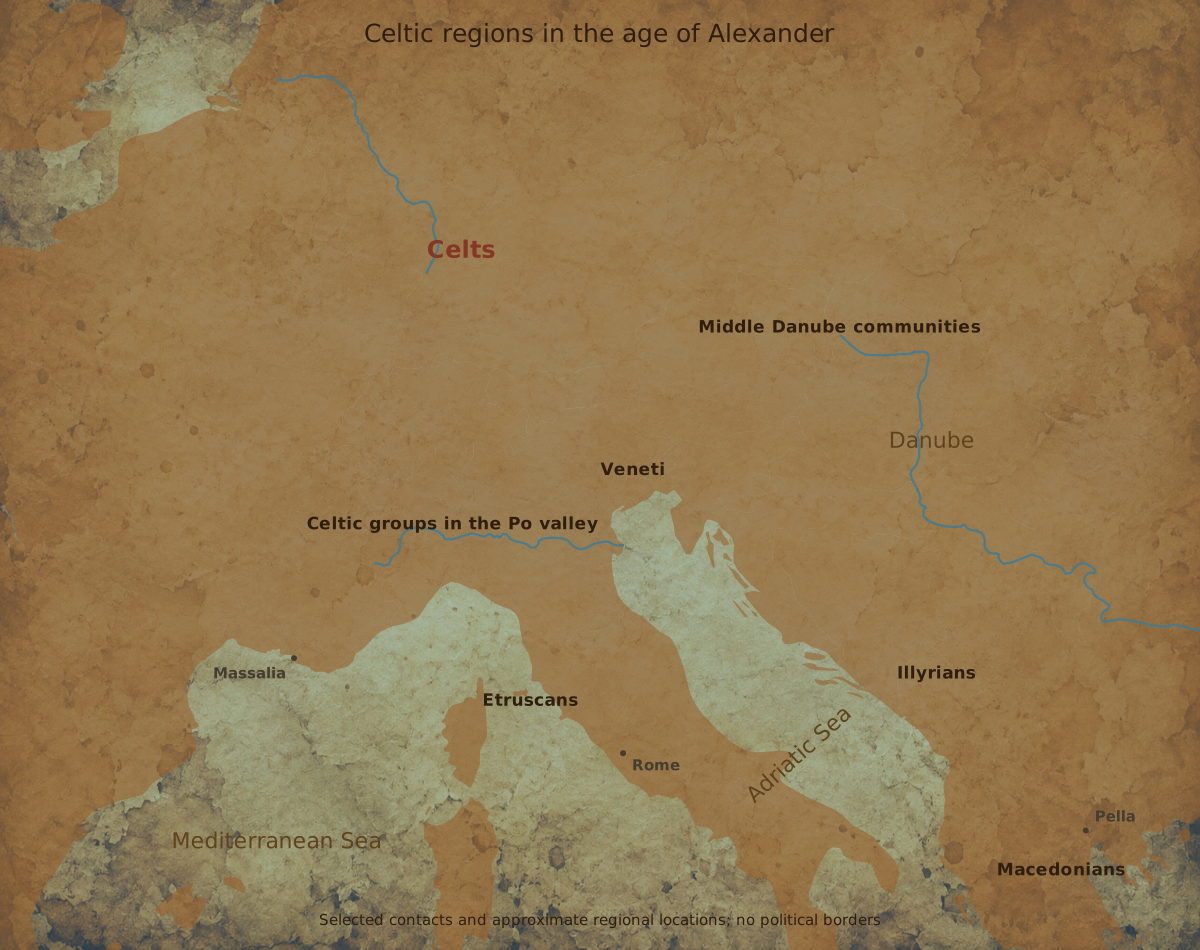
The peoples called Celts by Greek writers occupied many different countries across continental Europe. In the fourth century BC, their histories reached from the Atlantic-facing lands and central European river systems towards northern Italy and the approaches to the Balkans.
They formed communities and regional groupings with their own leaders, rivalries and relationships. A warband serving abroad, a people moving into new territory and an army defending its settlements could all appear under the same broad name in an outsider's account.
Farming, livestock and skilled production sustained those societies. Rivers and overland routes connected settlements, while valuable objects moved through trade, gifts and military service. The world north of the Mediterranean was part of the same history of exchanges that brought its warriors into Greek and Italian wars.
The makers of fine metalwork
The artistic traditions archaeologists call La Tène developed across much of this world. Curving designs transformed plant and animal forms into patterns suited to weapons, ornaments and vessels. Craftspeople could adopt a motif from farther south and make it recognisably their own.
The bronze helmet from Berru, made around 375 BC, offers an exceptional example. Hammered from a single sheet and decorated with coral and engraved designs, it reinterprets the palmette known from Greek and Etruscan art. Its workmanship belonged to a society capable of investing great skill in the equipment and display of a distinguished person.
Such objects reveal hierarchy as well as taste. The owner of an elaborate helmet possessed something different from the ordinary equipment needed to join a fight. Wealth could mark a leader and make his standing visible to followers and rivals.
Warriors and their followings
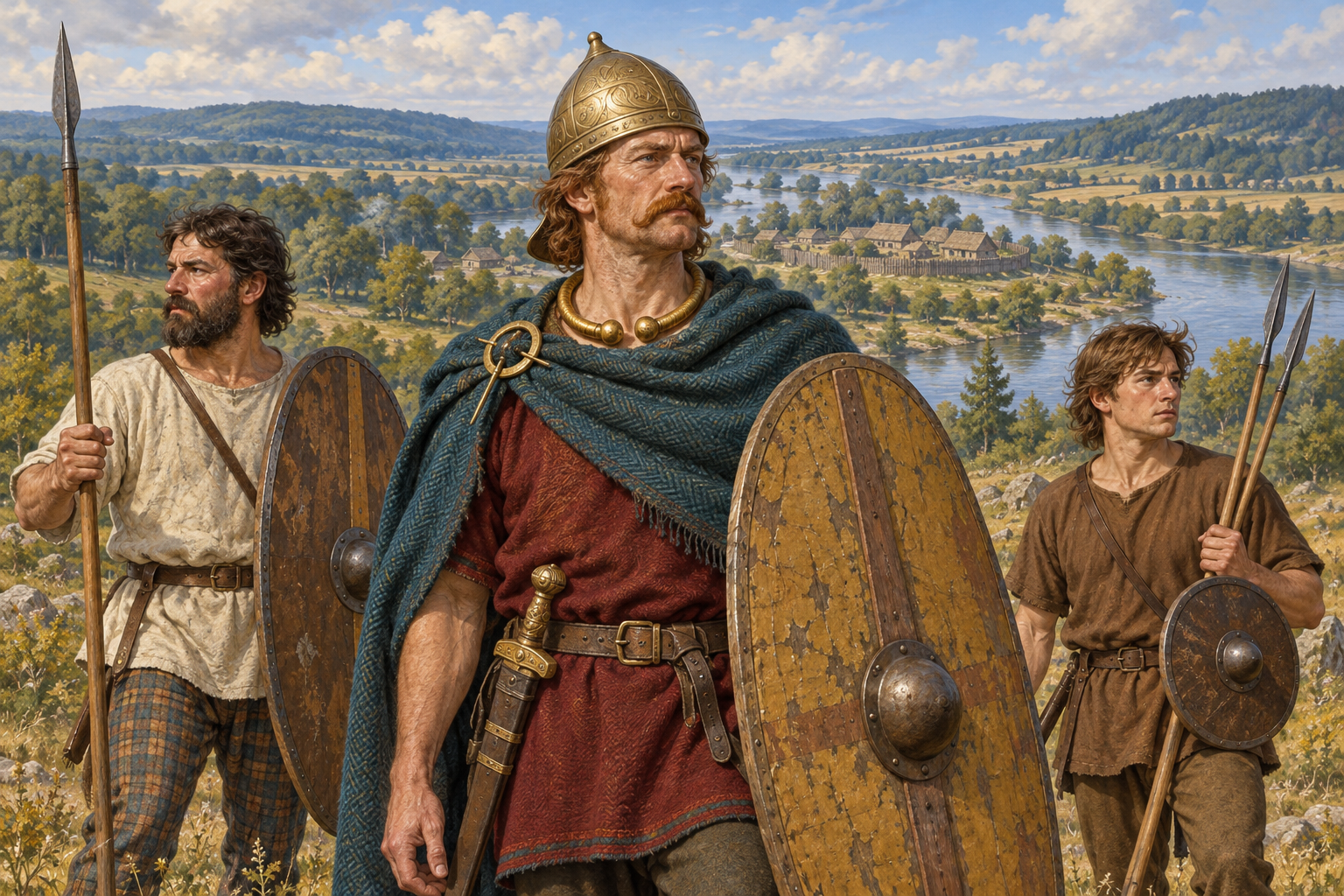
Spears, shields and swords formed part of the armed world represented in the archaeological record. The quality and quantity of equipment varied, while horses gave their owners a means of movement and a visible claim to status. A leader's ability to gather men depended on relationships that extended beyond possession of fine weapons.
Campaigning offered opportunities for wealth and reputation. Success could bring plunder, gifts from an employer and recognition among companions. Failure could destroy the following on which a chief relied or leave men far from home without the resources they expected.
Those incentives could sustain cooperation across communities for a particular expedition without creating one permanent Celtic state. The scale of an army depended on the occasion and the leaders able to bring it together.
Across the Alps
In Italy, Celtic settlement and warfare transformed the northern plains. Polybius describes different peoples occupying the Po valley and traces the struggles that brought them into contact with Etruscans and Romans. The fertile country south of the Alps offered land as well as routes towards the peninsula.
The sack of Rome in the early fourth century became the most famous of those encounters. Its memory remained powerful because it exposed the vulnerability of a city whose later victories would reshape the Mediterranean. For the Celts involved, the expedition belonged to a wider history of movement and war in Italy.
The northern Italian peoples continued to make alliances and resist their neighbours through the generations around Alexander. Their interests were tied to the country in which they had settled, even as Greek observers connected them with a much larger Celtic world.
In the pay of Dionysius
In 369 BC, Dionysius of Syracuse sent reinforcements to Sparta that included Celts and Iberians. Xenophon records their arrival and the effectiveness of the force in the fighting that followed. Men from beyond the Greek mainland had entered its wars through the resources of a Sicilian ruler.
Paid service created another route into Mediterranean politics. It could carry warriors across the sea, place them beside unfamiliar troops and offer rewards unavailable in a local quarrel. Their employer obtained men whose own reasons for fighting did not depend on membership of a Greek city.
The relationship also required practical cooperation. A contingent had to respond to commands, obtain provisions and survive the end of an agreement. Foreign service belonged to the experience of fighting men, not simply to the spectacle of their appearance in a Greek narrative.
Ritual, memory and authority
Burials and deposits of valuable objects reveal the importance of ritual in Celtic societies. Weapons, ornaments and other possessions could be removed from ordinary use and placed in settings whose meaning depended on shared beliefs. The treatment of the dead made some forms of social distinction especially visible.
Later accounts, most famously Caesar's description of Gaul in the first century BC, give druids responsibilities in teaching, judgement and religious life. They describe an authority different from that of a warrior chief. These later traditions belong to the longer history of Celtic societies, whose religious institutions varied across regions and generations.
Alexander's horizon
The meeting of 335 brought Celtic diplomacy into Alexander's career without producing a war between him and a united Celtic people. Another tradition recorded by Arrian placed Celtic envoys among the visitors seeking his friendship near the end of his life.
After his death, Celtic armies would become far more prominent in the affairs of the Hellenistic world. The invasions of the Balkans and Greece in the early third century, followed by settlement in Anatolia, opened another chapter of that history.
In Alexander's own age, the connections were already present: envoys on the Danube, soldiers employed by Syracuse and communities established in Italy. Their world was neither outside Mediterranean history nor governed by its kings. The men who answered Alexander with the falling sky had come to negotiate from a position of their own.
Sources
Ancient narratives
- Arrian, Anabasis, I.4 and VII.15.
- Xenophon, Hellenica, VII.1.20–22 and VII.1.31.
- Polybius, Histories, II.17–20.
- Caesar, Gallic War, VI.13–14, later testimony on druids.
Archaeology and historical studies