






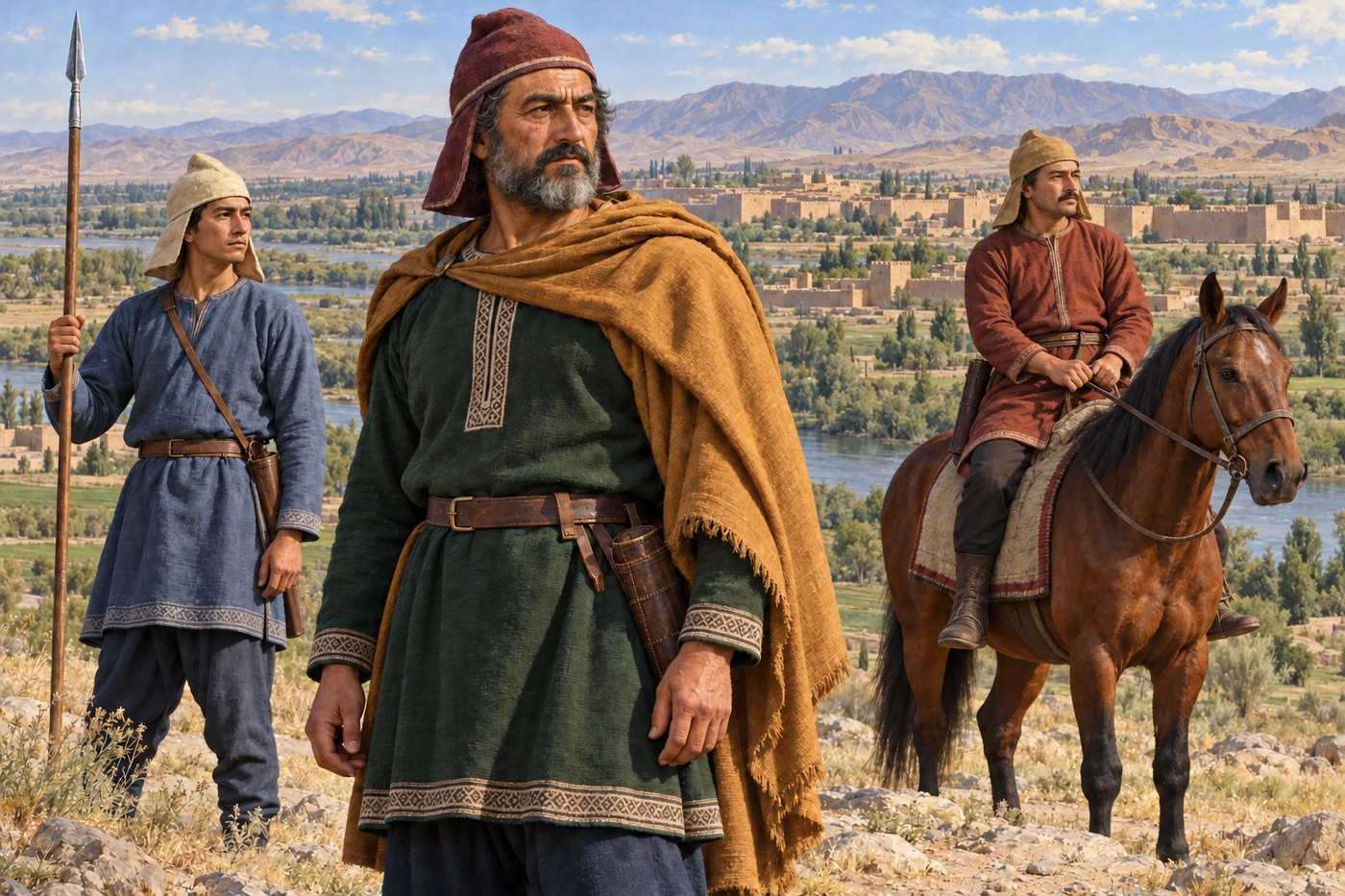
Sogdians
The victory beside the river
In 329 BC, a Macedonian detachment pursuing Spitamenes found itself unable to bring its enemy to a decisive fight. Mounted warriors circled, shot and withdrew. The pursuing horses were tired, the infantry exposed, and the river Polytimetus offered the hope of cover and safety.
The attempt to cross became a disaster. Orders broke down, men crowded towards the water and Spitamenes' followers attacked from several directions. The force sent to secure Maracanda was destroyed. Alexander had defeated Persian kings and occupied great capitals, but in Sogdiana the war could be lost by a detachment on an unfamiliar riverbank.
The cultivated country beyond the Oxus
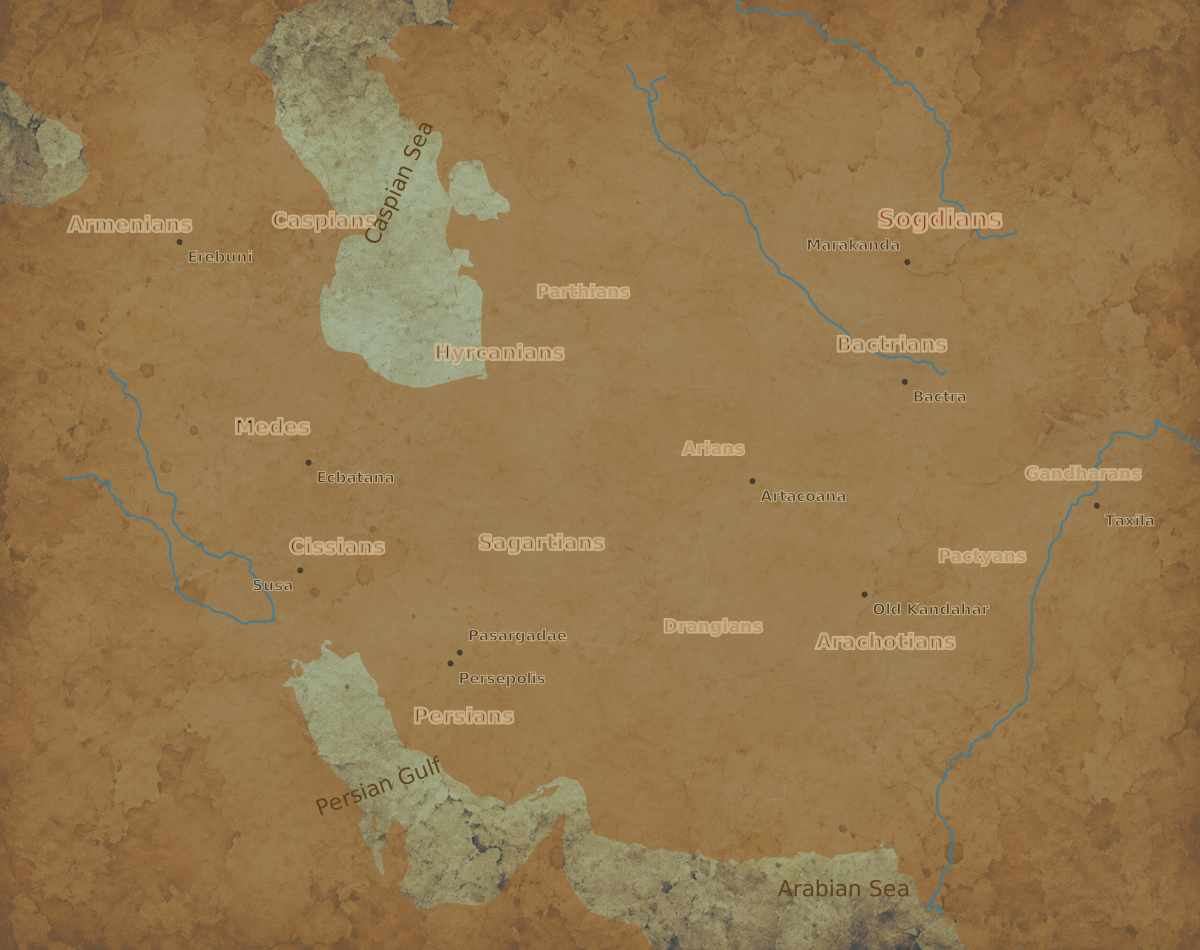
Sogdiana lay north of Bactria, beyond the Oxus and towards the Jaxartes. Maracanda, the ancient centre associated with Samarkand, stood in the country of the Zarafshan, called the Polytimetus by Greek writers. Cultivated valleys and oasis settlements lay within a wider landscape of uplands and steppe approaches.
Water created the conditions for settled life. Fields and communities depended on river systems and the work needed to direct them. Fortified places protected local centres, while roads connected districts that could be difficult for an outsider to control as one continuous territory.
Beyond the cultivated ground lived mobile pastoral peoples whose relationships with Sogdian leaders could become decisive in war. A ruler threatened in the valleys might find mounted allies and refuge towards the steppe. The frontier was a source of connections as well as danger.
In the service of Persia
Sogdiana appears among the lands of the Achaemenid empire. Its position made it a distant province whose resources had to be gathered through local relationships. The great royal capitals stood far away, but the demands of the monarchy reached its soldiers and aristocratic households.
Herodotus includes Sogdians among Xerxes' forces in 480 BC, comparing their equipment with that of the Bactrians. In 331, Arrian places them under Bessus at Gaugamela. Their participation carried men from the eastern frontier into the final great attempt to defend Darius III.
After that defeat, the same eastern country offered the possibility of continued resistance. Bessus withdrew through Bactria and across the Oxus, relying on relationships with nobles and mounted forces beyond the river. Sogdiana became part of the struggle over who would inherit the Persian throne.
Spitamenes breaks with Bessus
Bessus' retreat weakened his claim to kingship. Spitamenes and Dataphernes seized him and offered to hand him over to Alexander. The new king's capture appeared to remove the principal focus of eastern resistance.
Spitamenes soon demonstrated that his own power did not depend on maintaining Bessus. He raised forces against the Macedonian occupation and threatened the garrison at Maracanda. His campaign drew strength from the ability to move between local settlements and the neighbouring mounted peoples.
The distinction mattered. Alexander could capture a claimant and appoint governors without ending the relationships that allowed another leader to gather resistance. Sogdiana's war became a struggle over places, followers and freedom of movement.
Horsemen and strongholds
The defeat beside the Polytimetus showed the effectiveness of Spitamenes' coalition. Mounted archers could refuse close combat, exploit worn-out horses and strike when an enemy formation became disordered. Knowledge of when to withdraw was as useful as the courage to attack.
Other communities resisted from fortified settlements and high places. Alexander had to divide his army, assault positions and respond to threats appearing behind him. The campaign demanded repeated local operations rather than another battle resembling Gaugamela.
The violence reached the people sustaining those positions. Captured settlements, devastated country and the movement of garrisons altered the life of the valleys. For local leaders, continued resistance involved the security of families and dependants as well as their own standing.
The end of Spitamenes
Spitamenes carried the war into Bactria and continued to rely on steppe allies. Macedonian commanders increasingly sought to deny him the freedom that had made his earlier operations effective. Coenus eventually defeated a force he had assembled.
After that reverse, the coalition broke apart. Arrian reports that the Massagetae killed Spitamenes and sent his head to Alexander. His protection among allies had ended when the risks of continuing to support him became too great.
The loss removed the most effective mobile leader of the resistance. It did not automatically settle every district, and Alexander continued against the strongholds held by other aristocratic families.
Roxana on the rock
At the Sogdian Rock, the defenders trusted the difficulty of the approach and the stores behind their position. Alexander sent climbers by night, using ropes and iron pegs to reach ground above them. When the defenders saw troops on the summit, they surrendered.
Among the captives was Roxana, daughter of Oxyartes. Alexander married her, joining his household to one of the eastern noble families. The marriage gave the conquest a dynastic connection that force alone could not provide.
Oxyartes then became useful in negotiating with other leaders. At the rock of Chorienes, his intervention helped secure a surrender after Macedonian engineering work had begun to threaten the position. Chorienes retained authority and supplied the army from his stores.
Another future for the ruling families
These settlements offered a path different from Spitamenes' continued war. A noble who submitted could keep influence and enter the new political order. Alexander gained supplies, local knowledge and men able to govern after his departure.
The consequences reached the next generation. Roxana's son became Alexander IV, the child in whose name officers would claim to preserve the empire. Spitamenes' daughter Apama married Seleucus at Susa in 324 and became part of the dynasty that would rule much of Alexander's Asian inheritance.
Sogdiana had resisted through horsemen, fortified communities and aristocratic coalitions. Its settlement likewise depended on people whose authority could survive a change of king. The conquest broke armies and destroyed leaders, but it also carried eastern families into the future monarchies of the Hellenistic world.
Sources
Ancient narratives
- Herodotus, Histories, VII.66.
- Arrian, Anabasis, III.8 and III.28–30; IV.5; IV.16–17; IV.19; IV.21; VII.4.
Historical geography and studies
- “Sogdiana ii. Historical Geography”, Encyclopaedia Iranica.
- Étienne de la Vaissière, “Sogdiana iii. History and Archaeology”, Encyclopaedia Iranica.
- Valerii P. Nikonorov, The Armies of Bactria, 700 BC–450 AD, volumes I–II (1997), Achaemenid-period sections.