






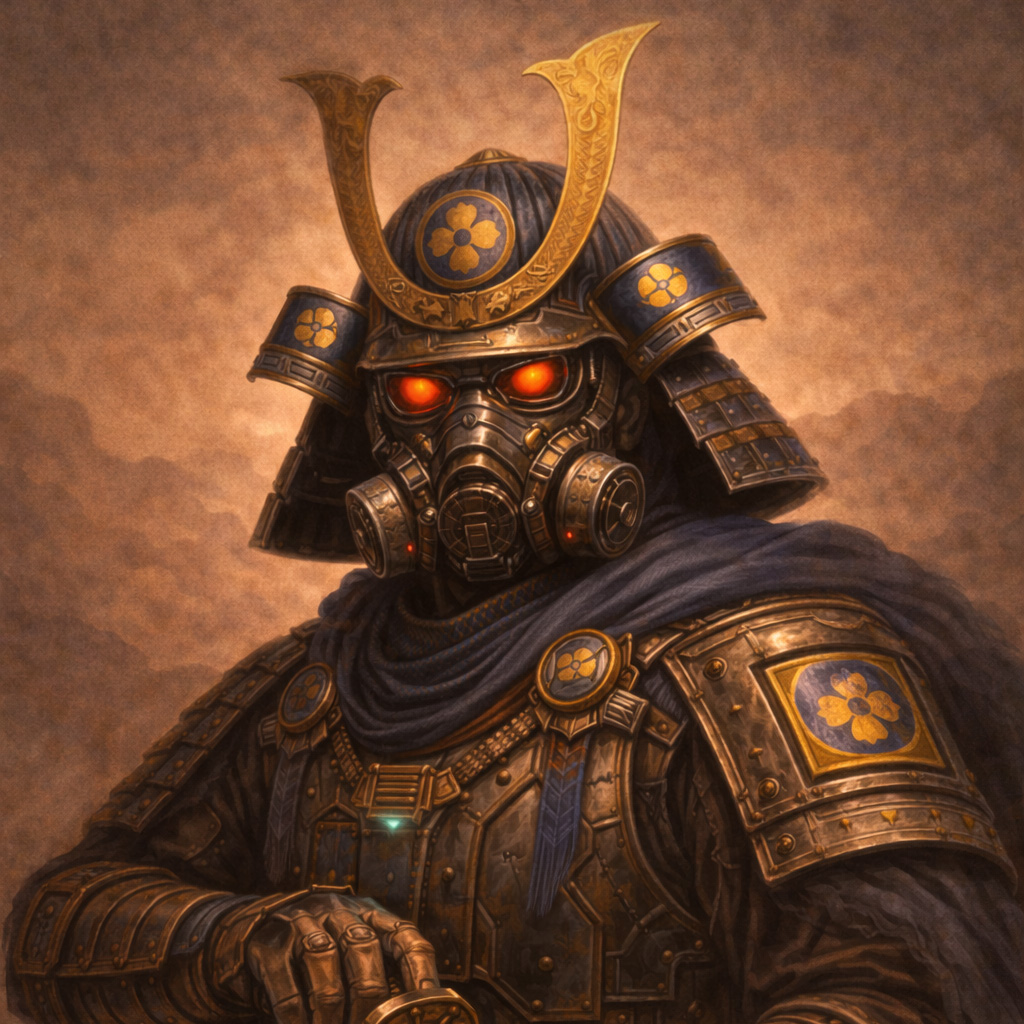
Part I, The Gate Between Powers
Among the great clans of northeastern Tohei, few occupy a more delicate or more valuable position than the Mori. Their lands stand between Kento and the Swolfs, touching routes by which armies march, merchants grow rich, envoys negotiate, and refugees flee when larger powers collide. They are not the largest realm of the region, nor the most feared, nor the most celebrated. Yet when crises erupt, all roads seem to lead through Mori territory.
To outsiders, the clan can appear restrained, even secondary. This impression has ruined more than one rival. The Mori learned long ago that loud ambition attracts coalitions, while quiet necessity attracts dependence. Their strength has rarely come from dramatic conquest. It comes from being too useful to destroy and too well prepared to intimidate cheaply.
Their domain is a land of river mouths, wooded ridges, fortified roads, productive coastal settlements, and defensible passes linking inland Tohei to the northern shore. Whoever seeks secure movement between Kento influence and Swolf authority must either bargain with the Mori or pay heavily to bypass them. Geography granted them importance. Discipline allowed them to keep it.
This strategic location shaped every aspect of Mori statecraft. They developed traditions of layered diplomacy, where no single alliance is allowed to become a chain. They built fortresses not merely to resist invasion, but to buy time for negotiation. They cultivated officers who could read supply ledgers as carefully as battle maps. Even their ceremonies reflect this mentality: dignity without extravagance, prestige without waste.
Because they stand between stronger powers, the Mori are often asked where their loyalty truly lies. The answer depends on who asks, when, and why. They share old cultural bonds with Kento, yet understand the realities of Swolf supremacy. They trade with Palter, watch Ritolia carefully, and maintain ties with inland houses whose allegiance changes with the season. To some this appears indecisive. To the Mori, it is simply adulthood in politics.
The clan’s enemies sometimes mistake moderation for softness. But the Mori have survived centuries beside more expansive neighbors precisely because they know when to bend, when to delay, and when to strike with absolute clarity. They do not need to dominate every horizon. It is enough that others cannot ignore the gate they control.
In an age where many states burn themselves chasing greatness, the Mori remain what they have always been: the power that endures at the crossroads.
Part II, Origins of the House Mori
The origins of House Mori reach back to the early settlement of Tohei, in the centuries when the descendants of the Wind Confederation spread across contested lands and transformed frontier outposts into enduring domains. While some clans sought glory through great campaigns or the conquest of fertile heartlands, the ancestors of the Mori were entrusted with harsher tasks: guarding passes, securing river mouths, watching forests, and holding the edges where order met uncertainty.
These first Mori domains were not rich kingdoms but exposed thresholds. Their settlements stood where raiders emerged from wooded highlands, where smugglers crossed waterways, where rival clans tested borders, and where trade could flourish only if someone made the roads safe. Necessity shaped them into a people less concerned with grandeur than with reliability.
From these beginnings came the character for which the clan is still known. Mori authority was built through service before it was built through prestige. A lord who could not keep bridges standing, maintain watchtowers, or respond quickly to border violence was considered unworthy regardless of noble blood. Competence became inseparable from legitimacy.
As generations passed, the Mori expanded carefully rather than spectacularly. They absorbed weaker neighbors through marriage, treaty, debt, and selective force. Villages that accepted Mori protection often retained local customs so long as roads were maintained and taxes paid. In this way the clan grew not as a blazing empire, but as a network of obligations tied to security.
Their long proximity to other powers also encouraged a political realism uncommon in more isolated houses. The Mori learned early that an enemy today might be a buffer tomorrow, and that humiliating a defeated rival could create a future coalition. They became skilled judges of proportion: how much force to use, how much mercy to show, how much tribute to demand before profit turned into rebellion.
Though never as mythologized as Kento or as flamboyant as later powers, the Mori earned a quieter reputation. When neighboring regions descended into succession wars or ideological fervor, merchants often rerouted caravans through Mori land because contracts would still be honored there. When border communities were threatened, displaced families sought Mori jurisdiction because order was likely to survive the season.
Even now, many old sayings of the northeast reflect that memory. A reckless warrior may win a hill for a day, they say, but only a Mori can keep the road beneath it open. Whether entirely fair or not, such proverbs capture the essence of the clan’s origin: born not from dreams of domination, but from the hard discipline of making civilization function where it was easiest to lose.
Part III, Rise Through Trade and Defense
House Mori did not rise through vast conquest or legendary crusades. Its ascent was slower, quieter, and in many ways more durable. While rival clans exhausted themselves chasing prestige, the Mori transformed necessity into advantage and geography into lasting power.
Their coastal settlements became reliable ports where merchants could unload cargo without paying bribes to three competing lords before sunset. Their roads were patrolled, bridges repaired, tolls predictable, and contracts enforced. In a violent age, such ordinary virtues generated extraordinary wealth. Traders often prefer certainty over grandeur, and certainty became a Mori specialty.
Timber from northern forests, fish from cold coastal waters, grain from protected valleys, metal goods from inland exchange routes, and imported luxuries from farther shores all passed through Mori markets. Rather than monopolize every trade, the clan learned to profit from movement itself. Warehouses, harbor fees, convoy escorts, customs duties, insurance pacts, and licensed brokers filled their treasuries without requiring endless expansion.
This prosperity funded an equally careful military system. The Mori did not seek the largest army in Tohei. They built the army they needed. Fortified passes, layered watch networks, coastal batteries, reserve depots, and disciplined standing troops allowed them to answer threats quickly and cheaply. Where others spent fortunes replacing armies after reckless campaigns, the Mori invested in preventing disasters before they began.
Over time, this created a powerful reputation. To raid Mori lands was possible. To profit from doing so was much harder. Invaders found roads blocked, supply columns harassed, local guides unreliable, and fortified positions stronger than expected. Even victories often cost more than they were worth.
The clan’s growing wealth also increased its diplomatic relevance. Smaller houses sought Mori arbitration in border disputes. Merchant leagues requested Mori guarantees. Even stronger neighbors sometimes preferred a stable Mori frontier to the uncertainty that would follow its collapse. This gave the clan influence beyond what raw population figures might suggest.
By the eve of the Imperial invasion, the Mori had become one of the most stable powers of northeastern Tohei. They were not the loudest state, nor the most romanticized. But they possessed what many rivals lacked: functioning institutions, respected officers, strategic depth, and a population accustomed to discipline rather than panic.
When the world changed, those habits would matter more than old boasts.
Part IV, The Imperial Invasion and the Choice of Survival
When the fleets of the Supreme Empire descended upon Damocles, the Mori faced the same terror and uncertainty that shook every clan of Tohei. Ancient balances collapsed in weeks. Great houses vanished. Old certainties burned with their capitals. Yet for the Mori, the central question was never how to preserve pride. It was how to preserve the clan itself.
At first, they resisted as duty demanded. Border forts were reinforced, roads obstructed, militia reserves called up, and coastal batteries brought to readiness. Local commanders fought delaying actions designed less to win glorious victories than to buy time, protect civilians, and prevent enemy forces from seizing key infrastructure intact.
This strategy proved wiser than many understood at the time. While some rivals committed their full strength to desperate battles and were shattered, the Mori traded space for endurance. Bridges were destroyed only when necessary. Granaries were evacuated before capture. Garrisons withdrew in order rather than die symbolically. To critics, this looked cautious. To survivors, it looked intelligent.
As the invasion deepened, another reality became impossible to ignore. The Imperial factions were not unified. Some pursued conquest through massacre and terror. Others, especially the Swolfs, combined force with diplomacy and sought durable submission rather than barren ruins. The Mori observed carefully and adapted faster than more ideological neighbors.
Rather than embrace blind resistance or immediate surrender, they chose selective accommodation. Hostile factions were fought where necessary. Negotiations were opened where survival could be secured. Local autonomy, continuity of administration, and protection of core territories were treated as strategic objectives equal to battlefield success.
This policy saved the clan from annihilation. While radical Imperial elements and fanatical defenders of the Celestial Peace were later purged across much of Tohei, the Mori endured with their governing structure largely intact. Their officers remained useful. Their ports remained valuable. Their roads still mattered. In times of upheaval, usefulness can become a shield.
The price, of course, was moral ambiguity. Some accused the Mori of compromise bordering on cowardice. Others argued that dead heroes govern nothing. Both judgments survive to this day. The clan itself rarely bothers to answer them.
What matters historically is clear: when many powers of Tohei were broken beyond repair, the Mori crossed the age of conquest wounded but alive. And in politics, survival is often the first victory from which all later victories grow.
Part V, Between Kento Honor and Swolf Power
No question defines modern Mori politics more than this one: where should the clan truly stand between Kento and the Swolfs? It is not a matter that can be settled once and for all, because both powers represent something the Mori cannot afford to ignore.
Kento embodies memory, legitimacy, and the old moral architecture of Tohei. Through centuries of shared customs, noble marriages, military cooperation, and mutual recognition, the Mori developed deep cultural affinity with the Kento order. Many among the Mori aristocracy still view Kento ceremony, restraint, and inherited duty as the highest expression of civilized rule. To abandon that heritage entirely would feel, to them, like abandoning part of themselves.
Yet sentiment does not erase reality. The Swolfs emerged from the age of invasion as the decisive arbiters of the northeast. Their power rests not only on arms, but on networks of alliance, political intelligence, and the ability to prevent rivals from uniting against them. The Mori understand this perhaps better than anyone, because they live directly beside it.
Thus the clan walks a narrow path. Too much closeness with Kento risks provoking Swolf suspicion or drawing Mori lands into conflicts born of Kento prestige politics. Too much dependence on the Swolfs risks gradual absorption, loss of initiative, and resentment among Mori houses who refuse to become elegant servants of a foreign-centered order.
This tension appears everywhere. A marriage treaty with Kento may be balanced by a trade agreement with Swolf-backed merchants. Joint military exercises with one side may be followed by diplomatic visits to the other. Public speeches invoke ancient values while budgets quietly fund modern strategic partnerships. Outsiders often call this duplicity. The Mori call it statecraft.
There are moments when balance becomes harder to maintain. If Kento appears weakened, some argue the Mori must distance themselves before being dragged down with it. If Swolf authority seems to waver, others insist the time has come to reclaim fuller independence while the opportunity exists. Every regional crisis therefore becomes an internal Mori debate.
So far, no faction has fully resolved the dilemma because none truly can. Kento offers meaning without sufficient power. The Swolfs offer power without emotional belonging. The Mori survive because they understand that choosing only one would make them poorer than living between both.
In this sense, the clan’s greatest challenge is also its greatest talent: remaining whole while standing between two gravitational forces strong enough to break lesser states apart.
Part VI, Government and Political Currents
Though outsiders often speak of the Mori as if it were a single disciplined machine, the clan contains lively internal competition. Its institutions are stable not because disagreement is absent, but because disagreement has been organized into durable channels of power.
At the center stands the ruling house, supported by councils of governors, military officers, commercial magistrates, and hereditary retainers. Formal authority flows downward through provincial administrations, port jurisdictions, and fortress commands. Informal influence flows through family networks, military prestige, merchant credit, and long memory. A decree may carry a seal, but whether it succeeds often depends on who quietly supports it.
The Traditional Court draws strength from old noble houses, ceremonial officials, and families tied by blood or sentiment to Kento. They emphasize continuity, rank, proper hierarchy, and the preservation of ancestral obligations. To them, Mori stability exists because the old order was never fully abandoned.
The Strategic Realists are influential among senior administrators, diplomats, and officers shaped by two centuries of post-invasion politics. They favor pragmatic cooperation with the Swolfs, calibrated neutrality in regional disputes, and careful avoidance of ideological crusades. They are often accused of cynicism, though their defenders note that cynicism has kept the clan alive.
The Commercial Reformers are strongest in ports, market cities, and newer administrative circles. They advocate infrastructure expansion, technical education, urban growth, deeper trade with Palter and the guild networks, and merit-based advancement over inherited privilege. Their opponents say they would turn Mori into an efficient marketplace with no soul. They reply that a starving noble lineage is still starving.
The Northern Hawks consist of harder-line officers, frontier lords, and younger patriots frustrated by permanent caution. They argue that every year of balance strengthens rival powers while the Mori remain reactive. In their view, the clan must militarize further, expand its buffer zones, and be ready to seize opportunities before others dictate the future again.
No current rules alone for long. Policies are usually compromises shaped by circumstance. A military scare may empower the Hawks. Economic downturns favor Reformers. Diplomatic crises strengthen Realists. Cultural anxieties revive the Traditional Court. The clan’s direction therefore changes by degree rather than sudden revolution.
This pluralism is both a strength and a burden. It prevents catastrophic extremism, yet can slow decisive action. Still, many neighboring peoples would gladly trade their own chaos for the Mori habit of arguing within institutions rather than burning them down.
Part VII, Economy of the Threshold Lands
The strength of the Mori does not rest on a single miracle resource or vast imperial hinterland. It rests on position, discipline, and diversification. Their lands sit where sea routes, inland roads, and northern corridors intersect. In Damocles, such geography can sustain a state for centuries if managed well.
The coast provides the first pillar of Mori prosperity. Fisheries from cold northern waters feed urban centers and military garrisons alike. Salting houses, smoke yards, ship chandlers, rope makers, sail workshops, and dock labor networks support a broad maritime economy that extends far beyond simple fishing fleets. Even in years of war, people must eat, and ports that can still function become priceless.
Trade forms the second pillar. Merchants moving between Kento, Swolf territories, the inland clans, and more distant markets often pass through Mori customs zones. The clan has long preferred predictable tolls over arbitrary extortion, a policy that made its routes attractive even to rivals. Warehousing, convoy insurance, bonded storage, cargo arbitration, and transport licensing generate wealth with less risk than conquest.
Timber from forested ridges and upland valleys provides the third pillar. Wood fuels construction, shipbuilding, fortification works, charcoal industries, and civilian heating. Managed forests are treated as strategic assets rather than wilderness. Entire administrative offices exist to regulate cutting cycles, replanting, and emergency wartime reserves.
River customs and inland transit form the fourth pillar. Barges, ferries, bridge crossings, and canalized stretches of water link coastal markets to interior towns. Taxes on movement are rarely celebrated by the population, but they have financed roads, depots, harbor defenses, and public granaries for generations.
Unlike states built around a single export, the Mori economy is resilient because losses in one sector can be offset by another. A poor fishing season does not collapse customs revenue. A closed border does not erase timber reserves. A military scare may even increase demand for transport, repairs, and provisioning.
This prosperity has also shaped society. Mori cities are known for orderly markets, literate officials, skilled craftsmen, naval workshops, and a middle stratum of merchants and professionals stronger than in many purely aristocratic realms. Wealth does not erase hierarchy, but it gives talent more room to matter.
For this reason, stronger neighbors have often discovered an uncomfortable truth: conquering Mori land is possible, but replacing the systems that make it productive is much harder. The clan’s greatest treasury lies not in vaults, but in habits of competent administration.
Part VIII, Armed Forces of the Mori
The armies of the Mori are designed in the image of the state itself: disciplined, efficient, and built to endure pressure rather than chase spectacle. They rarely seek reckless glory. They seek favorable outcomes.
At the center of Mori military doctrine stand layered fortifications. Mountain passes, bridge approaches, harbor entrances, and strategic roads are protected by mutually supporting strongpoints, artillery nests, reserve depots, and fallback positions prepared long before war begins. A single wall means little. A system of walls, guns, mines, and supply routes can bleed a superior enemy for months.
Mori infantry are respected across Tohei for steadiness under pressure. Their line troops train heavily in defensive maneuver, coordinated withdrawal, urban fighting, and disciplined fire control. They are less theatrical than elite shock formations from other clans, but commanders know they can be trusted to hold difficult ground when panic begins elsewhere.
Mobile reserve forces provide the necessary counterweight to static defense. Mechanized detachments, cavalry scouts, rapid-response infantry, and armored carriers remain behind the main line until weak points appear. Rather than contest every meter of land equally, the Mori prefer to let enemies commit, extend, and then strike where momentum becomes vulnerability.
The clan’s coastal artillery and fleet, though smaller than those of some maritime rivals, are maintained to high standards. Shore batteries guard approaches to major ports, while patrol squadrons suppress piracy, escort convoys, and deny easy amphibious raids. The Mori navy exists less to dominate oceans than to ensure no one else can use nearby seas freely.
Reconnaissance is another traditional strength. Border riders, drone observers, signal towers, hidden relay posts, and local guide networks give Mori commanders better awareness than many enemies expect. Surprise is difficult to achieve against a clan that watches roads as carefully as it watches armies.
Technologically, the Mori combine dependable modern equipment with selected relic systems preserved from earlier ages. Stabilized field guns, precision rifles, encrypted communications, shielded bunkers, surveillance arrays, and restored legacy weapons are integrated carefully rather than worshiped blindly. They prefer tools that can be maintained in war, not miracles that fail at the wrong hour.
The result is a force often underestimated by more aggressive neighbors. Yet campaign after campaign has repeated the same lesson: the Mori may yield ground, but rarely cheaply, and those who advance too confidently into their lands often discover that the battle they thought won was only the opening stage of a much longer defeat.
Part IX, Faith, Society, and Identity
Mori culture is often described by outsiders as austere, reserved, or overly practical. The Mori themselves would call it disciplined. In a land shaped by borders, trade routes, and the constant need to survive beside stronger neighbors, extravagance was rarely admired for long. Reliability earned more respect than brilliance that could not be sustained.
Duty stands at the center of social life. Lords are expected to govern competently, officers to prepare seriously, merchants to honor contracts, and households to contribute to the wider stability of the clan. Failure is tolerated more easily than negligence. A commander defeated after hard resistance may keep his honor. One who neglected supplies before battle may lose everything.
This ethic has produced a society that values literacy, record keeping, engineering, logistics, and administrative skill more than many neighboring states. Ceremony remains important, but usually in measured forms. Public rites emphasize continuity, remembrance, and mutual obligation rather than theatrical displays of magnificence.
Religious life reflects the same temperament. Ancestor veneration remains widespread, especially among older families and rural communities. Shrines to household founders, fallen defenders, and local protectors can be found in homes, fortresses, docks, and market streets alike. The dead are remembered not only for who they were, but for the order they helped preserve.
The Mori also tolerate a range of spiritual traditions so long as they do not threaten civil peace. Temples tied to older Tohei customs, moderated forms of Celestial worship, merchant devotional societies, and regional cults all exist within the realm. What the state resists is not belief itself, but fanaticism. Any movement seeking to place absolute doctrine above public stability is watched carefully.
This creates a distinctive identity. The Mori are neither nostalgic traditionalists nor rootless modernizers. They do not define themselves through purity, but through function. To be Mori is to belong to a political community that endures because its members continue doing the difficult work of making it endure.
In an age of louder ideologies, that identity can appear unromantic. Yet when storms come, many still prefer a sober harbor to a glorious fire.
Part X, The Six Named Figures
Lord Harunobu Mori is the current ruler of the clan and the embodiment of its cautious statecraft. Patient, observant, and difficult to provoke, he rarely commits himself before understanding the second and third consequences of any decision. Critics call him overly careful. Supporters answer that carelessness is a luxury for weaker men. Under his rule, the Mori have remained stable while more flamboyant rivals consumed themselves in avoidable crises.
Lady Ayame Kento-Mori, born of a prestigious union linking the two houses, is the strongest voice for deeper alignment with Kento traditions. Elegant, educated, and politically formidable, she argues that prosperity without moral legitimacy cannot endure. Many conservative nobles and ceremonial circles rally behind her, though opponents suspect she dreams of binding Mori policy too tightly to Kento interests.
Marshal Renji Takamori is the architect of the clan’s modern defensive doctrine. A veteran of border campaigns and internal reforms, he reorganized reserve mobilization, fortress logistics, and officer training into a coherent system studied even by foreign observers. He has little patience for court intrigue and prefers maps to speeches. Soldiers trust him because his plans usually work.
Admiral Kaede Isoroku commands the coastal fleet and the wider security of Mori sea lanes. Known for sharp judgment and relentless standards, she transformed a modest navy into an efficient force capable of suppressing piracy, protecting convoys, and deterring larger rivals through preparedness. Her crews respect her deeply, though few would describe serving under her as comfortable.
Master Treasurer Junpei Arata represents the commercial reformers. Son of a merchant family elevated through talent rather than blood, he champions technical education, port expansion, industrial workshops, and deeper trade ties with external partners. Traditionalists distrust his growing influence, but even they quietly rely on the revenues his policies generate.
Envoy Sigrun Morizawa, of mixed Mori and Swolf heritage, is one of the clan’s most valuable diplomats. Equally at ease in northern courts and Mori councils, she has negotiated border settlements, intelligence exchanges, and crisis truces that prevented wars few citizens ever knew had nearly begun. To some she symbolizes dangerous compromise. To others, she is the future speaking two languages at once.
Part XI, The Mori Today
In the current age, the Mori remain one of the most stable and underestimated powers of Tohei. They rarely dominate headlines, launch ideological crusades, or seek theatrical conquest. Yet when trade falters, borders shift, or alliances crack, attention repeatedly turns toward their lands.
If Kento weakens, many wonder whether the Mori could inherit part of its native legitimacy. If Swolf authority declines, the clan’s strategic position may become even more valuable than it already is. If Palter expands economically, Mori ports and roads will matter more, not less. If Ritolia grows reckless, Mori fortresses stand directly in the path of ambition.
Their greatest strength is not any single army, harbor, or dynasty. It is institutional memory: the accumulated habit of surviving beside larger forces without becoming their victim. Few states master that art. Fewer still sustain it for centuries.
Yet endurance also carries danger. A clan too devoted to caution may miss the moment when history rewards boldness. Younger voices within Mori society increasingly ask whether preserving balance is enough in a world where others prepare to redraw it.
For now, House Mori remains what it has long been: the gate between powers, the keeper of roads others need, and the quiet force that shapes events most when louder powers begin to fail.
Should the day come when the Mori choose not merely to endure, but to lead, much of Tohei may discover that restraint was never the same thing as weakness.