






Greeks
The freedom of the cities
In 338 BC, the armies of Athens and Thebes faced Philip II at Chaeronea. Their alliance had brought old rivals together against a danger neither could safely ignore. Behind their soldiers stood cities accustomed to deciding their own affairs, fighting their neighbours and claiming a place of honour among the Greeks. Philip's victory left that world alive, but placed a Macedonian king above it.
The struggle was about more than a change of commander. For a Greek community, freedom meant the power to govern itself, keep its laws and resist another city's interference. Those claims could inspire courage while coexisting with the desire to dominate weaker neighbours. The fourth century was filled with leaders who promised liberation and armies whose arrival made somebody else's freedom less secure.
A homeland made of many communities
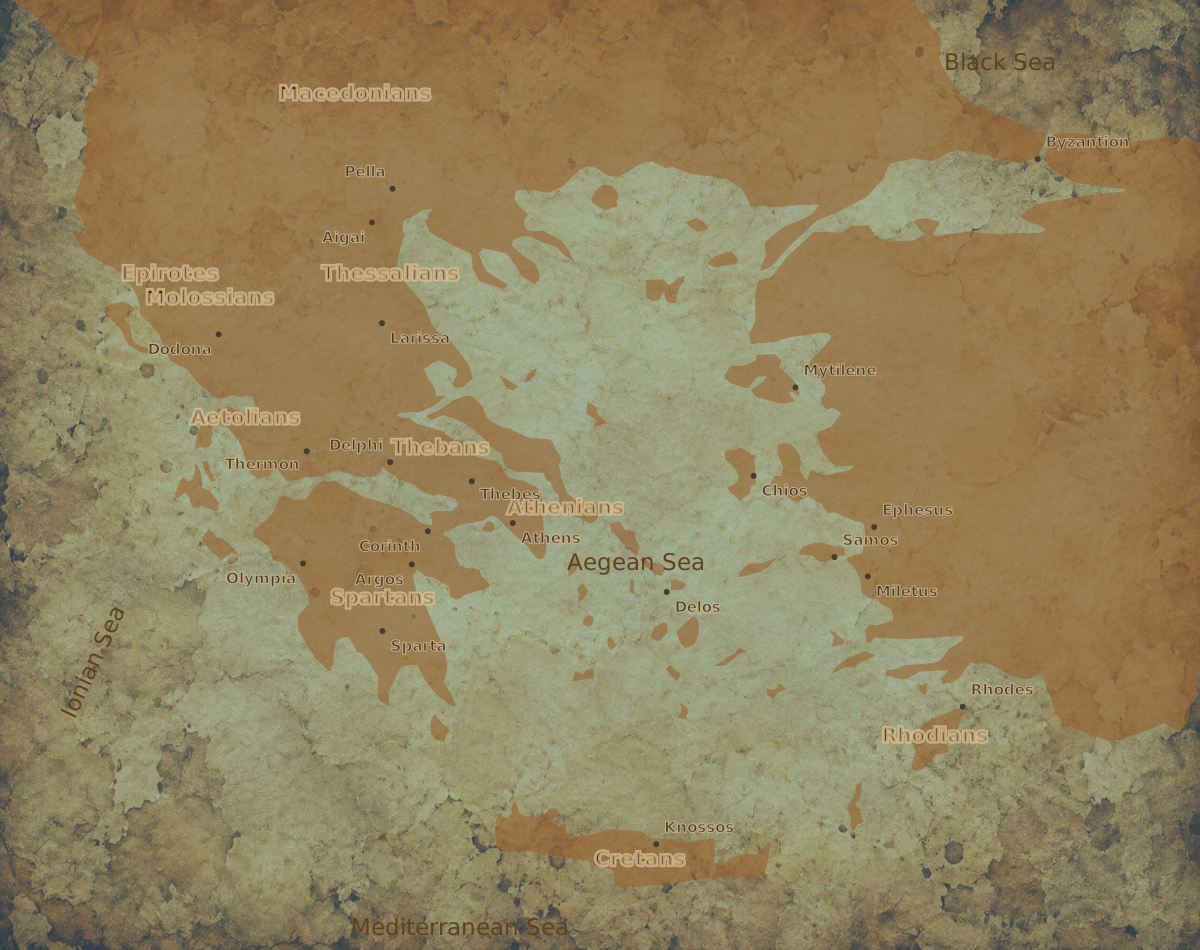
Mountains divided the mainland into territories whose roads and passes could be controlled. Seas linked islands and coasts, carrying people between places separated by difficult journeys overland. A citizen's strongest political attachment was usually to a particular community: its land, sanctuaries, laws and remembered ancestors. Greeks also recognised wider connections of language, worship and custom, celebrated at common sanctuaries and in stories reaching back to the heroes.
Political life took many forms. Democracies entrusted important decisions to assemblies; oligarchies restricted power to smaller groups; some regions organised themselves through federal institutions. Exile and civil conflict could overturn these arrangements. Men driven from their city might seek help abroad and return with an army, while their opponents accused them of betraying the very community they hoped to recover.
A polis depended on the countryside as well as the meeting place of its citizens. Grain, vines, olives and grazing land sustained urban life. Farms could be burned, harvests seized and roads closed. The fortification of a town did not make everything outside it expendable. Decisions about marching out to fight or remaining behind walls were therefore decisions about households, livelihoods and the limits of endurance.
Sacred weapons and the man beside you
An inscription from Acharnai in Attica preserves the oath expected of young men entering civic military service. It binds the soldier to his weapons, the companion beside him, the laws and the ancestral sanctuaries. Its witnesses include gods, the boundaries of the homeland and the crops that grow within them. Defence of the community was expressed through things a citizen could see, cultivate and inherit.
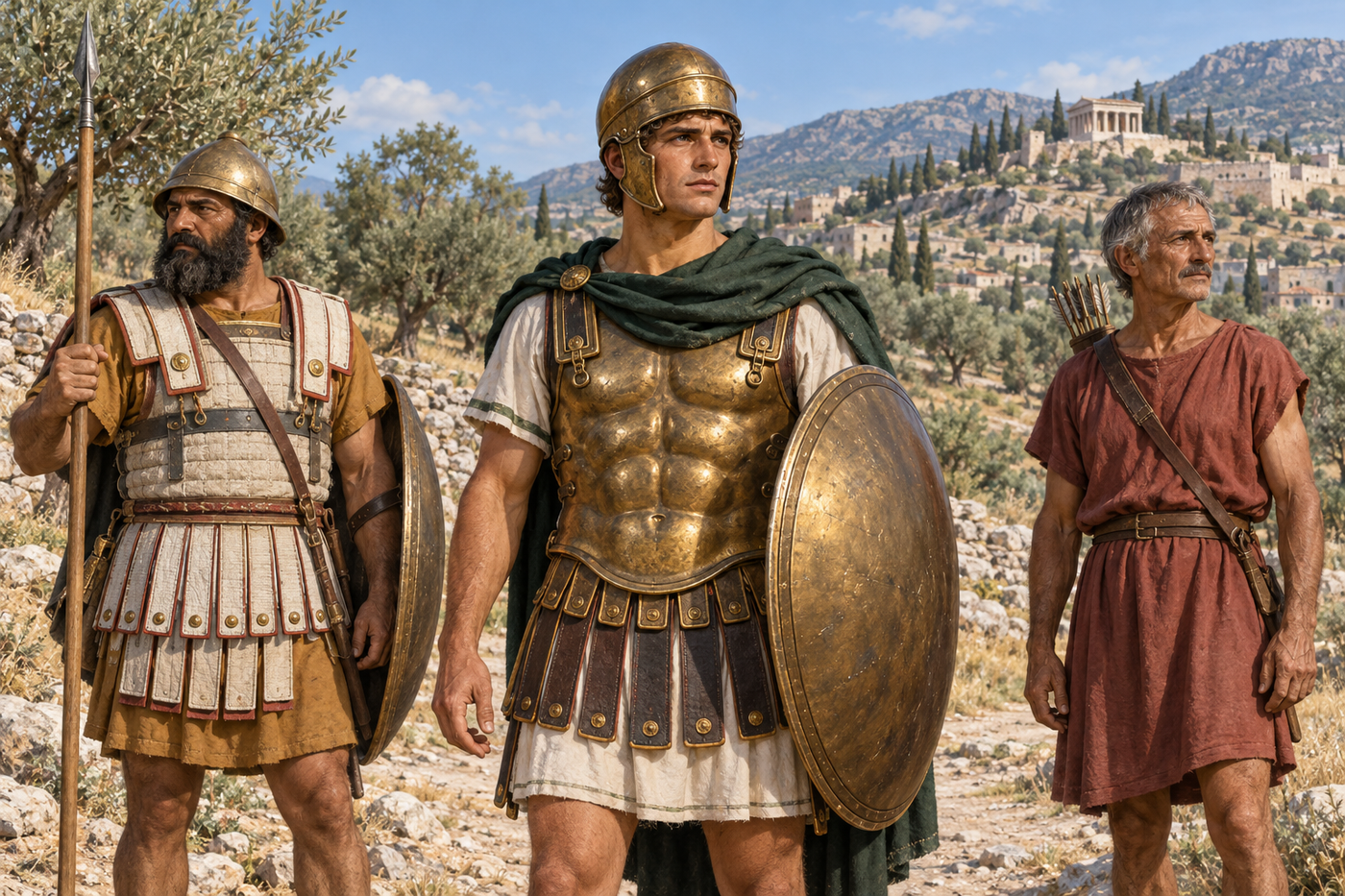
The shield-bearing infantryman gave that obligation a familiar military form. Armed with spear and shield, hoplites fought in a line whose cohesion mattered to each man's survival. Wealth and circumstance affected the protection they wore. Bronze armour remained prestigious, while other forms of body protection and changes in equipment gave armies a varied appearance. The shared duty of service did not make every citizen equally prosperous or equally experienced.
Religion accompanied campaigning from the decision to march to the disposal of the dead. Commanders sacrificed, consulted signs and sought divine favour. Trophies proclaimed victory, and defeated armies asked for the recovery of their fallen. Sacred obligations could shape the pace of operations and the meaning of success. A general had to lead people for whom a bad omen or an unfulfilled vow could be as pressing as a report from a scout.
How Iphicrates defeated the Spartans
The hoplite remained important, but the fourth century repeatedly demonstrated the danger of relying on heavy infantry alone. Near Lechaeum in 390 BC, Iphicrates and the Athenian hoplite commander Callias saw a Spartan force moving without adequate support from light troops and cavalry. They recognised an opportunity that reputation could not remove.
Iphicrates sent his peltasts against the Spartans. Javelins forced the heavier soldiers to react; when they charged, the lighter men withdrew beyond reach. Once the pursuit lost momentum, the attackers returned. Repeated efforts to catch them exhausted and depleted the Spartan formation. The presence of Callias' hoplites also constrained the defenders, who could not pursue without considering the stronger body waiting nearby.
Xenophon's account makes the commanders' judgement central to the result. They had noticed a temporary weakness and used different kinds of troops together. The episode did not make hoplites obsolete. It showed why an army needed to protect them, and why movement, missiles and the ability to choose when to close could defeat men otherwise formidable in a direct fight.
Soldiers who travelled for pay
War also created a world beyond the citizen levy. Greek soldiers served abroad for employers who could offer wages, provisions and the prospect of reward. Some had been displaced by political struggles; others followed commanders they trusted or sought opportunities unavailable at home. Service could become a career, carrying men between Greek cities, Persian satraps, Egyptian rulers and ambitious princes.
The expedition of Cyrus the Younger in 401 BC revealed the scale of this mobile military world. Greek troops marched deep into the Persian Empire to support his claim to the throne. They held their own in the fighting at Cunaxa, but the death of Cyrus destroyed the purpose and security of their employment. Their subsequent retreat, told by Xenophon, required new leaders, negotiations, discipline and constant attention to food.
Commanders who could gather and retain such soldiers gained influence beyond their own city's resources. Money mattered, but so did reputation and personal relationships. An employer who failed to pay risked losing obedience; a successful leader could attract followers whose loyalty survived a change of campaign. These connections joined the politics of the polis to the contests of kings.
The search for a lasting peace
After the Peloponnesian War, Sparta attempted to exercise a supremacy that many former allies soon found oppressive. Athens recovered enough strength to return to major diplomacy and naval warfare. Thebes rose under leaders capable of challenging Spartan military dominance. Victories changed who could impose terms, but each new arrangement left others with reasons to resist.
Peace treaties offered the language of autonomy while powerful states argued over its meaning. A city could demand freedom for another community when that demand weakened a rival, then defend its own authority over neighbours as a different matter. The result was a succession of alliances, reversals and renewed campaigns. Greek leaders knew the value of peace; securing an agreement that all would accept proved far harder than describing it.
Philip entered this political world through its existing divisions. His strength lay in the army he built and in his ability to act when other powers could not agree. Diplomacy, marriage, intervention and siege served the same expanding royal position. By the time his opponents assembled at Chaeronea, they faced a commander whose resources and accumulated victories had transformed Macedonia.
Chaeronea and the king's settlement
The defeat of 338 BC ended the immediate attempt to stop Philip in battle. Athens and Thebes paid different prices. Philip needed a settlement that would make further resistance difficult while allowing him to direct Greek resources towards a war against Persia. The League of Corinth gave his supremacy a common institutional form.
The surviving treaty oath promised peace and protection for the established political order. Its members were bound by commitments that limited their freedom to wage war or overturn governments. Philip stood at the centre of the arrangement as leader. A language familiar from earlier Greek attempts at common peace now served a power strong enough to enforce its preferred terms.
The proposed Persian expedition gave the settlement an outward purpose. Old memories of the Persian Wars could support the claim that a common campaign would avenge earlier wrongs. Yet Greek soldiers already served on both sides of the Aegean. The coming war would bring men with related traditions into opposing armies, each under commanders whose fortunes depended on defeating the other.
Alexander and the fate of Thebes
Philip's assassination reopened the question of obedience. Alexander moved rapidly to obtain recognition and prevent opponents from turning uncertainty into a coalition. The crisis became most terrible in 335 BC, when Thebes revolted. Reports and hopes about the young king's fate encouraged resistance, but he returned from the Balkans with an army before the expected opportunity had matured.
The fighting ended in the capture and destruction of the city. Other Greek enemies of Thebes participated in the decision that followed its defeat. Longstanding grievances gave the punishment a setting wider than Alexander's anger alone. For the communities watching, however, the message was unmistakable: a revolt could bring the loss of homes, political existence and personal freedom.
Alexander crossed into Asia the following year with the authority of the league behind his campaign. Greek contingents accompanied him; Greek mercenaries fought for his Persian opponents. At the Granicus, the destruction and capture of the latter became part of the king's warning against service on the other side. The ideal of a united expedition existed beside the reality of divided loyalties.
Resistance while the king was away
Alexander's victories did not remove every hope of resistance in Greece. Agis III of Sparta sought Persian help and gathered support while the Macedonian king was occupied in Asia. In 331 BC, Antipater confronted him near Megalopolis. The fighting was severe, and Agis died after continuing the struggle despite his wounds. His defeat preserved Macedonian authority in the king's absence.
When Alexander died in 323 BC, another coalition rose, with Athens playing a leading role. The war that followed again showed the endurance of civic ambition and the difficulty of overcoming Macedonian military power. Greek political life had not ended at Chaeronea. Assemblies still debated, generals still sought allies, and communities still risked much for their idea of freedom.
That persistence gives the Greek world of Alexander's age its particular tension. Its people possessed deep traditions of service and self-government, yet lived among powers able to impose unwelcome choices. A citizen might defend his own frontier, a mercenary follow a commander into Asia, or an envoy bargain with a king. Each acted within a world where the independence of the city remained precious precisely because it was so difficult to secure.
Sources
Ancient accounts
- Xenophon, Hellenica IV.5.13–18; Anabasis.
- Arrian, Anabasis of Alexander I.1, I.7–9 and I.16.
- Diodorus Siculus, Library of History XVII.62–63.
Inscriptions
- RO 88, dedication from Acharnai with military oaths, ca. 335–325 BC.
- IG II³ 1, 318 / RO 76, treaty with Philip II, 338/7 BC.
Historical studies and reference works
- Charlotte Van Regenmortel, Soldiers, Wages, and the Hellenistic Economies, chapter 1.
- Edith Foster, “Xenophon's Hellenika on the Greeks' Continuous Warfare”, Histos, supplement 12.
- Nicholas Sekunda, The Ancient Greeks, Osprey Elite 7.