






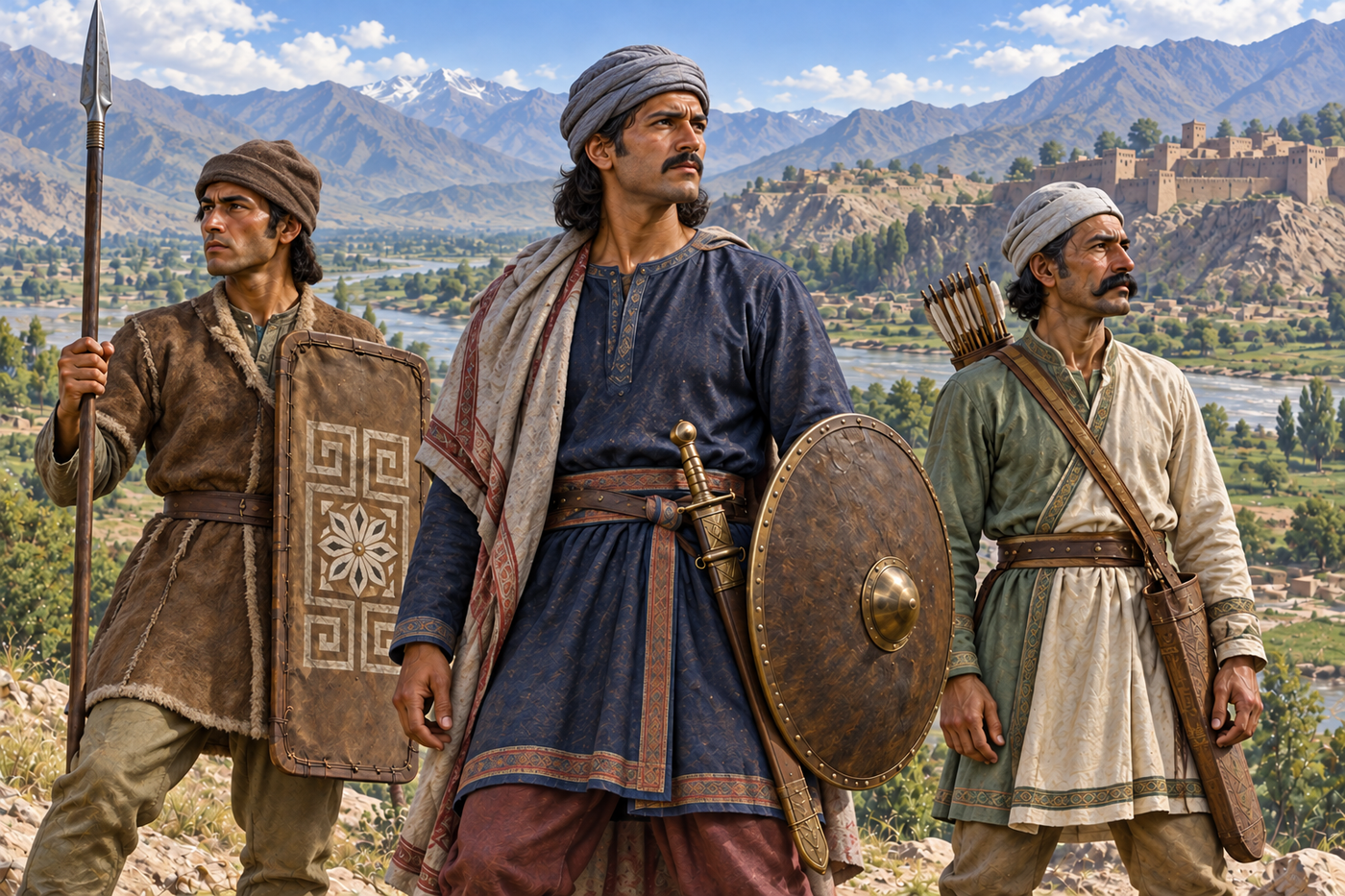
Gandharans
Taxiles chooses an ally
Before Alexander reached the Indus, the ruler known to Greek writers as Taxiles had already decided to welcome him. Gifts, animals and mounted reinforcements announced his friendship. The city of Taxila would receive the invader, giving him a base from which to enter the river kingdoms farther east.
The decision belonged to a local political world. Taxiles had rivals of his own, including Porus beyond the Hydaspes. The arrival of a conqueror could threaten a kingdom, but it could also offer an advantage over another king. In Gandhara, Alexander encountered rulers making choices about their own future, rather than simply accepting the role of his next opponents.
Where the roads entered India
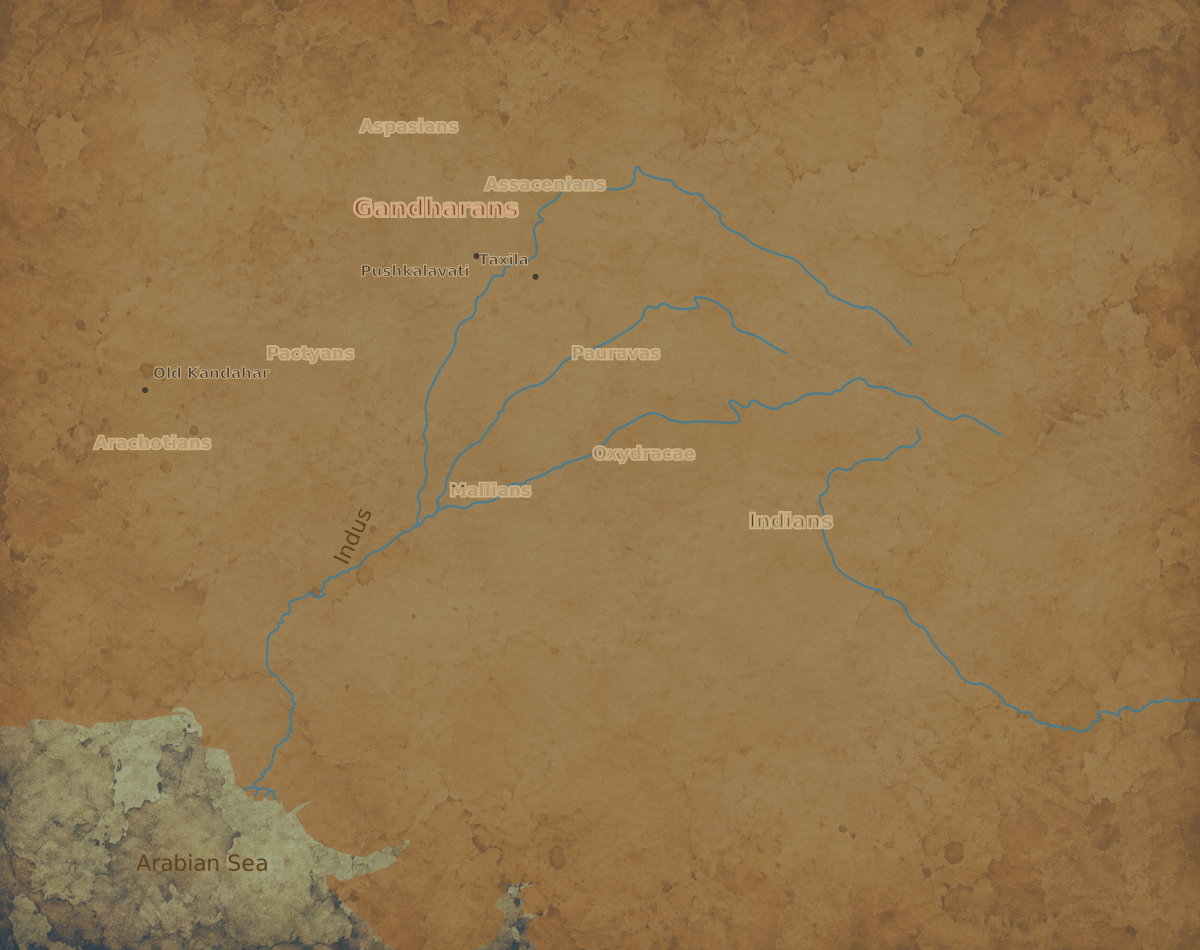
Gandhara occupied the north-western approaches to the subcontinent, around the Indus and the valleys leading towards it from the west. Pushkalavati, near modern Charsadda, and Taxila were among its principal urban centres. Routes through the Kabul valley connected this country with the passes towards the Iranian world.
The landscape included broad cultivated ground as well as upland communities and difficult approaches. Rivers offered water and communications but also obstructed armies. A commander arriving from the mountains had to secure both settlements and crossings before moving farther into the plains.
Gandhara's position encouraged contact across regions. Goods, military expeditions and learned traditions travelled through the same general network of valleys and roads. The country acquired a history shaped by connections with Iran, Central Asia and the Indian plains.
A name older than the conquest
Indian texts knew the Gandharan name long before Alexander. It also appears among the countries listed by Darius I in the Behistun inscription. The region therefore belonged to both Indian geographical traditions and the eastern horizon of the Persian empire.
Achaemenid rule connected its resources to a monarchy whose centres lay far to the west. Herodotus includes Gandarians in Xerxes' army and compares their equipment with that of the Bactrians. Men from these approaches to India could serve in a royal expedition that carried them as far as Greece.
The region also belonged to the intellectual world associated with Panini, the great grammarian usually connected with its north-western setting. His work gives another measure of the country beyond the military routes through which Greek historians encountered it. Language and learning formed part of its life before Macedonian soldiers arrived.
The city at Bhir
The archaeological landscape of Taxila preserves several successive settlements. The Bhir Mound belongs to the earlier city associated with the time of Alexander. Its streets and buildings represent a different urban setting from the later planned city at Sirkap and the monuments created under subsequent rulers.
That earlier centre drew life from its position near important routes. A city could offer markets, stores, artisans and political authority to an army whose journey had already crossed mountains and contested valleys. For Taxiles, the ability to supply and receive Alexander made his friendship immediately useful.
The later fame of Gandharan Buddhist art belongs to a much longer sequence of cultural change. The region's history after Alexander would draw upon several new powers and traditions, while Taxila continued to develop through successive urban foundations.
Submission and resistance
Alexander divided his army on the approach to the Indus. Hephaestion and Perdiccas took one route with orders to secure the settlements ahead and prepare the river crossing. The king led another force through the northern country, where several communities resisted.
The two advances reveal the variety of the region's political responses. An agreement with Taxiles did not make every stronghold obedient. A settlement could negotiate while another prepared to fight, and a local ruler's allegiance could affect the route chosen by a much larger army.
At Aornus, the defenders relied on a position whose steep approaches seemed to promise security. Alexander used troops and engineering work to gain ground near the rock, then forced the crisis that ended its resistance. The episode became part of the conqueror's heroic story through the claim that even Heracles had failed to take the place.
Men who changed service
After capturing Aornus, Alexander entrusted its garrison to Sisicottus. Arrian describes a man whose career had already crossed several political boundaries: he had joined Bessus in Bactria, then entered Macedonian service after Alexander's arrival.
The appointment illustrates the practical character of the conquest. A local or regional officer with useful experience could acquire responsibility under the new king. Alexander needed men able to hold places after the main army moved on, and loyalty could be established through service rather than origin alone.
For those officers, conquest offered danger and opportunity together. The defeat of one patron might require a new allegiance; successful service might preserve influence that resistance could destroy. Their decisions helped determine how imperial authority reached individual districts.
Crossing the Indus
When Alexander arrived at the river, a bridge and vessels were ready. Taxiles' gifts included livestock, elephants and silver, making the resources of friendship visible at the crossing. Sacrifices and athletic celebrations accompanied the army's passage into the next stage of the campaign.
The agreement continued to shape operations beyond Gandhara. Taxiles supported Alexander against Porus, but victory did not simply remove his rival. Alexander restored the defeated king and made him another powerful partner. The conqueror's settlement balanced local rulers whose interests remained distinct.
The country after Alexander
Garrisons and appointed governors were left to sustain the new order. Their presence joined Macedonian military power to existing cities and rulers, but the arrangement depended heavily on the king who had created it.
After his death, the north-west entered the struggles that accompanied the rise of the Mauryan state. Later Iranian, Greek and Central Asian powers would again become part of Gandhara's history. Its celebrated artistic and religious developments emerged across those later generations.
At the moment of Alexander's arrival, the decisive figures were men such as Taxiles and Sisicottus, who sought a future through alliance and service, and the defenders who trusted their own strongholds. Their different choices made Gandhara a country of negotiations and battles, with a history that continued long after the conqueror's army had crossed its rivers.