






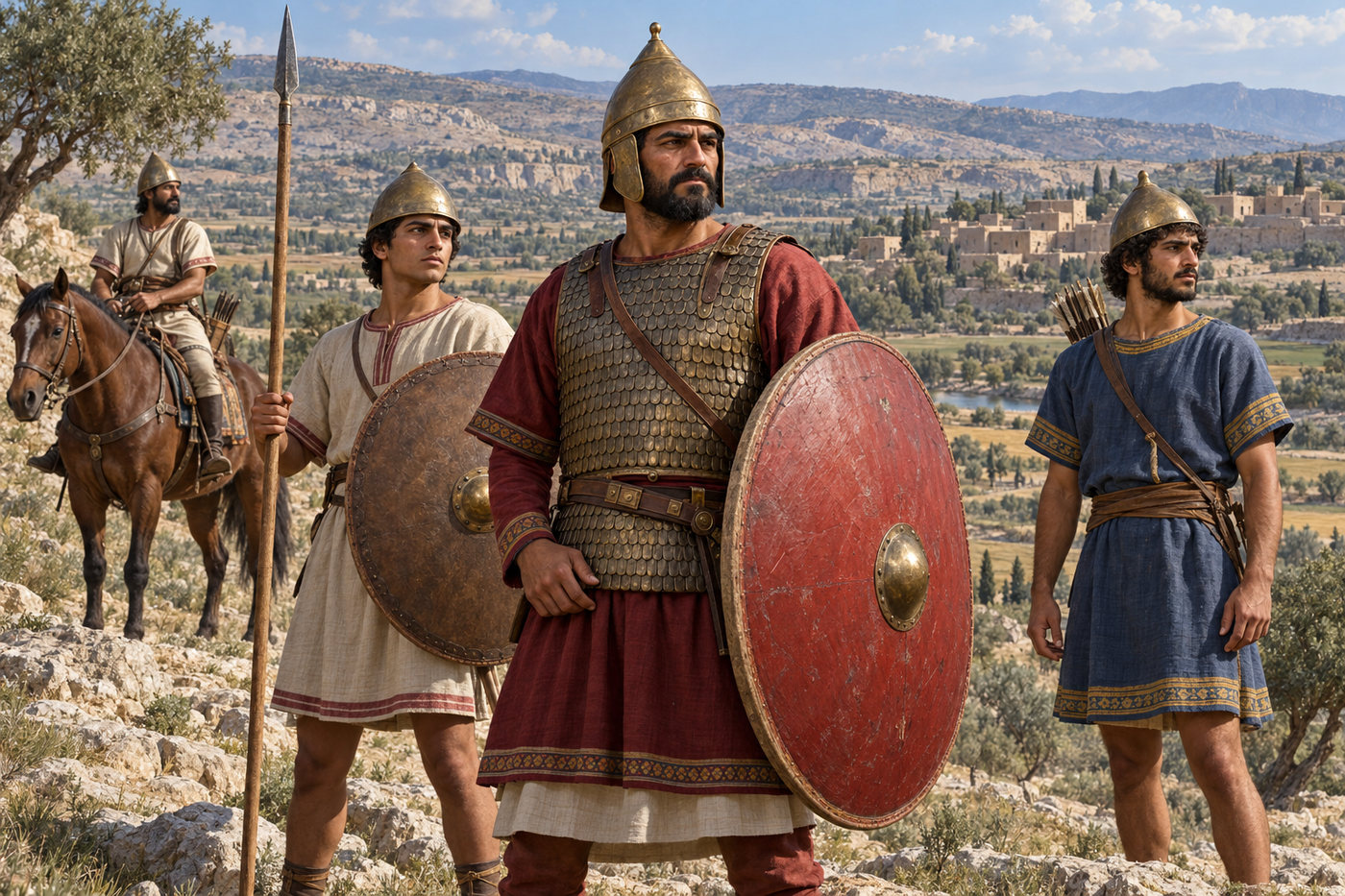
Syrians
The treasure left at Damascus
Before fighting Alexander at Issos in 333 BC, Darius III sent much of his treasure and the possessions of his court to Damascus. The king intended to return to them after the battle. Instead, his defeated army withdrew eastwards, and Parmenio moved to seize what had been left behind.
Money, attendants and members of aristocratic households fell into Macedonian hands. Greek envoys who had sought support from Darius were captured as well. In a Syrian city far from the battlefield, the consequences of the king's defeat reached people whose security had depended on his victory.
Between the river and the coast
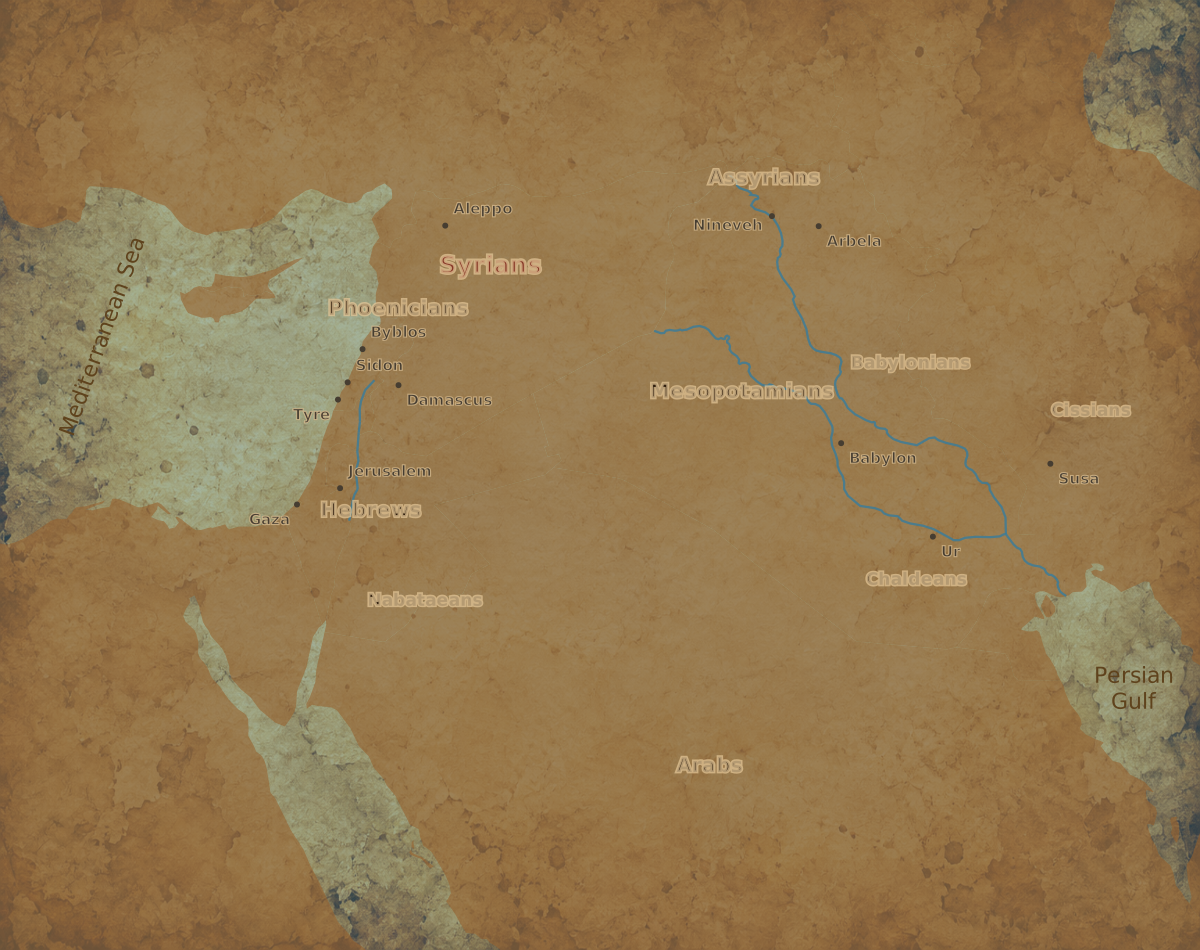
Syria occupied a central position in the routes connecting Anatolia, Mesopotamia, the Mediterranean and Egypt. Its different districts included cultivated plains, river valleys, inland cities and the approaches to drier country. Armies and caravans could pass through the same corridors, drawing upon settlements whose prosperity depended partly on those connections.
Damascus stood beside a fertile oasis on the edge of the inland routes. Farther north, the Orontes valley linked other centres and agricultural country. The Euphrates crossings opened the road towards Mesopotamia, while routes south connected the region with Palestine and the Egyptian frontier.
These relationships gave Syrian communities an importance greater than their distance from a royal capital might suggest. Whoever controlled the routes could move armies, collect supplies and communicate between major parts of an empire. Whoever lived along them faced the repeated arrival of people with the power to demand assistance.
The inheritance of older kingdoms
The region had been shaped by many centuries of local kingdoms and imperial conquest. Aramaean states, Assyrian rulers and Babylonian kings all belonged to its past. Persian rule inherited settlements and traditions already accustomed to relations with powers beyond their immediate country.
The imperial name Ebir Nari, the land beyond the river, placed the western territories within a political geography viewed from Mesopotamia. The Euphrates served as a reference point linking administrative language to the routes by which rulers reached the Mediterranean provinces.
Local identities and institutions continued within that larger framework. The empire collected resources and appointed officials, but the work of governing still passed through established towns, landholders, scribes and communities. A change at the summit did not replace every relationship through which orders became effective.
A language travelling with the empire
Aramaic became one of the principal means of communication across Achaemenid territory. Written in an alphabetic script and used on materials such as leather and parchment, it connected officials and communities whose spoken languages differed.
Its reach gave the Syrian world a place within imperial life extending far beyond the region. A language associated with the western lands could carry correspondence and transactions across countries ruled from the Persian court. Scribes made those connections practical, turning instructions, obligations and agreements into records others could use.
The same networks served economic activity. Goods moving between inland markets and coastal ports required arrangements among people who might live under different local authorities. Shared forms of writing helped sustain those dealings across distance.
Mazaeus and the royal war
Under the last Achaemenid kings, Mazaeus held commands connecting Cilicia, Syria and the approaches to Mesopotamia. His career illustrates the scale of responsibility a high-ranking Persian noble could acquire across the western provinces.
When Alexander advanced towards the Euphrates in 331, Mazaeus was responsible for obstructing his progress. The contest over crossings and supplies preceded the battle Darius was preparing farther east. Syria formed part of the space through which that final concentration of royal forces had to be protected.
After Gaugamela, Mazaeus helped arrange Babylon's submission and received a place in Alexander's government. His own survival crossed the boundary between the two monarchies, while the territories he had served became part of the conqueror's wider settlement.
The captives of Issos
The Greek envoys captured with the royal establishment at Damascus reveal the international life gathered around Darius. Thebans, an Athenian and a Spartan had sought the Persian king for reasons rooted in the conflicts of Greece.
Alexander treated them differently. Arrian describes the release of the Theban representatives and the honour shown to Iphicrates, son of the famous Athenian commander. The Spartan Euthycles remained a prisoner for a time because Sparta was actively hostile to Macedonia.
The Syrian city thus became a meeting point for wars that had begun elsewhere. Men seeking Persian assistance against Alexander were delivered to the very ruler they had hoped to oppose. Their fate depended on the political and personal distinctions he chose to recognise.
Supplies for the conqueror
Alexander installed new governors as his army moved south along the Mediterranean coast and then returned from Egypt. The demands placed on Syria continued: money, provisions, transport and the security of communications all mattered to the next stage of the invasion.
In 331, Arrian records the replacement of Arimmas by Asclepiodorus after a failure to prepare the supplies required for the advance inland. The episode makes the province's role concrete. A governor could lose his position because the army was not ready to be fed.
The people producing and carrying those supplies rarely appear by name in the campaign narratives. Their work nevertheless determined what the king could attempt. Conquest depended on fields and stores as much as on the soldiers who crossed the Euphrates.
The wars that followed
After Alexander died, Syria became one of the principal prizes of his successors. Its position between Egypt, Asia Minor and Mesopotamia made it difficult for any ambitious ruler to ignore. Control could change as armies advanced or withdrew, leaving cities to negotiate with the next commander.
At Gaza in 312 BC, Ptolemy and Seleucus defeated Demetrius, son of Antigonus. The victory opened the way for Seleucus to return towards Babylon, while the contest for Syria continued. The region's roads again connected a local battle to a much larger struggle for kingship.
For Syrian communities, Alexander's arrival was one decisive turn in a longer history of imperial power. Their cities retained their value because of where they stood and the people who sustained them. The treasure at Damascus had been lost in a single campaign; the routes and cultivated country that made Syria indispensable outlasted the kings who fought to possess them.
Sources
Ancient narratives
- Arrian, Anabasis, II.11, II.13, II.15 and III.6.
- Diodorus Siculus, Library of History, XIX.80–86.
History, language and administration