






Bactrians
Bessus takes the royal name
In 330 BC, Bessus returned to the east with a claim to the Persian throne. Darius III was dead, killed during the retreat in which his own commanders had taken him prisoner. Bessus, the governor of Bactria and one of the men involved in the seizure, assumed royal dress and the name Artaxerxes.
The centre of resistance now lay far from Babylon and Persepolis. From Bactria, a ruler could call upon eastern nobles, mounted forces and relationships extending towards the steppe. Bessus intended to make those resources the foundation of a renewed monarchy. Alexander intended to deny him the time to do so.
Between the mountains and the Oxus
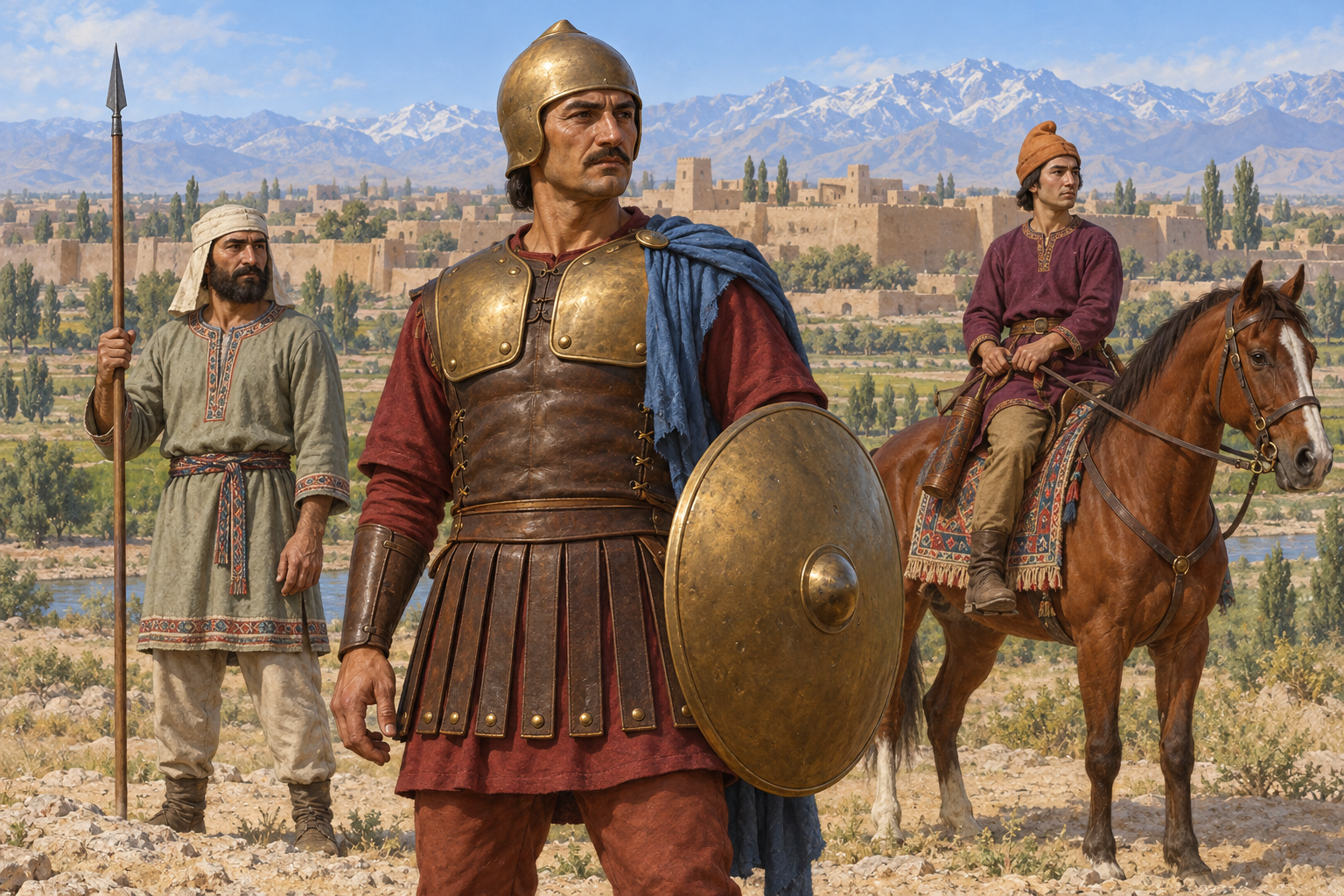
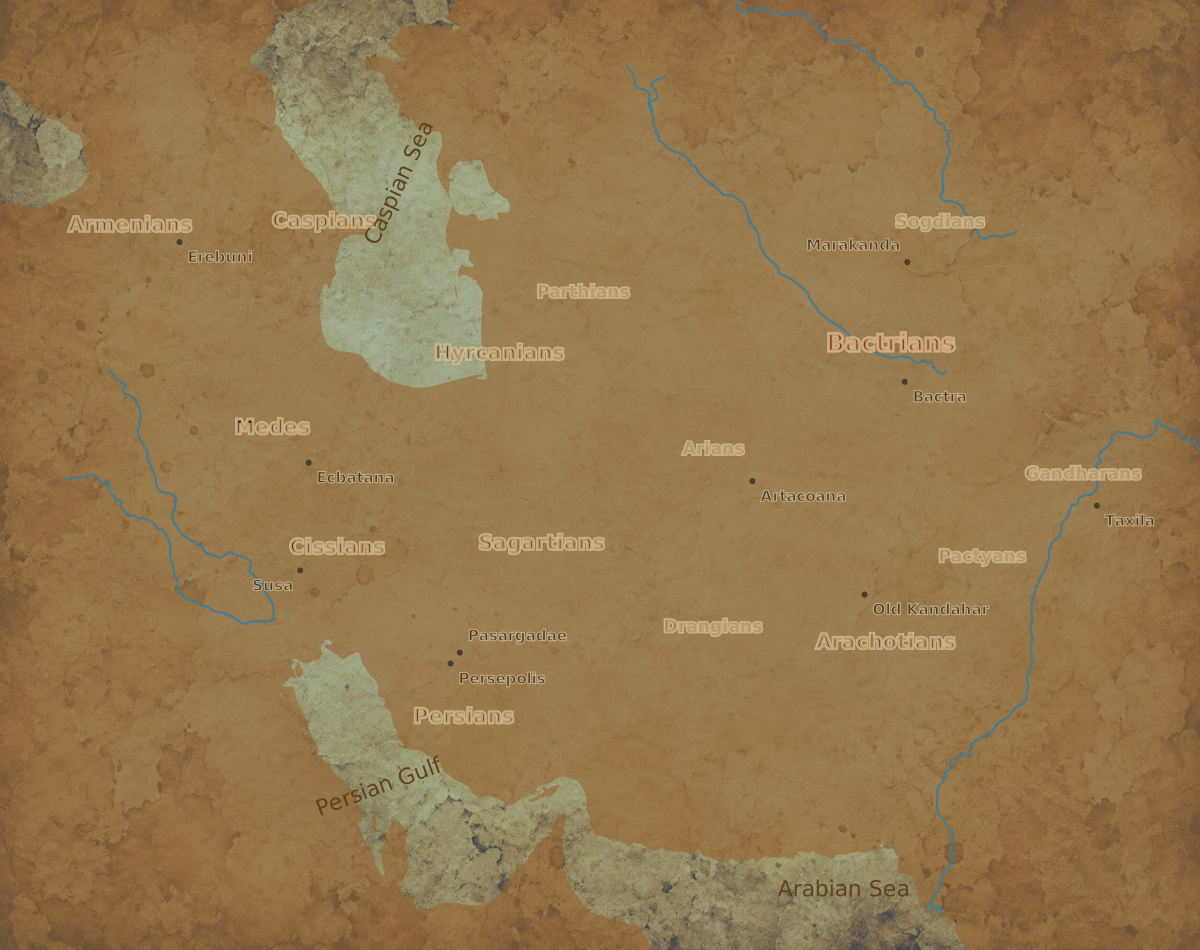
Bactria occupied the country north of the Hindu Kush and south of the Oxus, the great river now called the Amu Darya. Bactra, near modern Balkh, stood among its principal centres. Cultivated plains and irrigated settlements lay within a wider landscape of mountains, grazing country and dry expanses.
The region connected several worlds. Routes south crossed the mountains towards the lands beyond Kabul and the approaches to India. Northward, crossings of the Oxus led into Sogdiana. Westward lay the Iranian provinces through which royal communications could reach the empire's principal capitals.
These relationships made Bactria an important province in its own right. Its governor commanded resources at a great distance from the western court, while local nobles held influence in the settlements and fortified places through which an army had to move.
An eastern pillar of Persian power
Bactrian soldiers had served the Achaemenid kings long before Alexander's invasion. Herodotus includes them in Xerxes' army in 480 BC, describing bows and short spears within his catalogue of peoples. In the following century, Bactria remained capable of supplying mounted strength to the royal war effort.
At Gaugamela in 331, Bessus commanded the Bactrians and Sogdians, together with other forces from the eastern borderlands. The Saka joined the defence of Darius through their own relationship with the king. The army therefore drew upon connections extending beyond a simple chain of provincial administration.
The defeat did not immediately destroy those eastern resources. Bessus accompanied Darius in the retreat, and the hope of continuing the war depended increasingly on provinces that Alexander had not yet reached. Their distance offered a chance to regroup, but it also gave their commanders greater influence over the king's fate.
The wealth of the Oxus world
The objects known as the Oxus Treasure preserve a remarkable expression of Achaemenid-period wealth in this wider region. Gold and silver vessels, ornaments, plaques and a miniature chariot reveal skilled workmanship and connections with the visual culture of the Persian empire.
Some of the thin gold plaques show men in belted tunics, trousers and soft head coverings. Figures carrying bundles of rods have been interpreted as worshippers or ritual specialists. The objects bring devotion and elite display into the same material world, where precious metal could honour a deity as well as distinguish its owner.
The treasure's individual pieces travelled through circumstances that are not fully recoverable, but together they show that the Oxus country participated in a sophisticated exchange of objects and images. Bactria's place in imperial history was supported by communities with wealth and traditions of their own.
The road Bessus tried to close
Alexander approached through Arachosia and the mountain country in the winter of 330/329. Snow and shortages made the advance punishing. Bessus sought to increase those difficulties by devastating the land on the approach, depriving the invader of supplies.
The strategy relied on distance and exhaustion rather than an immediate pitched battle. If Alexander could not feed his troops and animals, the mountains might halt what Persian armies had failed to stop in the west. The cost of that defence fell on the same country Bessus claimed to rule.
Alexander continued. As the Macedonians approached, Bessus withdrew across the Oxus and destroyed the boats used for his passage. Bactrian cavalry dispersed towards their homes. The retreat weakened the connection between the new king's royal claim and the followers who had made it possible.
Artabazus governs Bactria
Alexander occupied Bactra and Aornus, installed a garrison and appointed Artabazus as governor. The choice placed an experienced Persian noble within the new administration. Artabazus had remained loyal to Darius and had subsequently entered Alexander's service, bringing a very different reputation from that of Bessus.
The appointment joined Macedonian military control to the standing of an Iranian aristocrat. It offered a means of governing a large eastern province while the king pressed on against the fugitives. Occupying the main centres was only the beginning of making that arrangement effective.
At the Oxus, the army faced another obstacle. A wide, fast river and a shortage of suitable timber made a conventional bridge difficult. The Macedonians improvised a crossing, then continued towards the men who had fled into Sogdiana.
The king handed over
Bessus lost the support of associates who had once helped sustain him. Spitamenes and Dataphernes offered to hand him over, and Alexander sent Ptolemy with a fast-moving force. The claimant who had abandoned Darius now found his own freedom dependent on men preparing to bargain with his enemy.
His capture ended the attempt to continue Achaemenid kingship under his name. Alexander treated him as a criminal against the royal person of Darius, a stance that also strengthened his own claim to avenge and inherit the defeated dynasty.
A war that crossed the river again
The surrender of Bessus did not secure Bactria. Spitamenes continued resistance with Sogdian followers and steppe allies. His mounted forces could move across the region while Alexander campaigned elsewhere, forcing garrisons and detachments to defend a country the main army had already crossed.
One raid reached the area of Zariaspa. Men left there during illness joined a pursuit that initially recovered plunder, then fell into an ambush on the return. Arrian names Aristonicus the musician among the dead and Peithon among the captured. The episode gives the eastern war an unusually personal scale: even members of the royal household could be drawn into a sudden local disaster.
Settlers, soldiers and a different future
Greek and Macedonian garrisons became part of the provincial landscape, while local cavalry and nobles entered Alexander's service. The settlement brought different groups together under a monarchy still trying to secure its eastern frontier.
After Alexander's death, Bactria remained within the disputes of his successors. In later generations it would become the centre of a powerful Greek kingdom, but that future grew from the difficult settlements of the conquest. Bessus had tried to make the province the refuge of the Persian throne. Alexander's armies made it a new meeting place of Iranian communities, steppe neighbours and soldiers who had come from the Mediterranean.
Sources
Ancient narratives
Historical studies and material culture
- “Bessos”, Encyclopaedia Iranica.
- Valerii P. Nikonorov, The Armies of Bactria, 700 BC–450 AD, volumes I–II (1997), Achaemenid-period sections.
- British Museum, gold plaque from the Oxus Treasure, 1897,1231.73; gold model chariot, 1897,1231.7.
- Metropolitan Museum of Art, The Cyrus Cylinder and Ancient Persia.