






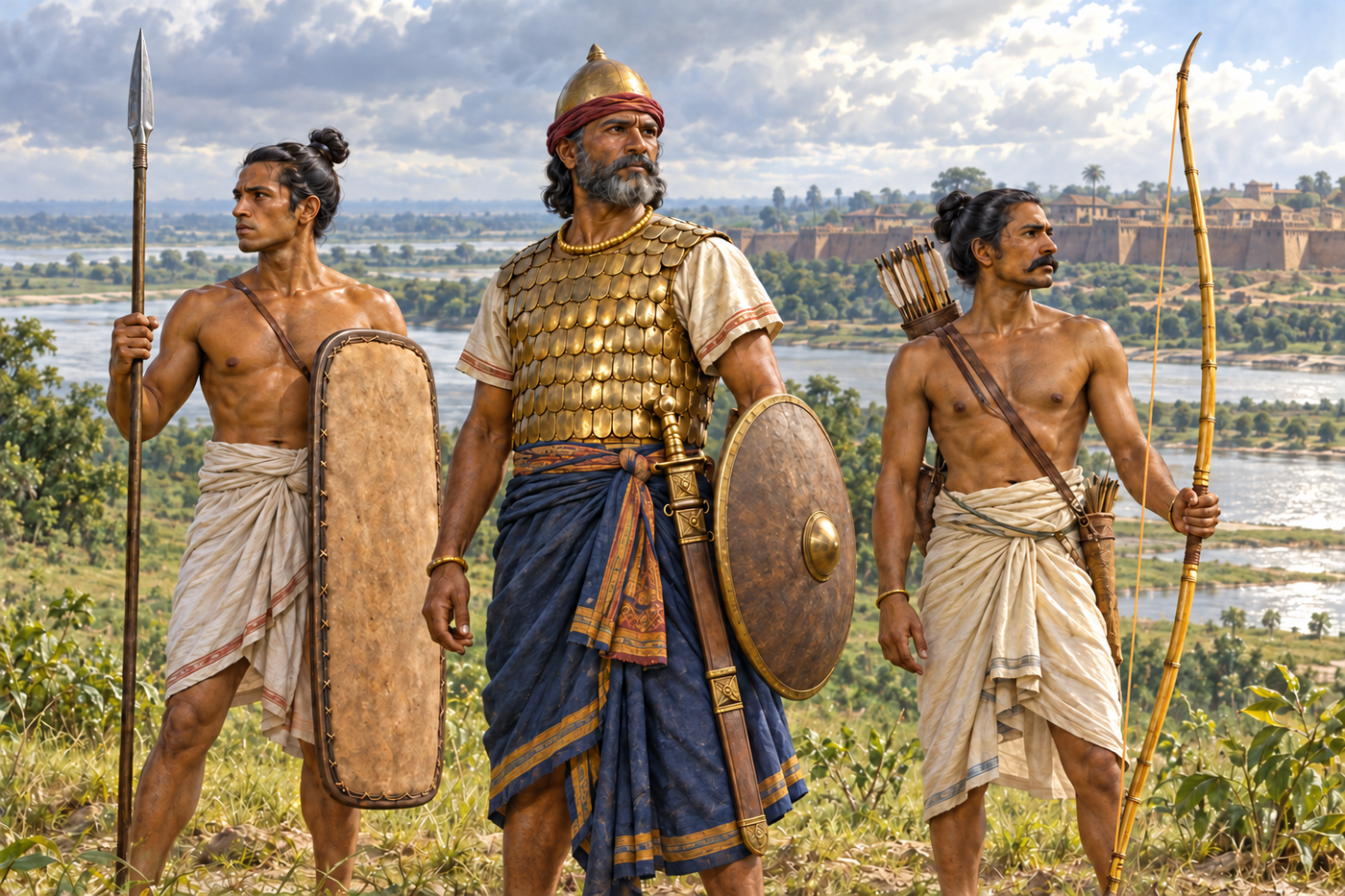
Indians
Porus keeps his ground
At the Hydaspes in 326 BC, Porus continued fighting after much of his army had broken. Wounded and mounted on an elephant, he remained the visible centre of resistance. Alexander wanted him taken alive, but the first envoy sent to approach him was Taxiles, an old enemy. Porus turned on him with a weapon, and the messenger escaped only by riding out of reach.
The encounter could still be resolved through another relationship. Meroes, who knew Porus as a friend, eventually helped bring him to Alexander. The defeated ruler was restored to power and gained territory under the conqueror's protection. A battle fought to defend a kingdom ended by making its king one of Alexander's principal partners in India.
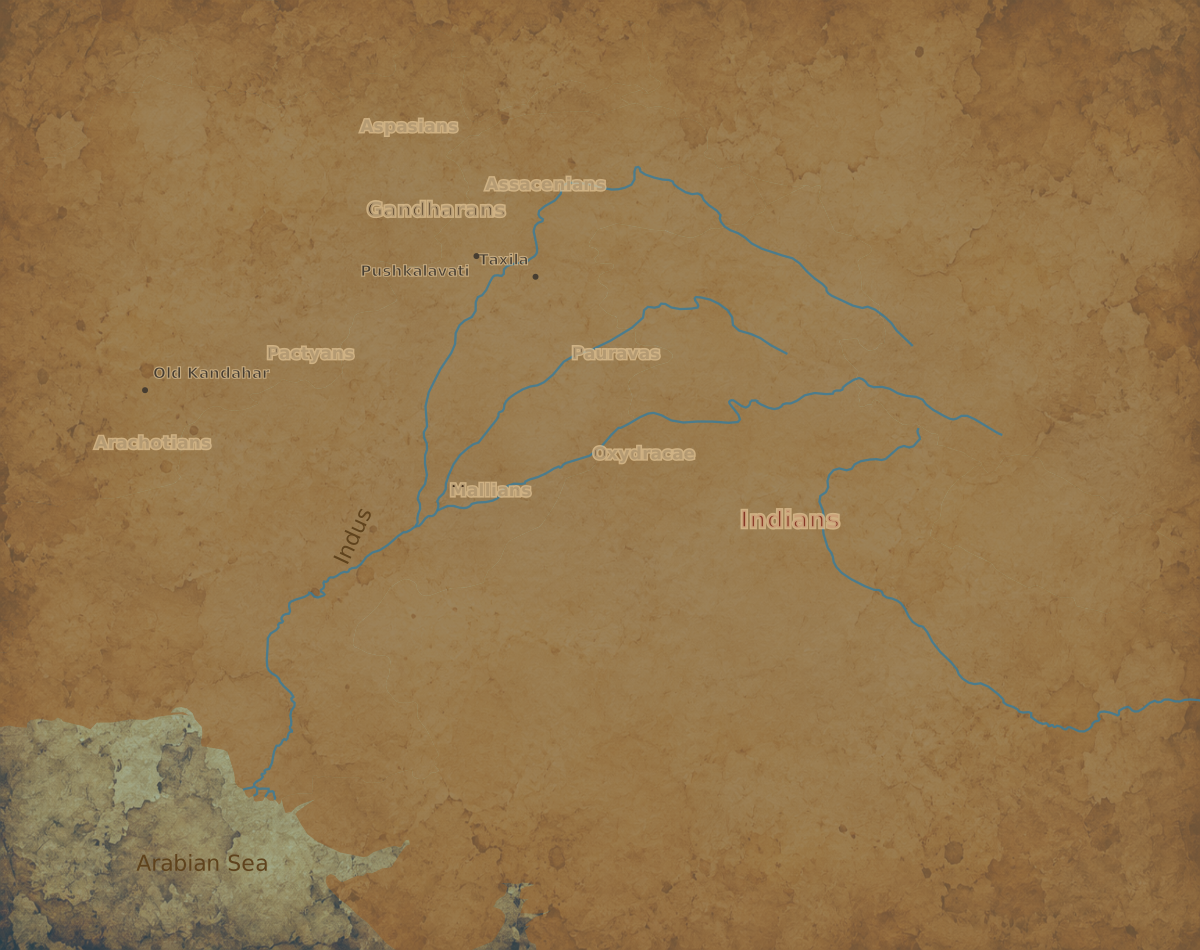
The countries beyond the Indus
Alexander entered a subcontinent containing many kingdoms and communities, rather than a single state waiting to be conquered. The Punjab's rivers divided territories and shaped the routes by which an army could advance. Farther east lay the great powers of the Ganges plain, beyond the country the Macedonians would reach.
The north-west had long been connected to Iran. Achaemenid rule drew parts of the Indus region into the Persian empire, while routes through the mountains linked it with Arachosia and Bactria. Soldiers, administrators and goods had travelled those connections before Alexander followed them with his army.
Within the river plains, cultivated land and settlements supplied the resources on which local rulers depended. An invading army encountered political relationships already in motion: rivals could seek its friendship, threatened kings could resist, and neighbouring communities could choose different responses to the same advance.
Taxiles' invitation
The ruler known to the Greeks as Taxiles welcomed Alexander and provided support. His position near the Indus made the alliance important to the Macedonian advance. Friendship with a powerful outsider could also strengthen him against rivals farther east.
Porus chose resistance. His kingdom lay beyond the Hydaspes, the modern Jhelum, where a swollen river could protect the bank more effectively than a line drawn across open country. Alexander's challenge was therefore to cross without allowing the Indian king to concentrate his strongest forces against the landing.
The rivalry between the two rulers shaped the campaign. Their choices gave the same invader an ally on one side of the political landscape and a determined enemy on another. Alexander exploited those divisions while presenting himself as a king able to recognise and reward local authority.
Arms of the river kingdoms
Arrian's Indica describes Indian infantry carrying large bows, with arrows suited to their size. He also records shields and substantial swords, while mounted men used different equipment. His account reflects the variety observed or reported by Greeks encountering the subcontinent.
Royal armies could combine infantry, cavalry, chariots and elephants. Each depended on different resources and skills: breeding and maintaining horses, building vehicles, supplying archers or training animals whose handling required specialist experience. A king's strength lay in bringing those elements together and sustaining them on campaign.
The elephant gave an army an imposing presence, but its value depended on the men around it. Drivers guided the animals, fighting men used the advantage of height, and infantry had to maintain their own movement beside them. An elephant wounded or deprived of control could endanger the force it had been brought to protect.
The crossing in the storm
Alexander repeatedly moved troops along the river, wearing down the defenders' certainty about where he intended to cross. He finally took a selected force upstream and attempted the passage during a storm. Rain helped conceal movement but also made the water more dangerous.
The first landing did not end the difficulty. The Macedonians had reached ground separated from the mainland by another channel. They found a ford and pushed through deep water before forming for battle. The success of the operation depended on speed after the crossing as well as secrecy before it.
Porus now had to respond to an enemy established on his side of the river. Part of Alexander's army still faced him across the original position, while the crossing force advanced from another direction. The Indian king committed his army to battle before that strategic pressure could become still worse.
Among the elephants
Porus placed elephants within the main line, creating a barrier that threatened the Macedonian horses and infantry. Alexander first sought an advantage against the Indian cavalry. Coenus' movement against its rear helped force the riders back towards the elephants.
The struggle then became crowded and violent. Arrian describes the elephants breaking into infantry formations, while Macedonian troops struck at animals and drivers. As control deteriorated, wounded beasts injured men on both sides. Indian troops retreating towards what had seemed a protective wall found themselves compressed into increasingly dangerous ground.
The outcome was a Macedonian victory, but the battle left a lasting impression on the conquerors. Porus' persistence and the destructive power of the elephants became central to its memory. Alexander commemorated the campaign with new foundations, including one named for Bucephalas, the horse whose life ended in this part of the expedition.
Priests, teachers and royal authority
The Greeks also encountered people whose authority rested on learning, ritual and religious practice. Their accounts describe Brahmans and other ascetics through categories familiar to Greek readers, often presenting them as philosophers. Such men could attract a conqueror's curiosity while exercising influence within their own societies.
Religious authority could support a ruler or oppose submission. In the campaigns farther down the river system, Alexander encountered resistance associated in Greek accounts with Brahman advisers. The meeting between the invading monarchy and local traditions therefore included political conflict as well as conversations about wisdom.
The limit at the Hyphasis
At the Hyphasis, the army refused to advance farther east. The men had endured years of campaigning, wounds, losses and exhausting travel. Reports of the forces beyond the next rivers promised another war without a visible end.
Coenus spoke for the demand to return. Alexander resisted, then accepted the limit imposed by his own soldiers. The decision left the eastern kingdoms beyond the campaign's reach and turned the expedition towards the descent of the river system and the journey home.
After the invader
Alexander's departure left governors, garrisons and allied rulers within an unsettled arrangement. His death in 323 removed the personal authority holding it together. In the years that followed, Chandragupta Maurya built a new power that would unite much of northern India and eventually confront Seleucus, one of Alexander's successors.
The Macedonian campaign had entered an existing history of kingdoms, rivalries and changing ambitions. Porus survived by turning defeat into a new settlement, while powers beyond Alexander's furthest march continued their own struggles. The subcontinent's future would be decided largely by rulers whose armies the conqueror had never faced.
Sources
Ancient narratives
- Arrian, Anabasis, V.8–19, V.25–29 and VI.7–17; especially the Hydaspes crossing, the battle and Coenus' appeal.
- Arrian, Indica, especially 16.
Historical studies
- “India iii. Political and Cultural Relations: Achaemenid Period”, Encyclopaedia Iranica.
- Metropolitan Museum of Art, Mauryan Empire.
- Nicholas Sekunda and John Warry, Alexander 334–323 BC: Conquest of the Persian Empire, Osprey Campaign 7 (1991).