






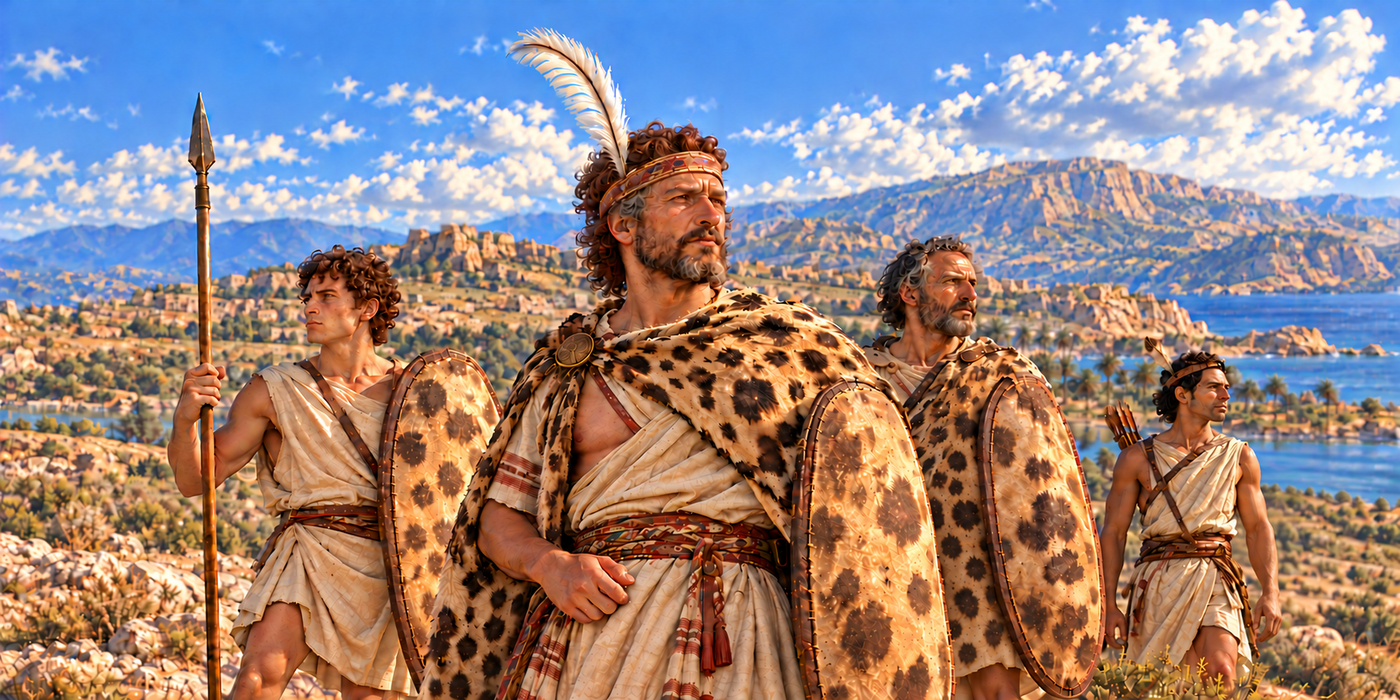
Libyans
The road to Ammon
In 331 BC, Alexander left the Nile country and travelled west towards the oracle of Ammon. Along the coast, the route still offered water. Beyond Paraetonium, it turned inland across country where sand could hide the track and a guide's knowledge became more valuable than the strength of an army.
The journey carried the Macedonian king into a world already connected by travellers, pastoral communities, oasis settlements and Greek cities. His arrival made it part of the story of a conqueror seeking divine recognition. For the people who lived there, its wells, palms and paths had long determined the possibilities of life.
A country of different ways of living
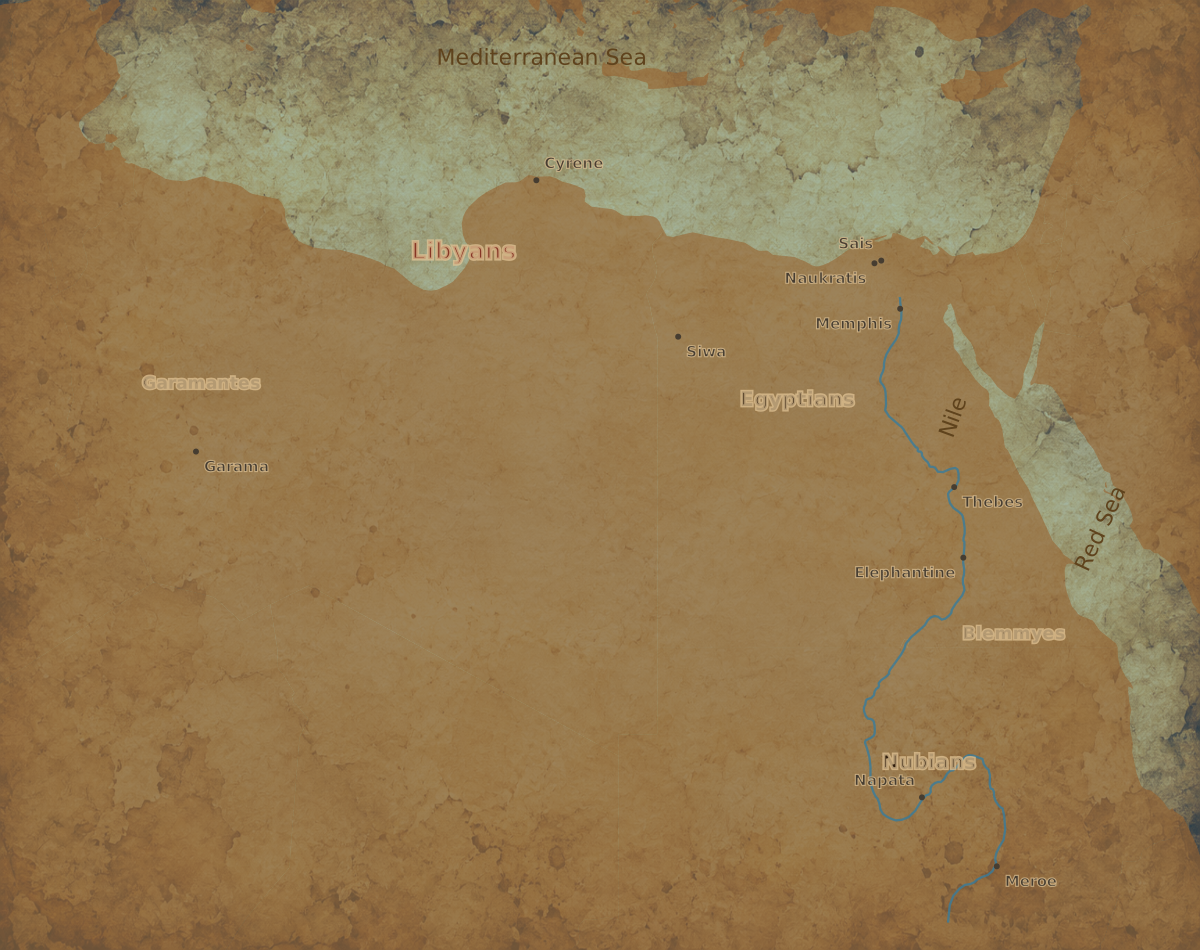
The Greeks used the name Libya for an immense part of Africa west of Egypt. Within that broad horizon lived many peoples, separated by distance and by the landscapes on which they depended. The Mediterranean coast, the cultivated uplands of Cyrenaica and the oases of the interior offered very different resources.
Some communities combined herding with seasonal journeys; others cultivated land around dependable water. The coastal cities linked local produce to seaborne exchange, while routes inland carried people beyond the immediate reach of those ports. Knowledge of the country joined places that an outsider might imagine separated by empty ground.
The political landscape was equally varied. Local rulers, Greek communities, Egyptian authorities and the powers of the western Mediterranean pursued interests that could meet at a pasture, a market or a route to water. No single king could speak for all the people whom a Greek writer called Libyans.
Herds and the date harvest
Herodotus describes the Nasamones moving inland to Augila for the date harvest while leaving their herds near the coast. The journey joined two sources of subsistence across a demanding distance. The palms of an oasis belonged within a seasonal economy extending well beyond its immediate fields.
His account also associates oaths and divination with the graves of distinguished ancestors. Such practices placed the dead within the decisions of the living. The authority of an ancestor could matter when an agreement was sworn or an answer sought about an uncertain future.
These details preserve a society whose movements followed known needs and occasions. A seasonal journey was purposeful, shaped by the resources available at different times of year. The ability to organise it depended on experience transmitted within communities.
Oases farther inland
Farther west and south, the Garamantes occupied the oasis country of the Fazzan. Herodotus knew of cultivation there and described journeys between springs, salt-bearing ground and date palms. His distant reports also included chariots and violent expeditions into neighbouring country.
Archaeology has given the oasis settlements a history far richer than those brief descriptions. Work around Jarma has revealed agriculture, settlement and extensive irrigation systems developing across the first millennium BC and later centuries. Water management allowed communities to sustain cultivation in an environment where rainfall alone could not support it.
The Garamantian world belonged to the wider interior beyond Cyrenaica and the Egyptian frontier. Its growth shows how much political and economic activity could exist away from the Mediterranean shore. Desert country contained centres of production and power, connected by routes whose value depended on those able to use them.
The neighbours of Cyrene
Greek settlement at Cyrene brought new demands for land and new opportunities for exchange. Herodotus recounts how additional colonists arrived under Battus II with the promise of allotments. Expansion came at the expense of neighbouring Libyan communities.
The Libyan ruler Adicran appealed to the Egyptian king Apries for help. The resulting expedition ended in defeat for the Egyptians and contributed to the crisis that overthrew Apries. A dispute over land beside a Greek colony had become entangled with the future of the Egyptian monarchy.
Cooperation also shaped the region. Greek settlements relied on relationships with people who knew the surrounding country, and local communities entered the life of the cities through several kinds of contact. Conflict did not erase the exchanges that made the coast and its hinterland dependent on one another.
Across Egypt's western frontier
The history of Egypt and its western neighbours reached back many centuries before Alexander. Libyan groups appear in Egyptian records as enemies, settlers and soldiers. Families of Libyan ancestry eventually established royal dynasties, making the relationship part of the history of the pharaohs themselves.
Sheshonq I and the rulers who followed him belonged to that earlier age. Their descendants' monuments and titles reveal the passage from regional leadership into Egyptian kingship. By the fourth century BC, the political world had changed repeatedly, but the western frontier remained connected to the Nile through movement and service.
The Persian conquest of Egypt added another imperial power to those relationships. Resistance in the Nile country could draw upon leaders and forces from its western approaches, just as the monarchy sought to secure the roads and communities on which its authority depended.
Alexander among the palms
The oasis of Ammon offered Alexander a fertile refuge within the desert. Arrian describes cultivated trees, palms, springs and the sanctuary whose reputation had drawn visitors from afar. The god was recognised through both Egyptian and Greek religious traditions, allowing the king's consultation to speak to several audiences.
Stories of the journey gave divine favour a visible form. Rain relieved the travellers, and later accounts told of birds or serpents showing the way. These traditions made the desert passage part of Alexander's exceptional destiny.
The consultation itself remained closely attached to the king's own account of what he had learned. Its public importance lay in the relationship it established between Alexander and Ammon. The ruler who had entered Egypt as a conqueror could now associate his future with an oracle honoured beyond the Nile.
New powers on the coast
Cyrene sent an embassy with gifts and sought friendship with Alexander. The city had reasons to recognise the power newly established in Egypt, while the king gained a connection westwards without leading a campaign against it.
After his death, that relationship developed into direct intervention. Fighting around Cyrene brought the mercenary commander Thibron into conflict with local factions, and Ptolemy sent Ophellas from Egypt. The settlement that followed placed the coastal cities within Ptolemaic power.
For the surrounding Libyan communities, another imperial neighbour had arrived. Their future would continue to be decided through local choices as well as royal campaigns: access to land, the safety of herds, relations with the cities and the routes between dependable water. The conquerors changed; the knowledge needed to live in that country remained in the hands of its people.
Sources
Ancient narratives
- Herodotus, Histories, IV.159, IV.168–183, especially the Nasamones and the Garamantes.
- Arrian, Anabasis, III.3 and III.4.
- Diodorus Siculus, Library of History, XVII.49 and XVIII.19–21.
Archaeology and historical studies