






Cretans
Two roads out of Crete
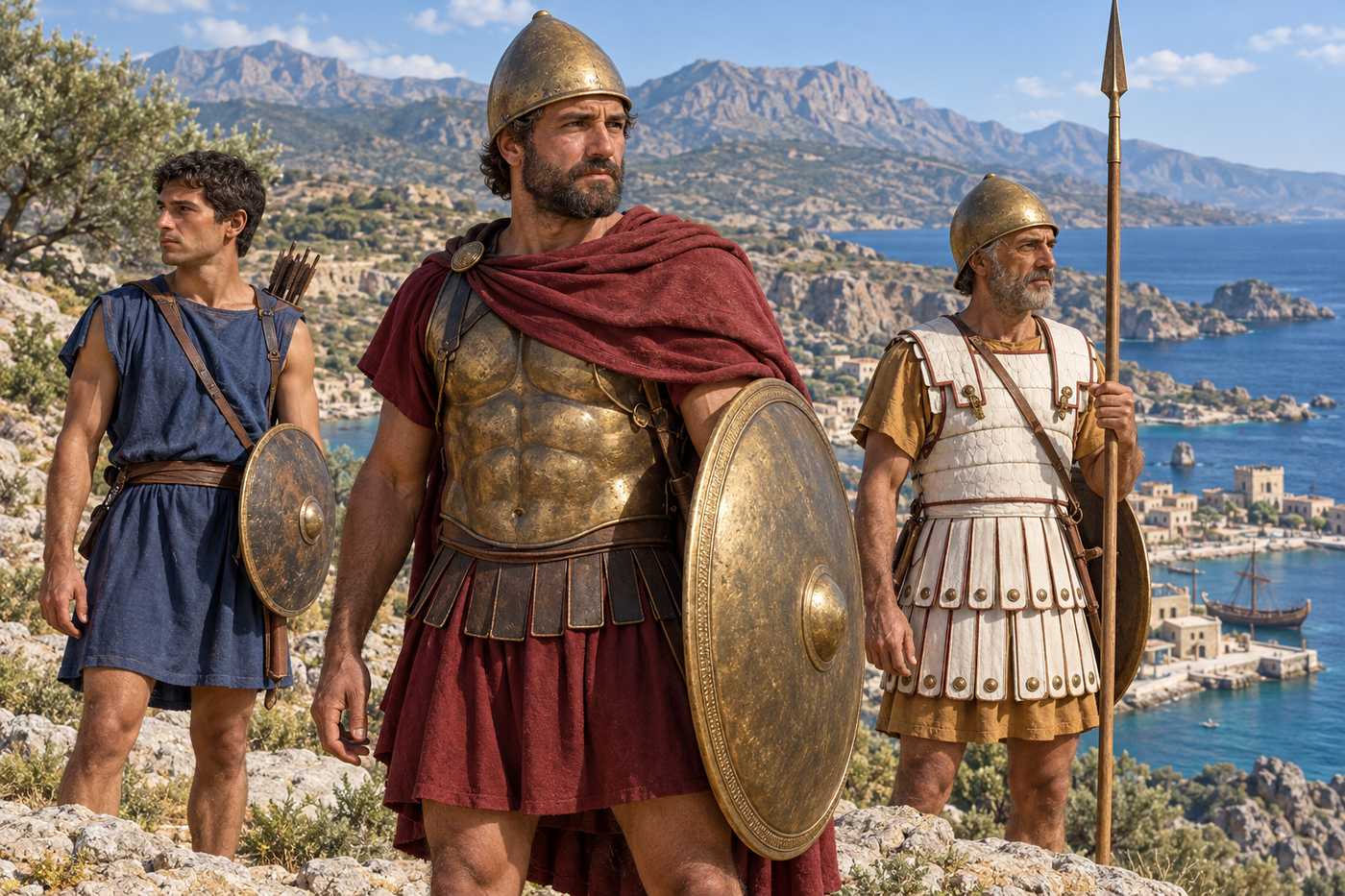
In 335 BC, Eurybotas the Cretan died leading Alexander's archers at Thebes. The attack had gone badly, and the Thebans drove his men back before the Macedonian phalanx recovered the initiative. His name survives in Arrian's account among the officers killed before Alexander had even crossed into Asia.
Within a few years, another royal project was drawing men towards Crete. Agis III of Sparta sought Persian money and ships to challenge Macedonian power. He sent instructions for his brother to sail to the island and establish his position there. Cretans could serve Alexander abroad while their own cities became part of the struggle against his supremacy.
An island of rival cities
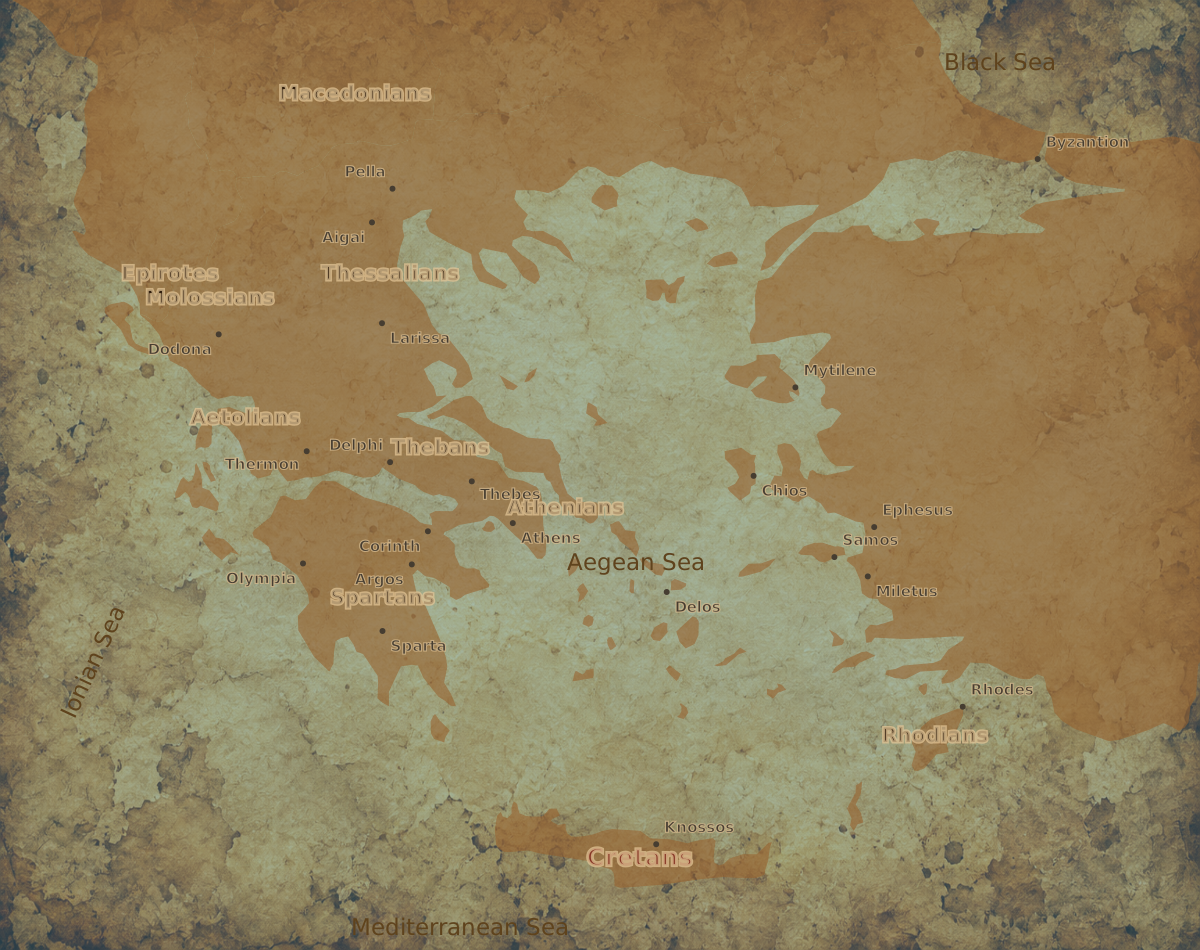
Crete stretched across the sea between the Greek mainland, the Aegean islands and the routes towards Egypt and Cyrene. Its mountains divided fertile valleys and shaped communications between settlements. Harbours opened individual communities to the Mediterranean, while travel through the interior joined them by more demanding paths.
Knossos, Gortyn, Lyttos and Kydonia belonged to a political world of separate cities. Each possessed its own territory, institutions and interests. Alliances could gather several communities together, but the island's name did not imply one government capable of ordering every Cretan to war.
That diversity stood behind the experiences of men serving overseas. A soldier might be identified abroad simply as a Cretan, while at home his family belonged to a particular city and its local relationships. Foreign employers saw a useful military reputation; the recruits carried more specific loyalties with them.
The island of Zeus
Crete held an exceptional place in the stories of Zeus. Mountain sanctuaries and the traditions surrounding Ida and Dicte connected the landscape with the god's childhood and protection. The island also belonged to the world of Minos, whose kingship and laws were remembered throughout Greek literature.
Those traditions gave civic institutions an ancestry reaching into the heroic past. For later Greek writers, Crete could represent an ancient source of law and disciplined life. The cities of the Classical period inhabited that remembered landscape while governing the practical disputes of households, land and political power.
Law written in stone
The great law inscription at Gortyn offers an unusually direct encounter with one Cretan society. Dating to the fifth century BC, it deals with family relations, property, inheritance, marriage and disputes over status. Its provisions distinguish between free people and enslaved people and regulate the claims of households across generations.
Behind the monumental text stood situations familiar to its inhabitants: a marriage ending, an inheritance contested, children whose rights needed definition, or a person's freedom disputed. The city made such questions part of a public legal order. Its citizens lived within rules more detailed than the martial reputation through which foreigners often remembered the island.
The inscription also reveals a society divided by unequal status. The civic community rested on distinctions between those entitled to political standing and those whose labour sustained households and land. The celebrated discipline of Cretan institutions belonged to that social structure.
Meals, magistrates and competition
Aristotle compared Cretan institutions with those of Sparta. He discussed the common meals, the magistrates called kosmoi and the concentration of authority among leading families. His account praises some arrangements and criticises others, treating Crete as a political example rather than an exotic curiosity.
The meals connected civic membership with shared provision and regular association. Public resources and the produce of dependent labour supported the system he describes. The same community that trained men for war also brought them together through institutions governing how they ate, served and recognised one another.
Competition among powerful families could still disrupt that order. Aristotle's criticism of faction and the manipulation of office shows that a reputation for ancient law did not eliminate ambition. Cretan cities faced the same struggle to contain elite rivalry that troubled many other Greek communities.
Archers in foreign service
Cretan archers acquired a reputation that made them valuable to employers beyond the island. Xenophon encountered them among the Greek forces that marched into the Persian empire with Cyrus the Younger in 401 BC. During the retreat, the problem was immediate: enemy missile troops could strike from beyond the Greeks' effective reach.
The Cretans adapted by using captured Persian arrows and practising longer-range shooting. Their skill appears in the account as something exercised under pressure, dependent on available equipment and the demands of a campaign. It helped an army survive encounters in which heavy infantry alone could not answer the enemy.
Mercenary service could turn such experience into a livelihood. A man who returned home had knowledge of distant countries, different commanders and the uncertainties of pay. Other men might follow the same route, joining groups in which shared origin offered useful connections.
Alexander's war and Agis' opportunity
Eurybotas' death at Thebes places a Cretan officer within Alexander's army at the beginning of the reign. It also shows the dangers faced by archers when a fight closed around them. Their mobility and missiles were valuable, but a successful enemy advance could leave them urgently dependent on supporting troops.
Agis pursued a different opportunity after Alexander entered Asia. The Persian naval commanders Pharnabazus and Autophradates could still support resistance in the Aegean. Arrian records money and ships being placed at the Spartan king's disposal, followed by the mission towards Crete.
The island's cities and manpower mattered because the war extended beyond the route of Alexander's main army. Influence at sea, access to recruits and the possibility of disturbing Macedonia's rear could alter the wider balance. Crete stood within that contest, rather than safely outside it.
Beyond a soldier's reputation
Later inscriptions continue to reveal Cretans acting across the Mediterranean. An Athenian decree honoured Eumaridas of Kydonia for helping captives taken to Crete and supporting efforts to protect Athenian interests there. It names several Cretan cities and the personal relationships through which diplomacy could operate.
The decree belongs to the Hellenistic period, when the island's connections remained both profitable and dangerous. Captivity, ransom, trade and civic friendship formed part of the same seaborne world that offered military employment.
For the Cretans of Alexander's age, the island was therefore a homeland of laws, cults and rival communities as well as a source of soldiers. Their archers became famous abroad, but the decision to leave began in cities whose own histories continued while those men fought in another king's war.
Sources
Ancient texts and inscriptions
- The law code of Gortyn.
- Aristotle, Politics, II.10.
- Xenophon, Anabasis, III.3–4.
- Arrian, Anabasis, I.8, II.13 and III.6.
- Strabo, Geography, X.4.
- Athenian honours for Eumaridas of Kydonia and Charmion, IG II³ 1, 1137.
Historical reference works
- Nicholas Sekunda, The Ancient Greeks, Osprey Elite 7 (1986).
- François Sabbathier, Dictionnaire pour l'intelligence des auteurs classiques grecs et latins, “Crète”.