






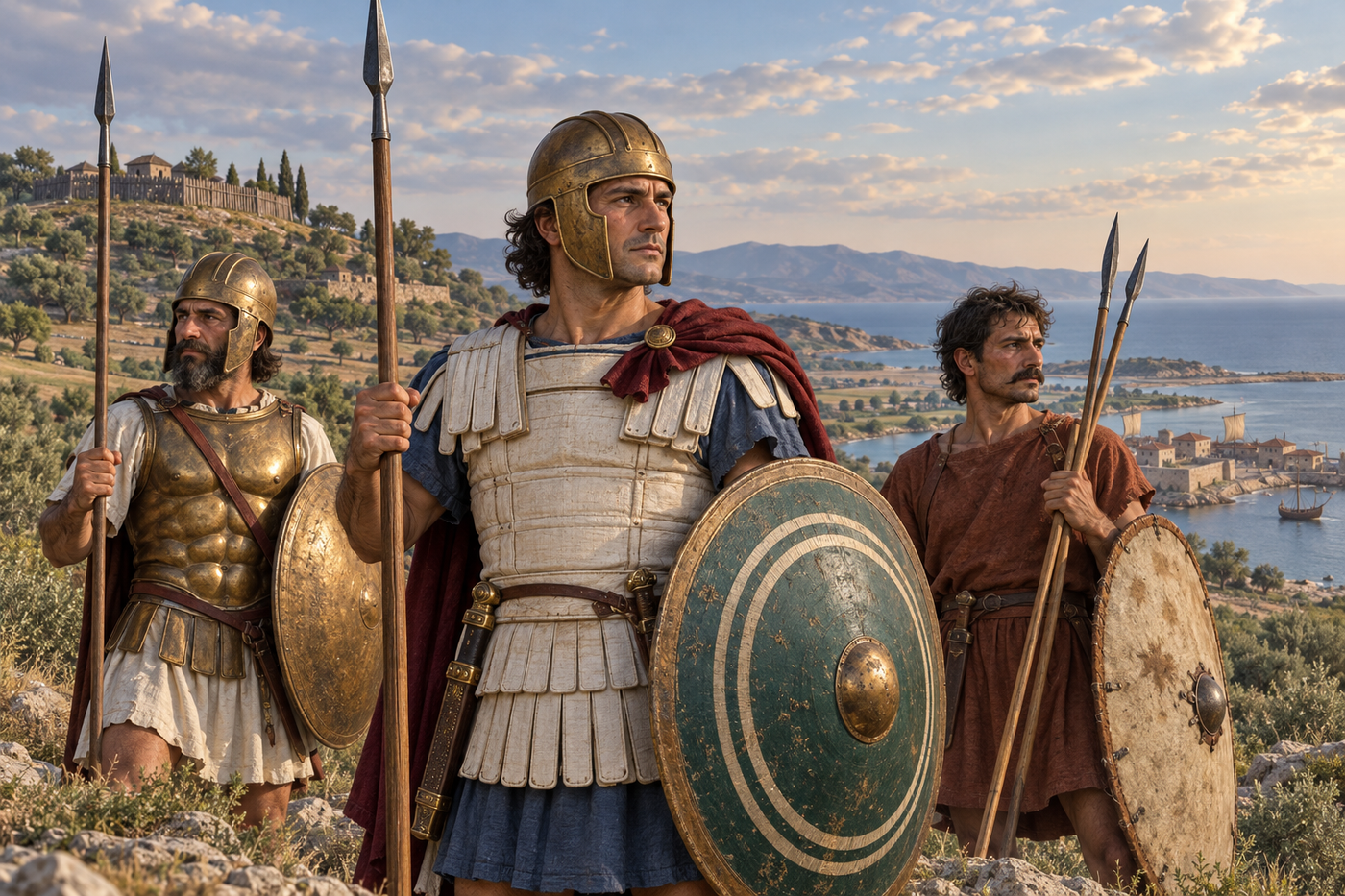
Taulantians
The king who sheltered Pyrrhus
The fugitives brought the child into Glaucias' house and placed him before the king. Pyrrhus was still an infant, driven from Epirus by the enemies of his father. Protecting him meant risking the hostility of Cassander, one of the most dangerous men in the struggles following Alexander's death.
Plutarch tells how the child clung to Glaucias and moved him to pity. The king entrusted him to his wife and refused to surrender him, even when Cassander offered a great sum of money. Years later, Glaucias returned with an army and placed the boy on his ancestral throne. The Taulantian ruler who had once fought Alexander was still shaping the future of Macedonia's neighbours.
The coast and its hinterland
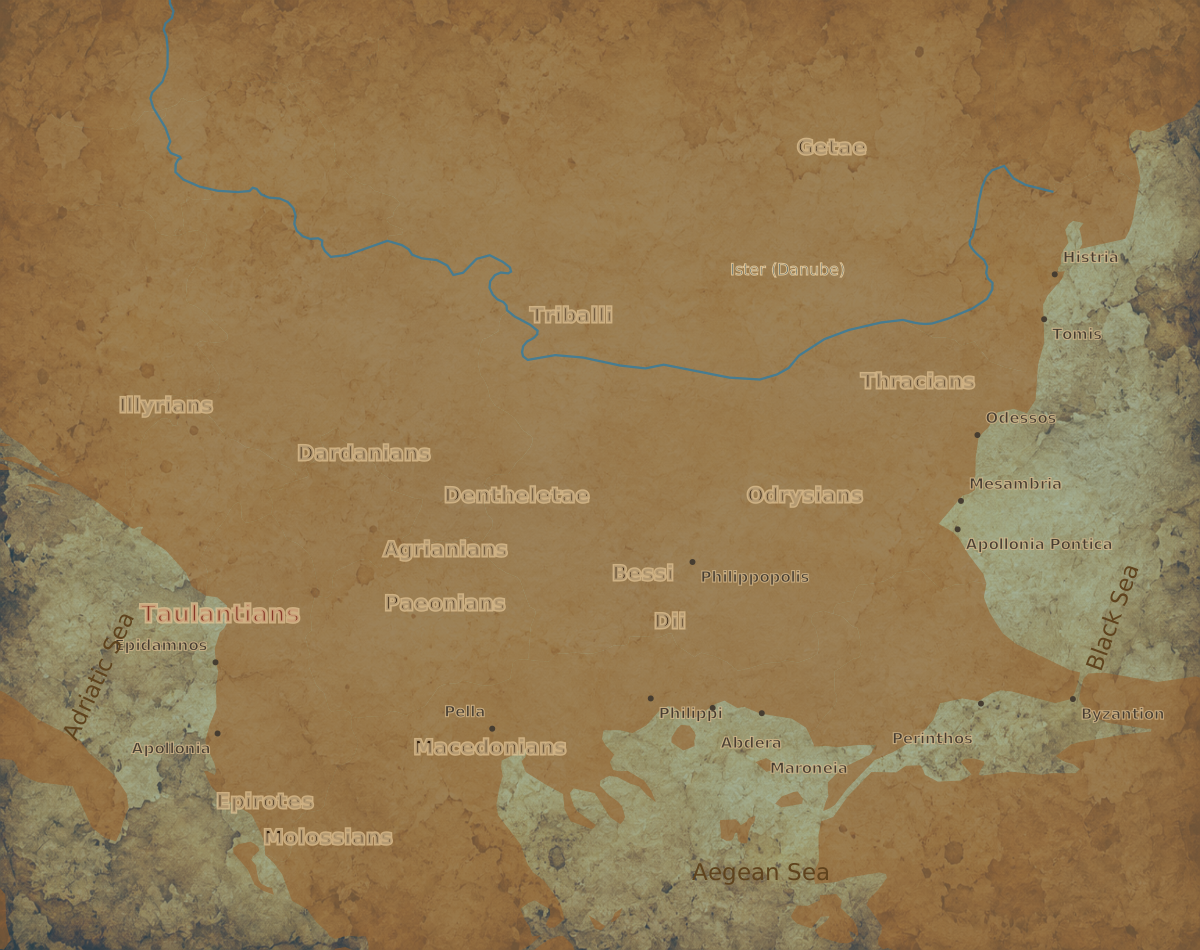
The Taulantians belonged to the Illyrian world beside the Adriatic, in the country around Epidamnus and the routes inland. Their position joined coastal exchanges to the river valleys and uplands of the western Balkans. Greek settlements stood close to communities whose leaders could influence access to the interior.
Ships arriving from Corcyra or farther south entered a landscape in which Greek civic institutions existed beside Illyrian political powers. Commerce, marriage, exile and warfare brought the two into repeated contact. A city could depend on its harbour while still finding its security decided by relationships beyond its walls.
A crisis at Epidamnus
Thucydides names the Taulantians as the Illyrian neighbours of Epidamnus when explaining the events leading towards the Peloponnesian War. The city had become prosperous, then suffered from internal conflict and war with surrounding peoples. Its expelled nobles joined local allies and attacked those who remained in the town.
The besieged citizens appealed to Corcyra, their mother city. When help was refused, they turned towards Corinth. The dispute drew larger Greek powers into a local struggle in which Illyrian neighbours were already participants. A quarrel on the Adriatic coast became one of the steps towards war between Athens and Sparta.
The episode shows how closely the Taulantian country belonged to the political life of the coast. The boundary between Greek city and Illyrian neighbour did not prevent alliances across it. Exiles could find supporters outside the walls, while rival Greek powers competed to decide the city's allegiance.
Glaucias joins Cleitus
In 335 BC, Glaucias allied with Cleitus, son of Bardylis, against Alexander. Cleitus occupied Pelion, a strong position surrounded by heights. The young Macedonian king had only recently completed his expedition towards the Danube when news of the coalition reached him.
Alexander moved quickly and arrived before Glaucias. He attempted to contain Cleitus, but the Taulantian army's arrival changed the situation. An assault on the town now risked an attack from outside, while the surrounding ground threatened Macedonian supplies and movement.
Glaucias acted against a foraging expedition led by Philotas, occupying the heights above the plain where the Macedonians intended to obtain provisions. Alexander had to bring selected troops to its rescue. The coalition was attacking the practical requirements of the royal army: food, freedom of movement and a secure way out.
A retreat turned into a trap
Alexander answered with an extraordinary display of drill. His phalanx changed formation and direction in silence, then advanced with a sudden clash of weapons and battle cries. The manoeuvres helped clear ground for a withdrawal across the river, covered by archers and artillery.
Glaucias and Cleitus had failed to prevent the crossing, but they still held the position Alexander had left. Three days later, the Macedonian king learned that their camp was extended and insufficiently guarded. He crossed back by night with picked troops and attacked before the coalition could organise its defence.
The surprise shattered the camp. Cleitus abandoned and burned Pelion, then took refuge with Glaucias in Taulantian country. The defeat ended the immediate challenge to Alexander, yet it left Glaucias alive and in possession of a homeland beyond the battlefield.
The resources of a king
Arrian's account places cavalry, missile troops and heavier infantry within the forces facing Alexander. The coalition could exploit heights, threaten forage and press a retreat as well as defend a fortified place. Its failure came against an opponent able to combine disciplined movement with a sudden reversal of direction.
Glaucias' later career demonstrates the durability of his position. A ruler who could offer protection to another royal family, resist Cassander's demands and eventually intervene in Epirus possessed more than a temporary gathering of warriors. His authority survived a major defeat and continued through the upheavals of the Macedonian succession.
Cassander and the Adriatic cities
After Alexander's death, the Adriatic coast remained part of the struggle for power. Cassander campaigned towards Apollonia and Epidamnus, seeking to extend his influence while Glaucias defended his own position. Control of those cities affected both communications and the balance between Macedonia, the coast and the inland rulers.
Military success could be followed by political reversal. A garrison or agreement imposed on a city depended on the continued ability to sustain it. Glaucias' presence in the hinterland made him a continuing factor whenever a Macedonian commander attempted to settle the region.
A dynasty preserved
Pyrrhus' refuge brought the ambitions of Epirus directly into Glaucias' household. The protection of the child created a relationship whose importance grew as the boy approached the age of kingship. In 307 BC, Glaucias restored him by force of arms.
The act carried consequences far beyond Taulantian territory. Pyrrhus would become one of the great commanders of the next generation, campaigning in Macedonia, Italy and Sicily. His survival had depended on a king whom Alexander had defeated but failed to remove from the politics of the western Balkans. Glaucias' most lasting intervention began with the decision to shelter a child.
Sources
Ancient narratives
- Thucydides, History of the Peloponnesian War, I.24–26.
- Arrian, Anabasis, I.5 and I.6.
- Plutarch, Pyrrhus, 2–4.
- Diodorus Siculus, Library of History, XIX.67 and XIX.70.
Material culture and classical reference works