






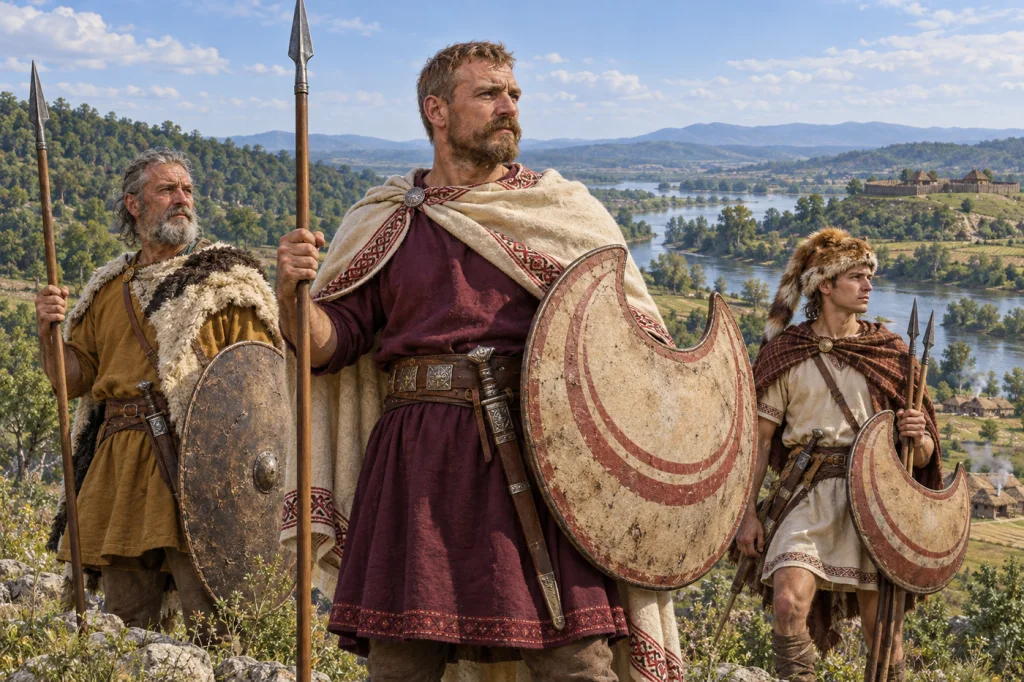
Triballi
The island Alexander could not take
In 335 BC, Syrmus sent his people's women and children to an island in the Danube. Alexander was approaching, and the Triballian king had prepared a refuge before the Macedonian army reached his country. Neighbouring Thracians joined the flight. The island, called Peuce in Arrian's account, became the place where survival mattered more than accepting the invader's preferred battle.
Alexander eventually brought ships against it, carrying archers and heavy infantry. The defenders met them at the shore. Steep banks, a difficult current and the limited number of vessels frustrated the attack, and the Macedonians withdrew. Syrmus had found ground on which the conqueror's army could not readily turn its strength into possession.
North of the great kings
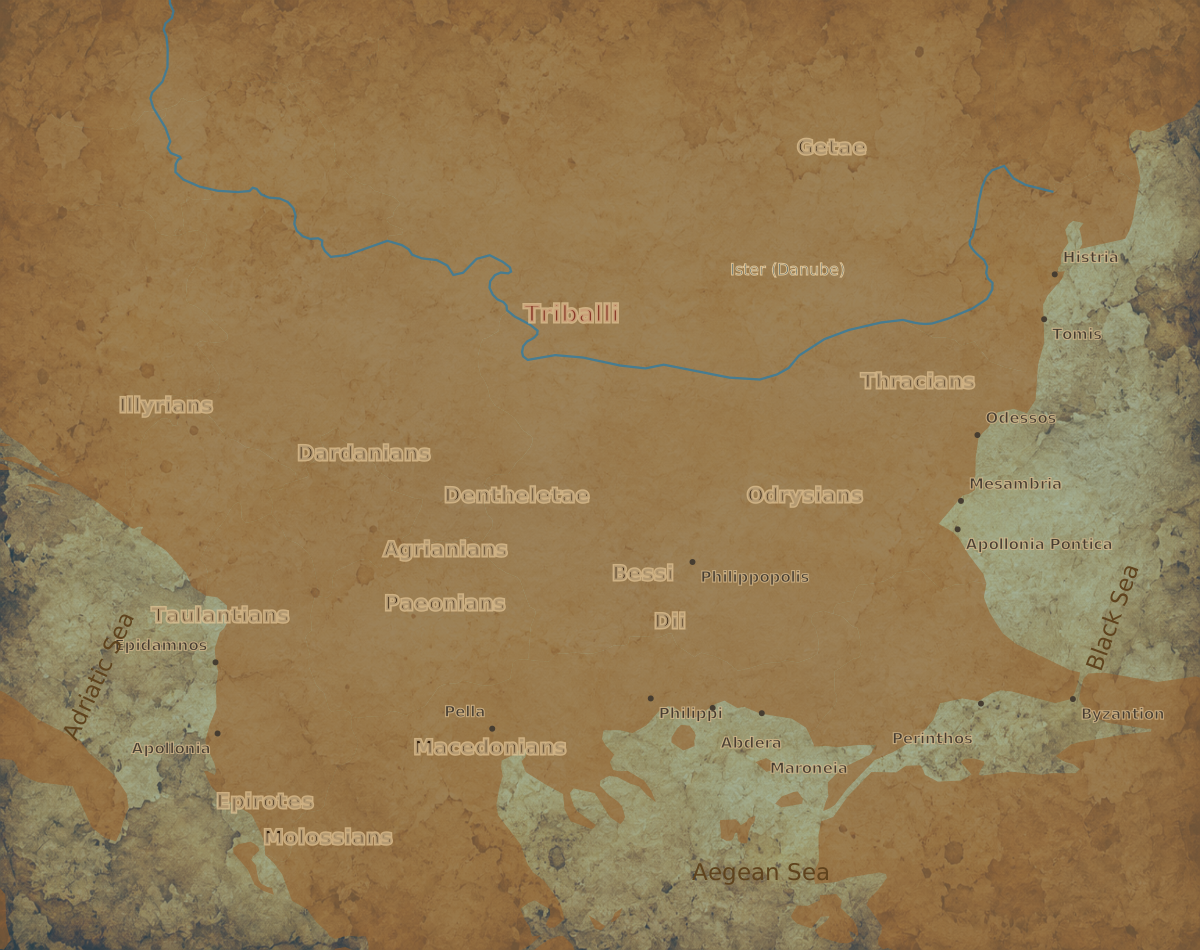
The Triballi occupied part of the northern Balkan interior, between the Danube and the country beyond the Haemus. Their history connected the river plains with the routes leading south through Thrace. Greek writers knew them as an independent power on the margins of the Odrysian world.
Their position offered access to several different landscapes. River valleys supported settlement and movement, forests could shelter warriors from pursuit, and the Danube provided both a barrier and a route. Boats allowed people to reach islands and communicate along its banks. The same geography that challenged an invading army could sustain the daily journeys of those who lived there.
Thucydides places the Triballi beyond communities associated with the reach of Odrysian kingship. Their independence formed part of the political geography surrounding Thrace's great fifth-century monarchy. The north contained peoples whom a king might threaten or bargain with without being able to command them as ordinary subjects.
Silver in the northern country
The Rogozen treasure reveals the wealth and connections of this wider region. Found in north-western Bulgaria, its great collection of silver vessels, many with gilding, accumulated over generations. Drinking and pouring vessels brought together elaborate workmanship, images and inscriptions within an exceptional deposit.
Such objects belonged to the world of aristocratic display, gifts and ceremonial drinking. They show that the northern interior participated in exchanges reaching beyond local settlements. Valuable possessions could pass between rulers, craftsmen and households through several kinds of relationship, including diplomacy and war.
The treasure's discovery in Triballian country gives the region a material richness that military narratives rarely pause to describe. The men who confronted Macedonian kings lived in a world where wealth could be collected and displayed with considerable sophistication.
When hunger carried war south
In the 370s BC, a Triballian force reached the territory of Abdera on the Aegean coast. Diodorus connects the movement with famine. The expedition carried the crisis of the northern country into the fields of a wealthy Greek city.
The Abderites fought back, but the conflict became a severe threat to them. Chabrias' Athenian forces helped end the immediate danger. The episode showed how far an inland people could project armed power when necessity or opportunity drew warriors beyond their usual country.
To the inhabitants of Abdera, the invaders represented destruction in the surrounding farms and the possibility of disaster for the city itself. To the men following the Triballian expedition, the same countryside offered food and booty. The encounter joined a local shortage to the wider struggle over security along the Thracian coast.
Philip's costly return
In 339 BC, Philip II returned from his campaign against the Scythian king Ateas with plunder and captives. The Triballi blocked his passage and demanded a share. Justin describes a dispute that became a battle, in which Philip suffered a severe wound to the thigh and the Macedonians lost the booty amid confusion over his fate.
The victory over the Scythians had therefore failed to guarantee a safe journey home. A royal army burdened with the proceeds of a campaign could become a tempting target, and control of the route gave the Triballi leverage over a king who had already defeated many of his neighbours.
Six years later, Philip's son entered the same northern world with an urgent purpose. Before Alexander could cross to Asia, he needed to make it dangerous for neighbouring peoples to exploit his absence. The campaign of 335 was part of the preparation for his Persian war.
Battle beside the Lyginus
After crossing the Haemus, Alexander reached the river Lyginus. Syrmus had already organised the refuge on the Danube, but a substantial Triballian force remained in the field. Alexander turned against it and found the warriors taking position in wooded ground beside the river.
He used archers and slingers to draw them out. When the Triballi advanced against those lighter troops, Macedonian cavalry struck their wings and the phalanx pressed the centre. The combined attack forced them back towards the trees and water. The wood and approaching darkness helped limit the pursuit, though Arrian describes heavy losses.
The action exposed the difference between skirmishing from favourable cover and receiving a coordinated attack in the open. The Triballi could contest the first kind of fighting effectively; Alexander sought to make them accept the second.
Syrmus makes peace
The subsequent failure to force a landing on Syrmus' island left the king with a refuge still intact. Alexander then crossed the Danube against the Getae, whose withdrawal and abandoned settlement allowed him to demonstrate his reach on the opposite bank.
After that expedition, envoys came from Syrmus and other independent peoples near the river. Alexander exchanged pledges of friendship with them. The campaign ended in an agreement, with the Triballian king still able to speak for his people.
For Syrmus, the essential achievement was preserving a future after an invasion by a stronger army. He had suffered a battlefield defeat, protected dependants on difficult ground and negotiated once the immediate balance had changed. The Triballi's story in Alexander's first campaign contains both the violence of resistance and the judgement required to end it.
Sources
Ancient narratives
- Thucydides, History of the Peloponnesian War, II.96.
- Diodorus Siculus, Library of History, XV.36.
- Justin, Epitome, IX.3, Philip and the Triballi.
- Arrian, Anabasis, I.2, I.3 and I.4.
Archaeology and military history
- Regional History Museum, Vratsa, The Rogozen Treasure.
- Christopher Webber, The Thracians 700 BC–AD 46, Osprey Men-at-Arms 360 (2001).