






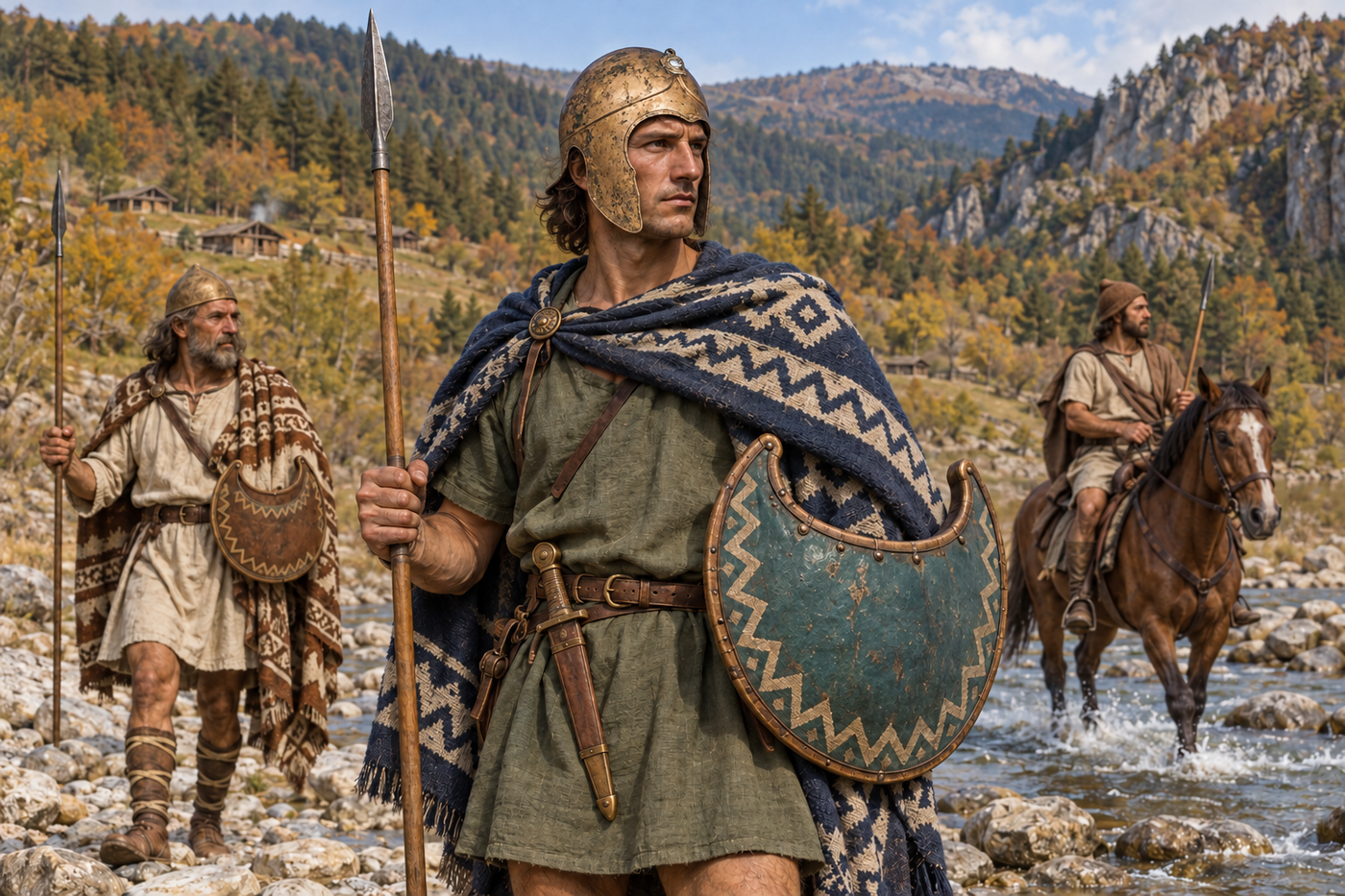
Dentheletae
Grain taken from an ally
In 181 BC, Philip V brought an exhausted army down from his expedition into the Balkan mountains and entered the country of the Dentheletae. They were his allies. Their villages held the grain his soldiers needed. Hunger overcame the obligations of friendship, and the Macedonians plundered the settlements that should have been protected by their agreement.
Livy describes the inhabitants appealing to the king and invoking the gods who guarded treaties. The episode came long after Alexander, but it reveals the value and vulnerability of this country with unusual clarity. Its people possessed fields, stores and political agreements. Their place between stronger powers could make all three matters of survival.
The upper Strymon country
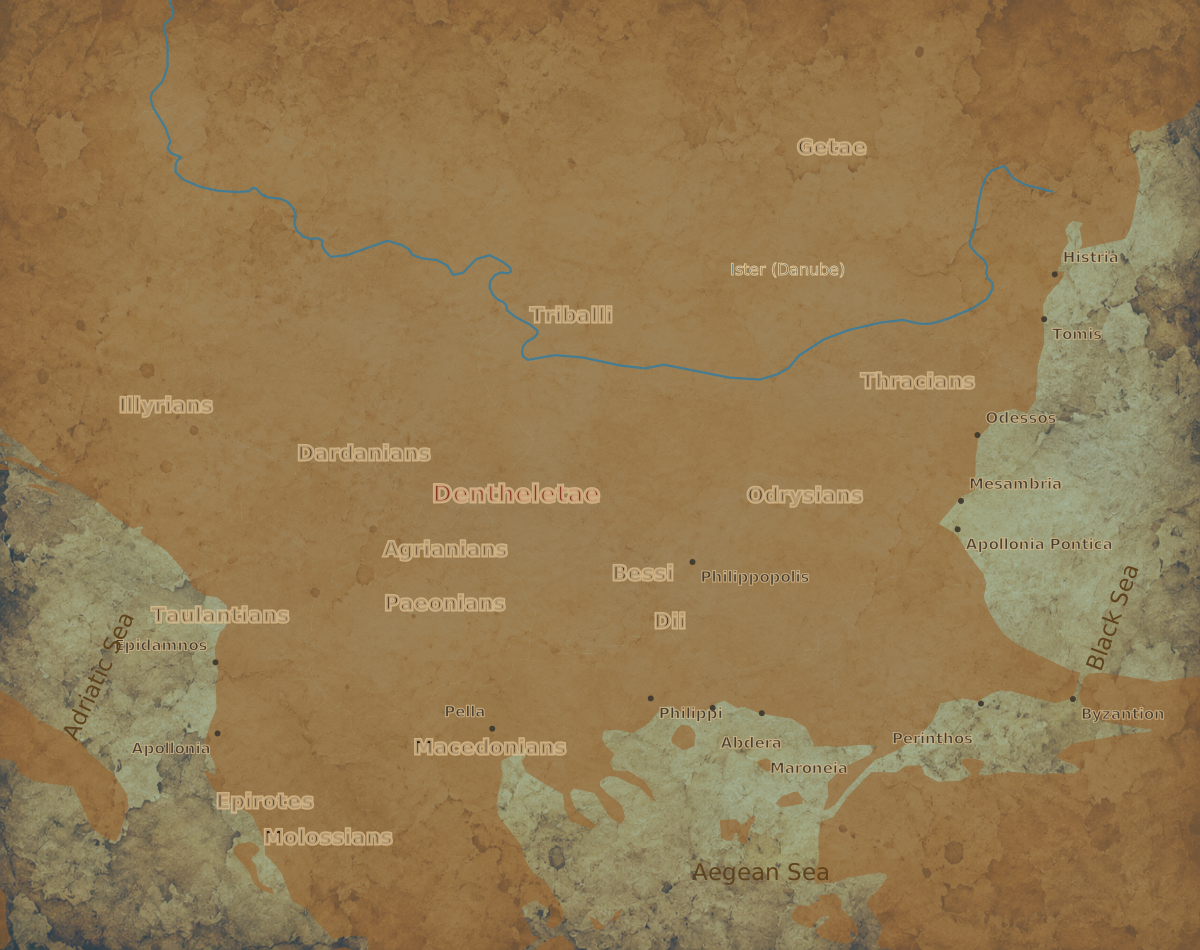
The Dentheletae were a Thracian people associated with the upper Strymon, the modern Struma, and the basins around Kyustendil and Dupnitsa. Their country lay among routes joining inland Thrace to Paeonia, Dardania and the western Balkans. Farther south, the river led towards Macedonia and the Aegean.
Broad valley floors, wooded ridges and mountain passages gave the region several different kinds of ground. Cultivated land could support settlements and provide stores, while upland grazing and access to neighbouring valleys linked communities beyond a single basin. The terrain offered both resources worth taking and places in which an invader's movement could become difficult.
Kyustendil's thermal springs formed another enduring attraction. The settlement later known as Pautalia developed in this favourable landscape. Its famous Roman buildings and civic prosperity belonged to a later age, but the combination of water, cultivable country and routes through the surrounding uplands had a much longer history.
A meeting place of Balkan worlds
The Dentheletae occupied a position between several regional societies. Contacts could run east towards Thracian rulers, south along the Strymon and west towards the peoples of the interior. Goods, armed groups and political ambitions moved through the same connected country.
This position gave local leaders opportunities as well as dangers. A neighbouring king might seek passage, supplies or troops; another might value an alliance securing his frontier. The ability to speak for a community and mobilise its resources could make a ruler useful well beyond his own settlements.
The region's mineral deposits added to its potential. Silver, copper and iron occurred in the surrounding mountains, with gold in the wider district. Their presence formed part of the resources of south-western Bulgaria, alongside its agricultural basins. The later prosperity of the area grew from a landscape that could sustain far more than an isolated life in poor mountain hamlets.
A name on bronze
The Dentheletae were already known to the fourth-century historian Theopompus. A rare bronze coin issue gives their political identity a more immediate expression: the community's name appears beside a head of Dionysos and a warrior with a curved sword and light shield.
Yannis Stoyas has proposed a date around 339–335 BC for this issue, placing it near the transition from Philip II to Alexander. The combination of divine and military imagery made a recognisable statement in a small object that could pass between hands. A people appearing only briefly in surviving narratives had chosen to put its own name into circulation.
The issue belongs to the wider monetary world of the Thracian interior. Kings and communities used coins to assert authority and conduct transactions in a region connected to Greek markets and neighbouring powers. The armed figure gave the Dentheletae an image of themselves suited to an age in which political standing depended heavily on the ability to defend it.
The Macedonian advance
Philip II transformed the balance of the Balkans. His victories over neighbouring peoples and his expansion into Thrace reduced the room in which local rulers could act independently. Alliances that had once balanced several powers faced a monarchy capable of coordinating larger campaigns and maintaining pressure across successive years.
For communities along the inland routes, Macedonian success could bring demands for obedience and resources, but also access to new military and political relationships. An agreement might protect a ruler from one neighbour while binding him more closely to another. The choices made by local leaders affected the security of their settlements as directly as the outcome of a distant royal battle.
Alexander inherited that northern world in 336 BC. Before crossing into Asia, he campaigned against the Triballi and the Illyrian coalition, seeking to secure Macedonia's approaches. The Dentheletae belonged to the connected country around those struggles, between the river valleys and the peoples whose alliances could change with a royal succession.
A useful ally of Macedonia
The later incident with Philip V shows how material that connection could become. An army returning from the heights required food immediately. The Dentheletae's grain was close at hand, and their alliance did not prevent its seizure.
Their appeal exposed the failure of a political bargain. A treaty promised a recognised relationship between ruler and community; the soldiers' actions turned the inhabitants into victims of the partner whose friendship they had accepted. The king's larger ambitions were paid for in the losses of farming households.
The blind king and the invaders
By the first century BC, the security of Macedonia had become a Roman concern. Cicero's attack on Piso, delivered in 55 BC, accused the former governor of mistreating the Dentheletae despite the value of their earlier support. The charge made sense because they were recognised as partners whose goodwill mattered on the frontier.
In 29 BC, the Bastarnae crossed into their country. Cassius Dio names their king as Sitas and describes him as blind. The Dentheletae held a treaty with Rome, and Marcus Licinius Crassus advanced to protect both the allied ruler and Macedonia. His approach drove the invaders away before a battle in Dentheletic territory.
The danger did not end with that intervention. The defeated Bastarnae later attacked the Dentheletae again, showing how an ally could become a target precisely because of his relationship with Rome. Sitas ruled in a landscape where decisions made by distant commanders could bring another army into his people's fields.
Across these episodes, the Dentheletae emerge as a community with a name, resources and rulers of its own. Their country helped connect the Thracian and western Balkan worlds. That position made them valuable to larger kingdoms, while leaving them to bear the immediate cost when friendship, hunger and war collided.
Sources
Ancient accounts
- Theopompus, fragments concerning the Dentheletae, discussed in the numismatic studies below.
- Livy, History of Rome, XL.21–22.
- Cicero, In Pisonem, 84.
- Cassius Dio, Roman History, LI.23 and LI.25.3.
Archaeology, geography and coinage