






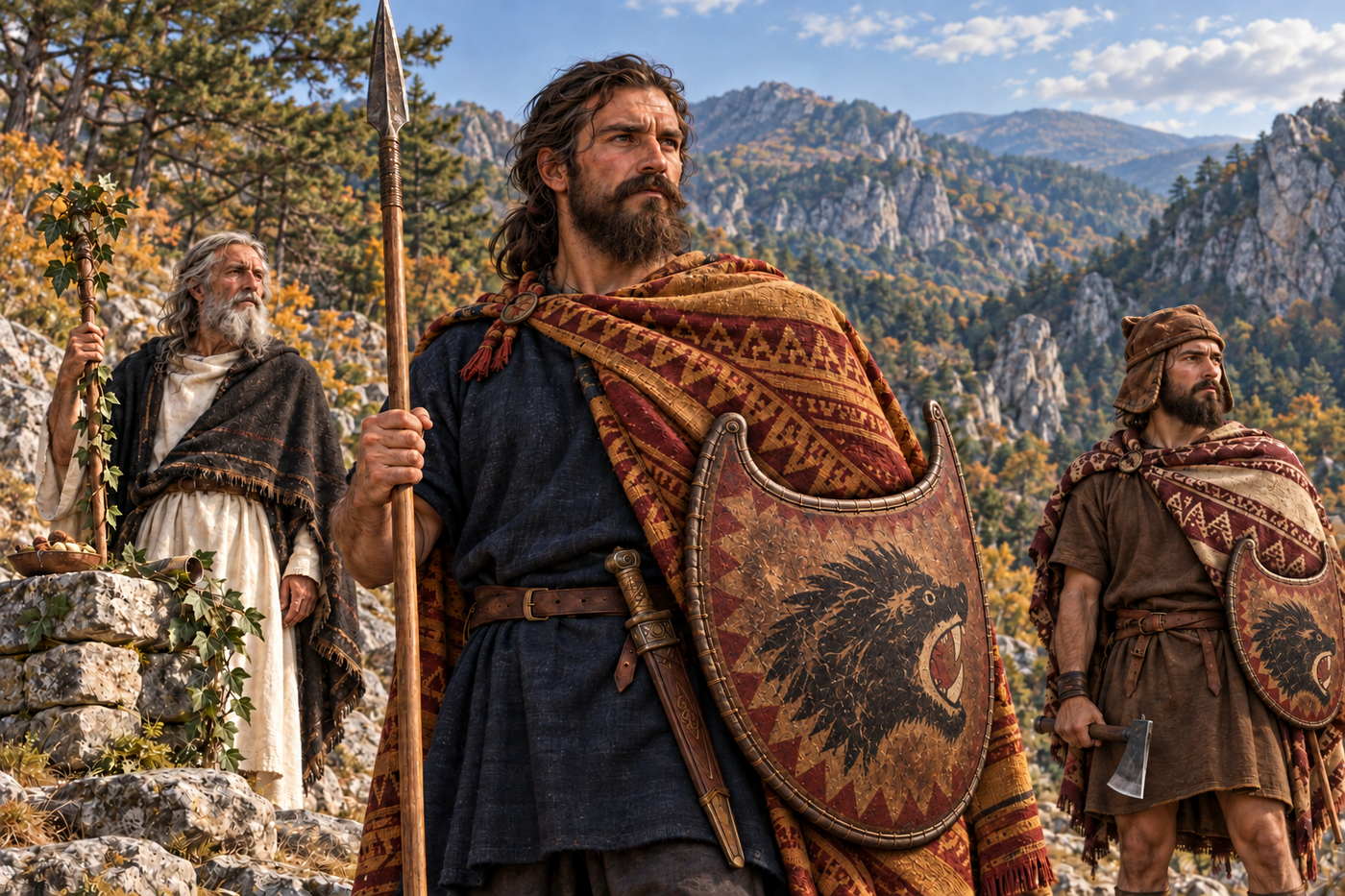
Bessi
The voice on the mountain
High in the mountains of Thrace, a prophetess spoke for Dionysos. Herodotus places the sanctuary among the Satrae, a people whom he describes as preserving their freedom in country covered with forests and snow. The Bessi served as interpreters of the oracle. At this remote shrine, the authority of the god could reach beyond the settlements and valleys surrounding it.
For the Greeks, such a place joined familiar religious questions to an unfamiliar landscape. Kings and travellers wanted to know what awaited them; a mountain sanctuary offered answers whose force depended on the reputation of its god and those who spoke in his name. The Bessi entered written history through that responsibility.
Between the valleys and the heights
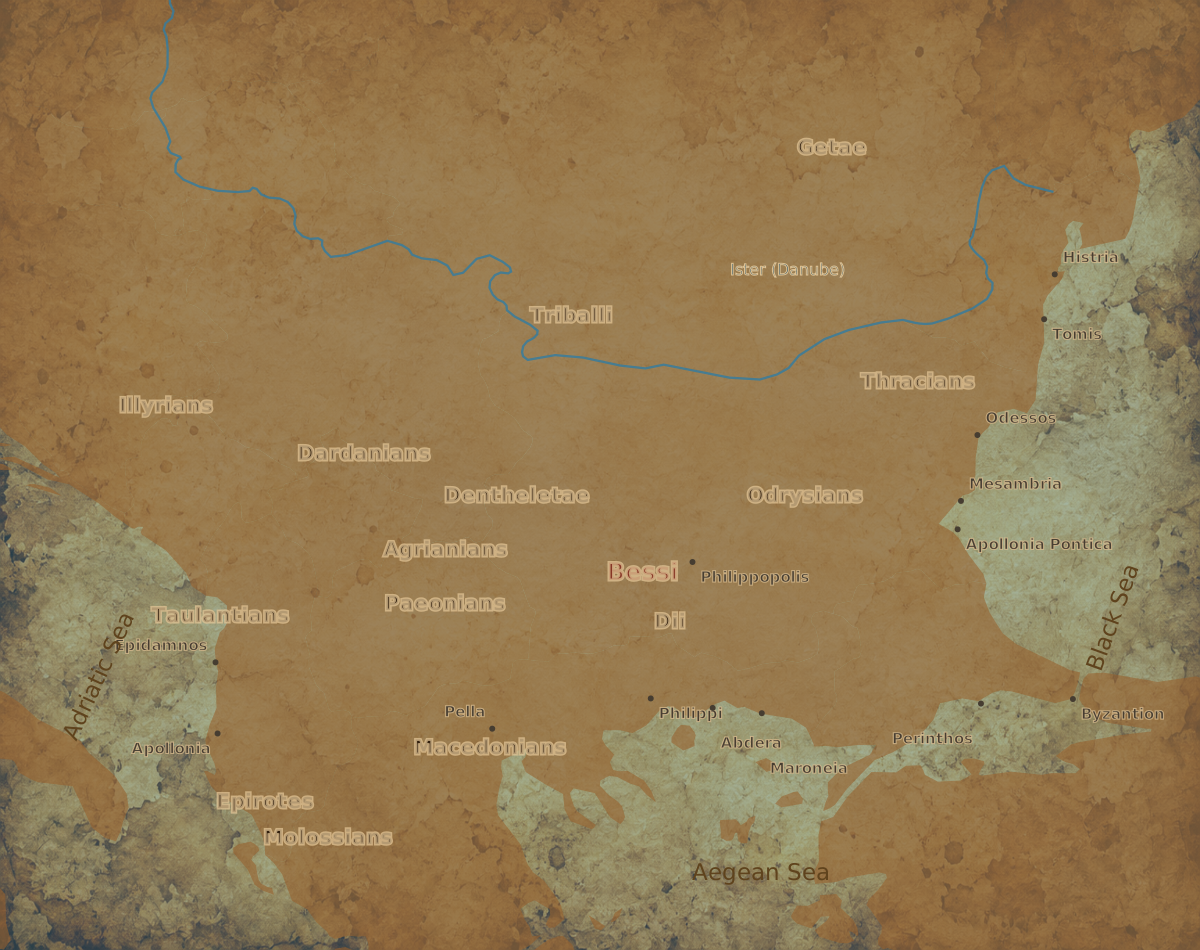
The Bessi belonged to the Thracian interior, associated with the mountain country around the Rhodopes and the upper approaches of the Hebrus. Here, the wider valleys opened towards the territories of powerful kings, while upland communities occupied ground more difficult for outsiders to control.
The contrast mattered whenever an army entered Thrace. A ruler could dominate a road or a rich plain without securing every neighbouring height. Passages through rough country favoured men who knew the tracks, could move with limited baggage and could avoid the kind of battle an invading commander preferred.
Later Greek and Roman writers gave the Bessi a fierce reputation. Their accounts often speak from the side of states trying to impose obedience on mountain peoples. The history behind that reputation includes repeated resistance to outside rule, but also a sacred office that could give local leaders influence beyond armed force.
Dionysos and those who interpreted him
Herodotus distinguishes the prophetess who uttered the oracle from the Bessi who interpreted it. This division of roles made the shrine a place of organised religious authority. Its standing depended on the transmission of a divine answer through people recognised as capable of understanding and presenting it.
The cult belonged to a Thracian world in which Dionysos could be associated with mountains, revelation and exceptional states of experience. Greek authors also connected the god with their own rites and stories. His worship therefore offered a point of contact between people who might otherwise meet as rivals, soldiers or strangers.
A visitor approaching such an oracle brought more than a private curiosity. A royal consultation could make a sanctuary part of the story of a reign. The answer might be remembered long after the immediate journey, especially if later events seemed to fulfil it.
Alexander in the sacred landscape
Philip II's expansion and Alexander's early campaigns brought Macedonian kings repeatedly into Thrace. In 335 BC, Alexander marched north before beginning the invasion of Asia; the security of the northern country mattered to everything he intended to attempt beyond the Hellespont.
A later tradition also placed him at a Thracian sanctuary of Dionysos. Suetonius tells the story while describing the omens surrounding Augustus. When Augustus' father consulted the priests about his son, wine poured on the altar supposedly produced a towering flame. The same sign, the story claimed, had appeared only once before, when Alexander sacrificed there.
The tale joined the two conquerors through divine promise. It belongs to the legends of their destinies, rather than to a securely dated stage in Alexander's march. Its lasting appeal nevertheless reveals the kind of power attributed to Thracian oracles: a remote altar could pronounce on the future ruler of the world.
The limits of the kings
Odrysian rulers had built their strength through tribute, alliances and the ability to gather many communities under a royal banner. The mountain interior presented a different challenge from the towns and open country. The freedom praised in Herodotus' description of the Satrae expressed the value attached to remaining beyond another king's command.
Macedonian supremacy changed the balance of Thrace without ending these local distinctions. Soldiers from the region served abroad, royal officers attempted to hold its territories, and new foundations secured strategic ground. In the uplands, the relationship between communities, their leaders and neighbouring powers continued to shape what conquest could achieve.
The Bessi's place within this landscape was strengthened by their religious associations. A sanctuary could draw attention from rulers who might otherwise dismiss an upland people as an obstacle. Its possession could also become a political prize when competing powers sought authority over the same country.
When a sanctuary became a cause for war
Centuries after Alexander, Roman intervention made that connection explicit. In the campaigns of Marcus Licinius Crassus in the late first century BC, the sanctuary of Dionysos became part of the settlement imposed on Thrace. Cassius Dio reports its transfer from the Bessi to the Odrysians. Control of sacred ground was treated as a reward that a victorious outsider could grant.
The decision placed religious prestige within the rivalries of Thracian peoples and Roman clients. A shrine was more than land: its custody carried standing, visitors and the right to speak from a recognised sacred centre. The loss could therefore strike at a community's position as well as its possessions.
The priest who raised an army
Under Augustus, the priest Vologaesus gathered followers through his reputation for divination and led a Bessian revolt. Dio describes him defeating and killing Rhascyporis, son of Cotys, then driving Rhoemetalces into flight. The movement carried destruction towards the Chersonese and forced Rome to respond.
Lucius Piso came from Pamphylia to conduct the war. The Bessi withdrew towards their own country, where he initially suffered a reverse before gaining the advantage. Submission followed through a mixture of battle, intimidation and agreements; renewed resistance brought further punishment.
This much later conflict gives a name and a face to the union of religious and military leadership. Vologaesus' followers acted in a world where belief could gather men as effectively as dynastic ancestry. Long after the age of Alexander, the Bessi still entered the affairs of great powers through the mountain country and the divine authority with which their history had begun.
Sources
Ancient accounts
- Herodotus, Histories, VII.111.
- Arrian, Anabasis, I.1–4, Alexander's northern campaign.
- Suetonius, Augustus, 94.5.
- Cassius Dio, Roman History, LI.25 and LIV.34, Vologaesus and Piso.
Historical studies and classical reference works
- Denver Graninger, “Late Argeads in Thrace: Religious Perspectives”, Ancient History Bulletin 31 (2017), pp. 120–144.
- Christopher Webber, The Thracians 700 BC–AD 46, Osprey Men-at-Arms 360 (2001).
- François Sabbathier, Dictionnaire pour l'intelligence des auteurs classiques grecs et latins, “Besses”.