






Odrysians
The king at the feast
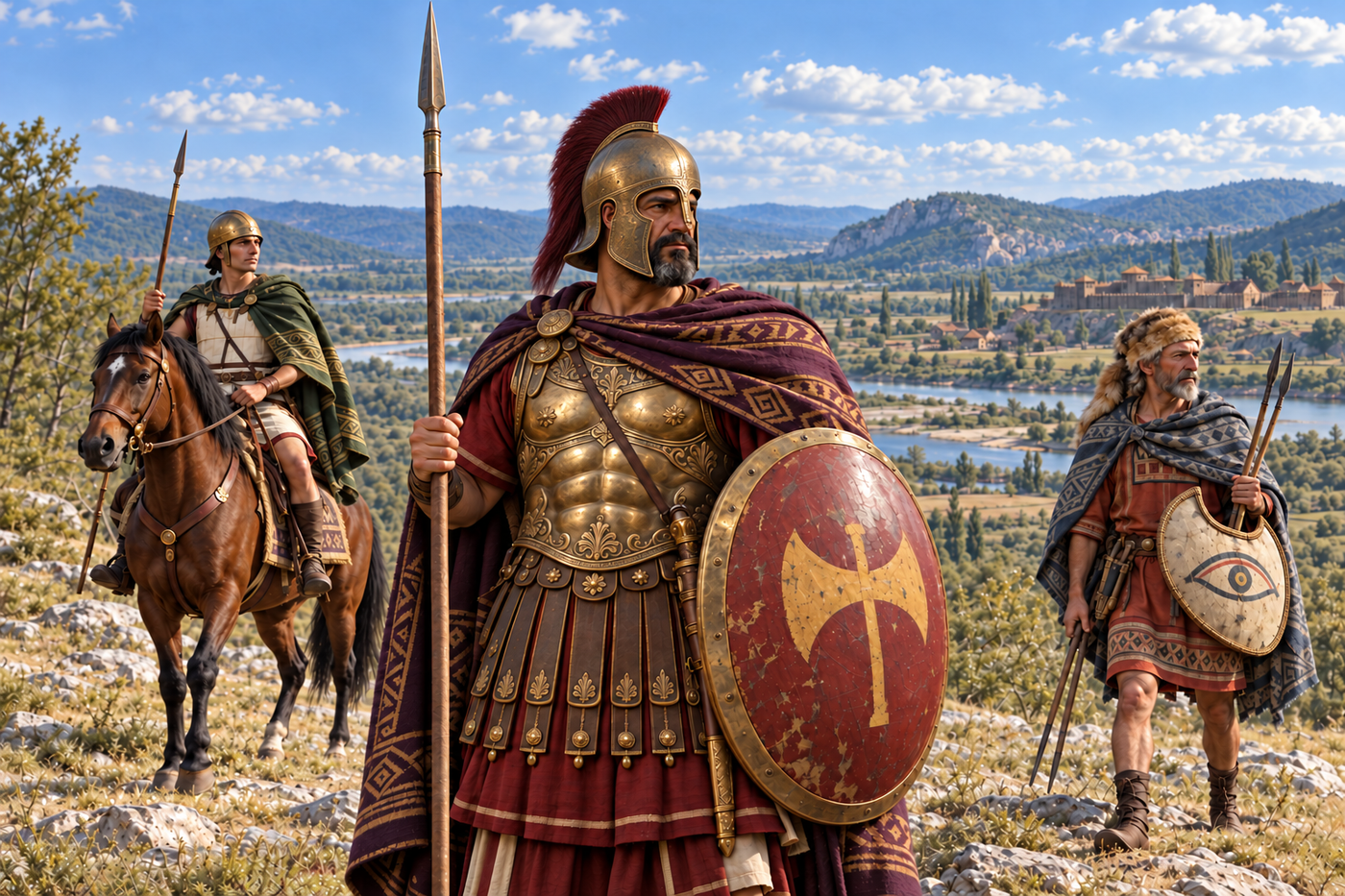
When Xenophon and the Greek soldiers entered the service of Seuthes II, they entered a world in which power was displayed at the banquet. Gifts passed to the ruler, drinking and entertainment accompanied negotiations, and the promise of military reward joined strangers to a Thracian prince. Seuthes needed armed followers to recover the country of his father. The Greeks needed a paymaster who could turn their long retreat from Asia into profitable service.
The bargain captured something essential about Odrysian kingship. A king's strength depended on the people he could gather, the resources he could distribute and the loyalties he could sustain. Horses, silver vessels, fine weapons and generous promises belonged to the same political world as the men who rode or marched behind him.
A royal power in Thrace
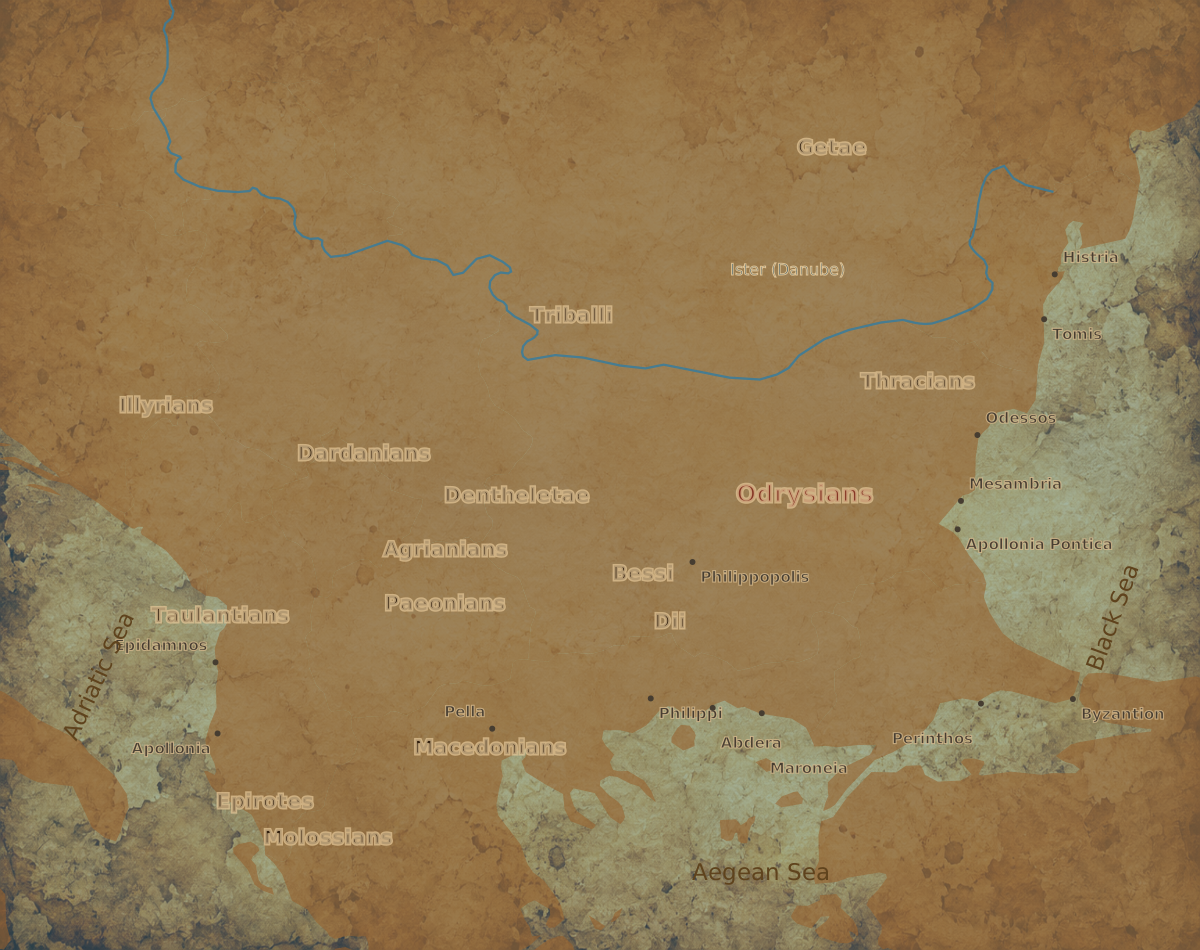
The Odrysians rose to prominence in the fifth century BC, when Teres and his successors brought a wide collection of Thracian communities into a powerful kingdom. The Hebrus valley formed one of its principal settings, while its influence extended towards the Aegean, the Propontis and the lands leading north to the Danube.
Authority varied across that broad country. Royal dependants, neighbouring rulers, independent mountain communities and Greek coastal cities could all enter a king's calculations without standing in the same relationship to him. A successful expedition might bring tribute and recognition; a disputed succession could loosen those ties again.
The resulting kingdom was one of the great powers known to the Greeks on their northern horizon. Its rulers could affect the security of Macedonia, the grain routes of Athens and the fortunes of the cities along the Thracian coast.
Sitalces and the great expedition
In 429 BC, Sitalces invaded Macedonia. Athens had cultivated his friendship, and the expedition brought together forces from across the territories and alliances over which he exercised influence. Thucydides describes cavalry from the more open country and large bodies of infantry, including independent mountain warriors who joined in expectation of gain.
The army's size could intimidate communities and devastate the countryside, but it also created demands that courage alone could not solve. Winter and shortages pressed upon the expedition. Sitalces' nephew Seuthes urged withdrawal, while Perdiccas of Macedonia worked to turn that influential adviser to his own advantage through a promised marriage.
The campaign ended without achieving its greatest aims. It nevertheless demonstrated the reach of Odrysian kingship. Thucydides' account of tribute and gifts under Seuthes I presents a monarchy whose resources rivalled those of major contemporary states. Wealth moved towards the king, then helped sustain the relationships on which his position depended.
The price of loyalty
Seuthes II's employment of Xenophon's soldiers, around the end of the fifth century, offers a closer view of that system under strain. The prince could promise pay and rewards, but obtaining and distributing the money proved contentious. Campaigning, plunder and negotiations over arrears threatened the relationship between employer and soldiers.
Mercenaries offered a ruler forces whose immediate loyalty rested on an agreement rather than local kinship. They could strengthen him against rivals, but they also expected the agreement to be honoured. Xenophon describes the tension from the soldiers' side, making the unsettled payment a central concern of his account.
Odrysian rulers operated among such competing expectations. Their own followers sought gifts, foreign soldiers demanded wages, neighbouring kings offered marriages and Greek cities pursued their commercial interests. Royal power was maintained through repeated acts of negotiation as well as battle.
Merchants under the king's protection
The inscription associated with Pistiros reveals a different side of the same society. Issued after the reign of Cotys I, it preserves guarantees concerning traders and their property. Merchants connected with Maroneia, Apollonia and Thasos conducted business within the Thracian interior under arrangements recognised by royal authority.
The text concerns the security of goods, routes and commercial activity. It places Greek-speaking merchants within an inland community where political protection mattered. A ruler who safeguarded trade could benefit from the prosperity it created, while merchants required assurances that their possessions and journeys would be respected.
Coinage supplies another record of these exchanges and ambitions. Odrysian dynasts put their names and chosen images into circulation. The issues of rulers such as Cotys, Cersobleptes and Seuthes help reveal a succession of royal centres and claims. They also make visible the connection between the resources of the country and the authority of individual men.
Cotys' inheritance and Philip's opportunity
Cotys I made Odrysian power a pressing concern for Athens in the first half of the fourth century. After his death in 359, rival rulers divided the political landscape. Cersobleptes, Amadocus and Berisades belonged to the struggle over that inheritance, while Athens attempted to protect its position around the Chersonese.
Philip II exploited the opportunities created by these divisions. In 356/355, the Athenians concluded an alliance with the Thracian Ketriporis and his brothers, together with the Paeonian Lyppeius and the Illyrian Grabus. The surviving decree names Philip as their enemy. Its oath turned several threatened powers towards a common war.
The coalition failed to halt Macedonian expansion. Philip continued to intervene in Thrace, and his campaigns in the 340s broke the independence of the strongest Odrysian rulers. Macedonian foundations and military authority changed the balance of the country. Royal families and local loyalties survived, but they now faced a neighbour able to impose its own order on much of Thrace.
Warriors and aristocrats
Odrysian warfare drew on mounted nobles, infantry and the wider Thracian tradition of mobile fighting. The equipment of wealthy men could reflect close contact with the Greek world, while the resources of less affluent followers favoured lighter protection. Fine arms, decorated horse gear and drinking vessels marked the standing of an aristocrat beyond the battlefield.
The rich burial associated with Seuthes III at Goliama Kosmatka preserves that world in striking form. Objects bearing the name of Seuthes, weapons, horse ornaments and precious vessels were deposited within a monumental setting. The bronze head found at the site gives an unforgettable image of royal presence, while the burial assemblage links that presence to ceremony and elite display.
Seuthes and Alexander's successor
Alexander's Asian conquests carried Macedonian attention far beyond Thrace, but they did not extinguish local kingship. After his death in 323, Lysimachus received responsibility for the region and encountered Seuthes III in arms. Diodorus describes a hard-fought battle in which neither side emerged with an easy decision.
Seuthes was able to maintain a royal centre in the Thracian interior. Seuthopolis, the city that bore his name, expressed an Odrysian ruler's place in the new Hellenistic world: an organised urban foundation associated with a monarchy that had survived Macedonian conquest.
The kingdom had changed greatly since Sitalces' expedition. Its territory was more contested, its neighbours more dangerous and its rulers enmeshed in the wars of Alexander's successors. Yet the essential struggle remained recognisable. A king still had to gather men, secure resources and make his authority visible. For Seuthes, the survival of that kingship was itself a victory.
Sources
Ancient narratives and inscriptions
- Thucydides, History of the Peloponnesian War, II.29 and II.95–101.
- Xenophon, Anabasis, VII.3 and VII.4–7.
- Athenian alliance with Ketriporis, Lyppeius and Grabus, 356/355 BC, RO 53.
- Pistiros regulation, SEG 49.911.
- Diodorus Siculus, Library of History, XVIII.14.
Archaeology and coinage