






Caspians
A name carried far from home
On the Nile, among the people serving the Persian empire, Aramaic documents record men identified as Caspians. Some bore Iranian names. They had travelled far from the northern world whose name also belonged to a great inland sea, entering the military society of a province at the opposite end of the king's dominions.
Their presence offers a glimpse of the people behind the imperial lists. A Caspian could appear to a Greek geographer as an inhabitant of a distant shore, to a royal official as a member of a taxable population, and to an Egyptian document as an individual within a garrison community. The empire joined these different worlds through service, migration and command.
The western shores
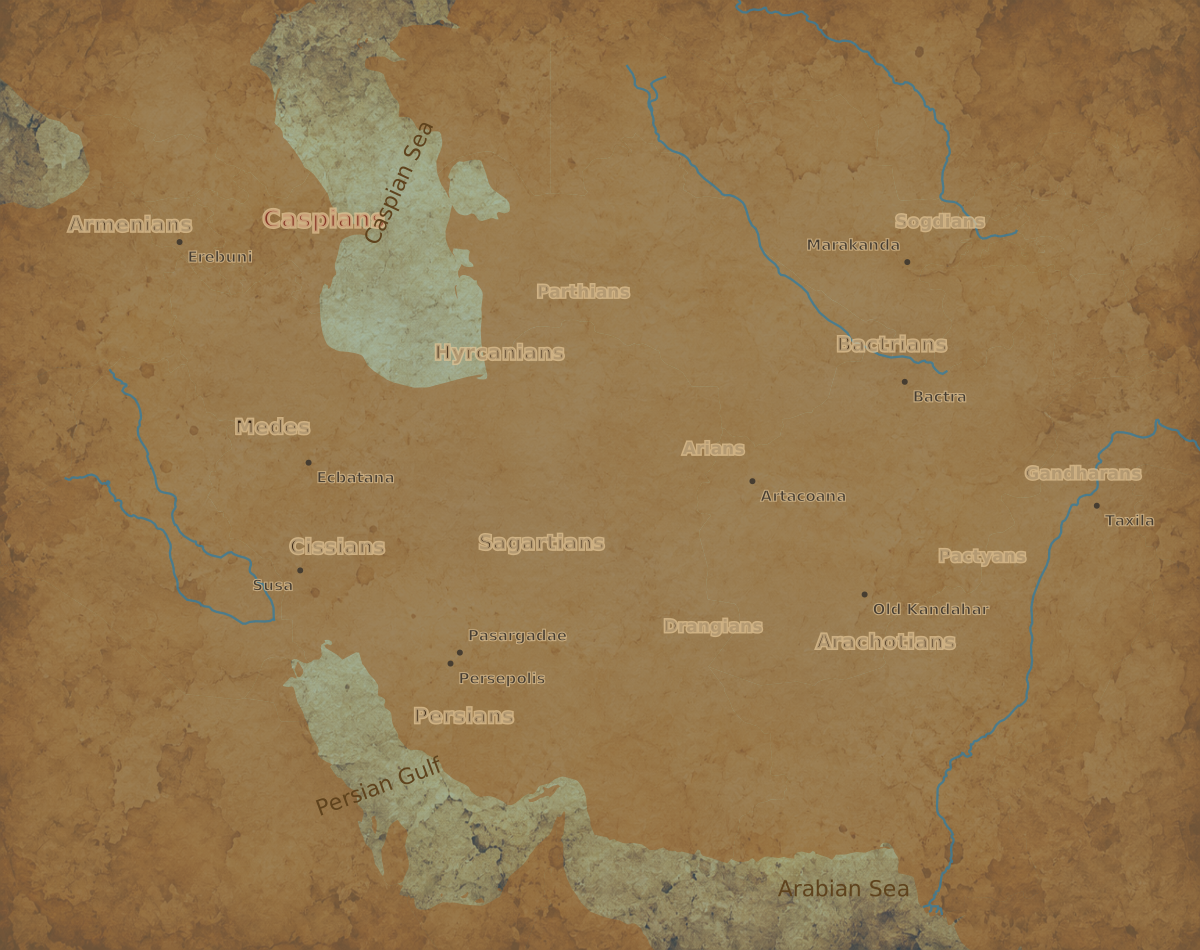
The Caspians were associated with the western and south-western side of the Caspian Sea, towards the country of the Kura and the approaches to the Caucasus. Their neighbours belonged to a varied frontier between the Iranian plateau, mountain districts and the lowlands beside the sea. Farther east, the southern shore led towards Hyrcania.
The water itself acquired different names from the peoples along its margins. Greek and Roman writers spoke of the Caspian or Hyrcanian Sea. For the communities on its shores, it was part of a lived landscape of river mouths, coastal country and upland approaches; for rulers looking north from the Iranian interior, it marked a horizon beyond the principal royal roads.
Herodotus understood that this sea stood apart from the ocean. Later writers sometimes imagined a connection with the world's surrounding waters. Such competing visions would still influence Alexander's plans at the end of his life, when he ordered an expedition to investigate its coastline.
Within the Achaemenid realm
Herodotus includes Caspians in the revenue arrangements attributed to Darius I. One grouping places them with the Pausicae, Pantimathi and Daritae. Their obligations therefore appear within a larger collection of communities, through which the monarchy drew resources from lands far from its principal residences.
The royal system could carry people as well as revenue across great distances. In Egypt, garrison life brought soldiers and their families into contact with local inhabitants, administrators and other communities serving the king. Aramaic supplied a language through which many of those transactions could be recorded. The Caspian names preserved there belong to this wider society of the Achaemenid provinces.
Iranian names among these men reveal connections with the cultural world of the monarchy. At the same time, their identification as Caspians preserved a distinction within that world. Service to the king did not require every recruit to lose the name of his people or country.
Soldiers in the Greek accounts
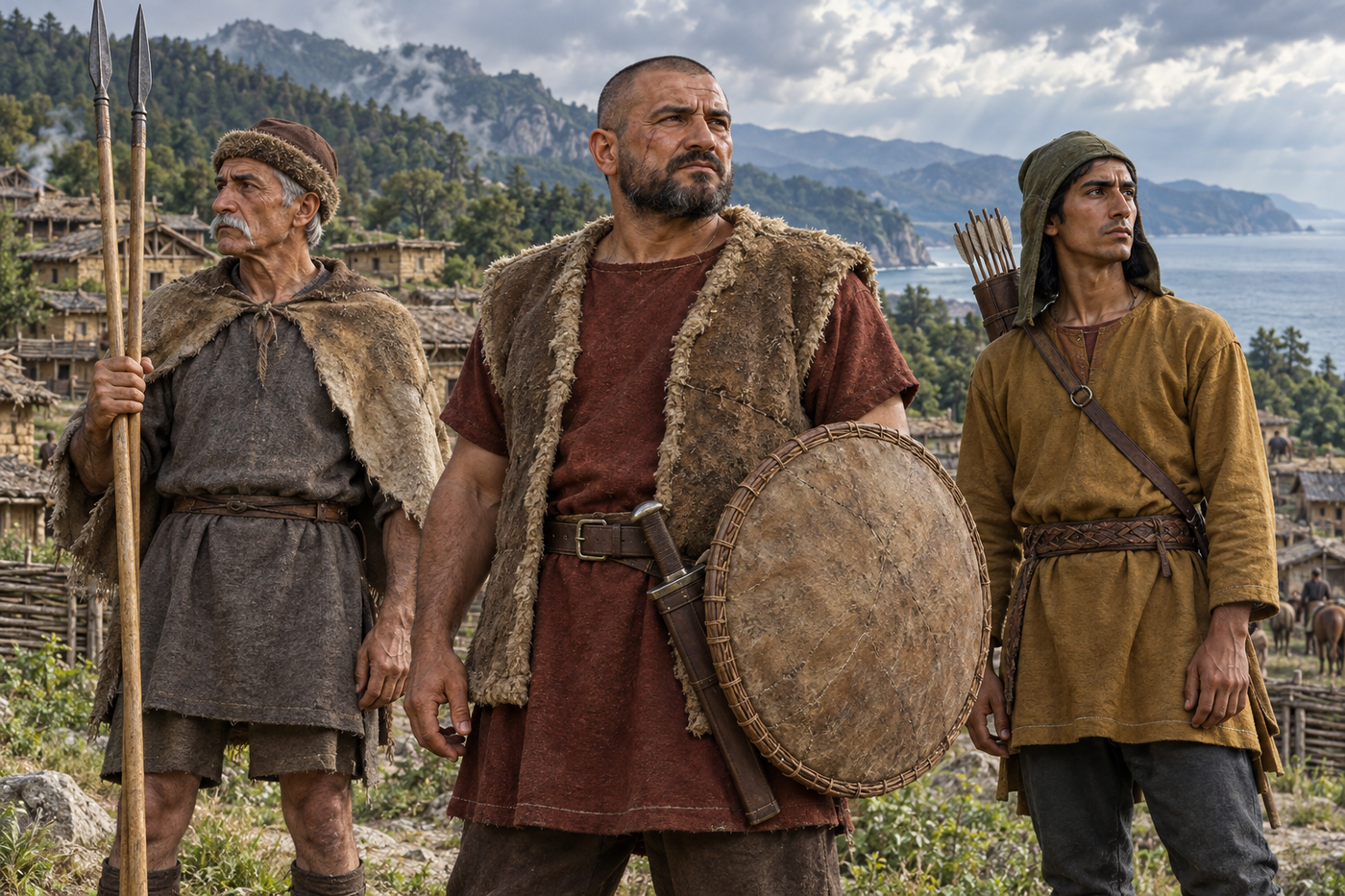
In his description of Xerxes' forces in 480 BC, Herodotus names Caspians wearing garments of skin and carrying reed bows and short swords. He also mentions Caspian mounted troops. These figures belonged to the extraordinary variety of the army assembled for the invasion of Greece.
The catalogue reaches across the empire, including a Caspian name in an eastern grouping associated with the Saka as well as the western Caspians known from geography. The western shore communities and the soldiers in this passage enter the narrative through different routes. What the account vividly preserves is the imperial army's ability to bring unfamiliar dress and weapons into a single expedition.
For Greek readers, the invasion made distant peoples immediate participants in their own history. The men behind those descriptions had crossed provinces and seas to serve a royal campaign. Their homeland might remain obscure to the people they fought, even while their weapons and appearance became part of the memory of Xerxes' army.
The road south of the sea
In 330 BC, Alexander pursued Darius through the Iranian interior. At Rhagae, near modern Ray, the chase had exhausted soldiers and killed horses. Darius had already passed through the defile known as the Caspian Gates. Alexander paused to rest his troops before advancing again towards Parthia.
These Gates lay on the route south of the Alborz, rather than on a coastal road through the Caucasus. Their name linked the imperial highway with the northern Caspian world, but the pursuit followed the line connecting Media to the eastern provinces. Darius' remaining companions were deserting him, and the war was moving towards the crisis that would end in his capture and death.
Alexander's unfinished northern horizon
After the eastern campaigns, Alexander returned to the problem of the sea. He sent Heraclides, son of Argaeus, to Hyrcania with shipwrights and orders to build vessels from local timber. Arrian describes the king's desire to discover whether the Caspian communicated with the Black Sea or with the wider ocean.
The project made exploration part of imperial ambition. Ships could extend the reach of knowledge and royal authority beyond the routes the army had already travelled. For the peoples of the Caspian shores, it raised the prospect of another encounter with a monarchy seeking to define the limits of its world.
Alexander died at Babylon in 323 before his northern plans could become another great campaign. The communities around the sea remained beside a frontier that his victories had brought into a new political age. Their name endured on maps, while the Egyptian papyri preserved a different kind of survival: the traces of individual Caspians whose service had once carried them far beyond that shore.
Sources
Ancient geography and narratives
- Herodotus, Histories, I.202–203; III.92–93; VII.67 and VII.86.
- Arrian, Anabasis, III.20, the Caspian Gates; VII.16, Heraclides' expedition.
Historical geography, papyri and reference works