






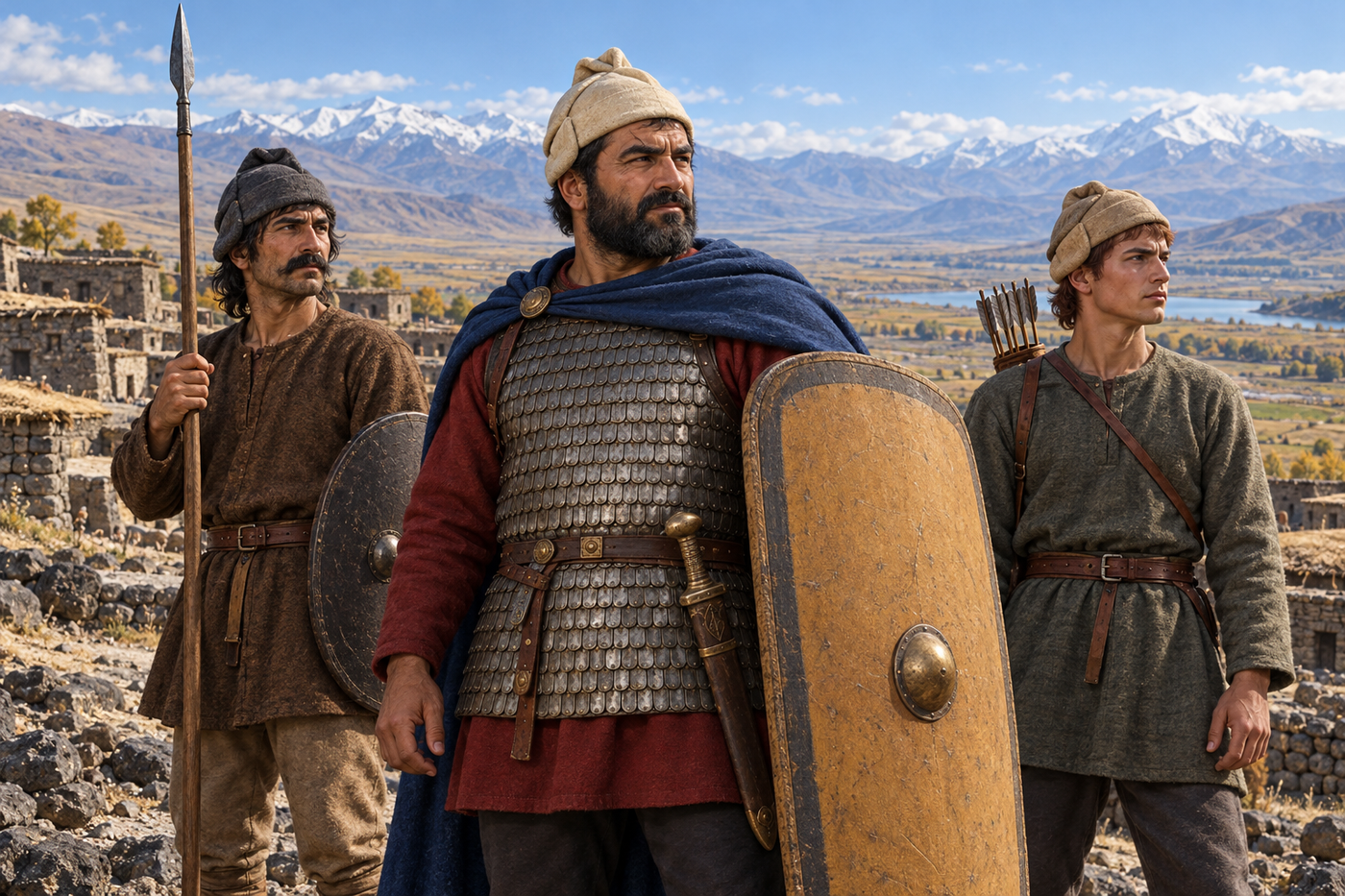
Armenians
A country beyond the victory
After Gaugamela, Alexander appointed Mithrenes governor of Armenia. Mithrenes had already helped him acquire Sardis, surrendering its citadel at the beginning of the invasion. Now the conqueror entrusted him with another country. Yet Armenia did not fall into Alexander's hands as Sardis had done. Its mountains remained outside the route of his great army, and the local dynasts who had served Darius survived the destruction of the monarchy they had defended.
This was a land where an imperial appointment and the possession of power could be very different things. Armenian cavalry had ridden to Darius' last battle under Orontes and Mithraustes. After the Persian defeat, the authority of those who could gather followers within the country mattered more than a proclamation issued far away.
The highlands between empires
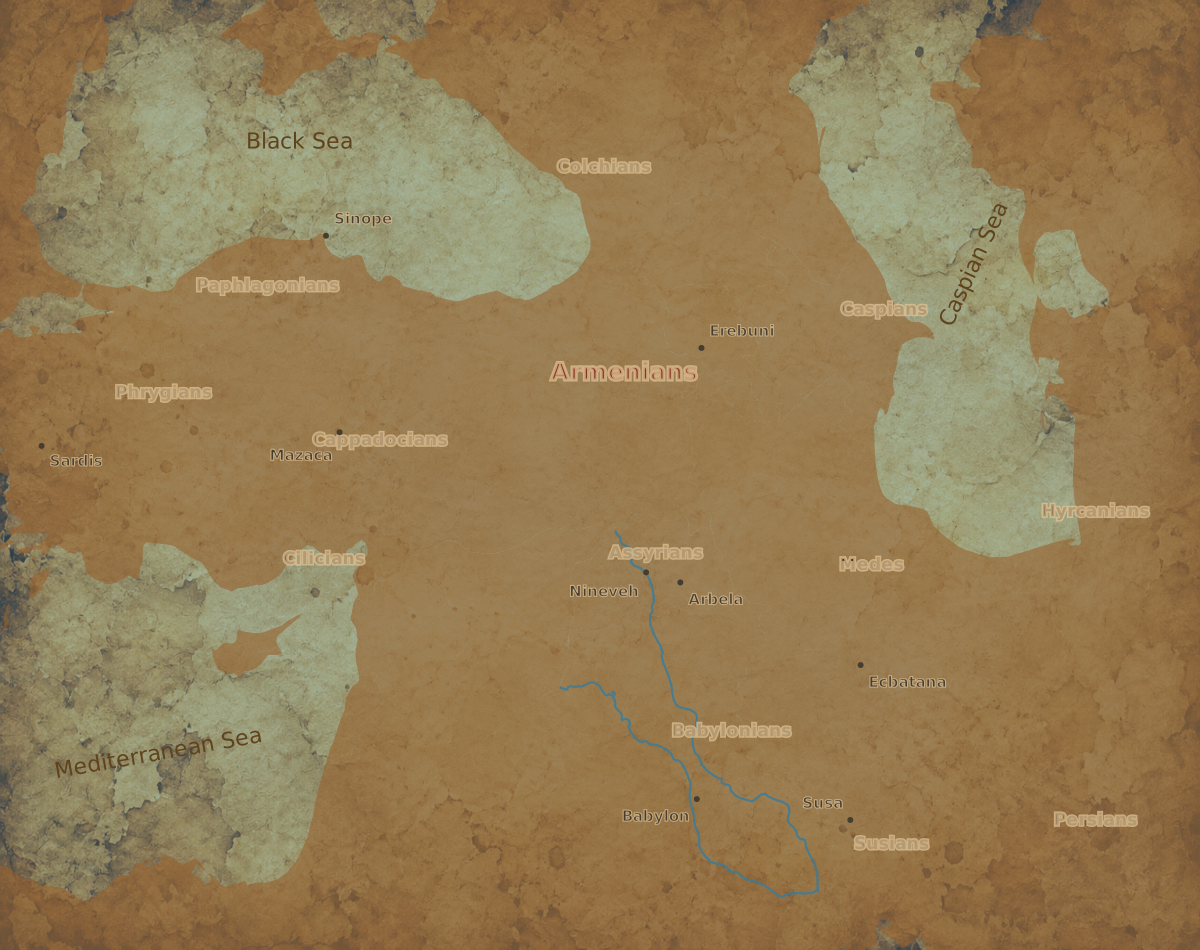
Armenia stretched across the high country between Anatolia, Mesopotamia and the Iranian world. The upper Euphrates and Tigris, the Araxes valley and the country around Lake Van connected its history to several different horizons. Armies entering from the south encountered rivers and upland approaches; those travelling east or west had to reckon with mountain corridors and the seasons.
The region carried the inheritance of Urartu, whose kings had built fortresses and ruled around Lake Van before the Achaemenid period. In Darius I's inscriptions, the Old Persian name Armina appears where the Babylonian version employs the older name Urartu. The two names stand within different written traditions describing the same broad highland world.
Fortified centres, cultivated valleys and stock-raising communities gave the country its resources. The uplands could be difficult for an invading army without being poor. Wealth accumulated in herds, agricultural stores, noble households and the ability to control movement between neighbouring districts.
The empire reaches into the valleys
Armenia formed part of the Achaemenid realm, supplying revenue and soldiers to the king. During Xerxes' invasion of Greece in 480 BC, Herodotus places Armenians alongside Phrygians under Artochmes, a royal son-in-law. Their service carried men from the highlands into an expedition extending across the Hellespont and into Greece.
Armenian rulers also entered the royal family. The Orontes who governed in the time of Xenophon was married to Rhodogune, daughter of Artaxerxes II. Such a marriage joined provincial authority to the prestige of the Achaemenid house. It could make a governor a formidable figure whose influence rested both on his local command and on his place among the king's relatives.
The relationship was personal as well as administrative. Xenophon describes Tiribazus, a governor in western Armenia, as a man honoured with the privilege of helping the king mount his horse. The gesture expressed a closeness to royal power that could distinguish one noble from his rivals. At home, that same man travelled with mounted followers and the costly furnishings of an aristocratic household.
The river to Babylon
Herodotus offers another view of Armenia through the boats descending towards Babylon. He describes round craft made from hides stretched over a framework, loaded with cargo and carried downstream. Once the goods had been sold, the wooden framework was disposed of and the hides taken home on pack animals.
The account makes the highlands part of the commercial life of Mesopotamia. The river connected communities separated by climate, language and political rank. Merchants could exploit its current in one direction and return overland with the portable parts of their vessels. Armenia's relationship with the southern plains included these practical exchanges alongside tribute and war.
Xenophon's winter
In 401/400 BC, the Greek survivors of Cyrus the Younger's expedition crossed Armenia on their retreat towards the Black Sea. Xenophon's account preserves a country of villages, stored food, horses and bitter winter weather. Snow overwhelmed men and animals; provisions and shelter could determine whether exhausted soldiers continued at all.
Tiribazus negotiated with the Greeks, then sought to block their onward route. His forces included local troops and mercenaries from neighbouring peoples. The episode reveals a governor combining diplomacy with an attempt to exploit a mountain passage, rather than seeking an open battle on terms favourable to the invaders.
The village headmen whom the Greeks encountered possessed another kind of authority. They knew where supplies were stored and how the surrounding settlements could be reached. For an army passing through the uplands, cooperation at this level could be as important as an agreement with a distant satrap. Xenophon's narrative repeatedly turns from the orders of commanders to the immediate struggle for food, guides and warmth.
Horsemen in the king's army
At Gaugamela in 331, Orontes and Mithraustes led the Armenian contingent in Darius' army. Arrian places the Armenians with the Cappadocians on the Persian right. Their position brought the mounted strength of the northern provinces into the enormous deployment assembled to stop Alexander in the plains of Assyria.
The choice of battlefield was important. Darius had gathered forces from across his empire and sought room in which his numerical strength and cavalry could be used. Armenian horsemen had left the enclosed landscapes of their homeland for a battle whose outcome would determine the future of the royal government.
Alexander broke the Persian centre and Darius fled. The defeat destroyed the king's ability to hold Babylon and the principal western capitals, but it did not carry Macedonian troops into every province represented in his army. For Armenian leaders, the return from the battlefield opened a new political situation at home.
Mithrenes and the limits of conquest
Mithrenes' appointment demonstrated Alexander's willingness to employ Iranian nobles who had entered his service. It also offered him a claim to govern Armenia without diverting the royal army into its uplands. While Alexander pursued Darius and continued towards Central Asia, Armenia remained on the northern margin of the conquest.
Local dynastic power endured. The Orontid house, known in Armenian as the Eruandids, became the principal royal tradition associated with the country in the generations that followed. Its rulers drew authority from an inheritance connecting Armenia to the Iranian aristocratic world, even as Macedonian commanders fought over the former Persian empire.
After Alexander
The arrangements made after Alexander's death brought Neoptolemus into Armenian affairs. The struggles of the successors soon carried him into conflict with Eumenes, showing how quickly the conqueror's lieutenants could become enemies. Their rival claims extended across countries in which effective control still depended on local relationships and armed force.
Armenia retained rulers of its own through these changes. In the early Hellenistic world, Armenian support could influence neighbouring dynasties, including the struggle of the Ariarathids to recover Cappadocia. The highlands remained a political power between the larger kingdoms rather than disappearing into their administrative geography.
For the Armenians of Alexander's age, the decisive story was one of continuity through an imperial collapse. They had furnished cavalry to Darius and stood within the Achaemenid aristocratic order. When that order fell, their valleys, estates and dynastic connections remained. Alexander could appoint a governor; the enduring question was who could make the country obey.
Sources
Ancient accounts
- Herodotus, Histories, I.194, river trade with Babylon; III.93 and VII.73.
- Xenophon, Anabasis, IV.3–5, the Armenian journey.
- Arrian, Anabasis, III.8, III.11 and III.16.
- Diodorus Siculus, Library of History, XVIII.29–31 and XXXI.19.
Historical studies