






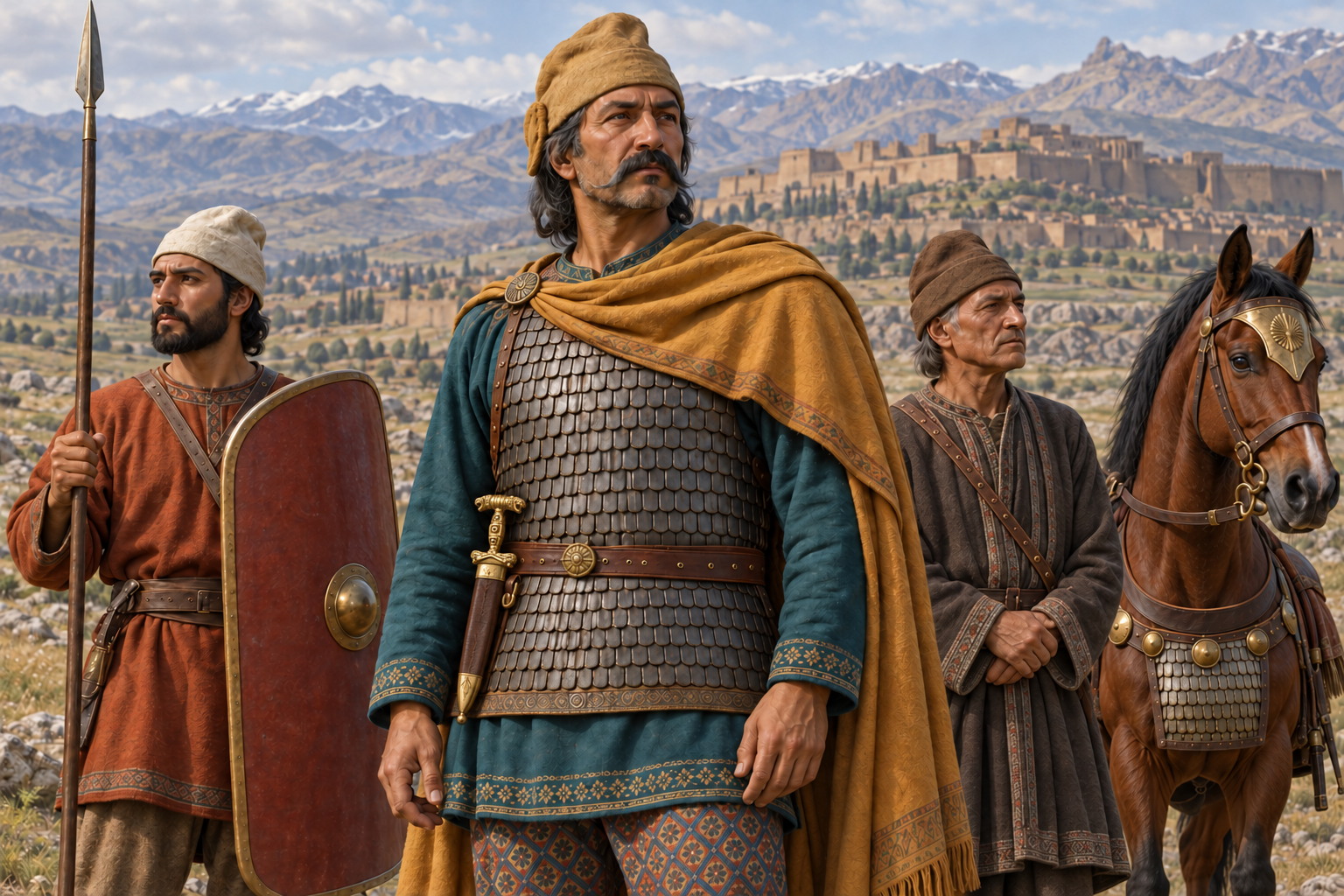
Medes
The king who came back
At Gaugamela in 331 BC, Atropates commanded the Medes in the army of Darius III. Seven years later, his daughter married Perdiccas at the great wedding celebrations in Susa. Between those two occasions, the Persian king had been defeated and killed, Alexander had crossed Asia, and Atropates had lost and recovered his province. He survived the conquest by making himself useful to its victor. When Alexander died, the Median governor would possess something more durable than an invitation to the conqueror's court: a territorial power base from which his family could rule.
Media had already experienced the fall of a royal dynasty. Its people had once supplied kings of their own; under the Achaemenids, their country remained one of the principal centres of imperial government. In Alexander's lifetime, its cities, horse pastures and aristocratic households stood close to the heart of the struggle for Asia.
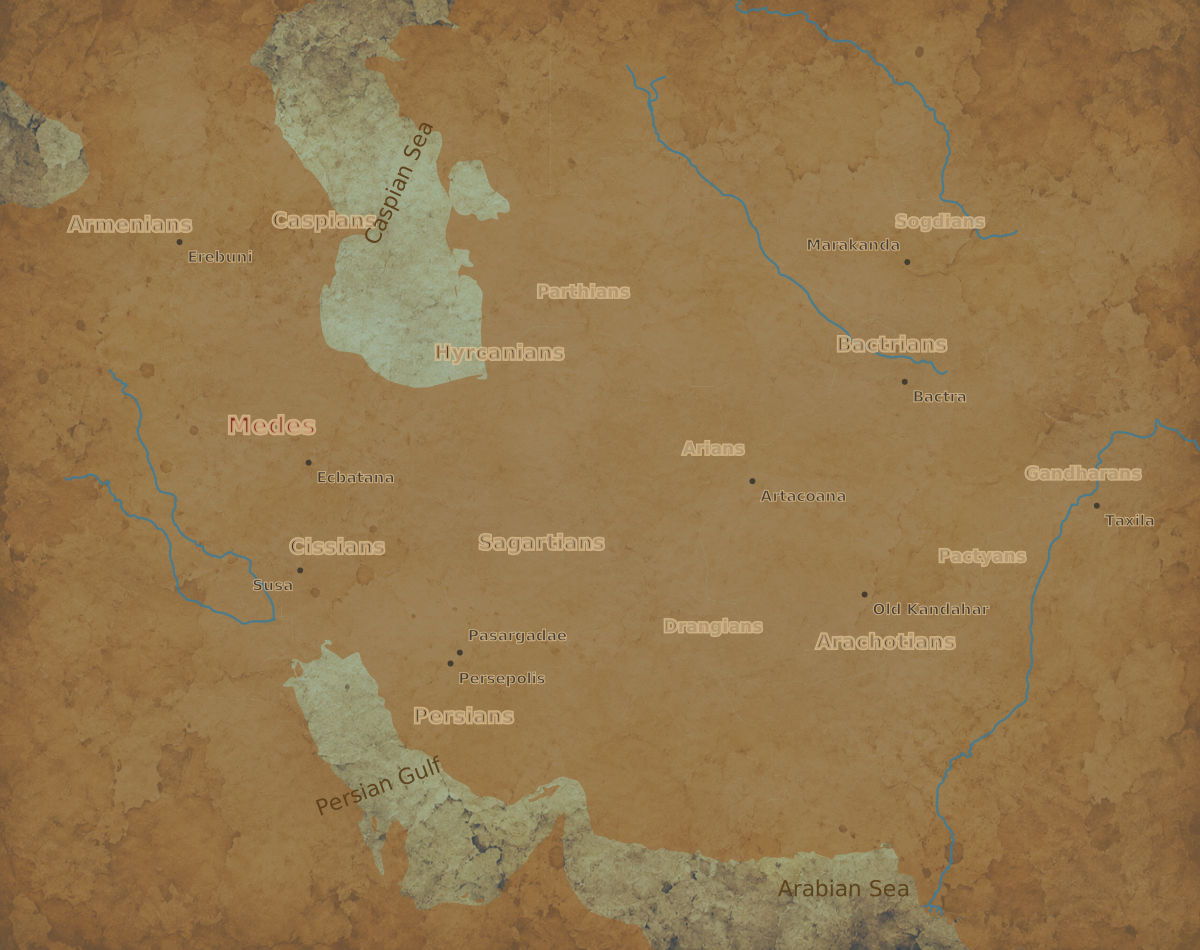
Beyond the Zagros passes
The Median homeland lay in western Iran, beyond the mountain approaches from Mesopotamia. Around Ecbatana, modern Hamadan, cultivated plains opened beneath the Alvand range. Travellers arriving from the hot lowlands entered a country of upland winters, grazing grounds and settlements connected by routes through the Zagros. Ecbatana occupied a commanding position on the passage between the western lands and the Iranian interior.
The country contained much more than its royal city. Earlier Assyrian expeditions had encountered numerous local rulers and communities in these uplands. Over generations, conquest, alliances and the growth of larger political powers brought these districts into the history of the Medes. Mountain strongholds and agricultural plains belonged to the same landscape; control of a capital could never make every neighbouring valley equally obedient.
Before the Persians
For Greek readers, the rise of Media was inseparable from the kings described by Herodotus. His Deioces began as a celebrated judge and became a ruler separated from his subjects by court ceremony and the walls of Ecbatana. The story turns the creation of kingship into a drama of authority: the man whom neighbours once approached for justice eventually became a figure whom they could no longer meet freely.
Cyaxares belonged to the age when Assyrian power collapsed. In 612 BC, Median and Babylonian forces brought down Nineveh. The destruction of the Assyrian capital changed the balance of power throughout the Near East. Media emerged from the shadow of the empire whose armies had repeatedly entered the Iranian uplands, while Babylon established its own supremacy farther south.
That ascendancy ended under Astyages. Around 550 BC, Cyrus overthrew him and established Persian rule. Herodotus made the conflict a family tragedy filled with warnings, vengeance and betrayal. Behind that memorable account stood a lasting political reversal: the Achaemenids inherited the position of the Median kings, and Ecbatana became a royal centre within a larger empire.
A people within the royal household
Persian supremacy did not remove the Medes from imperial life. Median nobles served the monarchy, and Median dress became part of the visual language through which the empire presented its ruling peoples. On the terraces of Persepolis, figures in different garments appear together within the ordered world of the royal court. The distinction between Persian and Mede survived alongside their participation in the same political system.
Herodotus describes the Medes serving Xerxes in 480 BC with equipment resembling that of the Persians, and explicitly gives Median origins to that style of dress and armament. His account places bows, spears, shields and close-fitting clothing within an older military tradition. It also shows how thoroughly the armies of the two peoples had become associated in Greek memory.
Religion was another part of that shared world. The Magi appear in Greek accounts as ritual specialists associated with the Medes and the Persian monarchy. Sacrifice, the correct performance of rites and the interpretation of signs mattered at court and on campaign. A ruler's public relationship with divine favour belonged to the exercise of authority, alongside his ancestry, wealth and ability to reward service.
Horses for an empire
The great horse pastures associated with Media were among its most celebrated resources. Ancient writers praised the Nisaean horses, and Alexander later visited the royal grazing grounds. Arrian preserves traditions of enormous herds, diminished by the disruption and plundering of the conquest. Even without accepting every reported total, the visit reveals the value attached to breeding grounds that could sustain royal and military demand.
Horses made the prosperity of an estate visible and gave mounted retainers their place in war. At Gaugamela, Atropates brought the Medes into Darius' final great army, together with contingents associated with the northern approaches to Iran. Their presence connected the battlefield to the households and provincial relationships through which the king gathered his forces.
Darius' last refuge in the west
After Gaugamela, Darius withdrew towards Media. Ecbatana offered treasure, communications with the east and the possibility of assembling another army. As Alexander occupied Babylon, Susa and Persepolis, the defeated king still had time to hope that distance and fresh forces might restore his position.
In 330, that hope contracted. Reinforcements expected from the northern peoples had not arrived when Alexander advanced. Darius sent property and members of his household ahead, then abandoned Ecbatana and moved towards the Caspian Gates. Alexander reached the city to discover that the decisive encounter had escaped him again.
Ecbatana also marked a turning point for the conqueror's army. Alexander released the Thessalian cavalry and the Greek allied troops from their original service, paying them and offering additional rewards. Some chose to remain as mercenaries. The expedition that had crossed into Asia under the banner of a Greek war against Persia was becoming an open-ended struggle for the whole empire.
The Median capital became a treasury and military centre under Macedonian control. Parmenio received responsibilities connected with the region and the onward movement of forces, while Alexander resumed the pursuit. Beyond Media, Darius would fall into the hands of his own captors and die before his rival could take him alive.
Atropates chooses his moment
Atropates submitted after Darius' death, but Alexander initially appointed Oxydates to govern Media. The old satrap's return was therefore an achievement, rather than an automatic reward for surrender. By 328/327, Alexander's distrust of Oxydates had opened the way for Atropates to recover his office.
He then demonstrated his loyalty in a form the king could readily understand. Baryaxes had claimed royal authority among the Medes and Persians; Atropates captured him and brought him to Alexander, who ordered his execution. The governor had helped extinguish an alternative claim to sovereignty. In doing so, he strengthened both the conqueror's authority and his own position within it.
The marriage of his daughter to Perdiccas in 324 connected the family to one of Alexander's leading commanders. It was a place within the new ruling circle, secured while the king was deliberately joining Macedonian officers to Iranian noble families. Atropates had passed from commanding against Alexander to helping sustain his empire.
A death in Ecbatana, a dynasty in the north
Alexander returned to Ecbatana in 324. Sacrifices and athletic celebrations accompanied the royal visit, but the festivities ended in catastrophe when Hephaestion died after a fever. Arrian records the scale of Alexander's grief and the mourning that followed. The Median capital, once a refuge for Darius, became the setting for the most devastating personal loss of the conqueror's final year.
Alexander himself died at Babylon in 323. In the division of commands that followed, the larger Median satrapy passed to Peithon, while Atropates retained power in the north-west. From this smaller territory developed the kingdom known as Atropatene. Its name preserved that of the governor whose career had crossed the boundary between two empires.
Media's future was therefore divided. Ecbatana and the greater province remained coveted prizes in the struggles of Alexander's successors; farther north, Atropates' descendants established a lasting regional monarchy. The man who had faced the Macedonians at Gaugamela had lived to turn survival into a dynasty.
Sources
Ancient narratives
- Herodotus, Histories, I.95–130, including the overthrow of Astyages; VII.62, the Medes in Xerxes' army.
- Arrian, Anabasis, III.8; III.19, Ecbatana and the dismissal of the allies; VI.29; VII.4; VII.13, the royal horse pastures; VII.14, the death of Hephaestion.
History and historical geography