






Paeonians
A kingdom on Alexander's northern horizon
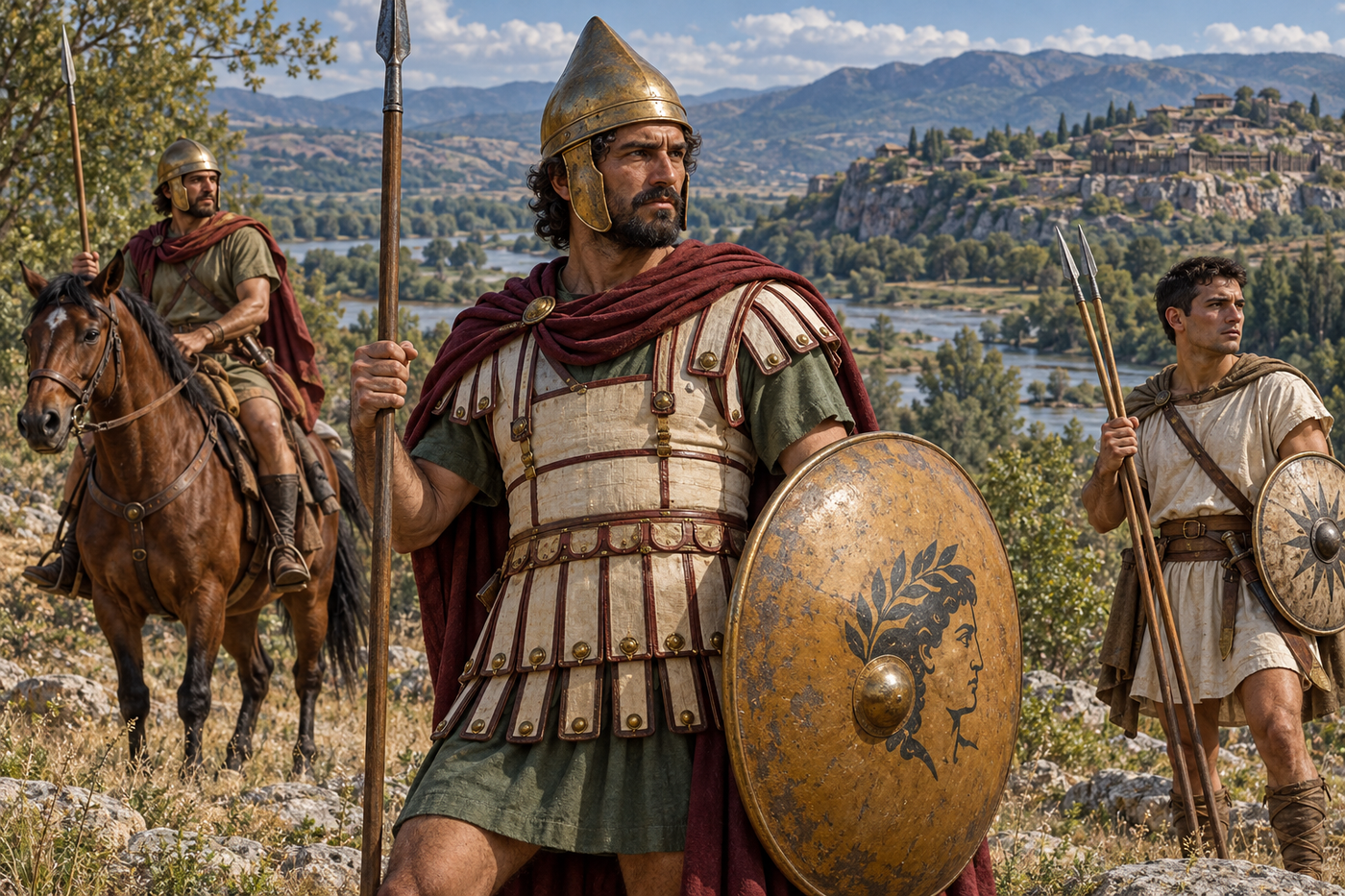
Before Alexander crossed into Asia, he had to know who would stand behind him in the Balkans. In 335 BC, as messages arrived announcing revolt on Macedonia's western approaches, Langarus came to meet him with the best armed men of his household guard. The king of the Agrianes had been Alexander's friend while Philip was still alive. Now that friendship could decide whether another enemy would fall upon the Macedonian army while it was marching towards danger.
The encounter belonged to a northern world of river valleys, upland communities and ambitious rulers. Paeonia lay close to Macedonia, but its kings had their own names, allies and claims to authority. Some fought Philip's expansion. Others sent horsemen into Alexander's campaigns or sought security through personal relationships with the Macedonian court. Their history follows the changing choices of a kingdom whose powerful neighbour offered both opportunity and the threat of submission.
The valleys beyond Macedonia
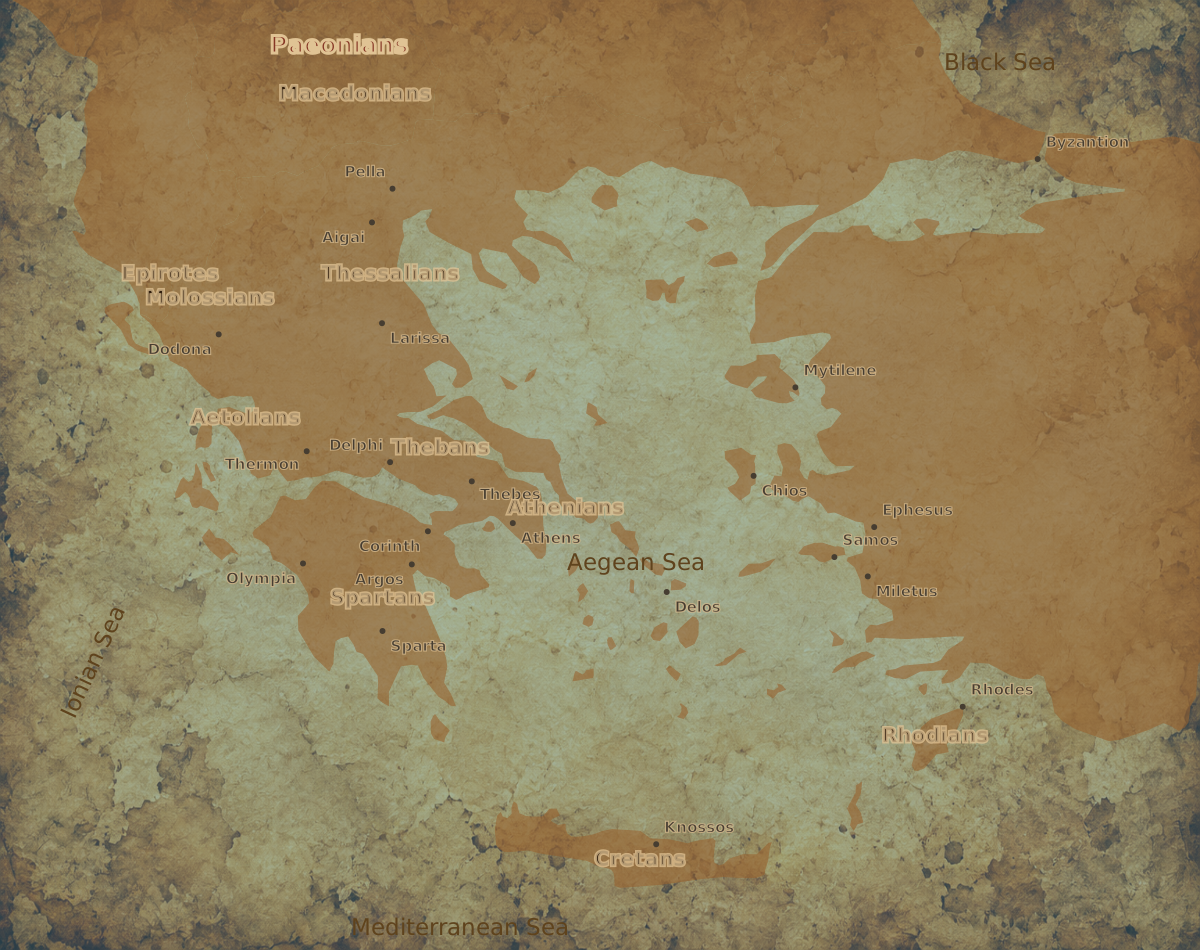
The Axios, the modern Vardar, formed one of the great routes between the Aegean and the Balkan interior. Its tributaries opened further passages through cultivated basins and wooded hills. The Strymon valley to the east connected another succession of communities, crossings and approaches. Ancient accounts place Paeonians across parts of this wider landscape, although the extent of their settlements and the reach of particular kings changed over time.
The rivers mattered to armies and households alike. They supplied water, nourished farmland and guided movement through country broken by uplands. To command a route was to influence who could travel, trade or invade. Paeonian rulers lived among neighbours who wanted the same advantages: Macedonians to the south, Illyrian powers to the west and Thracian communities towards the east. Their diplomacy followed these connections as closely as their soldiers followed the valleys.
The region's communities could also resist through the particular conditions of their own homes. Herodotus describes people around Lake Prasias living on platforms supported above the water, reached from the shore by a narrow bridge. His account evokes a striking landscape of houses, boats and fishing beneath the dwellings. It also explains why a victorious invader might fail to bring every nearby community under control.
The sister who caught the Great King's eye
Herodotus introduces the Persian attack on the Paeonians through the ambitions of two brothers, Pigres and Mantyas. Seeking power among their own people, they brought their sister to Sardis and arranged for Darius to notice her. She passed the king carrying a water jar on her head, leading a horse and spinning flax at the same time. The display was designed to impress, and it succeeded disastrously.
Darius asked who she was and where her people lived. The brothers described the Paeonians near the Strymon. Their attempt to attract royal favour instead encouraged the Great King to imagine the usefulness of such subjects. He ordered his commander Megabazus to subdue them and remove them to Asia. In Herodotus' telling, a family's pursuit of influence helped expose whole communities to deportation.
The campaign turned on an error in anticipation. The Paeonians gathered to defend the coastal approach, expecting the Persians there. Megabazus advanced by the inland route and struck their settlements while the defenders were elsewhere. When they learned that their homes were threatened, the resistance collapsed. The conquerors carried away people from the districts they had subdued, while other communities, including those protected by the lake, remained beyond their grasp.
The deportees reappear during the Ionian Revolt. Aristagoras sent them an offer of help to return home. Families left their settlement in Phrygia and fled towards the coast; some stayed behind, frightened of the risk. Those who reached the sea crossed to Chios, then travelled by way of Lesbos and the Thracian coast. Persian horsemen arrived too late to stop them. The long journey back to Paeonia became a small reversal of the Great King's earlier command.
Philip and the death of Agis
By the middle of the fourth century, the immediate pressure came from Macedonia. Paeonian attacks were among the dangers confronting Philip when he took power in 359 BC. His early response combined preparation with diplomacy, buying time while he strengthened his position. The death of the Paeonian king Agis then gave him an opening.
In 358 BC, Philip moved quickly against the Paeonians and forced them to accept his authority. He could then turn towards Bardylis and the Illyrian army holding Macedonian towns. From the Macedonian court, these victories marked the recovery of the kingdom. For Paeonian leaders, they meant confronting a neighbour who was learning to settle several frontier struggles in rapid succession.
Submission did not end every possibility of resistance. An Athenian decree of 356/5 BC records an alliance with Lyppeios the Paeonian, Grabos the Illyrian, and Cetriporis and his brothers in Thrace. Their representatives negotiated common action against Philip. The surviving stone preserves the diplomatic answer to Macedonian expansion: rulers from different regions attempting to make their separate dangers into a shared cause.
Patraos and the image of the horseman
Paeonian kings also spoke through silver. The coinage of Patraos, whose reign overlapped Alexander's campaigns, places a mounted warrior above a falling opponent. The rider drives his weapon downwards; the defeated man still carries the equipment of resistance. On the other face appears the laurel-crowned head of Apollo. The king's name surrounds a compact statement of victory and authority.
Such coins travelled farther than a royal messenger could address an assembly. They paid, rewarded and circulated, carrying the ruler's name into transactions beyond his immediate presence. The horseman was a particularly effective image for a monarchy whose mounted troops appear in the accounts of great battles. Speed, command of an animal and the power to strike an enemy all fitted within the small surface of the coin.
The divine portrait belonged to the same public language of rule. Apollo could be recognised across the Greek-speaking trading world, while the king's own name proclaimed the issuer. Paeonian courts participated in these wider habits without surrendering their separate political existence. Their rulers could serve or negotiate with Macedonia and still present victory as their own achievement.
Langarus makes his choice
The Agrianes occupied the upland world associated with Paeonia, but Arrian gives their king Langarus a distinct role. In 335 BC, Alexander learned that Cleitus and Glaucias were gathering against him and that the Autariatae might attack him on the march. Langarus offered to deal with the latter danger himself. His intervention allowed Alexander to concentrate on the more immediate western revolt.
Langarus invaded Autariatan territory and returned with captives and booty. The threatened attack on Alexander did not materialise. The action was useful because it changed the enemy's priorities: people defending their own homes had less freedom to strike a passing army. It was also the work of a local ally who knew which threat he could handle and was willing to act before it developed.
Alexander rewarded him generously and promised him the hand of his sister Cynane. Marriage would have given their friendship a place within the Macedonian royal family. Langarus never reached that future. He fell ill and died after returning home. The episode leaves the outline of a career interrupted at the moment when personal service might have become a lasting dynastic alliance.
Horsemen and javelinmen in Asia
At the Granicus in 334 BC, Paeonian cavalry under Ariston formed part of Alexander's mounted forces. Their presence brought men from the northern valleys into the opening battle against the Persian satraps of Asia Minor. In an army containing several kinds of cavalry, they contributed to the mobile fighting around the main Macedonian formations.
The Agrianian javelinmen became especially prominent in Alexander's fast-moving operations. They crossed difficult ground, accompanied selected detachments and fought where the king needed soldiers who could move and respond quickly. Their work appears repeatedly beside archers and cavalry. These combinations allowed Alexander to build forces suited to an immediate task rather than move every part of his army at the same pace.
Military service carried the northern Balkans far beyond their own frontiers. Men whose homes lay near the approaches to Macedonia crossed rivers in Asia and fought among unfamiliar peoples. Their importance came from practical capabilities that the king repeatedly needed. Paeonian horsemen and Agrianian foot soldiers had different roles, but both helped make the expedition more flexible than its famous phalanx alone could have been.
Audoleon and the defence of a kingdom
After Alexander's death, Paeonia remained exposed to the contests of his successors. Audoleon, son of Patraos, had to defend his position amid invasions and competing Macedonian rulers. Royal diplomacy still reached beyond the nearest battlefield. An Athenian decree of 285/4 BC honours him for supporting the city's freedom and providing a substantial gift of grain at his own expense.
The Athenians voted him a gold crown, citizenship for himself and his descendants, and a bronze equestrian statue in the Agora. These were public rewards for help received at a dangerous moment. They also placed a Paeonian king visibly within the civic memory of Athens. The mounted ruler familiar from royal coinage would now stand in one of the most politically charged spaces of the Greek world.
The succession that followed reveals how vulnerable such a kingdom could become. Polyaenus tells how Lysimachus escorted Audoleon's son Ariston into Paeonia, apparently to establish him in his inheritance. The young king underwent the traditional bathing ceremony in the river Astibus. With the rite completed, the occasion turned into a trap: Lysimachus seized the opportunity to take control. A ceremony intended to affirm continuity instead accompanied the loss of royal freedom.
Across these generations, the Paeonian court moved between resistance, alliance and service. Its rulers could oppose Philip, aid Alexander, send grain to Athens or fall victim to the calculations of a successor king. The kingdom's place beside Macedonia gave it access to a widening world, while leaving its independence dependent on the strength and judgement of the people who wore its crown.
Sources
Ancient accounts
- Herodotus, Histories V.12–16; V.98.
- Diodorus Siculus, Library of History XVI.2–4.
- Arrian, Anabasis of Alexander, especially I.5, I.14 and III.12–13.
- Polyaenus, Stratagems IV.12.3.
Inscriptions and coinage
- Attic Inscriptions Online, RO 53, alliance of 356/5 BC.
- IG II³ 1, 871, Athenian citizenship for King Audoleon, 285/4 BC.
- Ashmolean Museum, Heberden Coin Room, HCR127114: silver tetradrachm of Patraos.
- Royal Library of Belgium, SILVER research database: Paeonian royal coinage.
Historical reference works