






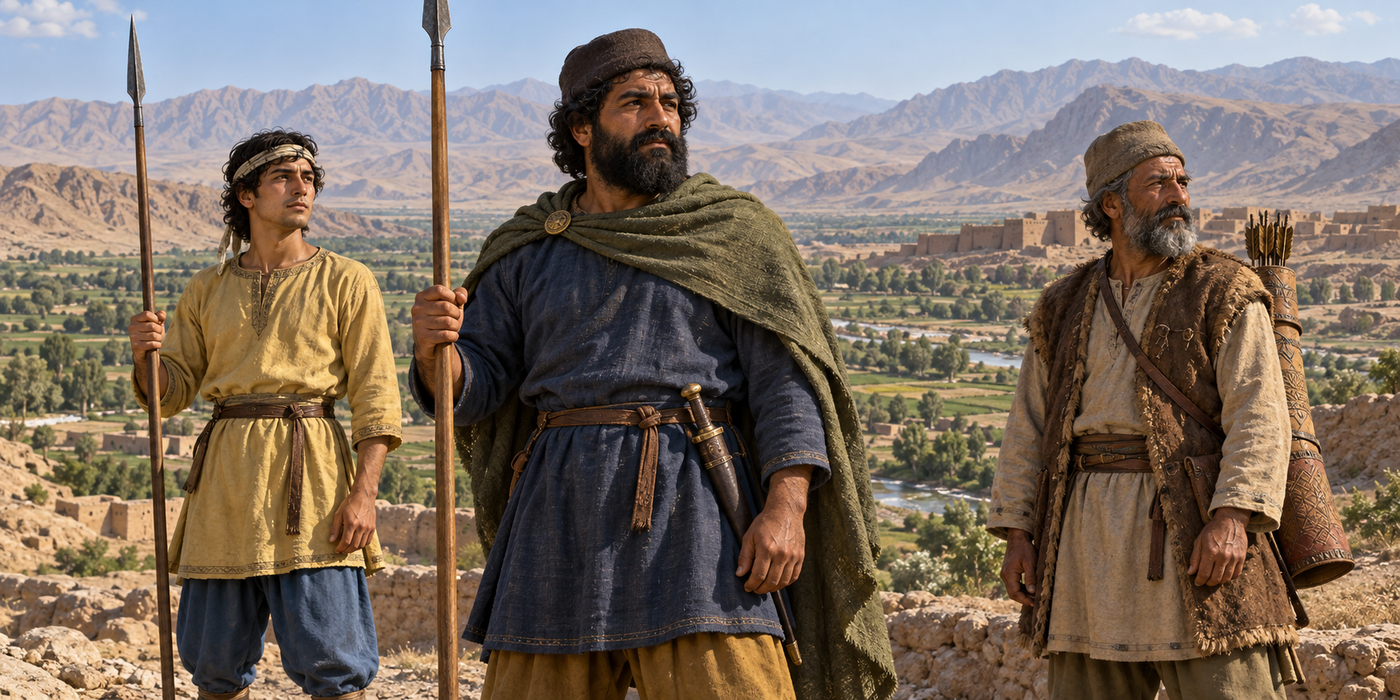
Arachotians
The road beyond Darius
In the winter of 330/329 BC, Alexander's advance carried his army through Arachosia towards the mountains separating it from Bactria. Darius was dead, but the eastern provinces still contained men capable of continuing resistance. Bessus had assumed royal authority, and the conquest now required long marches through countries far from the Mediterranean.
Arrian describes severe cold, snow and shortages during this part of the advance. Arachosia became a province to be secured and a route through which the army had to pass. Its valleys and settlements stood within a contest whose direction was pulling the Macedonians towards Central Asia and, eventually, India.
The country of the Arghandab
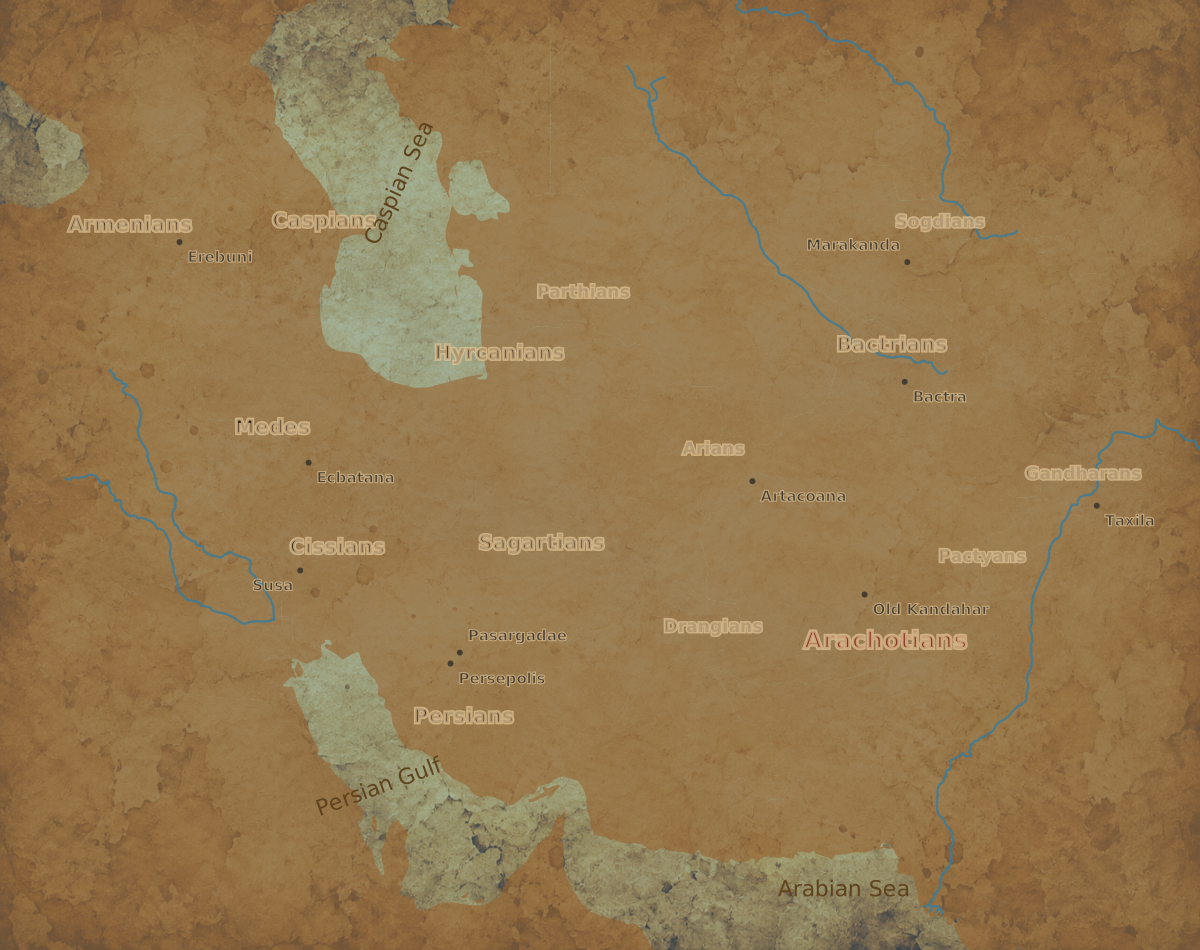
Arachosia lay in the south-eastern Iranian world, around the region of modern Kandahar and the Arghandab river. Its name is associated with the Old Persian Harauvatiš. Water and cultivable valleys supported settlement within a wider landscape of dry country, uplands and routes towards neighbouring regions.
The Kandahar basin occupied an important position between the Iranian interior and approaches leading towards the Indus. Travellers moving through it encountered a country in which access to productive ground and reliable supplies could determine the course of a journey. Routes mattered because armies and caravans could not live on a map's shortest line.
Arachosia's neighbours included Drangiana to the west and the countries bordering the great mountain barrier to the north. The southern approaches led towards Gedrosia. These connections made the province a meeting place for movements across different environments and administrative boundaries.
Vivana holds the province
Arachosia enters Achaemenid royal history with unusual clarity during the struggles that followed Darius I's accession in 522 BC. His Behistun inscription names Vivana as the satrap who remained loyal when a rival claimant, Vahyazdata, sent forces against him.
Vivana defeated the attacking army and pursued its commander to a fortress. The king's account placed the provincial fighting within his wider restoration of order. A distant governor's success helped preserve the monarchy at a moment when rebellion threatened several parts of the empire.
The episode reveals Arachosia as an established sphere of command rather than an empty margin. There were forces to mobilise, fortified places to hold and routes along which rival armies could operate. Royal authority depended on the actions of men able to fight effectively within the country.
Resources for a distant court
The province also appears in Achaemenid accounts of imperial resources. Darius' building inscription at Susa names Arachosia among the places from which ivory was brought for the palace. A product associated with a distant source entered a royal statement about the lands contributing to the king's work.
Such claims gave the empire's geography a material form. Stone, timber, precious metals and other goods were assembled at centres far from their origins. The organisation required carriers, officials and routes connecting provincial production with royal demand.
For Arachosia, participation in that system linked local resources to imperial display. The province's importance lay partly in what could move through it and from it. A governor had to preserve the means by which men, goods and messages reached their destinations.
Barsaentes and the royal cause
Under Darius III, Barsaentes commanded the Arachosians and neighbouring forces in the army assembled against Alexander. Arrian places them among the contingents at Gaugamela in 331 BC. The province's men thus participated in the monarchy's last great attempt to defeat the invader in a single battle.
After the defeat, Barsaentes remained with Darius during the withdrawal east. He then joined Bessus and Nabarzanes in seizing the king. The plot broke the authority that had held the retreating royal following together and made the future of the eastern provinces part of a new struggle over kingship.
Darius' death did not release those provinces from danger. A ruler who had helped depose him might claim to preserve resistance, but also faced Alexander's demand for submission and punishment. Provincial power now had to survive the collapse of the dynasty from which it had received legitimacy.
Arachosia and Drangiana
The political relationship between Arachosia and Drangiana brought neighbouring riverlands into the same commands. Farther west, the Helmand system and the basin around Lake Hamun supported another concentration of communities. Travel between them joined cultivated districts across stretches of more difficult ground.
These connections could carry soldiers as well as produce. A commander acting across both regions needed the cooperation of local authorities and access to supplies along the route. The survival of a province's military resources depended on more than a single defended centre.
Alexander's advance passed through this connected landscape after the loss of Darius. The task was to turn a claimed victory over the empire into obedience across places whose troops and revenues had previously answered to its governors.
The new governor
Arrian records the submission of Arachosia and Alexander's appointment of Menon as governor. The army continued towards the northern mountains, leaving a new representative to hold the country behind it. A brief sentence in the campaign narrative contained a much longer practical undertaking.
A governor had to secure routes, deal with communities and maintain the resources expected by an army operating elsewhere. The king's departure made those responsibilities more important. A conquered province that could not provision or communicate with the main force remained a weakness in the imperial rear.
Later, Sibyrtius received Arachosia and Gedrosia. His command joined a productive inland region to the southern country through which Alexander's returning army suffered catastrophic losses in 325 BC. Provincial administration had to respond to the consequences of decisions made far from the people required to support them.
An Alexandria in the east
The city later known as Alexandria in Arachosia was associated with the site of Old Kandahar. It occupied a place already important before the Macedonians, and its subsequent history joined an established regional centre with Greek settlement and administration.
The name announced a new royal connection, but the country's older inhabitants and routes remained fundamental. A settlement could carry the conqueror's name while depending on the fields, water and local knowledge that had sustained earlier communities.
The city's position would keep it relevant after the main army had gone. It stood in a region connecting Iranian and Indian political worlds, where a governor's strength depended on relations extending beyond one valley.
Sibyrtius after Alexander
When Alexander died in 323 BC, Sibyrtius retained his provincial command in the settlement made by the successors. The continuing appointment gave Arachosia an element of administrative continuity while the unity of the monarchy began to fracture.
The later wars drew eastern governors into rival coalitions. Troops, money and alliances from provinces such as Arachosia could influence conflicts fought at a considerable distance from their home bases. The governor's ability to preserve his own position depended on navigating those changing relationships.
Arachosia's history therefore did not end with the winter march. The country remained a source of resources and a route between larger powers, while its inhabitants lived through the demands attached to whichever commander could obtain their obedience.
The languages of a later king
In the third century BC, the region came within the Mauryan political world. Inscriptions of Aśoka found at Kandahar addressed readers in Greek and Aramaic. They belong to the generations after Alexander, when the consequences of the conquest were still taking new forms.
The inscriptions are an extraordinary witness to the communities and skills present in the city. Greek literary expression and an Aramaic administrative inheritance could be used to communicate the policy of an Indian emperor. Arachosia had become a place where several political histories met on the same stone.
That later evidence gives a durable perspective on the country Alexander crossed. Its value had never rested solely on remoteness or resistance. Valleys, roads and established settlements made it a connection between worlds, and ensured that successive kings would seek a place within its history.
Sources
Royal inscriptions and ancient narratives
- Darius I, Behistun inscription III.54–76: Vivana and the first battle; the pursuit; Susa building inscription DSf.
- Arrian, Anabasis, III.8, III.21 and III.28.
- Diodorus Siculus, Library of History, XVIII.3.
Historical geography and epigraphy
- Rüdiger Schmitt, “Arachosia”, Encyclopaedia Iranica; “Kandahar i. Historical Geography”.
- André Dupont-Sommer, “Une nouvelle inscription araméenne d'Asoka découverte à Kandahar (Afghanistan)”, CRAI 110.3 (1966).
- François Sabbathier, Dictionnaire pour l'intelligence des auteurs classiques grecs et latins, “Arachosie”.