






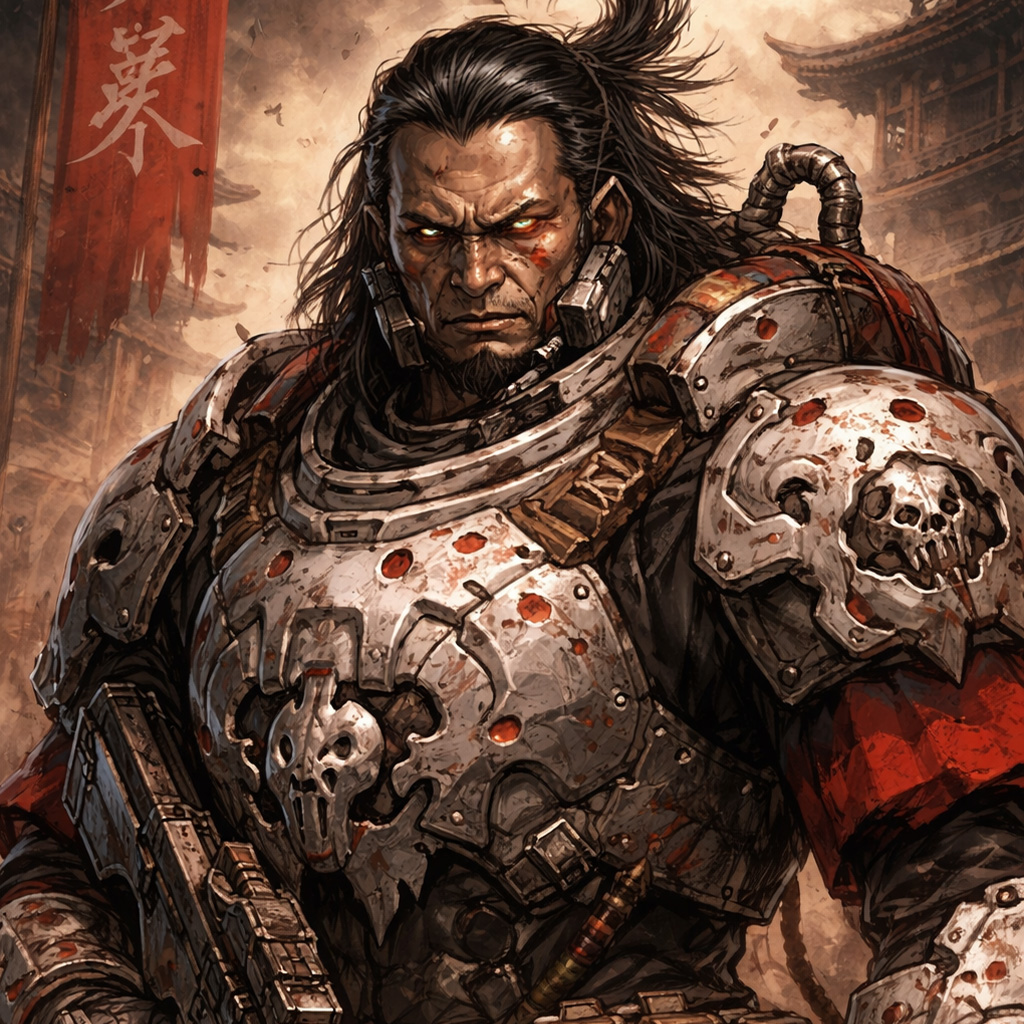
Part I – The Ruins of the Holy City
Tenkyo was once among the greatest sacred cities of Damocles, a place where faith, governance, and advanced knowledge converged beneath the authority of the Emissaries. Pilgrims crossed deserts and mountains to walk its ceremonial avenues, consult its archives, and kneel before shrines said to hold fragments of celestial truth.
That city still exists—but only in broken form. Its skyline is now a jagged line of collapsed temples, shattered towers, armored bastions, cratered plazas, and districts rebuilt a dozen times after a dozen battles. Ancient stone sanctuaries stand beside reinforced ferrocrete walls and gun emplacements assembled from later wars.
Beneath the surface lies another city entirely. Transit tunnels, maintenance shafts, forgotten vaults, drainage networks, and sealed corridors from older ages run under the streets like buried arteries. Whoever controls them can move unseen, store weapons, or strike where no assault was expected.
No district remains permanently secure. A boulevard patrolled by Imperial troops in daylight may belong to insurgents by night. A marketplace can become a battlefield in minutes. A shrine thought abandoned may conceal a command post, a relic cache, or an execution chamber.
For the rebels, Tenkyo is more than terrain. It is proof that the sacred center still resists. For the Empire, it is proof that rebellion has not yet been extinguished. That is why the city continues to bleed long after lesser places would have been abandoned.
Part II – Origins of the Rebellion
The rebellion began not as one movement, but as many acts of refusal. When Imperial power spread through Massaloï, surviving sect militias, dispossessed families, temple guardians, and former administrators each resisted in their own way. Some hid weapons. Some sabotaged roads. Some simply refused to recognize the new order.
Tenkyo quickly became the natural center of this resistance. Its sacred prestige gave meaning to sacrifice, while its ruins provided ideal ground for clandestine war. Priests who had escaped arrest organized safe houses. Veterans of earlier campaigns trained youths in alley warfare. Merchants hostile to occupation moved supplies through hidden routes.
At first, Imperial commanders expected the unrest to fade once key districts were occupied and leaders eliminated. Instead, every execution created martyrs, every raid uncovered only fragments of the network, and every victory was followed by new attacks elsewhere.
Over time, scattered resistance matured into permanent insurgency. Children born under occupation grew into fighters who had never known peace. Old rivalries between sects did not disappear, but the city itself became a cause strong enough to force temporary unity.
What had begun as local defiance became an institution of war, passed from generation to generation like a sacred inheritance.
Part III – A Magnet for the Faithful
Tenkyo no longer belongs only to those born there. Across Damocles, the name of the ruined holy city carries enormous power. To believers, it is the place where the old order still breathes beneath ash and concrete. To warriors seeking purpose, it is where faith can be proven in battle.
Volunteers therefore arrive constantly. Some come from the villages of Massaloï after losing family to pacification campaigns. Others travel from distant provinces drawn by prophecy, vengeance, or the promise of honor. Many of the most committed recruits come from the Tohei, where currents hostile to Imperial domination see Tenkyo as a worthy front in a larger struggle.
These foreigners bring more than numbers. They bring money, weapons, technical knowledge, and new military traditions. A fighter from the Tohei may train locals in disciplined close-quarters combat. A caravan veteran may establish new smuggling routes. A pilgrim noble may finance an entire cell.
This diversity creates tensions of language, doctrine, and leadership, yet it also gives the rebellion unusual resilience. If one district is crushed, support can rise from far beyond the city walls.
Thus Tenkyo became something rare in the modern age: a sacred foreign legion where men and women of many lands choose hardship, anonymity, and likely death for a city that is not theirs—but whose meaning they claim as their own.
Part IV – Society Under Siege
For civilians, life in Tenkyo is an endless negotiation with danger. Front lines shift without warning, curfews appear overnight, and streets considered safe for months can suddenly become kill zones. Families learn to read distant gunfire the way farmers read weather.
Food arrives through a mixture of ration systems, black markets, hidden gardens, and smuggled caravans. Water is stored obsessively. Medicine is treasured. Electricity exists in fragments, powered by stolen generators, repaired relic cells, or improvised neighborhood grids that may fail during battle.
Religious life never disappeared. Shrines hidden in basements, ruined courtyards, and sealed transit chambers host ceremonies attended by workers, widows, fighters, and children alike. In many districts, faith is less a doctrine than a way of enduring humiliation and loss.
Children grow up quickly. They memorize safe routes, recognize uniforms, and know which walls conceal tunnels. Some become couriers before adolescence. Others are taught trades so their district can survive blockade. Innocence exists, but it is heavily defended.
Yet the city is not only misery. Markets reopen after shelling, musicians perform in damaged squares, weddings are celebrated between offensives, and jokes circulate about every occupying force. Tenkyo survives because its people insist on living, not merely resisting.
Part V – Organization, Politics, and Supply
The rebellion is not a single army but a layered movement held together by necessity. Combat cells operate semi-independently, often knowing little about neighboring units. This limits the damage of arrests and infiltration, but makes coordination difficult.
Above them stand militant brotherhoods, sect commanders, neighborhood councils, and hidden committees that allocate fighters, food, and intelligence. Some leaders are sincere idealists. Others are ruthless survivors who learned politics in siege conditions. Most are both.
Unity remains fragile. Rival sects dispute doctrine, prestige, and access to relics. Foreign volunteers sometimes clash with local commanders. Smuggling families demand influence in exchange for risk. Personal grudges can derail major operations.
Supply is a constant battle. Weapons are captured, purchased, repaired, or dug from ruins. Ammunition is rationed carefully. Donations arrive through pilgrim networks, sympathetic merchants, and secret patrons across the continent. Every hidden warehouse is worth more than a monument.
What keeps the movement alive is not perfect discipline, but shared belief: that if Tenkyo falls in spirit, something greater than a city will be lost with it.
Part VI – Weapons and Elite Veterans
New recruits fight with whatever can be found: captured rifles, homemade explosives, scrap armor, knives, old carbines, and improvised drones assembled from civilian parts. Many enter battle under-equipped, learning survival before mastery.
Veterans are another matter entirely. Those who survive years of street war become among the deadliest fighters on Damocles. They know every sound a wall makes before collapse, every angle of fire in broken corridors, and every mistake an occupying soldier is likely to make.
The best-equipped among them carry relic weapons from the Celestial era or highly advanced systems restored in hidden workshops. Compact beam carbines, shield emitters, adaptive optics, autonomous scout drones, exo-assisted armor, and breaching tools of forgotten design appear in their hands.
Such equipment is rare, difficult to maintain, and often irreplaceable. It is therefore entrusted only to those who have proven skill, discipline, and devotion over many campaigns. Losing a veteran can mean losing knowledge no factory can replace.
This is why Imperial troops fear certain symbols and callsigns more than whole militias. A squad of seasoned Tenkyo veterans, properly armed and fighting on familiar ground, can destroy forces many times its size before vanishing back into the ruins.
Part VII – Doctrine of Urban Holy War
The Tenkyo Rebels do not seek victory through open-field battle. They wage a form of war shaped by ruins, memory, and faith. Every collapsed avenue, shrine wall, tunnel junction, and abandoned apartment block is treated as terrain to be weaponized.
Ambush is preferred over frontal assault. Imperial patrols are allowed to advance into carefully studied kill zones before explosives seal exits and marksmen strike from multiple elevations. When the enemy adapts, the trap changes with it.
Tunnel warfare is central to rebel doctrine. Fighters move beneath streets, bypass checkpoints, emerge behind fortified lines, or evacuate civilians through routes invisible from above. Entire offensives have failed because attackers captured surface districts while the real battle moved under their feet.
Rooftops serve as sniper nests, signal posts, drone launch sites, and escape paths. Barricades are built not only to stop armor, but to channel it into crossfire. False retreats lure pursuers into mined corridors. Sacred buildings are often defended with exceptional ferocity, both for morale and symbolism.
Most dangerous of all are coordinated uprisings. While one sector draws attention with loud resistance, hidden cells ignite elsewhere, striking depots, communication hubs, and collaborators simultaneously. In Tenkyo, the front line is wherever the rebels decide it is.
Part VIII – Enemies, Allies, and the Wider War
The most immediate enemy of the rebellion is the Imperial pacification apparatus: occupation troops, armored police units, intelligence officers, and locally recruited auxiliaries tasked with holding districts the city itself rejects. Their uniforms change over time, but their mission does not.
Lioners detachments are especially feared when deployed. Better equipped and more disciplined than ordinary garrison troops, they are often sent when symbolic victories are required or when rebellious sectors must be broken quickly and publicly.
Yet not all opposition wears Imperial colors. Rival sects sometimes denounce the rebels as reckless usurpers. Criminal networks profit from disorder while betraying whichever side threatens business. Some local notables prefer occupation to endless war and quietly cooperate with authorities.
The rebellion also receives support, though rarely without cost. Sympathetic factions in Massaloï provide shelter, recruits, or grain. Hidden clergy circles channel money and relic intelligence. In the Tohei, anti-Imperial currents and religious hardliners send volunteers, weapons, and prestige seekers eager to fight in the sacred city.
Many outside powers view Tenkyo less as a cause than as a tool. Some want the city liberated. Others merely want the Empire weakened. The rebels understand this well—and accept help anyway.
Part IX – Named Figures and Tenkyo Today
Supreme Commander Harun Sadeq is the current military head of the rebellion. A former district organizer turned strategist, he is respected for balancing fanatic morale with practical warfare. He knows Tenkyo cannot survive on martyrdom alone.
Mother Zuleika Voss is the movement’s most feared preacher and recruiter. Her sermons turn grief into rage and hesitation into devotion. Entire waves of volunteers have entered the city after hearing her speak.
Captain Jiro Takemasa, a veteran from the Tohei, became a legend after leading foreign volunteers through three encirclements without losing his banner. He symbolizes the wider continental struggle against Imperial domination.
Old Karim the Mole commands the tunnel networks beneath central Tenkyo. Smuggler, engineer, and saboteur, he knows more hidden routes than any living map. Some claim he has not seen daylight in years.
Sister Naima Reth maintains the rebellion’s relic arsenal. Half mechanic, half archivist, she restores ancient systems no one else fully understands and decides which fighters are worthy to carry them.
The Warden Seraph is the most famous veteran squad leader still active in the ruins. His small unit has destroyed armored columns, rescued trapped districts, and vanished before counterattack. Many doubt one person could do all attributed to him. That only strengthens the myth.
Today Tenkyo is exhausted, fragmented, and materially scarred beyond measure. Yet it remains unconquered in the only way that now matters. The city still inspires recruits, consumes armies, and refuses to become merely a memory. As long as fires burn in its ruins, the rebellion lives.