






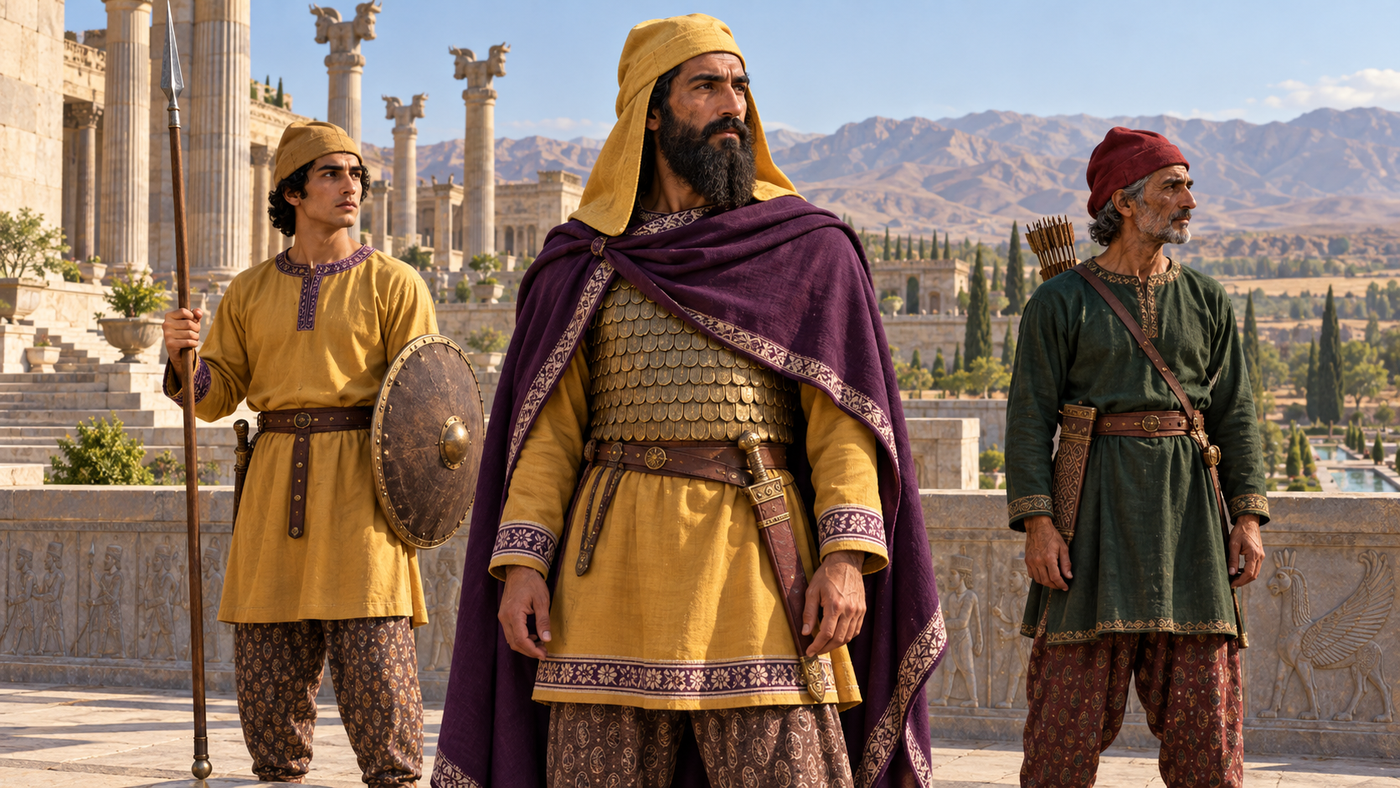
Persians
The king whose empire still stood
When Alexander crossed into Asia in 334 BC, Darius III ruled a monarchy extending from the Mediterranean towards India and Central Asia. Its provinces contained ancient cities, powerful families and armies whose traditions differed greatly. A defeat on the western frontier did not immediately deprive the Great King of the resources to fight again.
For the Persians at the centre of that monarchy, the war threatened a political world built over two centuries. Royal service had connected their households with lands far from Persia itself. The survival of the dynasty meant the survival of offices, honours and relationships upon which their standing depended.
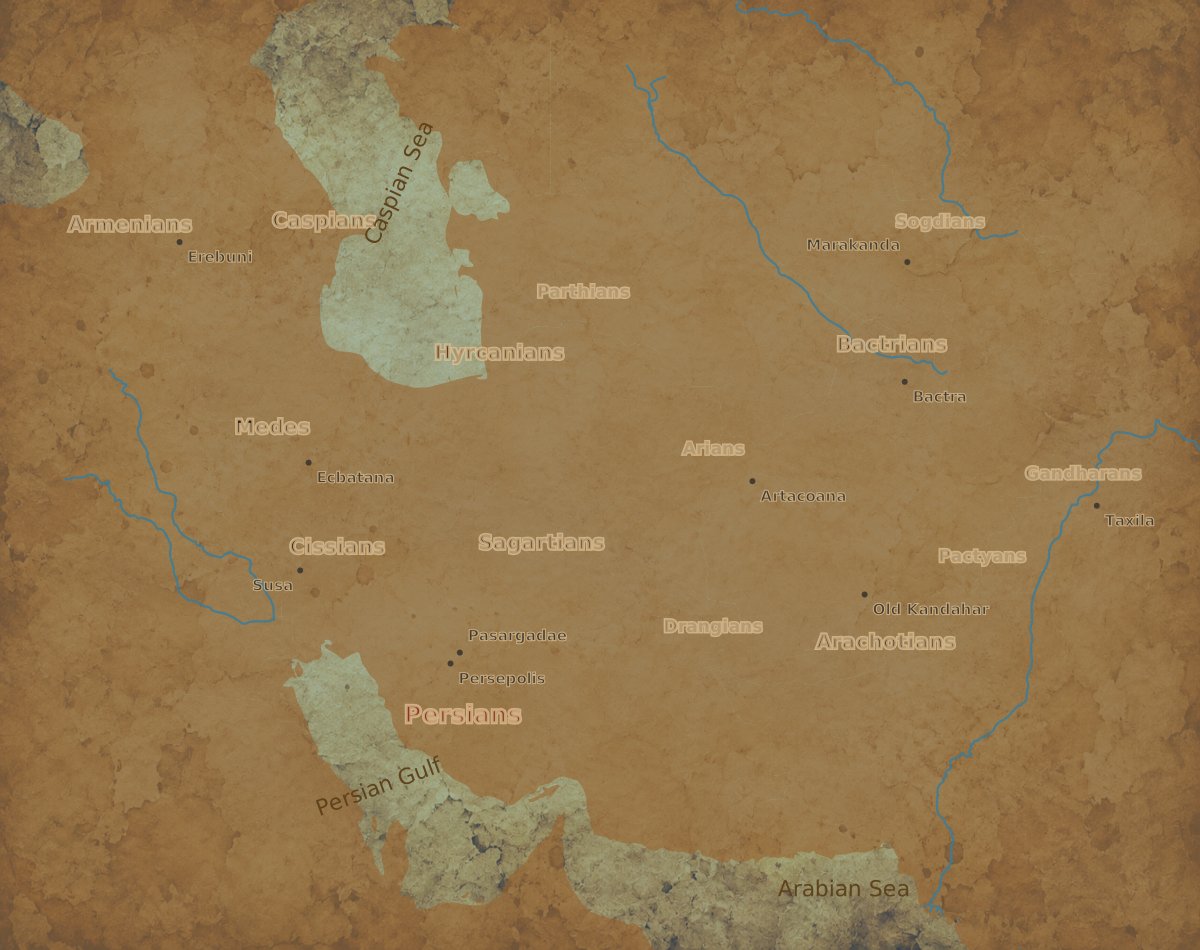
The homeland of the dynasty
Persia's original heartland lay in the south-western Iranian country known as Parsa, broadly corresponding to Fars. Valleys and uplands supported settlements, cultivation and livestock, while routes connected them with the lowlands of Susiana and the wider Iranian plateau. The homeland remained a special place within a monarchy whose authority reached far beyond it.
Cyrus established Pasargadae as a royal centre, and later kings developed Persepolis. The terrace, halls and sculpted stairways of Persepolis presented the dynasty through an ordered image of empire. Peoples from many countries appeared bringing gifts towards the royal presence.
The representations gave diversity a particular political meaning. Different dress and offerings distinguished the delegations, while their movement towards the king expressed a shared relationship with the monarchy. The ruler's authority made a multitude of lands appear within one carefully arranged world.
Cyrus and the enlargement of kingship
Cyrus' victories over Media, Lydia and Babylon in the sixth century BC created an imperial power of exceptional extent. Conquest brought the Persian dynasty into possession of institutions and populations whose histories were much older than its own rise.
The new kings used local forms as well as Persian ones to express sovereignty. Cyrus' Babylonian cylinder presented his rule through Marduk's favour; royal images and titles elsewhere addressed other audiences. Effective government required men able to work within several administrative and religious traditions.
Darius I consolidated the monarchy after a violent succession crisis and widespread revolts. His inscriptions made the defeat of the Lie central to the recovery of order. Roads, provinces and royal centres helped bind the territories together, while the court distributed recognition and command among those who served it.
The ideal Persian ruler
On his tomb, Darius I described the qualities of a king capable of governing others and himself. Justice, judgement and control of anger stood beside physical courage. He represented himself as an accomplished horseman, archer and spearman, able to fight both mounted and on foot.
The claim joined moral authority to martial competence. A sovereign should reward service, distinguish right from wrong and resist being governed by his impulses. The inscription set an ideal before future readers rather than recounting only victories over enemies.
For aristocratic households, royal service offered a path through which such values could be displayed and recognised. Skill in riding and weapons belonged to a world in which rank did not remove the expectation of personal participation in war. The king's companions and relatives stood close to his power and to its dangers.
The empire at work
Behind the ceremonial image stood extensive administration. The Persepolis Fortification Archive preserves clay records concerning the distribution of food and other resources. Officials, workers, travellers and religious personnel appear in documents that reveal the daily organisation supporting the royal centre.
The archive includes several languages and systems of recording. Its existence makes the empire visible through movements and obligations far smaller than a campaign: an allocation authorised, a journey provisioned, a delivery received. Monumental power depended on these repeated acts.
Across the provinces, satraps governed within relationships that combined royal appointment, local resources and personal connections. Leading men could maintain strong territorial bases, and a succession or rebellion could force the king to renegotiate their service. The empire's size gave it resilience while making coordinated action a continuing task.
Ahura Mazda and the Magi
Achaemenid royal inscriptions repeatedly honoured Ahura Mazda as the giver of kingship and support. Darius presented his capacity to rule as a divine gift and connected his victories with the restoration of right order. Religion entered the public explanation of why the king deserved obedience.
The Magi served as priests within western Iranian religious life. They participated in royal rites and received provisions through the institutions surrounding the court. Sacrifice, recitation and the care of proper observance made their knowledge important to those who sought divine favour.
The empire also contained many other sanctuaries and traditions. Royal dealings with Babylonian, Egyptian and Anatolian cults formed part of governing its peoples. At the Persian centre, the king's relationship with Ahura Mazda existed within a realm whose religious life could not be reduced to a single local practice.
Persian men under arms
Persian forces combined missile weapons with the capacity to fight at close quarters. Herodotus' account of Xerxes' army describes bows, short spears, swords and wicker shields, with protective equipment worn beneath patterned garments. His description belongs to the great invasion of 480 BC, generations before Darius III.
Mounted service occupied a particularly important place among men of rank. Royal and aristocratic cavalry could fight with spears and other weapons, supported by the wealth needed to maintain horses and equipment. At court, selected troops guarded the king and made his presence on the battlefield conspicuous.
In Alexander's campaigns, these Persian elements operated beside forces drawn from many provinces and Greek mercenaries. Their cooperation required commanders able to bring different arms into action together. The Great King's army was a political assembly as well as a military one, gathering service owed through a wide range of relationships.
Darius at Issus
In 333 BC, Darius met Alexander at Issus. The battle placed the royal armies in a narrow coastal setting, where the Persian king could not use all the advantages that a larger force might possess on open ground. Alexander's attack broke the position around the royal centre, and Darius escaped.
His family and much of the baggage fell into Macedonian hands. The capture gave Alexander hostages of exceptional value and placed the Persian royal household within the conqueror's camp. Darius' personal defeat now had a family dimension as well as a military one.
Negotiations followed without ending the war. The Great King still held the empire's central and eastern resources, and he could assemble another army. Alexander, meanwhile, secured the Mediterranean coast and Egypt before returning towards the decisive confrontation.
The last great muster
At Gaugamela in 331 BC, Darius chose a broad plain and prepared the ground for battle. His army included Persian royal troops, cavalry from the Iranian lands, Greek mercenaries, chariots and contingents from across the empire. The gathering represented the monarchy's remaining ability to call upon distant service.
The engagement produced fierce fighting in different parts of the field. Mazaeus' forces pressed the Macedonian left while Alexander sought his opening against the Persian centre. The chariot attack failed to deliver the hoped-for disruption, and the battle turned into another royal defeat.
Darius withdrew towards Media. Babylon and Susa passed to Alexander, providing the victor with major centres and immense royal resources. The loss of those places changed the scale of the struggle. The Persian king was still alive, but the foundations from which he could restore his position were narrowing.
War reaches Persia
The approach to the Persian homeland brought resistance at the Persian Gates. Ariobarzanes held a difficult position against Alexander before the Macedonians found a way around it. The road then opened towards Persepolis.
The seizure of the royal centre was followed by plunder and the burning of the palaces. Arrian presents the destruction as an act associated with revenge for the Persian invasions of Greece. Whatever political purpose the king attached to it, the fire struck at buildings through which the Achaemenids had expressed the dignity and order of their empire.
Royal treasure supplied the conqueror's future campaigns. The ceremonies once represented on the stairways belonged to a dynasty whose principal places were now occupied by its enemy. For Persian households, defeat had reached the country from which the monarchy had first emerged.
The death of Darius
In 330 BC, Darius' retreat ended in a seizure by men from his own following, including Bessus, Nabarzanes and Barsaentes. Alexander pursued at great speed. Before he could take the king alive, the captors abandoned Darius mortally wounded.
The murder gave Alexander a new claim: he could present himself as the avenger and successor of the king he had fought. Bessus, meanwhile, assumed royal authority in the east, extending resistance beyond the death of the man whose army had lost at Gaugamela.
Persian service did not vanish with the dynasty. Alexander increasingly incorporated Iranian nobles and soldiers, and the relationship between them and his Macedonian followers became a central tension of the later reign. The conquest ended Achaemenid kingship, but the resources, people and political traditions of the Persian world continued to shape the empire built upon its defeat.
Sources
Royal documents and ancient narratives
- Darius I, tomb inscription DNb.
- Herodotus, Histories, VII.61 and 83.
- Arrian, Anabasis, II.8–15 and III.8–22, particularly the imperial muster, Persepolis and the seizure of Darius.
Archaeology and historical studies