






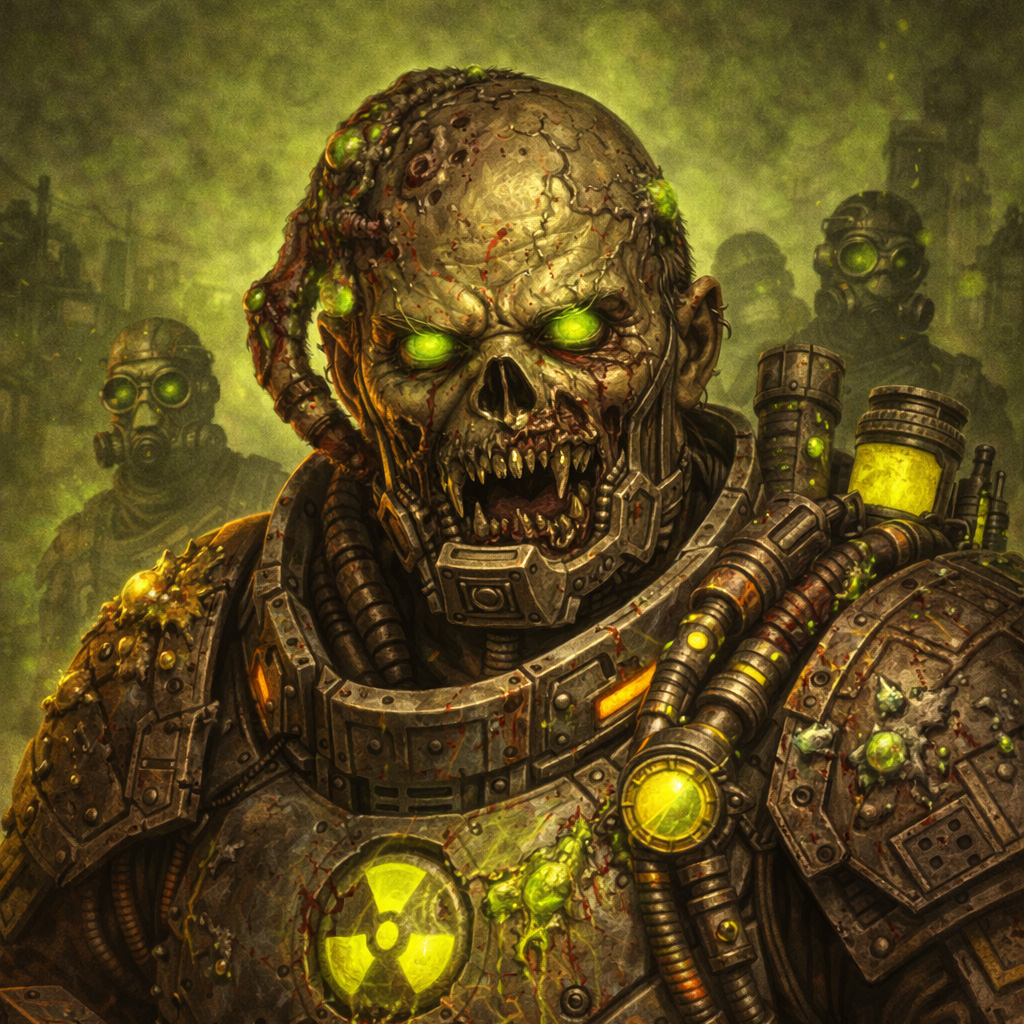
Part I – Born from Atomic Fire
The Naxjabas were not born as a people in the ordinary sense. They were forged in catastrophe. Their ancestors were mountain traditionalists, stubborn frontier clans, refugees, and holdouts who resisted the final Lioners campaigns when much of the continent had already bent the knee.
These highland communities knew they could not defeat imperial armies in open war, yet they believed survival without freedom was only a slower form of death. They fought from ridgelines, caves, ruined passes, and ancestral fortresses, forcing the conquerors to pay for every ascent in blood.
When conventional campaigns failed to break resistance quickly enough, the answer came in atomic fire. Bombardments fell upon valleys, tunnels, settlements, and entire mountain chains suspected of harboring insurgents. What could not be pacified would be erased.
It was not erased. It was transformed.
Those who survived emerged burned, poisoned, blinded, scarred, infertile, enraged—or changed in ways no one understood. Children were born twisted yet hardy. Flesh adapted where machines could not. Communities that should have vanished instead learned to live inside the wound left by war.
From those generations came the Naxjabas: heirs of the massacred, descendants of resistance, and living evidence that annihilation had failed.
Part II – The Broken Mountains
The homeland of the Naxjabas is a labyrinth of shattered highlands stretching through bomb-scarred ranges once contested during the conquest. Peaks split by old detonations tower above valleys where radiation still lingers in the soil, water, and bone.
To outsiders, the region appears uninhabitable. Roads end abruptly in landslides. Weather changes without warning. Entire slopes collapse after seasonal thaw. Old mine tunnels breathe toxic vapors, while ruined fortresses sit half-buried beneath stone and ash.
Yet beneath this apparent wasteland lies a hidden world. Cavern settlements glow with fungus gardens and reclaimed machinery. Underground rivers feed reservoirs known only to local guides. Forgotten transit shafts connect valleys separated by cliffs that no army could cross from the surface.
The mountains are also rich in remnants of older ages: abandoned mines, sealed depots, lost shrines, and wreckage from campaigns long forgotten. What others see as debris, the Naxjabas see as inheritance.
No occupying force has ever fully mastered these lands. Maps become lies after one winter. Supply lines vanish. Patrols return missing men—or do not return at all. The Broken Mountains are cruel to everyone, but they are home to the Naxjabas.
Part III – Flesh Against Steel
Deprived of stable industry, isolated from advanced academies, and hunted by stronger powers, the Naxjabas survived by mastering the one resource they always possessed: living matter. Where their enemies trusted armor, reactors, and standardized weapons, the mountain clans learned to improve flesh, poison blood, and adapt bodies to hostile environments.
What began as desperate medicine became a distinct science. Healers studied radiation sickness, mutation patterns, accelerated healing, fungal symbiosis, and the effects of toxins carried in mountain water and ash. Crude remedies evolved into disciplined biological knowledge passed through guarded lineages.
Their warriors now use grafted organs that filter poison, skin treatments that harden against cold and shrapnel, stimulants brewed from cavern molds, and tailored venoms delivered through blades, darts, or aerosol traps. Some fighters possess enhanced night vision, unusual bone density, or scar tissue cultivated almost like armor.
Not every experiment succeeds. Many die in testing. Others become unstable, feral, or physically broken. Such failures are hidden, pitied, or used in war according to the customs of each clan.
To outsiders, these practices seem monstrous. To the Naxjabas, they are simply proof that flesh can defeat steel when steel tries to erase it.
Part IV – Society of the Scarred
Naxjabas society is built around endurance. Beauty, noble pedigree, and polished manners mean little in the highlands. What matters is whether a person can survive winter, protect the clan, carry burdens, and remain standing when easier souls would collapse.
Most communities are organized through clan councils led by elders, war captains, healers, and those whose deeds command respect. Authority is practical rather than ceremonial. A famous hunter may outweigh a hereditary chief. A healer who saves children through plague years may speak louder than any warrior.
Scars are not hidden. Burns, missing limbs, graft marks, and visible mutations often carry status because they testify to suffering endured and overcome. Some rites of passage even require controlled hardship: fasting in toxic caves, solitary hunts in irradiated zones, or surviving nights in ancestral ruins.
Outsiders are treated cautiously. Hospitality exists, but never innocence. A guest may be fed warmly while being watched by six rifles. Trust is earned slowly and can be lost in a sentence.
Despite their harsh reputation, Naxjabas communities are deeply protective of their own. Children, elders, and the infirm are considered collective responsibility. In a land that tried to kill them all, survival was never an individual act.
Part V – Endless War with the Lioners
The Naxjabas do not consider their struggle with the Lioners a border conflict or a political dispute. To them, it is an unfinished sentence written in atomic fire. The bombings that created their people are not ancient history but inherited memory, repeated in stories, scars, and burial rites.
Because of this, peace has never fully taken root in the mountains. Raids strike supply convoys moving toward frontier forts. Bridges collapse beneath armored columns. Officers disappear on inspection tours. Remote outposts wake to find their water poisoned or their communications severed.
Voltrmen industry is a favored target. Foundries, rail links, fuel depots, and ore caravans feeding Lioners power have been sabotaged for generations. Even failed attacks force expensive security measures and constant paranoia.
The Lioners answer with sweeps, bounties, fortified roads, and punitive expeditions. They win many engagements. They destroy camps, capture cells, and kill local leaders. Yet each victory tends to scatter resistance rather than end it.
The mountains reward patience more than conquest. So the war continues: sometimes loud, sometimes quiet, never truly absent.
Part VI – Trade, Alliances, and Pragmatism
Though driven by vengeance, the Naxjabas are not blind ideologues. Survival in the highlands requires trade, and trade requires dealing with people one may despise. As a result, they have built a reputation for ruthless pragmatism beneath their reputation for hatred.
Smugglers cross hidden passes carrying medicine, machine parts, grain, ammunition, and luxuries for those wealthy enough to pay. In return, the Naxjabas sell rare minerals, toxins, biological compounds, salvage from forgotten battlefields, and access through routes no conventional map records.
Relations with the Bug Army are inconsistent and dangerous. Some clans exchange guides, prisoners, or battlefield intelligence. Others fight bitter skirmishes over slaves, territory, or contaminated resources. Cooperation rarely survives success for long.
Frontier lords and desperate factions sometimes hire Naxjabas mercenaries for tasks regular troops avoid: tunnel clearing, mountain pursuit, sabotage, monster hunting, or assassination in hostile terrain. Payment is expected in advance.
No alliance is permanent. The Naxjabas trust necessity, not promises. If circumstances change, yesterday’s customer may become tomorrow’s target.
Part VII – Named Figures
War-Chief Dargan Khor is the most respected commander among the mountain clans. Scarred from dozens of campaigns and missing one arm replaced by a living grafted construct, he unites rival chiefs only when danger is greatest. He does not dream of conquest—only of ensuring that the highlands are never conquered again.
Vesha the Pale Huntress is a legendary tracker said to move through irradiated valleys without protection. Albino from generations of mutation, she has slain Lioners officers, Bug Army raiders, and beasts no scholar can classify. Parents frighten children with her name; soldiers whisper it before entering the mountains.
Master Surn Valek is the foremost bio-alchemist of the Naxjabas. His hidden laboratories produce adaptive venoms, regenerative salves, fungal stimulants, and living weapons feared across the frontier. He insists science is neutral. Few believe him.
Miraq Tolen serves as diplomat, fence, and caravan broker between the clans and the outside world. Fluent in several trade tongues and equally fluent in deception, he can negotiate safe passage at noon and sell the same route to ambushers by dusk.
Mother Zarifa Ash-Voice is a prophetess of uncompromising vengeance. She preaches that every compromise with the lowlands delays justice for the dead. Her followers burn treaties, reject trade, and volunteer eagerly for missions few survive.
Kael Voren is a young reformer from a rising clan who argues that endless revenge will one day destroy the Naxjabas more surely than any bomb. He seeks stronger institutions, selective diplomacy, and a future where mountain children inherit more than hatred.
Part VIII – Naxjabas Today
To much of Damocles, the Naxjabas are monsters born from radiation and bitterness. To frontier officers, they are insurgents who can never be fully defeated. To smugglers, they are difficult but profitable partners. To themselves, they are survivors who paid for existence in blood.
They remain too divided to descend in force and build a lasting lowland state. Old clan rivalries, harsh geography, and conflicting visions prevent lasting unity. Yet those same divisions make them almost impossible to destroy, because no single defeat can end them all.
Their sciences grow more sophisticated each generation. Their memory of the bombings does not fade. Their youth are torn between vengeance and reinvention. Meanwhile every great power continues underestimating what hardship has made of them.
The Naxjabas did not choose the form history gave them. But in the broken mountains of Damocles, they have become one of its most dangerous answers.