






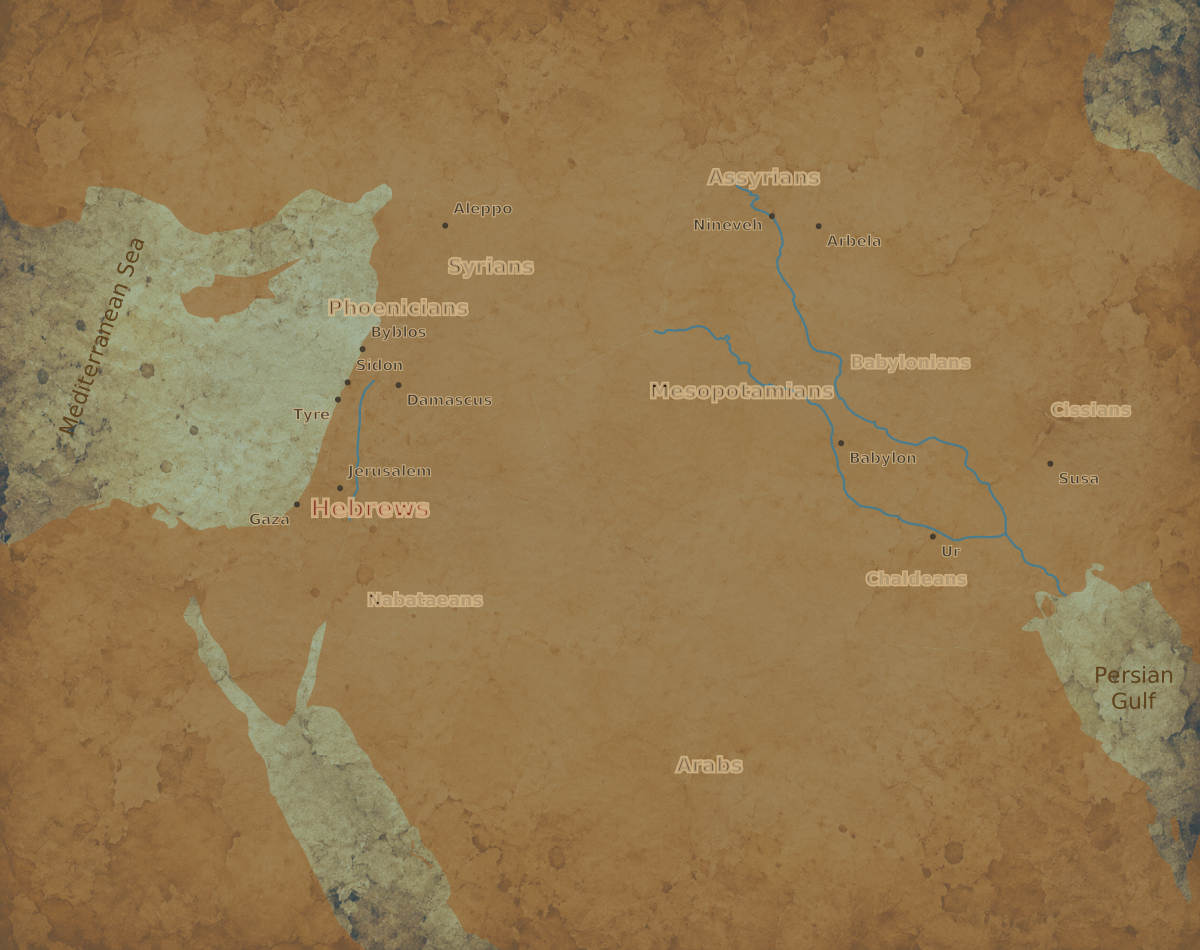
Hebrews
The high priest and the conqueror
Josephus tells a striking story about Alexander's approach to Jerusalem. The high priest Jaddua had refused to abandon his oath to Darius, and the Macedonian king was expected to punish the city. Instead, Alexander saw the priestly procession, recognised a figure from a dream and honoured the God whose name the high priest bore. The threatened encounter ended in sacrifice and favour.
This later Jewish tradition gave Jerusalem a place within the conqueror's destiny. Its central figure was a priest, standing before an army with the authority of his sanctuary. In the country Alexander acquired, the old monarchy of Judah had long disappeared. The Temple, the community around it and their relationship with imperial government shaped the exercise of power.
The hills of Yehud
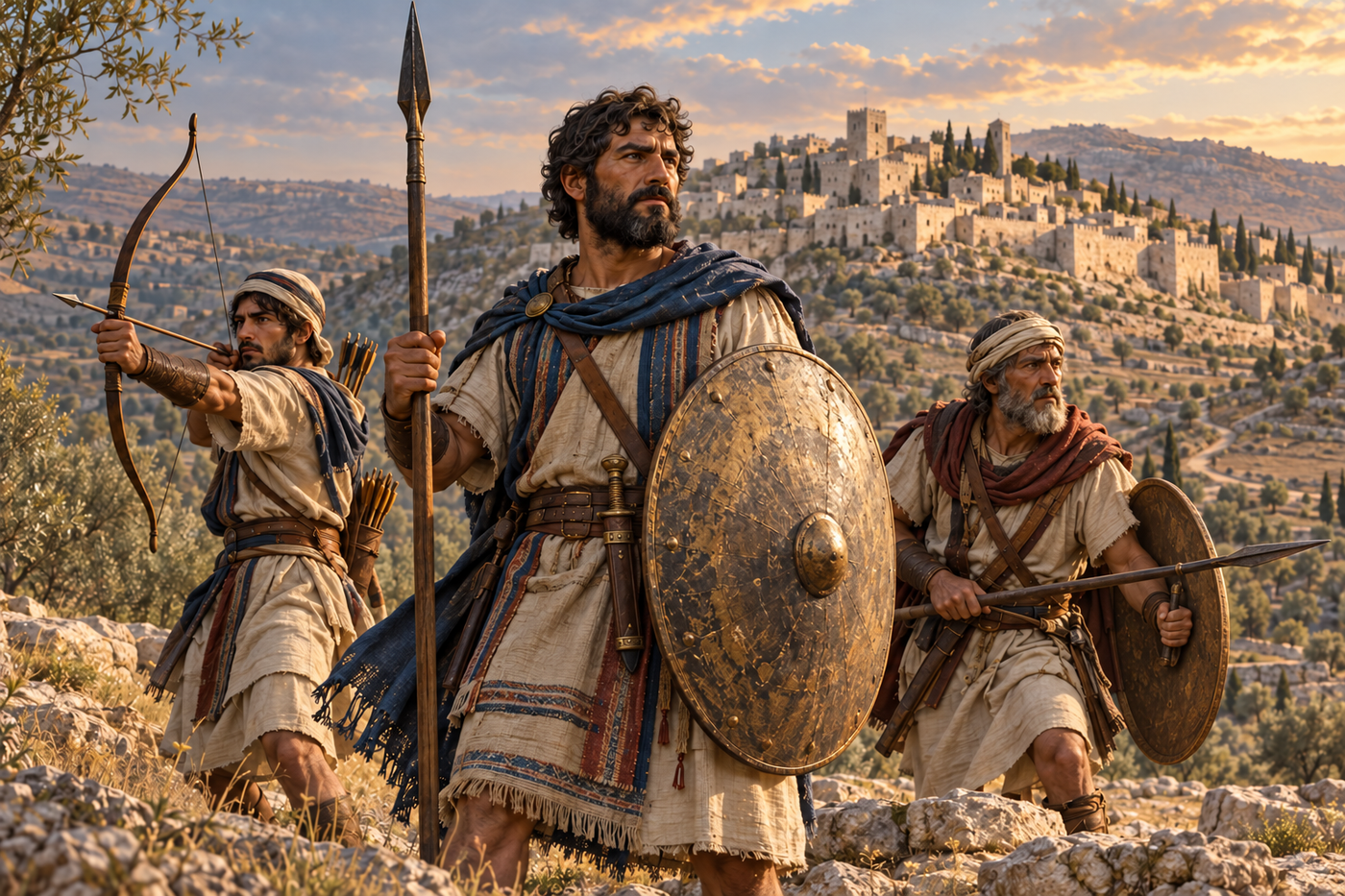
The Persian province of Yehud occupied part of the southern Levantine highlands around Jerusalem. Its communities lived among cultivated slopes, valleys and routes connecting the interior with the coastal plain. The surrounding region linked Egypt, Phoenicia, Syria and the roads towards Mesopotamia.
This was a smaller political world than the kingdoms remembered in the narratives of Israel and Judah. Villages, agricultural holdings and the provincial centre sustained a population whose obligations were local and imperial at once. Land, kinship and religious observance gave everyday life structures that a change of distant king did not automatically overturn.
Jerusalem's standing rested particularly on its sanctuary and the memory attached to it. Families could recognise a shared past of kings, destruction and return while living under a governor answerable to an empire. The survival of the community involved maintaining those inherited connections within the practical demands of provincial life.
The memory of destruction
Babylonian conquest had transformed Judah in the early sixth century BC. Nebuchadnezzar's armies took Jerusalem, removed members of its ruling and skilled population, and eventually destroyed the city and its Temple. The monarchy ended, and displaced families began new lives far from the hill country.
The consequences extended beyond those taken away. People remaining in the land faced damaged institutions, disrupted property and the loss of the royal centre. In Babylonia, the exiles and their descendants entered another social and economic world while preserving names and attachments linking them to Judah.
Cuneiform documents give some of these displaced people a presence outside the biblical narratives. They record households and transactions within Babylonian and Persian society. The diaspora became an enduring part of Judean history, rather than an interval ending when a new imperial king permitted return.
Cyrus and the return
Cyrus' capture of Babylon in 539 BC acquired exceptional meaning in Jewish memory. Biblical accounts associated his rule with permission to return and restore the sanctuary at Jerusalem. Persian conquest could therefore appear as the opening through which a devastated community recovered religious life in its homeland.
The rebuilding belonged to a process extending over generations. The Temple was restored under Darius I, and later traditions about Ezra and Nehemiah connected royal authorisation with the regulation and protection of the community. The relationship with Persia could be presented as an opportunity to uphold inherited law.
Imperial favour did not remove disputes. Questions of membership, marriage, land and authority could divide people claiming the same past. Returning families and established inhabitants had to negotiate their places within a country whose political institutions differed fundamentally from those before the exile.
Priests, governors and obligations
The high priest occupied a position in which sacred standing could carry political weight. The Temple gathered offerings, personnel and the expectations of those who identified with it. Its leading households could speak to officials beyond Jerusalem as well as direct ceremonies within the sanctuary.
A provincial governor held another kind of authority. Persian rule required revenues, order and communication with wider administrative structures. Aramaic served as an important language of that world, connecting local affairs with officials and documents elsewhere in the empire.
Neither role made its holder immune to rivalry. In Josephus' account of the Persian period, a dispute within the high-priestly family brought violence into the Temple and an intervention by the royal commander Bagoses. The episode presents religious office as a prize over which personal ambition and outside power could meet disastrously.
Silver marked with a provincial name
Small silver coins bearing the name Yehud provide a particularly tangible connection with the fourth century BC. Their images could draw on familiar eastern Mediterranean coin types, including forms associated with Athenian silver. The provincial name placed a local identity upon money circulating within a much broader economic world.
Scientific study of late Persian and early Macedonian examples has identified high-purity silver and examined how the pieces were produced. These modest objects reveal skilled work and regulated choices at a scale far removed from the great royal treasures described in conquest narratives.
Coinage did not make Yehud an independent kingdom. It showed a capacity to express local authority within larger systems of exchange. A small province could remain recognisable through the marks on its silver even while sovereignty over the region passed from Persia to Macedonia.
Communities beyond Jerusalem
Jewish life extended along routes of migration and military service. At Elephantine in southern Egypt, fifth-century Aramaic papyri preserve the affairs of a Jewish community within a Persian garrison environment. Families made contracts, held property and maintained a temple of their own.
After that sanctuary was destroyed, its members sought support from officials in Yehud and Samaria. The surviving appeals reveal connections across considerable distances. Religious concerns, provincial authority and the needs of a military settlement could join the Nile frontier to the southern Levant.
These documents also show how service abroad could become settled life. Soldiers belonged to households, entered legal agreements and raised families. Their history widened the community's geography without removing Jerusalem's importance as a point of reference.
Neighbours and competing sanctuaries
Samaria formed another important regional centre, and Mount Gerizim became a focus of worship for its community. Relationships with Jerusalem involved shared traditions as well as disputes over legitimate priesthood, ancestry and sacred place. Political boundaries did not neatly separate every religious attachment.
Josephus placed the establishment of the Gerizim sanctuary within the story of Sanballat, Manasseh and Alexander. In his narrative, family marriage and priestly exclusion create an opening for a rival religious centre, while the Macedonian king becomes the power whose permission makes the project possible.
The story expresses an enduring competition through named individuals and their choices. A marriage could connect leading families across provincial divisions; a claim to sacred office could direct support towards another sanctuary. The arrival of a conqueror offered an opportunity to seek recognition for arrangements contested at home.
Within the Macedonian conquest
Alexander's victory at Issus and his capture of Tyre and Gaza brought the southern Levant within his power before he entered Egypt in 332 BC. Communities away from the main siege routes still faced the consequences: demands for supplies, decisions about allegiance and a new authority claiming the revenues and obedience formerly owed to Darius.
The Jerusalem story preserved by Josephus answers those pressures through the figure of Jaddua. Sacred dignity prevents destruction, and the new king recognises the community's laws. It is a powerful expression of how later Jewish memory made sense of surviving a change of empire.
After Alexander's death, his successors fought over the lands between Egypt and Syria. Judea lay within that contested corridor. For its inhabitants, the future depended on maintaining households, fields and worship under rulers whose wars repeatedly crossed the region. The Temple and the community around it would remain central as the names of the great kings changed.
Sources
Ancient narratives and documents
- Flavius Josephus, Jewish Antiquities, XI.7–8: the high priests, Samaria and the Alexander tradition.
- Ezra 1–6; Nehemiah 1–6: return, the Temple and provincial government.
- Elephantine temple petition, 407 BC; Staatliche Museen zu Berlin, Texts and Scripts from Elephantine.
Archaeology and historical studies
- Metropolitan Museum of Art, “Cyrus and the Judean Diaspora”.
- “Archaeometallurgical Analysis of the Provincial Silver Coinage of Judah: More on the Chaîne Opératoire of the Minting Process”, Materials 16.6 (2023), 2200.
- “Jerusalem and Iran”, Encyclopaedia Iranica.
- François Sabbathier, Dictionnaire pour l'intelligence des auteurs classiques grecs et latins, “Jaddus”.