




Part I – Gravokharn, Twenty Millennia Ago
Twenty thousand years before the present age, when many powers now remembered only in myth still shaped the fate of Damocles, the kingdom of Gravokharn already stood in the northwest of the Cinan world. Few realms can claim such depth of continuity. Fewer still can claim to have endured while remaining recognizably themselves.
Gravokharn was never a simple mountain hold nor a mere tribal confederation. It was a hybrid state built across two environments and two peoples: surface domains of the Colbs and subterranean strongholds of the Tnedjes. Where others divided land by conquest, Gravokharn organized it by function and mutual necessity.
The open lands above provided trade routes, pasture, patrol zones, and contact with neighboring states. The mountains below offered mines, workshops, secure halls, and natural defenses. Together they formed a kingdom whose strength came from integration rather than uniformity.
Its location mattered greatly. Positioned near the Cinan Theocracy yet not absorbed by it, Gravokharn became a strategic intermediary between cultures of faith, war, and industry. It learned early that survival did not require empire if one could become indispensable to empires.
Even in that distant era, the foundations of the modern Old Guild were already visible: endurance, craftsmanship, negotiated order, and the refusal to disappear.
Part II – Peoples of Stone and Dust
The first pillar of Gravokharn was the Colbs, surface-dwelling humanoids distinguished by their hyena-like heads, sharp instincts, and talent for life in exposed lands where vigilance meant survival. They were scouts, caravan wardens, hunters, mercenaries, and guardians of roads others feared to travel.
Colb society valued mobility, practical courage, and communal obligation. They understood the moods of the plains and the dangers that move across open ground. In war they were known for aggression, pack discipline, and a fierce capacity to hold broken frontiers against stronger foes.
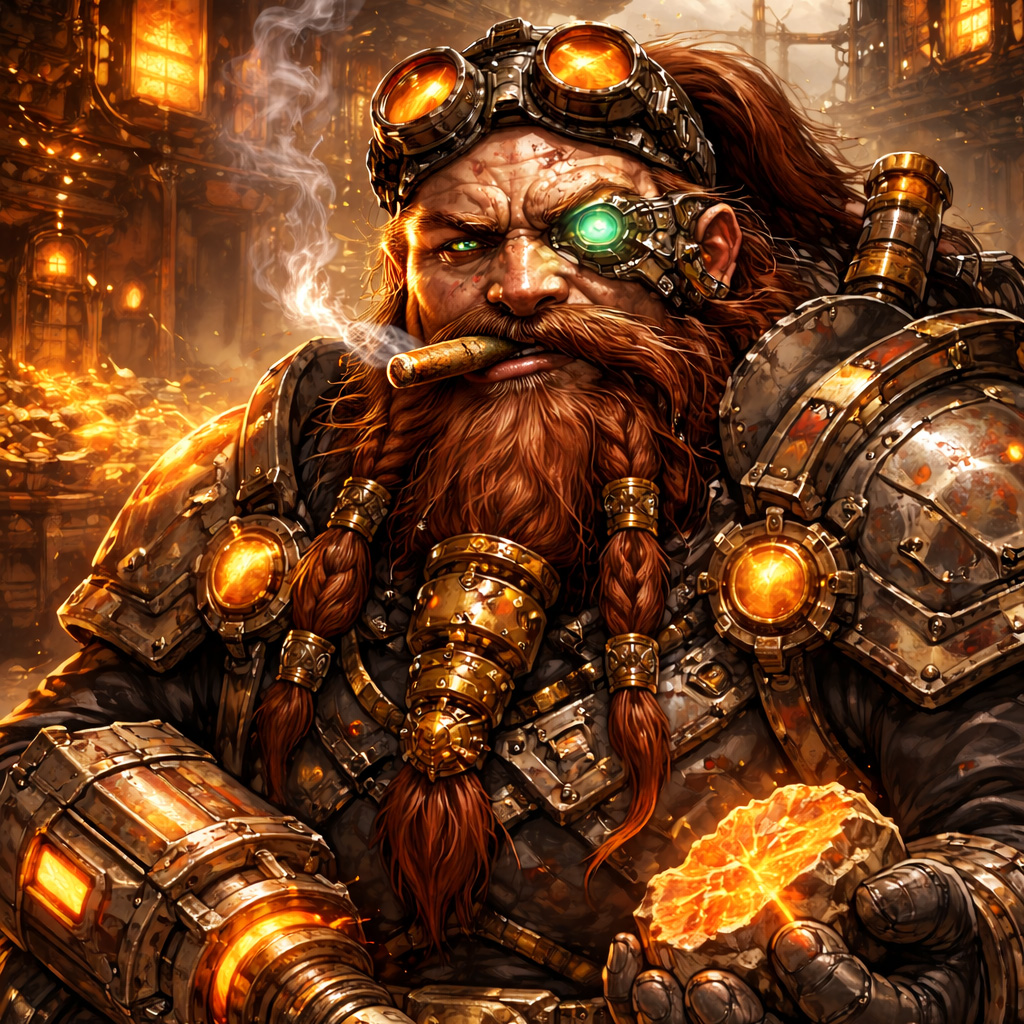
The second pillar was the Tnedjes, massive proto-human descendants with broad frames, powerful arms, and short sturdy legs adapted for underground labor and mountain life. They are the people now known simply as dwarves.
Tnedje culture centered on endurance, technical mastery, memory, and the slow accumulation of skill across generations. Where Colbs excelled in movement and reaction, the Tnedjes excelled in construction, extraction, engineering, and patient statecraft.
Each people possessed what the other lacked. Gravokharn endured because neither was complete alone.
Part III – Council of Six
The political heart of Gravokharn was neither king nor conqueror, but a council. Six representatives governed the realm: three chosen from the Colbs and three from the Tnedjes. This balance of equals became one of the oldest functioning constitutional systems on Damocles.
The arrangement was not built on idealism alone. It emerged from necessity. No surface ruler could command the mines without cooperation below, and no mountain lord could secure trade or borders without the peoples above. Shared government proved cheaper than civil war and wiser than domination.
Decisions were often slow, but rarely reckless. Debate, precedent, oath-binding agreements, and negotiated duty shaped public life. A law accepted by all six voices carried immense legitimacy because it represented the whole kingdom rather than one victorious faction.
Disputes still existed, sometimes bitterly. Yet conflict was channeled into institutions instead of endless blood feud. Over centuries, this produced something rare in Damocles: political continuity stronger than individual ambition.
Many modern states appear more dynamic than the Old Guild. Few can match the durability of a system that learned twenty millennia ago how to survive disagreement.
Part IV – Forge of the Cinan Age
Among the greatest advantages of ancient Gravokharn was its relationship with the Cinan Theocracy. While many neighboring powers feared or resented Cinan influence, Gravokharn cultivated profitable and stable ties with one of the dominant civilizations of the age.
The Tnedjes supplied what the Theocracy valued most: weapons, machines, metalwork, and the disciplined labor required to sustain industrial production at scale. Their workshops beneath the mountains became known for reliability rather than extravagance. What they built worked, endured, and could be repaired.
The Colbs contributed in different ways. Contingents of seasoned warriors served as mercenaries, escorts, and auxiliary troops in campaigns where mobility and ferocity mattered more than ceremonial rank. Their reputation carried far beyond their homeland.
This partnership enriched Gravokharn while preserving its autonomy. It sold capability without surrendering sovereignty, a balance many richer powers failed to achieve.
Even then, the kingdom understood a principle that would define it for millennia: supplying history can be safer than trying to rule it.
Part V – Blood of the Antes
The deeper origins of the Tnedjes reach into ages more obscure still. They are said to descend from the Antes, ancient proto-humans whose fate became entangled with the first great powers of Damocles.
According to preserved traditions, groups of Antes were captured by the Seraphim, the saurian humanoids who formed the earliest known high civilization on the planet. Through forced adaptation, labor, and selective shaping, these populations became the foundation from which later beast-folk and altered peoples emerged.
The Tnedjes are believed to be one of the closest surviving lines to those original stock populations—changed by time, hardship, and mountain life, yet still bearing echoes of a forgotten humanity older than modern nations.
For this reason, some later cultures viewed them with unusual reverence. Certain Cinan thinkers even regarded the Tnedjes as ancestral figures, living reminders of the distant roots from which many peoples ultimately sprang.
Whether every detail of these accounts is literal truth matters less than their cultural weight. In Damocles, origins are power, and the dwarves possess origins few can rival.
Part VI – The Long Continuity
Empires rose, faiths spread, trade routes shifted, and wars remade the map of Damocles. Through all of it, Gravokharn endured. Dynasties elsewhere vanished entirely while the Council of Six continued to meet beneath the mountains.
This survival was not the result of military supremacy. The kingdom rarely sought expansion and seldom chased glory abroad. Instead, it relied on defensible geography, internal cohesion, useful exports, and a reputation for honoring agreements long after others had broken theirs.
When new technologies appeared, Gravokharn adopted them cautiously. When old systems failed elsewhere, its own slower institutions often proved more resilient. Conservatism cost speed, but purchased continuity.
The realm changed across the centuries, of course. Languages evolved, borders shifted, neighboring powers transformed, and old allies disappeared. Yet the essential pattern remained: Colbs above, dwarves below, shared rule between them, and labor treated as civic duty rather than humiliation.
Many nations can claim ancient roots. The Old Guild can claim something rarer: uninterrupted function.
Part VII – Dwarves of the Modern Age
In the present era, few outsiders still use the ancient name Tnedjes. Across Damocles they are simply known as dwarves. The change in language reflects more than convenience: it marks how deeply they have entered the shared imagination of the world.
Today the Old Guild is widely regarded as one of the most dependable states on the continent. It does not threaten neighbors with grand conquests, does not chase ideological crusades, and rarely produces the spectacular instability common elsewhere. It builds, repairs, delivers, and remembers.
Dwarven craftsmen are trusted because they value reputation as much as profit. Their contracts tend to be honored, their measurements precise, and their promises costly to break. In a world of shifting alliances, such predictability becomes a strategic asset.
This reliability is paired with conservatism. The Old Guild places immense value on inherited forms, sworn word, ceremonial procedure, and social roles refined over centuries. Outsiders sometimes mistake this caution for backwardness.
Yet when a machine must function, a tunnel must hold, or a treaty must survive the passions of the moment, many still turn first to the dwarves.
Part VIII – Brothers of the Forge
Relations between the Old Guild and Voltria, especially the Voltrmen, are exceptionally warm by the standards of Damoclean politics. Trade alone cannot explain it. The bond reaches into myth.
The ancestors of the Voltrmen on Wanyue revered the Dragon of the Forge, and in their oldest traditions the dwarves were remembered as the dragon’s chosen servants: masters of flame, metal, and hidden craft beneath the mountains.
A small community of dwarves that once fled to Wanyue aided the first northern human settlers there, according to legend. That colony vanished long before the migrations to Damocles, passing from history into sacred memory.
When Voltrmen explorers and settlers later encountered the living dwarves of Damocles, they believed they had rediscovered beings thought lost to myth. Friendship followed quickly, strengthened by mutual respect for labor, endurance, and martial seriousness.
Even now, this relationship remains one of the most sincere alliances on the continent: not merely profitable, but emotionally rooted in shared stories older than either modern state.
Part IX – Industry Beneath the Mountains
Beneath the mountains of the Old Guild lie vast production halls, foundries, machine vaults, and precision workshops whose scale outsiders rarely imagine. Surface towns may appear modest, but much of the nation’s true strength is hidden below stone.
Many specialized components essential to Voltrmen engines, war machines, transport systems, and industrial tools are manufactured there. The dwarves excel particularly in parts requiring durability, exact tolerances, and long-term reliability under harsh conditions.
Modernization, however, is never embraced blindly. New methods are tested against inherited standards, debated by guild masters, and introduced only when proven worthy. This can frustrate impatient partners who want rapid innovation at any cost.
Yet the same caution prevents fashionable disasters. Technologies discarded elsewhere as unstable or wasteful are often the ones the Old Guild refused to adopt too quickly in the first place.
Thus the workshops beneath the mountains remain both ancient and advanced: a place where tradition does not oppose progress, but insists on supervising it.
Part X – Surface Wars and Imperial Allegiance
While the deep halls of the Old Guild are known for order and industry, the surface remains a harsher world. There, the Colbs continue the ancient duty of guarding roads, passes, farms, and frontier settlements against threats descending from neighboring wastes and contested lands.
Among the most dangerous of these enemies are the Naxjabas, twisted survivors of atomic devastation whose hatred of the Lioners and all allied powers often spills across borders. Against such foes, the vigilance and aggression of the Colbs remain indispensable.
When the age of imperial conquest reached the region, the Old Guild responded with characteristic pragmatism. Assured by Lioners authorities that both dwarves and Colbs met the conditions of recognized humanity under imperial law, they accepted integration rather than gamble their continuity on futile resistance.
The decision preserved autonomy in local affairs while opening access to broader markets and securing powerful allies against regional threats. As in many earlier ages, the Guild chose survival through usefulness rather than glory through ruin.
It was a practical bargain—and one entirely consistent with twenty thousand years of statecraft.
Part XI – Named Figures
High Forgemaster Dhorim Vask is first voice of the Council and master of the deepest industrial halls. Stern, methodical, and famously difficult to impress, he believes every generation’s first duty is to hand the kingdom to the next in better condition than it received it.
Marshal Rakka Ironfang commands the Colb frontier hosts. A veteran of countless border campaigns, she is admired for direct courage and feared for relentless pursuit of raiders, mutants, and invaders who mistake the surface lands for easy prey.
Law-Speaker Brenn Torvald serves as keeper of precedents, oaths, and constitutional memory. He can recite treaties older than neighboring dynasties and is known to end disputes with a single sentence no one can legally ignore.
Engineer Kaela Bronzewire is a brilliant young reformer whose experiments in automation, advanced alloys, and adaptive machinery alarm traditionalists and excite industrial partners abroad. Some see the future in her workshops. Others see disaster.
Part XII – The Old Guild Today
The Old Guild stands today as one of the quiet pillars of Damocles. It commands no vast empire, seeks no dramatic crusade, and rarely dominates headlines or heroic songs. Yet much of the modern continent depends, directly or indirectly, on what it builds.
Its strength lies in continuity. While other powers chase rapid gain, the Guild invests in systems meant to endure. While others speak loudly of destiny, it honors schedules, tolerances, and sworn obligations. While neighbors fracture under vanity, its institutions continue to function.
This modesty can make outsiders underestimate it. They see mountains, workshops, and conservative councils. They do not always see the strategic leverage of being trusted, needed, and difficult to replace.
Ancient yet practical, cautious yet productive, the Old Guild remains proof that history is not shaped only by conquerors. Sometimes it is shaped by those who make sure the world still works after conquerors are gone.