






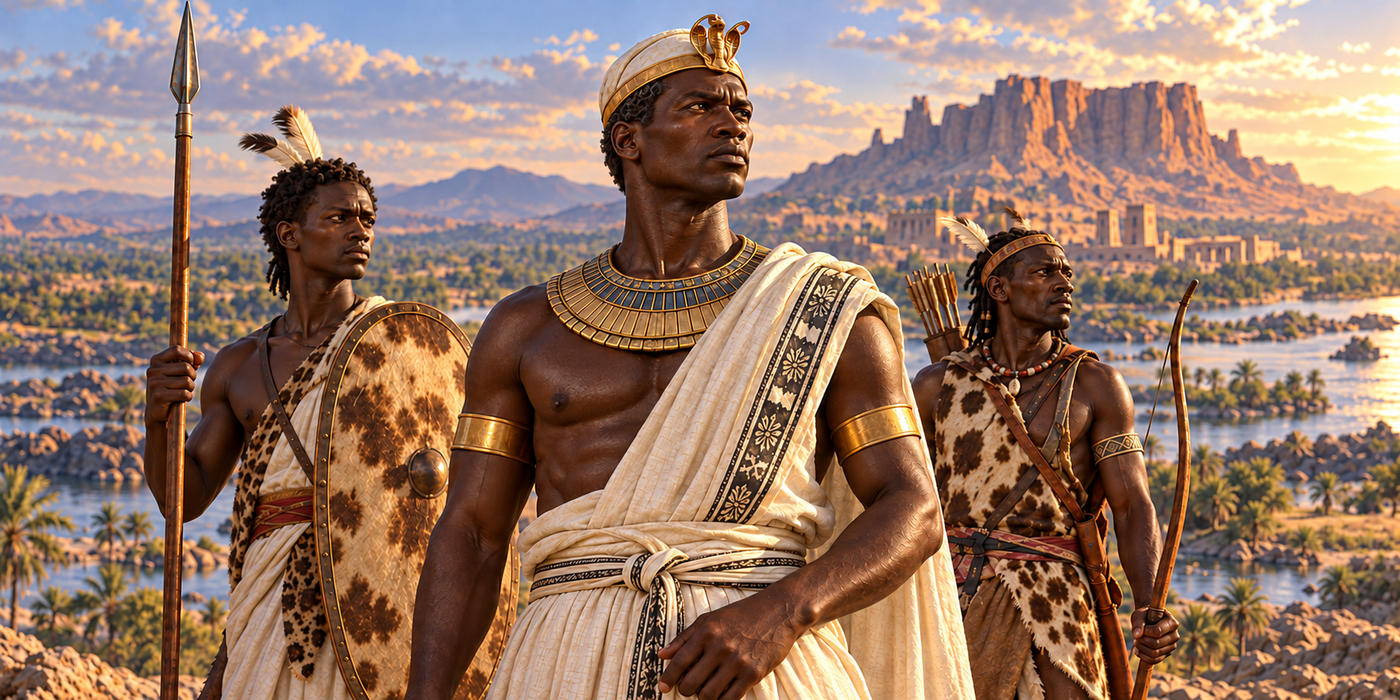
Nubians
A king before Amun
In the late fourth century BC, King Nastasen commemorated his reign on a great stone stele. Its upper scenes show him honouring Amun in two forms: the ram-headed god of Napata and the human-headed god of Karnak. Below, an inscription recorded the sovereign's achievements within a tradition that joined accession, warfare and gifts to the gods.
While Alexander conquered the Persian Empire, another monarchy maintained its own sacred history farther up the Nile. The kings of Kush had once ruled Egypt. Their successors no longer held the northern country, but they continued to command a kingdom whose institutions, sanctuaries and royal cemeteries gave it a durable centre of authority.
Beyond the cataracts
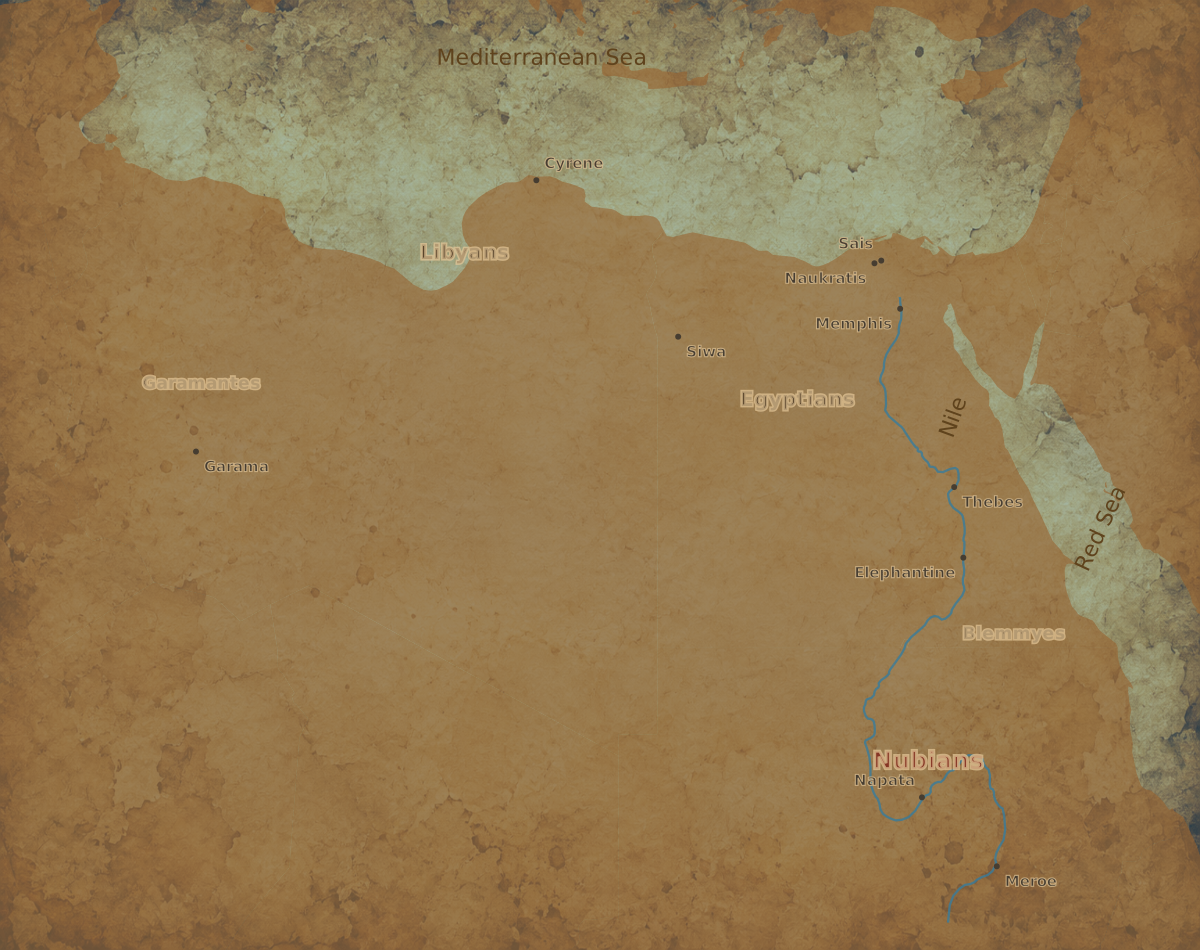
Nubia extended along the Nile south of Egypt, across lands now divided between southern Egypt and Sudan. The river connected settlements and cultivation, while cataracts interrupted navigation. Desert roads could shorten a great bend or join places difficult to reach by boat, making local knowledge essential to movement.
The country possessed resources that had attracted Egyptian rulers for centuries. Gold, ivory, valuable woods and goods arriving from farther within Africa passed through regional networks. Trade and royal demands brought people into contact across considerable distances. Control of a crossing or a well-used route could help a ruler draw wealth from beyond the land immediately cultivated by his subjects.
The southern kingdom also embraced different environments. The river valley, the country around Meroe and the approaches through the desert offered distinct opportunities for settlement and production. Its power rested on communities connected to one another through royal authority, exchange and sacred institutions.
An older history of strength
Long before the dynasty of Napata, the kingdom centred at Kerma had exercised substantial power in the region. Egyptian conquest later brought much of Nubia under the pharaohs of the New Kingdom, who established towns, temples and officials along the river. Those centuries created deep connections between Egyptian institutions and local communities.
The direction of conquest eventually reversed. In the eighth century BC, Kushite rulers advanced north and established themselves over Egypt. Piye's campaign and the reigns of his successors created the Twenty-fifth Dynasty. Kings from the south claimed the crowns and sacred responsibilities of the united Nile country.
Taharqa's monuments gave that ambition an enduring form. Temples and royal images asserted his relationship with the gods, while war with Assyria threatened the northern dominion. The eventual expulsion of the dynasty from Egypt ended one empire, but the royal house and the kingdom of Kush survived in their southern homeland.
The sacred mountain
Near Napata, Gebel Barkal rises sharply above the plain beside the Nile. The mountain became a focus of the cult of Amun, whose presence gave the landscape exceptional religious importance. Sanctuaries at its foot joined the visible height to ceremonies of kingship.
For Kushite rulers, recognition by Amun made sovereignty more than possession of an army. Coronation and consultation connected the living monarch with divine authority. The king's movements between sacred centres renewed a relationship that officials, priests and royal subjects could witness.
The continuing prestige of Napata survived changes in royal residence. Meroe became another major centre farther upstream, but the mountain and its god remained essential to the dynasty's legitimacy. A ruler's effective power could extend across the kingdom while his right to wield it was celebrated at particular sacred places.
The memory of Egypt
Kushite kings continued to employ Egyptian forms of royal representation and Egyptian writing for their great public inscriptions. These were inherited resources within their own political tradition. The ruler presenting offerings to Amun at Napata was acting in a world shaped by centuries of contact along the Nile.
The connection did not make relations with Egypt peaceful. In 593 BC, the army of Psamtik II struck south into Kush. Destruction and damaged royal monuments reveal the violence of the encounter. The northern kings could view the memory of Kushite rule as a threat as well as a defeated past.
After such confrontations, the southern monarchy continued to develop its own centres and resources. The loss of Egypt had not removed its religious institutions or the loyalty available to its rulers. Kush remained a power whose future could not be measured simply by whether its king occupied Memphis.
The bow in Greek imagination
Nubian archery had a reputation reaching far back in Egyptian history. Archers from the south could serve Egyptian rulers as well as defend their own communities. The bow became an enduring sign of military identity in the way outsiders represented the region.
Herodotus gave that reputation a memorable expression in his story of Cambyses. The Persian king's envoys received a great bow from the Ethiopian ruler, with a challenge: an invading army should come only when its men could draw such a weapon as easily as its owner. The gesture turned an instrument of war into a demonstration of royal confidence.
In the same narrative, Cambyses attempted the southern march without adequate supplies and was forced back by hunger. The story makes the invader's ambition founder on distance and preparation. Possession of Egypt did not automatically place the country beyond it within an emperor's grasp.
Nastasen's world
Nastasen belonged to the generation whose reign overlapped the Macedonian conquest in the north. His stele, dated to his eighth regnal year, continued a series of royal monuments preserving the kingdom's own account of its rulers. Accession, campaigns and benefactions were subjects worth setting permanently before Amun.
The two forms of the god in its upper register connect Napata with Karnak. The image asserts a sacred relationship across a politically divided Nile valley. The north might acknowledge a Persian or Macedonian king while the Kushite monarch presented his own offerings to the god whose authority sustained his rule.
Nastasen was buried at Nuri, within a royal cemetery whose earlier monuments included Taharqa's great pyramid. The setting placed the later king among predecessors whose ambitions had once reached much farther north. Royal memory remained attached to the Napatan region even as the importance of Meroe grew.
Royal households and the dead
The cemeteries around Napata preserve a succession of kings and royal women. Pyramids, burial chambers and chapels made the relationship between dynasty and sacred landscape visible across generations. Their arrangement required labour, skilled work and resources, demonstrating another form of the power concentrated around the court.
These places also gave continuity to a monarchy exposed to war and succession. A living king followed individuals whose names and cults remained present. The care given to their resting places made the dynasty's past part of the obligations of the present.
Later centuries would bring further changes in burial and royal display around Meroe. In Alexander's generation, the Napatan tradition remained a living framework for kingship. Its monuments belonged to a kingdom with a long past and a future extending well beyond the collapse of Persia.
The conquest stops in Egypt
Alexander's acquisition of Egypt in 332 BC did not become a campaign against Kush. He visited Memphis and Siwa, founded Alexandria and then turned east towards Darius. The southern kingdom remained outside the route of his army.
For Kush, the northern frontier now faced another sovereign. The change affected a country with which its rulers shared sacred traditions and a history of competing claims. Yet the events that dominated Macedonian narratives did not replace the concerns recorded in Kush's own royal monuments.
Nastasen's stele gives that parallel history a tangible presence. Amun receives offerings, the king records his deeds, and the dynasty maintains its place beside the Nile. Beyond Alexander's conquests stood a monarchy whose authority was expressed in its own names, ceremonies and remembered victories.
Sources
Royal monuments and ancient narratives
Archaeology and historical studies