






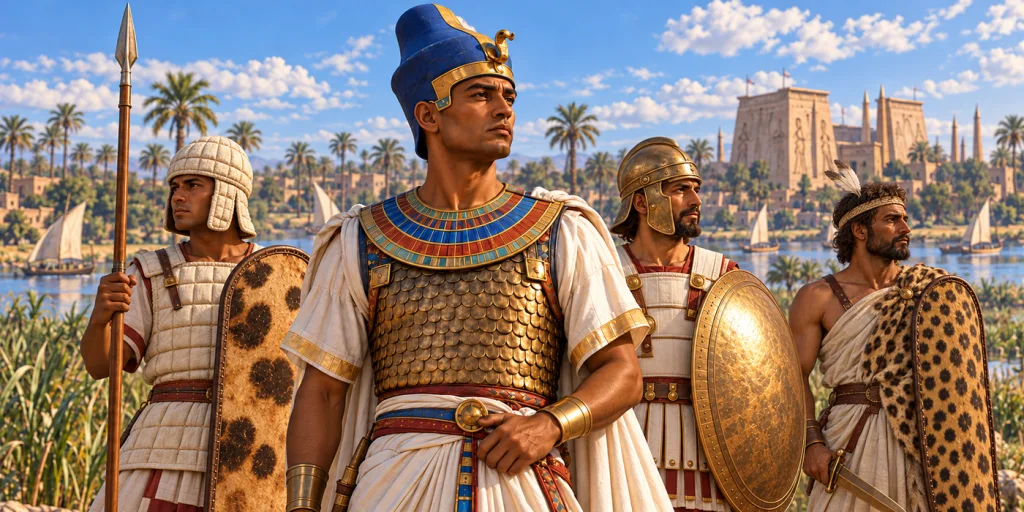
Egyptians
A conqueror before Apis
At Memphis in 332 BC, Alexander sacrificed to Apis and the other gods of Egypt. The Persian governor Mazaces had admitted him without a major battle, and the Macedonian king now presented himself within the sacred order of the country he had acquired. His army's arrival ended a brief restoration of Persian control and began another foreign dynasty's claim to the Nile.
For Egyptians who had lived through the fall of Nectanebo II, the change came within a generation of their last native king. Temple building, resistance and imperial invasion belonged to recent experience. Alexander entered a country whose institutions reached back millennia, but whose leading families and priests were confronting an immediate question: how would this new sovereign rule?
The river and the two lands
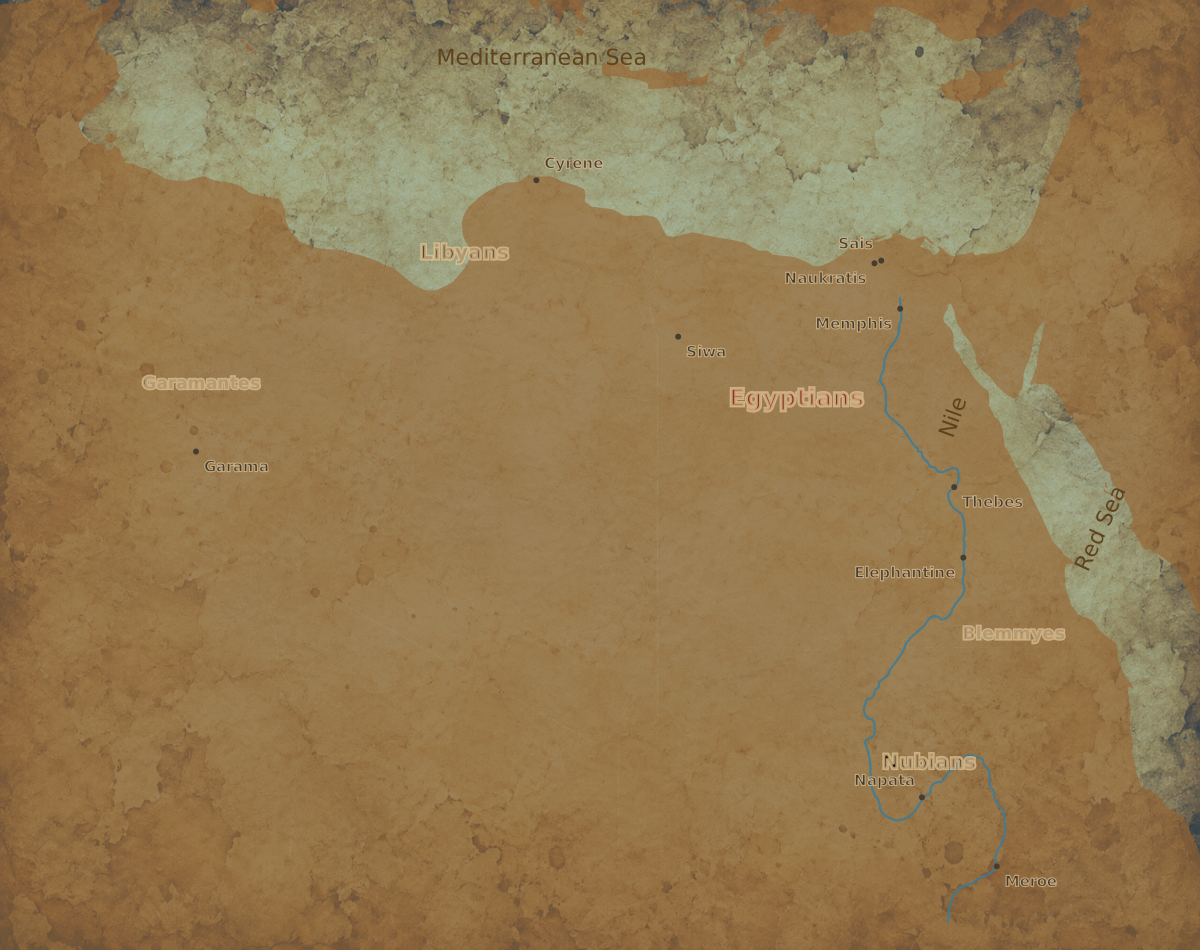
The Nile joined Egypt's agricultural country into a long inhabited corridor. Its flood and the management of the land sustained villages, cities and royal revenues. In the north, the Delta spread into several branches before reaching the Mediterranean; in the south, the valley led towards the cataracts and the lands of Kush.
Royal imagery united Upper and Lower Egypt, while the practical exercise of power depended on officials, local households and religious establishments distributed along the river. Boats carried people and goods between centres that a desert journey could separate sharply. Control of the waterways was essential to governing and defending the country.
The approaches from Asia made the eastern Delta particularly important. Pelusium guarded a route used by invaders and defenders across successive wars. Marshes, channels and fortified positions could make an attack difficult, but the same network required coordination. Once an enemy obtained a useful crossing or access to a less protected route, a defensive plan could unravel.
A renewed monarchy
Egypt's fourth-century rulers inherited a long struggle with Persia. Cambyses had conquered the country in 525 BC; rebellion eventually restored native rule at the end of the fifth century. Successive dynasties then sought to hold what had been recovered, balancing the authority of the crown against the resources required for defence.
The kings of the Thirtieth Dynasty invested heavily in sanctuaries. Nectanebo I and Nectanebo II commissioned buildings and images that placed them within the established duties of Egyptian kingship. A ruler appeared before the gods as their benefactor and the guardian of the order they sustained.
These works were acts of living patronage, supporting institutions whose land, personnel and local standing mattered throughout the country. Temples preserved learning, conducted ceremonies and gathered resources. The relationship between king and sanctuary gave royal power a visible presence far from a battlefield.
Egyptian soldiers and foreign captains
The armies defending Egypt included Egyptian troops and soldiers recruited abroad. Greek and Carian service had become a durable feature of the country's military life. Mercenary commanders brought experience from the wars of the Aegean, while rulers of Egypt supplied the money and political purpose behind their employment.
The arrangement could be effective and dangerous. A successful captain gained influence, and contingents could recognise their immediate leaders as the men on whom pay and survival depended. Royal strategy therefore involved managing commanders whose loyalties might shift with a disputed succession.
Egyptian forces also operated within a country whose river and Delta encouraged particular military problems. An invading army needed crossings, supplies and access through difficult ground. Defenders could use strong positions to delay it, while rival commanders argued over the risks of advancing. The ability to maintain an army through these conditions was as consequential as the outcome of a single encounter.
Nectanebo's last defence
Nectanebo II resisted Persian efforts to recover Egypt before Artaxerxes III finally broke through in the 340s BC. Diodorus describes the reconquest as a struggle involving fortified Delta positions and substantial Greek contingents on both sides. Egyptian independence was defended and attacked by armies whose composition crossed the divisions between Greek and Persian.
The campaign combined force with negotiation. Once some defended places accepted terms, the fear of isolation encouraged further surrender. Nectanebo withdrew south, and the Persian king recovered Egypt. The last native pharaoh's departure ended a monarchy whose monuments still proclaimed confidence in divine protection.
The defeat did not make the recent reign disappear from memory. Nectanebo's building works and royal images remained in Egyptian sacred spaces. Later storytelling would give him an extraordinary second life, making him a magician connected with Alexander's birth. That legend joined the vanished Egyptian king to the conqueror who succeeded the Persians.
The road from Gaza
Alexander approached after Issus, the siege of Tyre and the capture of Gaza. Darius had lost the coastal positions from which Egypt might receive support. Mazaces, the Persian governor, lacked the forces needed to contest the advance and surrendered the country.
The Macedonians established a garrison at Pelusium. Alexander then moved towards Heliopolis and crossed to Memphis, while his fleet used the river. The ease of the passage contrasted with the sieges that had delayed him on the Levantine coast. Egypt's possession strengthened his position before he returned to pursue Darius.
At Memphis, sacrifice to Apis accompanied contests for which Greek performers arrived. The king's public activity addressed more than one audience. Egyptian gods received honour within their own country, and the army witnessed ceremonies recognisable within its Greek cultural world.
Pharaoh in the temples
Egyptian kingship offered a language through which Alexander could be represented as a legitimate sovereign. Monumental images placed him in pharaonic dress, making offerings to the gods. In such scenes the foreign conqueror occupied a role whose forms were much older than his dynasty.
A surviving fragment of a water clock names Alexander while showing the king before Egyptian deities. The imagery belongs to an enduring relationship of offering and divine favour. The gods grant life and dominion; the king performs the acts expected of him. His Macedonian origin did not prevent his name from entering that traditional setting.
The process depended on Egyptian knowledge and practice. Priests and craftsmen supplied the ceremonial and visual forms through which sovereignty could be expressed. Their institutions had survived earlier foreign rulers and would remain essential under Alexander's successors.
The journey to Ammon
Early in 331 BC, Alexander travelled west along the coast and then into the desert to consult Ammon at Siwa. The god was known to Greeks as Zeus-Ammon, and the oracle's reputation reached across the Mediterranean. The journey connected Egyptian and Libyan sacred geography with the heroic ancestry Alexander claimed.
Stories of the expedition made divine guidance part of the experience. Arrian preserves accounts of birds or serpents leading the travellers when the desert route became uncertain. The difficult approach itself gave the visit a character unlike the king's reception at Memphis.
The consultation strengthened the association between Alexander and divine parentage. Its exact exchanges remained less public than its political and religious impact. The king returned from the oasis with a relationship to Ammon that would become one of the most enduring features of his image.
A city towards the sea
Alexander also selected the site of Alexandria near the western Delta, between the Mediterranean and Lake Mareotis. The position linked access to Egypt with the routes of the wider sea. Arrian describes the king marking the arrangement of the new city, including places for Greek sanctuaries and for Isis.
The foundation looked beyond the immediate movement of his army. A city bearing his name could gather trade, settlement and royal presence at a strategic point on the coast. Its later growth would transform Egypt's relationship with the Mediterranean, although the great metropolis belonged to developments after Alexander's brief stay.
Memphis retained its importance during the campaign. There the king received embassies and reinforcements before arranging the administration of the country and preparing to march east. The new foundation and the old royal centre performed different roles within the same emerging settlement.
Dividing power
Alexander distributed responsibility among several officers. Egyptian officials retained civil roles, Macedonians held key garrisons and military commands, and Cleomenes of Naucratis received important financial responsibilities. The arrangement preserved local administration while placing armed force and revenues within the conqueror's control.
Arrian explains the division as a response to Egypt's natural strength: Alexander did not wish to give one man all the power required to hold it. The country offered extraordinary resources and a defensible position, qualities that made a trusted subordinate useful and a disloyal one dangerous.
After Alexander's death, Ptolemy acquired Egypt and built precisely such a territorial power. The Nile country became the foundation of a durable kingdom, and Alexander's body was brought there as a prize of immense prestige. The sovereign who had spent only months in Egypt remained central to the legitimacy of the dynasty that made it its home.
Sources
Ancient narratives and monuments
- Diodorus Siculus, Library of History, XVI.40–51: the Persian reconquest of Egypt.
- Alexander Romance, I.1–12: the later legend of Nectanebo.
- Arrian, Anabasis: III.1, III.3, III.5.
- British Museum EA933, water-clock fragment naming Alexander.
Historical and museum studies