






Part I – Land of Dust, Faith, and Ruins
Massaloï lies at the center of the continent, a vast inland region of dry plains, broken ridges, caravan corridors, and ancient settlements built wherever water can be held long enough to sustain life. Unlike the rich coastal belts to the east and west, its lands are harsher, less predictable, and forever vulnerable to drought, overuse, or war.
The territory is organized not by clean borders but by routes: roads between wells, fortified passes, riverbeds that flood only part of the year, and chains of market towns that survive by taxing movement rather than owning fertile land. Whoever controls a road may rule more effectively than whoever controls a field.
At the heart of the region lies the Inner Sea, a great body of water whose shores host ports, fishing communities, shrines, and old industrial ruins. It is both geographic center and symbolic heart of Massaloï. Around it live millions who depend on trade, irrigation, and transport linked to its waters.
To the west stretches the most cursed frontier on Damocles. There the land meets the advancing Fukai. Entire districts have been swallowed by mutated forest, radioactive growths, and spore storms born from ancient nuclear fire. Villages disappear, roads collapse into root systems, and what is abandoned one season may become hostile wilderness by the next.
Across Massaloï, the landscape bears scars of every age: collapsed shrines, shattered armored hulls, forgotten bunkers, dried canals, Celestial pylons half-buried in dust, and craters where cities once stood. It is a land that survives among ruins and still expects history to return.
Part II – Before the Celestial Peace
Before the arrival of the Emissaries, Massaloï was already populous but deeply divided. Hundreds of tribes, clans, city leagues, and warrior sects competed across the interior basin. Some controlled oases and irrigation canals. Others dominated trade roads with mounted retainers or fortified toll gates.
Water was the oldest cause of war. Rivers shifted, reservoirs failed, and rival rulers sabotaged canals as often as they defended them. A single broken dam could ruin a harvest and begin a generation of vengeance. Politics was local, brutal, and rarely stable.
Yet fragmentation did not mean backwardness. Many communities developed strong traditions of craftsmanship, horse breeding, metallurgy, astronomy, and religious scholarship. Market towns hosted philosophers beside mercenaries, and shrine complexes sometimes acted as banks, archives, or neutral grounds for negotiation.
No dynasty could unite the whole region for long. The distances were too great, loyalties too narrow, and resources too unevenly distributed. Massaloï produced armies and ideas in abundance, but not lasting order.
When later generations speak nostalgically of unity, they are often contrasting it with this earlier age: energetic, creative, and fiercely alive—but trapped in endless cycles of rivalry.
Part III – The Age of the Emissaries
The coming of the Celestial Peace transformed Massaloï more profoundly than perhaps any other region of the continent. Where previous conquerors had only taxed or raided, the Emissaries reshaped the environment itself. Their machines repaired ancient waterways, stabilized flood systems, and restored the dying Inner Sea that had nearly vanished under centuries of overexploitation.
As the waters returned, fields expanded, fisheries revived, and population soared. New roads linked distant markets. Caravan stations became planned towns. Storehouses, workshops, and temple-administrative centers appeared along routes that had once known only forts and bandits.
Tenkyo rose during this era as one of the holiest cities of Damocles. More than a capital, it became a spiritual and technical center where relics, teachings, archives, and sacred infrastructure converged. Pilgrims, scholars, engineers, and ambitious rulers all sought legitimacy there.
The Emissaries also changed warfare. Old clan feuds did not disappear, but they were contained within broader systems of law, arbitration, and supervised hierarchy. For the first time in living memory, many Massaloï communities could imagine prosperity lasting longer than a single ruler’s life.
This age left a permanent mark on the regional psyche. Even centuries later, ruined pumps, sacred reservoirs, and weathered transit pylons are remembered not merely as machines, but as proof that the world was once repaired—and could be again.
Part IV – Golden Memory and Living Nostalgia
For many peoples of Massaloï, the era of the Celestial Peace is not distant history—it is the standard by which all later ages are judged and found wanting. Elders still compare modern famine to the old abundance, modern warlords to the old administrators, and modern roads to the seamless routes once maintained by machines no one can fully reproduce.
During that remembered age, harvests were steadier, caravans safer, and disputes more often settled before they became massacres. Even those who resented foreign authority often admit that the land itself seemed healthier under Celestial stewardship. Water flowed where today there is dust. Markets functioned where today militias extort tolls. Knowledge circulated where now it is hoarded.
This nostalgia is not merely sentimental. It shapes modern politics. Reformers invoke the Emissaries to justify central planning and public works. Sect leaders preach that obedience and purification will bring their return. Merchants sponsor excavations hoping relic technology can restore lost prosperity. Rebels claim the Empire is illegitimate because it destroyed a better order.
Entire generations have grown up hearing that their grandparents lived in a more rational world. Whether true or exaggerated, the belief itself is powerful. In Massaloï, memory can mobilize armies as effectively as hunger or fear.
That is why the region remains fertile ground for visions, prophets, engineers, and fanatics alike. Everyone wants the past back—each in a different form.
Part V – The Imperial Invasion and the Great Resistance
When the Imperial invasion reached the central basin, Massaloï did not collapse as many expected. The region had no single king, but it possessed something more dangerous: countless communities willing to fight on their own terms. Clan horsemen struck supply lines, sect militias fortified holy sites, city leagues armed workers, and desert columns vanished into terrain foreign armies barely understood.
Resistance was chaotic yet relentless. A town pacified one month might revolt the next. A caravan road opened by Imperial engineers could become a graveyard by dawn. Even rival sects sometimes paused their feuds long enough to ambush common enemies.
The sacred prestige of Tenkyo and the surviving institutions of the Celestial era also gave the struggle ideological force. Many fighters believed they were defending more than land—they were defending the last remnants of a just age against opportunistic invaders.
The Lioners, leading much of the western Imperial war effort, eventually concluded that conventional campaigns would bleed them for years. To break organized resistance and terrorize future opposition, they escalated to catastrophic measures.
Nuclear bombardments fell upon fortified zones, rebel concentrations, logistical hubs, and territories suspected of harboring long-term insurgency. The old resistance was shattered—but the victory poisoned the land and awakened something far worse than rebellion.
Part VI – Awakening of the Fukai
The western scars of the bombardments did not remain empty for long. In regions where radiation, chemical residues, and buried biological corruption mixed with ancient roots beneath the soil, the Fukai awakened in a new form—mutated, aggressive, and profoundly unstable.
This was no ordinary forest reclaiming abandoned ground. It spread through ruined trenches, fed on poisoned rivers, and twisted dead industrial zones into breeding fields of spores, chitin, and flesh-like growth. Creatures born there often showed grotesque adaptation: armored hides, unnatural regeneration, or instincts shaped by toxic environments.
The first settlements to face the new growth vanished quickly. Patrols disappeared. Wells became contaminated. Refugees arrived with stories of forests that moved at night and beasts that learned from every attack.
From these cursed frontier zones emerged the Bug Army’s western raiders, drawn by salvage, captives, and opportunity. They struck weakened communities, stripped machinery from ruins, and carried off slaves into the green darkness.
Thus the Imperial bombings ended one war only to begin another with no clear front line and no final victory in sight. In western Massaloï, every generation has lived under the shadow of a catastrophe created before it was born.
Part VII – Tenkyo and the Wars of the Sacred Streets
Tenkyo was once one of the brightest jewels of the Celestial age: a city of shrines, archives, workshops, reservoirs, and ceremonial avenues where the authority of the Emissaries seemed tangible. Though damaged by centuries of war, it remains the spiritual center of Massaloï and a magnet for every faction seeking legitimacy.
No power fully controls it for long. Imperial patrols hold certain districts, tax gates, and fortified compounds. Local militias defend neighborhoods loyal to their patrons. Rebel cells emerge from tunnels, markets, and ruined sanctuaries. Treasure hunters, scholars, smugglers, and spies move between them all.
The city’s greatest battles are often fought over fragments rather than territory. A buried archive, an intact generator core, a sealed vault, or a forgotten transit node can provoke weeks of street fighting. Entire alliances have formed and collapsed over the rumor of a functioning relic.
Some insurgents search these ruins for their own enrichment. Others claim to act for the hidden clergy or for the future restoration of the Celestial Peace. Many simply fight because Tenkyo itself has become sacred ground where surrender feels like betrayal.
Its streets are therefore never truly at peace. Even in quiet seasons, everyone knows the next firefight may begin beneath a market stall, behind a shrine wall, or under the paving stones of an avenue built for gods.
Part VIII – Modern Political Fragmentation
Outside Tenkyo, Massaloï remains divided into a bewildering patchwork of powers. Clan confederations rule valleys and pasturelands. Sect brotherhoods govern temple towns. Merchant leagues dominate caravan hubs. Armed communes defend irrigated districts. Warlords rise from former militias and disappear just as quickly.
Authority is intensely local. A banner respected in one province may mean nothing two days away. Borders shift with marriages, betrayals, droughts, assassinations, or the price of ammunition. What outsiders call chaos is, to many inhabitants, simply politics conducted honestly.
Attempts at regional unity appear regularly and fail just as often. Some coalitions collapse under ideological disputes. Others are bought apart by foreign money or broken by old vendettas. Even victories can be dangerous, because a ruler who grows too strong immediately unites everyone who fears him.
This fragmentation has costs: endless skirmishes, duplicated taxes, interrupted harvests, and roads made unsafe by rival checkpoints. Yet it also prevents easy conquest. No invader can seize a single capital and expect obedience from the whole basin.
Massaloï survives divided because division weakens it—and protects it at the same time.
Part IX – Imperial Garrisons and Lioners Influence
To contain the most dangerous sects and keep trade routes open, the Empire maintains a network of forts, depots, airstrips, and armored outposts across Massaloï. On maps these positions appear formidable. In reality they are too few, too distant, and too dependent on fragile supply lines to dominate the whole region.
Many garrisons spend more time negotiating with nearby clans than fighting them. Commanders trade fuel for grain, intelligence for safe passage, and weapons contracts for temporary calm. Official doctrine speaks of order. Daily reality is compromise.
The western half of the region feels the strongest external pressure. There, Lioners-backed authorities oversee key roads, extraction zones, and strategic settlements facing the Fukai frontier. Their methods are harsher, their discipline tighter, and their tolerance for rebellion far lower.
Even so, Lioners power has limits. Every convoy must be guarded. Every collaborator risks assassination. Every punitive expedition creates new enemies. Strongholds can hold roads and cities, but not every village, shrine, canyon, or caravan trail.
The Empire remains present in Massaloï, but presence is not the same as control. Everyone in the basin understands the difference.
Part X – Economy of Scarcity and Endless Trade
Massaloï is often called poor, but this is only partly true. It lacks the easy abundance of richer coastal regions, yet it sits at the crossroads of resources no one else can ignore. What the land does not freely give, its people compensate for through trade, salvage, and relentless adaptation.
Food remains the central problem. Irrigation networks are damaged, water rights are disputed, and war regularly interrupts planting seasons. A district may enjoy full granaries one year and famine the next. Because of this, grain is as strategic as ammunition and often more valuable than coin.
Weapons, however, exist in astonishing quantity. Imperial stockpiles lost during old campaigns, locally manufactured firearms, refurbished armored hulls, scavenged energy cells, and relic devices from the Celestial age circulate through bazaars and black markets alike. In many towns it is easier to buy a rifle than fresh fruit.
The East Guild’s metal flows steadily into the region, traded for rare minerals, buried artifacts, technical components, and access to forgotten ruins. Deep beneath old strata lie materials needed to maintain ancient machines—substances scarce elsewhere on Damocles and therefore worth fortunes.
Caravans, smugglers, and armed merchants tie this economy together. In Massaloï, prosperity rarely looks clean or stable, but wealth is always moving somewhere.
Part XI – Armies, Militias, and Ways of War
No single Massaloï army exists. Instead, warfare is practiced by hundreds of forces shaped by local needs and traditions. Some are disciplined clan hosts built around cavalry and armored retainers. Others are sect militias driven by faith, merchant guards protecting convoys, or peasant levies called up for one season of crisis.
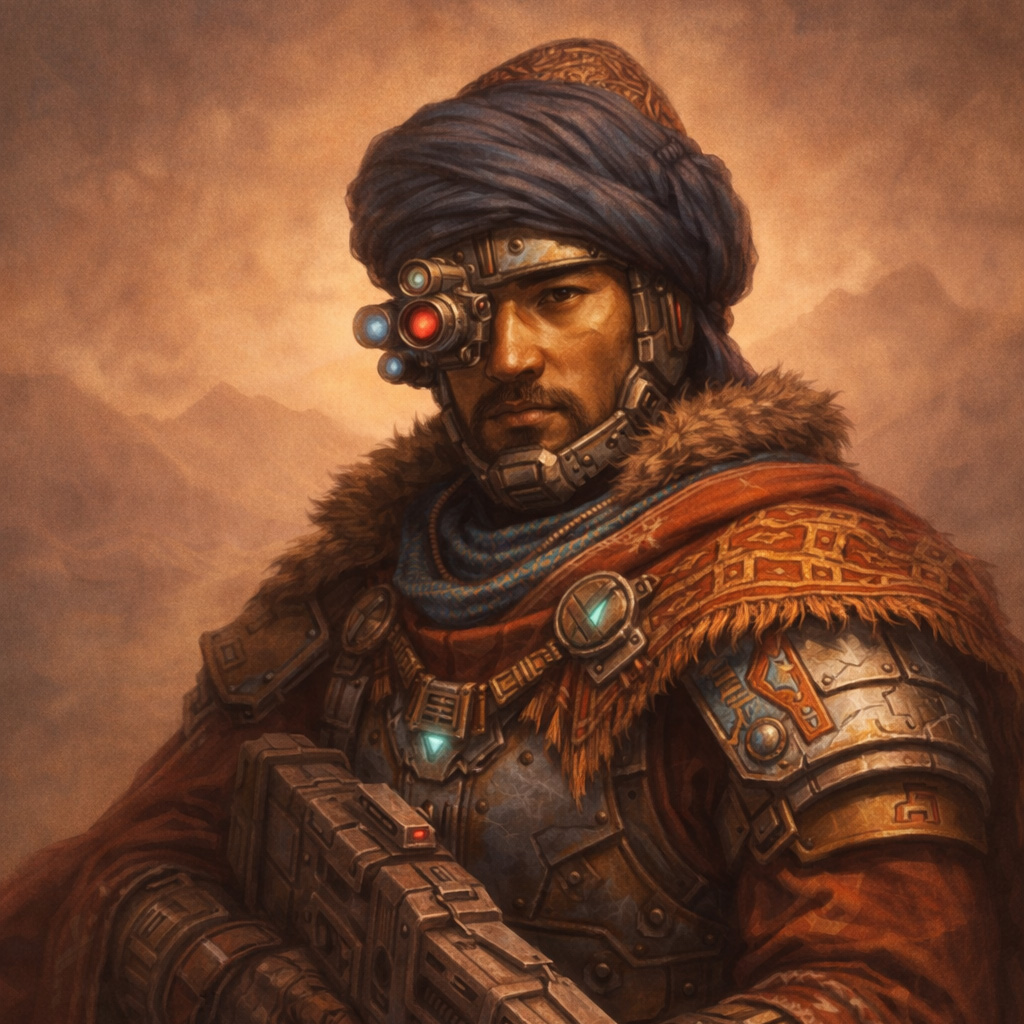
Technology varies wildly. A fighter carrying a handmade rifle may stand beside a veteran using invasion-era power armor stripped from a dead garrison. Light technical vehicles race across the plains while ancient tracked machines, repaired for generations, still serve as mobile fortresses. In sacred districts, relic weapons appear without warning and vanish just as quickly.
Massaloï commanders favor ambush, maneuver, attrition, and layered defense. They know the land, the wells, the dust storms, and the roads worth dying for. Foreign armies often win battles only to lose their supply chain, their patience, or their rear areas.
Mercenary culture is deeply rooted. Entire brotherhoods rent themselves to clans one year and temple leagues the next. Reputation matters almost as much as pay. A company known for holding under impossible odds can name its price.
War here is constant, adaptive, and deeply personal. Victory belongs less to the strongest force than to the side that can keep fighting longest.
Part XII – Massaloï Today: The Center That Cannot Be Ruled
Today Massaloï remains one of the most unstable and important regions on the continent. It links east to west, north to south, mountains to coast, Empire to rebellion. Every great power wants influence there, yet none has managed to fully master it.
The faithful still await the return of the Emissaries. Pragmatists seek only security and bread. Ambitious warlords dream of unification. Merchants profit from disorder while publicly condemning it. Hidden agents hunt relics beneath the noise of everyday conflict.
Meanwhile the western frontier worsens as the Fukai advances, and Tenkyo continues to burn in cycles of occupation and uprising. The people of Massaloï have learned to endure conditions that would break other nations.
To outsiders, the region looks fractured and exhausted. To those who live there, it is still the heart of Damocles—wounded, dangerous, and not yet finished.
Many have invaded Massaloï. Many have claimed it. None have truly ruled it for long.
Part XIII – Six Named Figures
Lord Timur Qasari is the most serious advocate of regional unity among the secular clans. Born to a minor caravan dynasty and elevated through military success, he argues that Massaloï will remain prey to outsiders until roads, taxes, and armies are centralized. Admirers see a future state-builder. Rivals see only another conqueror with better rhetoric.
Prophetess Samira al-Nur leads one of the fastest-growing revivalist movements of the basin. She preaches that the return of the Emissaries will not come through passive waiting, but through purification, discipline, and the destruction of corrupt powers. Her followers build granaries, train militias, and cleanse shrines in equal measure. Whether saint or dangerous fanatic depends entirely on who is asked.
General Bekzod Iron-Reed is a frontier commander whose name became legend in the western marches. He organized scattered villages into fortified defense belts, repelled multiple Bug Army slave raids, and survived exposure to spore zones that killed younger men. His authority comes not from title, but from the fact that people are still alive where he once stood.
Madame Dilara Vost rules the relic markets hidden beneath the bazaars of the Inner Sea. She brokers Celestial components, forged artifacts, ancient maps, and forbidden weapons with immaculate manners and terrifying efficiency. Priests denounce her, governors hunt her, and nearly all of them buy from her in secret.
Governor Cassian Vale is the senior Imperial administrator assigned to the central basin. Intelligent, exhausted, and permanently short of troops, he has learned that compromise achieves what decrees cannot. Hardliners call him weak. Survivors of the region call him realistic.
Engineer-Scholar Farid Temur devotes his life to restoring the machines of the Celestial era. Pumps, turbines, weather controls, transit relays—he believes Massaloï can be healed not by prophecy or conquest, but by understanding what was lost. Every faction courts him. None fully trust him.
Part XIV – Daily Life in Massaloï
For ordinary people, life in Massaloï is shaped less by ideology than by uncertainty. A farmer worries about water rights, taxes, raiders, and whether his sons will be recruited before harvest. A merchant worries about checkpoints, counterfeit coin, and which banner flies over the next bridge. A mother worries about food first and politics only when politics enters her street.
Yet the region is far from lifeless misery. Markets remain vibrant, music fills caravanserais, and festivals tied to old celestial calendars still draw thousands. Wrestling grounds, horse races, storytelling contests, and communal feasts continue even in provinces that expect war by winter.
Education is uneven but valued. Religious schools preserve literacy, merchant families teach accounting from childhood, and engineers train apprentices in workshops assembled from scavenged machinery. In some towns, children can recite sacred verses and disassemble a rifle before adolescence.
Hospitality is a matter of pride. Even poor households may offer tea, bread, and shelter to guests—while quietly verifying whether those guests are spies, tax collectors, or thieves. Courtesy and suspicion coexist comfortably.
The people of Massaloï do not live despite instability. They have learned to build lives within it.
Part XV – Legacy and Future
Massaloï’s greatest strength and greatest curse are the same: it remembers. It remembers abundance under the Celestial Peace, betrayal during invasion, miracles of old machines, and every grievance left unpaid. That memory prevents surrender—but also prevents easy reconciliation.
Several futures compete at once. A unified state might rise under a charismatic warlord. A religious revival could sweep the basin. Imperial power might harden if outside reinforcements ever return. The Fukai frontier may collapse and flood the center with war. Or the region may simply continue as it has for generations: divided, resilient, and indispensable.
What is certain is that no durable order on Damocles can ignore Massaloï. It sits at the center of the map, the center of trade, and often the center of every coming crisis.
Empires see it as a prize. Prophets see it as destiny. Its people see it as home.