






Illyrians
The kings beyond Macedonia
In 359 BC, an Illyrian victory brought Macedonia close to collapse. King Perdiccas III was dead, thousands of his soldiers had fallen, and his kingdom faced enemies on several frontiers. To the west stood Bardylis, whose successes had made Illyrian power a question of survival for the Macedonian monarchy. Philip II inherited the disaster. Before he could become the master of Greece, he had to recover the country his brother had failed to defend.
For the Illyrians, Macedonia was a neighbour to be fought, negotiated with, married into and sometimes dominated. Their rulers commanded substantial armies and dealt with Greek cities and Balkan kings. Along the Adriatic, communities watched the harbours and the routes into the interior; farther inland, strongholds overlooked cultivated basins and mountain passages. A successful king could connect these resources and turn a border war into a struggle for regional supremacy.
A country of routes and rival powers
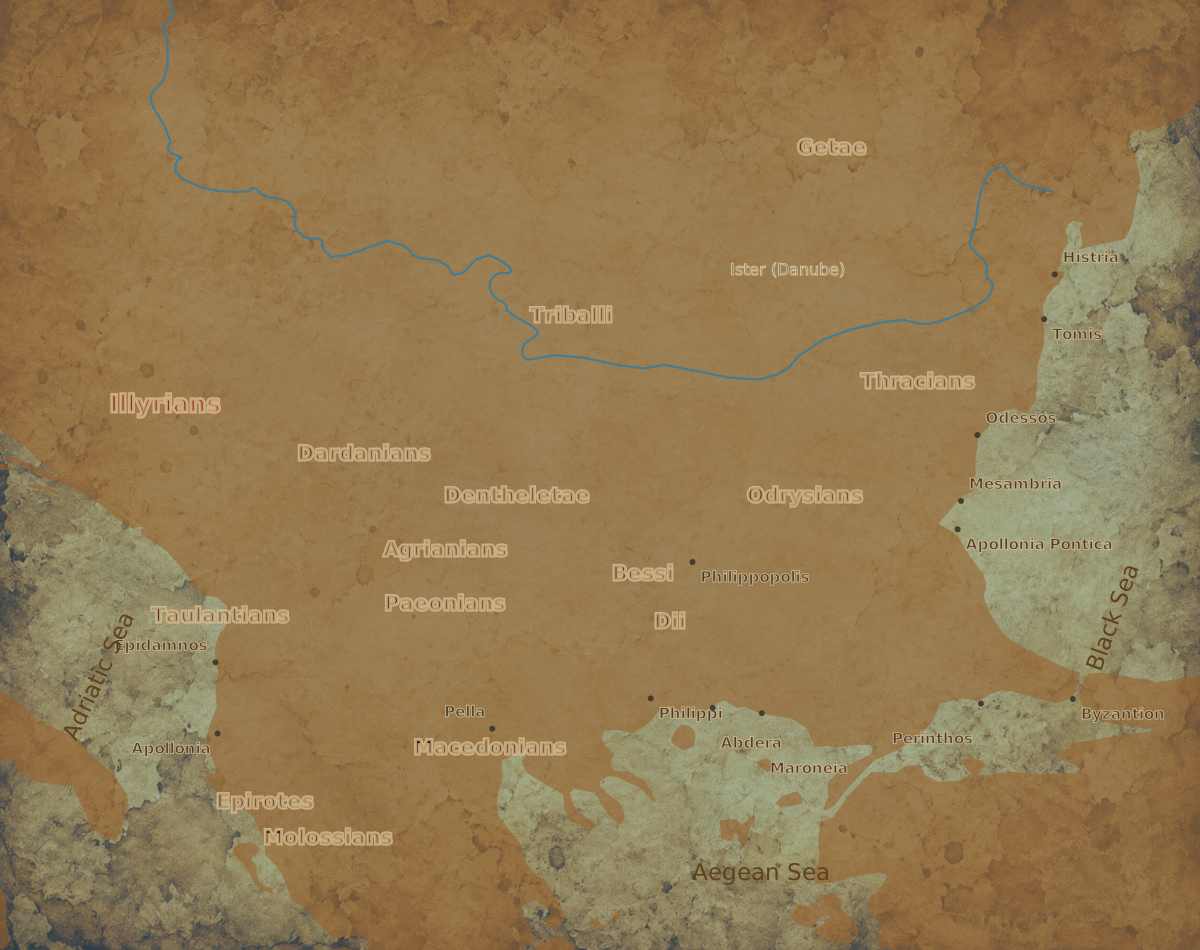
The western Balkans offered many different settings for political life. The coast was broken by islands, headlands and sheltered waters. Behind it rose difficult uplands, but the mountains enclosed farmland, lakes and routes through which people, livestock and goods could move. Those passages linked the Adriatic with Epirus, upper Macedonia and the wider Balkan interior. A ruler who controlled a crossing or a fortified town possessed something more valuable than an impressive stretch of wilderness.
Illyrian communities had their own leaders and interests. The Taulantians beside the Adriatic did not face exactly the same opportunities as the rulers fighting over Macedonia's western approaches. Alliances could bring these powers together; defeat could scatter them again. Kingship depended on the ability to gather followers, reward loyalty and hold contested places. A royal name in a Greek history may therefore stand at the centre of a coalition whose strength had to be renewed through action.
The Greek settlements of Epidamnus and Apollonia were important meeting places between these worlds. Ships brought the coast into contact with Corcyra, Corinth and markets farther away. Their inhabitants needed land, partners and security; their neighbours could offer or threaten all three. Imported objects found inland belong to this history of exchanges, ambitions and unequal access to wealth.
When the affairs of a city became a Balkan war
At Epidamnus, the boundary between a Greek civic dispute and a regional conflict could disappear quickly. In the fifth century, the city's quarrels drove a group of citizens into exile. The exiles obtained help from neighbouring people and attacked their former home. Thucydides places the Taulantians in this landscape, where the fortunes of the colony were bound to those of its surroundings.
The resulting appeals to Corcyra and Corinth helped draw larger Greek powers towards confrontation. Local actors were pursuing immediate objectives: recovering property, defeating rivals and securing outside support. Yet their choices carried consequences far beyond the Adriatic. Illyrian neighbours participated in the politics of the colonies as armed partners with interests of their own. They were close enough to affect a city's survival and powerful enough to matter in disputes that Greek states could not resolve among themselves.
Bardylis and the price of victory
Bardylis' position after the defeat of Perdiccas was formidable. Illyrian troops occupied Macedonian towns, and the new king had other enemies to consider. Philip first worked to make his army dependable and his throne secure. When he was ready to confront Bardylis in 358 BC, the dispute turned on possession of those towns. Bardylis proposed peace on the basis that each side should keep what it already held. For Philip, accepting that settlement would have preserved the visible evidence of Macedonia's humiliation.
Diodorus describes Bardylis taking the field with a force dominated by picked infantry and a much smaller body of cavalry. His soldiers offered determined resistance. This was a contest in which Illyrian foot soldiers could maintain a formation under pressure and fight a sustained battle against the army Philip was rebuilding. The struggle continued until Macedonian pressure, including an attack by the cavalry, broke their resistance.
The defeat forced a new settlement. Bardylis gave up the Macedonian towns, and Philip recovered the freedom to pursue wider ambitions. The victory would become one of the foundations of Macedonian expansion. From the other side of the frontier, it was the loss of a commanding position won through earlier campaigning. The same region that had threatened to overthrow Macedonia now had to reckon with a stronger and increasingly aggressive neighbour.
Embassies against Philip
Resistance also took diplomatic form. In 356/5 BC, Athens made an alliance with three Balkan rulers: Cetriporis and his brothers in Thrace, Lyppeios in Paeonia, and Grabos among the Illyrians. Their agreement survives in an Athenian inscription. Behind its formal language lie embassies and negotiations conducted under the pressure of Philip's growing power.
The partners came from different political worlds, but each had reason to fear the Macedonian king. Cooperation offered the possibility of forcing him to divide his attention. Athens could seek help on Macedonia's northern and western frontiers, while Balkan rulers could look beyond their immediate neighbours for a powerful ally. The inscription catches a moment when the outcome of Philip's rise was still contested, and when Illyrian decisions formed part of a much larger struggle.
Cleitus and Glaucias close the trap
Alexander inherited these western dangers with his father's throne. In 335 BC, while he was campaigning in the Balkans, news reached him that Cleitus, son of Bardylis, had risen against him. Glaucias, king of the Taulantians, supported the revolt. Their opportunity lay in Alexander's need to establish his authority quickly. Every delay in the west gave his other enemies more time to judge whether the young king could be resisted.
Cleitus held Pelion, a strong position surrounded by heights. Alexander arrived before Glaucias and attempted to bring the place under control, but the Taulantian army changed the situation. The Macedonians now faced opponents inside the fortified position and another force outside it. An assault could expose them to attack from behind; withdrawal required movement through narrow, wooded ground overlooked by enemy troops.
Glaucias understood the value of pressure on supplies. When Philotas led out cavalry and pack animals to find forage, he occupied the surrounding heights and threatened the expedition. Alexander had to intervene personally with infantry, archers, Agrianes and horsemen. Philotas returned safely, but the episode showed how readily a successful enemy could turn the needs of an army into a weapon against it.
Arrian describes the forces watching the Macedonians as a combination of cavalry, javelinmen, slingers and heavily armed infantry. Cleitus and Glaucias had assembled an army able to exploit the hills while still threatening a close fight. Their position placed Alexander in genuine difficulty. The king's answer depended on discipline: controlled movements, changes of formation and missile cover that allowed his troops to disengage without dissolving into a vulnerable crowd.
Once across the river, Alexander recovered the initiative. A few days later he learned that his opponents were camped without adequate precautions. He returned by night and attacked before they could organise their resistance. The force that had almost trapped him was scattered. Cleitus burned Pelion and withdrew to Glaucias. Alexander could turn south, where the revolt of Thebes demanded his attention, and then prepare for Asia.
Helmets, households and the prestige of a warrior
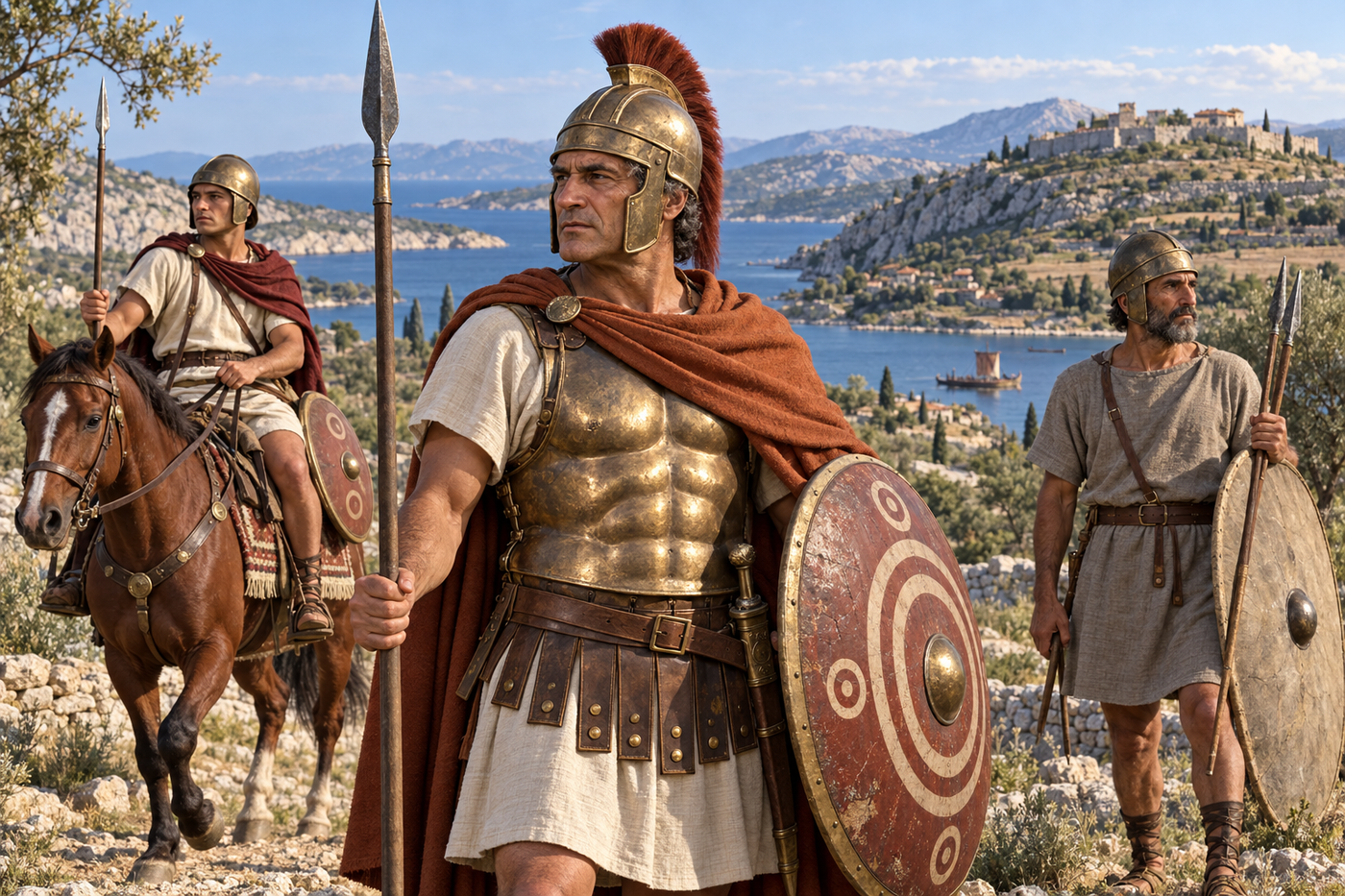
The material world of Illyrian leaders can still be glimpsed in graves. At Zakotorac on the Pelješac peninsula, archaeological work has revealed a burial landscape containing weapons, ornaments and objects connected with wider Adriatic exchange. A bronze helmet from a fourth-century grave gives a particularly striking face to the prestige of an armed man.
The helmet type conventionally called Illyrian leaves the face open between substantial cheekpieces. Its shape could accommodate an imposing crest, making the wearer conspicuous as well as protected. Such equipment demanded resources. Burial assemblages bring together military display and the standing of families who could obtain valuable metalwork and participate in networks extending beyond their immediate community.
At Pelion, the variety of troops described by Arrian reveals another side of the same military world. An army needed men who could hold their ground, men who could fight from slopes and men who could move on horseback. Royal power rested on bringing those different capabilities together. The battlefield was shaped by the combination of wealth, local knowledge and the authority of leaders able to persuade others to follow them.
Glaucias and the child who became Pyrrhus
Glaucias survived the confrontation with Alexander. His later career connects the wars of the fourth century with the next generation of Hellenistic kings. When the infant Pyrrhus was driven from Epirus after the fall of his father Aeacides, his protectors carried him to the Taulantian court. Plutarch tells how the child approached Glaucias and caught at his robe, turning a dangerous political request into a scene of supplication.
Protecting him meant angering Cassander, one of the strongest Macedonian rulers of the age. Glaucias nevertheless took Pyrrhus into his household and had him brought up with his own children. He refused to surrender the boy, even when Cassander offered a large payment. Years later he returned him to Epirus with armed support. The refugee would become the king whose campaigns carried an Epirote army into Italy.
The episode gives Glaucias a place in history beyond the Macedonian victory narrative. He could lose a campaign and remain a king; he could shelter a displaced prince and help determine the future of a neighbouring kingdom. Illyrian rulers continued to make choices that their more famous neighbours had to take seriously.
The Adriatic after Alexander
In the third century, the kingdom associated with Agron and then Teuta brought land warfare and maritime power together on a larger scale. Polybius describes troops carried by sea to relieve Medion and operations against Phoenice in Epirus. Ships could place armed men where an opponent did not expect them, exploit divisions and carry away prisoners and plunder.
These successes also widened the circle of enemies. Attacks affecting merchants, disputes over responsibility for raiding and the confrontation between Teuta and Roman envoys eventually drew Rome into the Adriatic. The balance of power was changing again. Yet the underlying strengths remained recognisable: command of routes, the mobilisation of fighting communities and the ambition of rulers determined to turn local advantages into a kingdom.
Sources
Ancient accounts
- Diodorus Siculus, Library of History XVI.2–4.
- Thucydides, History of the Peloponnesian War I.24–26.
- Arrian, Anabasis of Alexander I.5–6.
- Plutarch, Life of Pyrrhus 2–3.
- Polybius, Histories II.2–12; Strabo, Geography VII.5.
Inscriptions and archaeology
- Attic Inscriptions Online, RO 53: Athenian alliance with Thracian, Paeonian and Illyrian rulers, 356/5 BC.
- H. Potrebica, D. Perkić and M. Dizdar, the discoveries at Zakotorac, The European Archaeologist 83.
- Dubrovnik Museums, The Illyrian Helmet from Zakotorac.
Historical studies