






Ionians
Freedom and vengeance at Ephesus
When news of the Granicus reached Ephesus in 334 BC, its mercenary garrison fled by sea. Alexander entered a city in which the disappearance of Persian military support immediately transformed local politics. He restored exiles and replaced the oligarchy with a democracy. Money previously paid to Persia was redirected to Artemis.
The change released more than enthusiasm. Opponents of the former rulers sought revenge, and members of one leading family were dragged from sanctuary and stoned. Alexander intervened to stop further killings. The arrival of a king proclaiming liberation had opened a struggle over old injuries, sacred property and power within the city itself.
The cities of the eastern Aegean
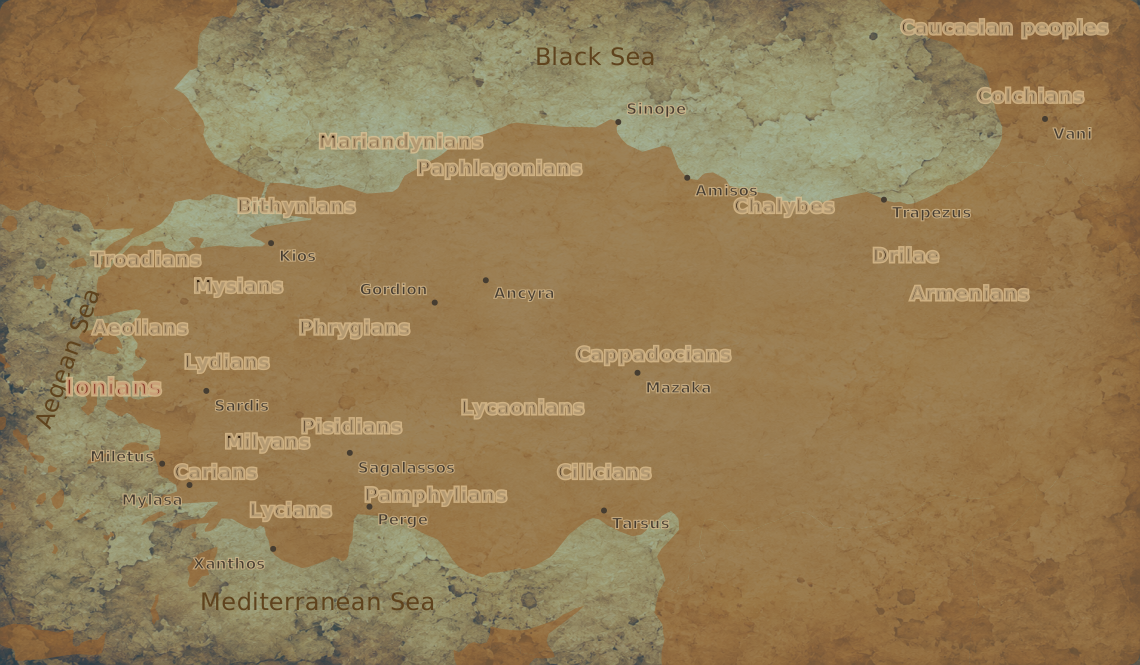
Ionia stretched along the western Anatolian coast and embraced important islands, including Chios and Samos. Miletus, Ephesus, Priene, Colophon, Teos, Erythrae, Clazomenae and Phocaea belonged to a world of harbours, cultivated valleys and routes leading into Lydia and Caria. Across the water lay the other Greek communities of the Aegean.
The cities shared dialects and religious affiliations while guarding their separate identities. Traditions connected their foundations with migration from Greece and gave Athens a special place in Ionian ancestry. Local histories, however, involved different founders and encounters with the peoples already living in Anatolia. Shared origin was a powerful claim rather than a single biography common to every household.
At the Panionion near Mycale, worship of Poseidon brought Ionian communities together. The sanctuary gave their relationship a common setting and could accommodate political consultation in a crisis. It did not erase rivalry or ensure that all cities would make the same decision when confronted by a larger power.
Miletus looks outward
Miletus became one of the great outward-looking centres of the Greek world. Its maritime connections reached through the Propontis and across the Black Sea, where Milesian foundations created new relationships between the Aegean and distant shores. Ships carried goods and passengers along routes that also transmitted stories, religious observances and political obligations.
The city was remembered as the home of Thales, Anaximander, Anaximenes and Hecataeus. Their attempts to describe nature and the inhabited world belonged to a community accustomed to looking beyond its immediate surroundings. Miletus' reputation joined intellectual curiosity to a history of navigation and settlement.
Its harbours remained central to urban life. Modern archaeological work traces a city whose public spaces and approaches developed around access to the water. At the time of Alexander, the sea could bring commerce or military relief; control of an anchorage might decide whether an army outside the walls could take the city.
Lydian kings and Persian power
The Ionian cities had long dealt with rulers of the Anatolian interior. Lydia's expansion brought coastal Greeks within the reach of its kings. Cyrus' defeat of Croesus in the sixth century BC then placed them before a new imperial power. Persian authority became a lasting presence in their political and military affairs.
Local rulers and factions operated within that order. A tyrant's relationship with a satrap could help sustain his position, while service to the Great King created opportunities far outside the city. Greek subjects of Persia could participate in imperial expeditions and naval forces without ceasing to inhabit Greek civic communities.
At the same time, the possibility of outside support invited opposition. A faction seeking power could appeal across the Aegean or towards the Persian court. The competition between larger states repeatedly entered civic life through the ambitions and fears of particular leaders.
Aristagoras' gamble
In 499 BC, Aristagoras of Miletus helped turn a failed expedition against Naxos into a far wider revolt. Facing the consequences of failure, he abandoned tyranny and urged the Ionian cities to remove rulers supported by Persia. He also sought assistance in Greece, obtaining ships from Athens and Eretria.
The insurgents reached Sardis and burned much of the city, carrying the conflict into the administrative heart of western Persian power. Revolt spread beyond Ionia, drawing in other communities whose relationships with the empire differed. What began through the choices of a Milesian ruler became a regional war.
In 494 BC, the naval confrontation at Lade broke the coalition's ability to defend Miletus. The city fell to Persia, suffering destruction and the removal of inhabitants. The disaster entered Greek memory with exceptional force. A city celebrated for its reach across the sea had been unable to preserve itself at home.
New protectors, old demands
The Persian defeats of 479 BC opened another political future. Greek victories and the growth of the Athenian alliance brought many eastern Aegean communities into a maritime system centred on Athens. Contributions to a common struggle increasingly supported an empire whose demands could be enforced against its own members.
The Peloponnesian War again turned the coast into a theatre of competition. Spartan commanders worked with Persian satraps against Athens; cities weighed revolt, protection and the risks of choosing the losing side. At the King's Peace in 387/386 BC, Persian sovereignty over the Asian Greek cities received recognition from the powers negotiating in Greece.
By Alexander's arrival, promises of autonomy therefore carried a long and complicated history. The removal of one garrison might leave a community dependent on another protector. Exiles could return as victors, and those who had governed under the previous settlement might suddenly find their lives in danger.
Artemis and the public life of Ephesus
The sanctuary of Artemis stood at the centre of Ephesian identity and wealth. Its fame reached far beyond the city, attracting offerings and giving religious authority an international presence. The rebuilding that followed the famous fire of 356 BC belonged to the living experience of Alexander's generation.
At Ephesus, Alexander honoured the goddess with sacrifice and an armed procession. His order redirecting Persian tribute to Artemis associated the new political settlement with the city's sacred centre. The act made liberation visible through a change in where civic resources would go.
Yet the violence accompanying his entry showed that sacred places did not stand outside political conflict. Accusations of temple plunder and hostility towards earlier benefactors fed the crowd's anger. Alexander's intervention placed the limit to vengeance in the hands of the new king, even as he restored institutions described as democratic.
Miletus chooses resistance
At Miletus, the prospect of Persian naval support changed the calculation. Hegesistratus, commanding the garrison for Darius, had offered surrender, then resolved to hold the city when the fleet approached. Alexander's ships reached the anchorage at Lade first, while troops occupied the island.
The Macedonian king refused a proposed arrangement by which both sides could use the city's walls and harbours. His siege engines opened the defences, and Nicanor's vessels blocked the entrance against Persian assistance. Miletus fell with the enemy fleet close enough to witness the attack but unable to prevent it.
Some defenders escaped towards a nearby islet, using boats or their shields to help them through the water. Alexander accepted the surviving mercenaries into his service and pardoned the citizens who had survived the capture. The city received freedom after a fight that had already killed many of its inhabitants and defenders.
The coast in Alexander's war
Alexander's policy in Ionia joined political change to military necessity. Friendly governments and secure harbours helped protect the rear of an army advancing inland. The overthrow of oligarchies could return exiles to power, but the new arrangements also depended on the success of the king whose forces sustained them.
The contrast between Ephesus and Miletus captures the choices confronting the cities. One lost its garrison and received Alexander amid violent political reversal; the other trusted in Persian relief and endured an assault. Both became part of his campaign, carrying their own civic histories into a new imperial settlement.
For Ionia, the struggle was conducted in assemblies and sanctuaries as well as on walls and ships. A decision by Aristagoras had once helped ignite a revolt; a decision by Hegesistratus brought another siege to Miletus. The coast's wealth and connections gave its cities influence, while repeatedly making their independence a prize in wars larger than themselves.