






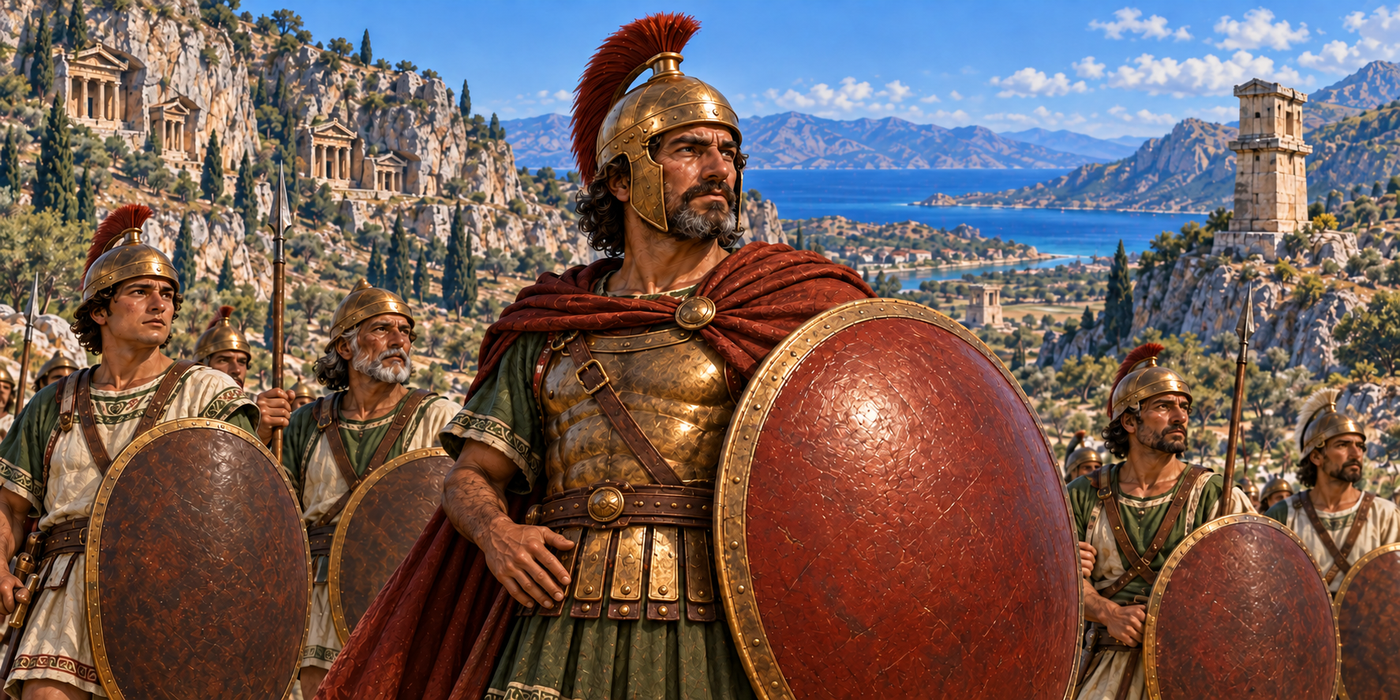
Lycians
The coast surrenders
In the winter of 334/333 BC, Alexander moved along the Lycian coast. Telmessos made terms; Xanthos, Pinara and Patara followed. Envoys approached from other communities, offering submission and friendship. After the prolonged struggle at Halicarnassus, the king acquired a succession of coastal positions without another siege of comparable scale.
The decisions mattered beyond Lycia. Persian naval power still threatened his campaign, and a fleet needed harbours and friendly shores. Alexander sought to deprive Darius of those advantages by controlling the land. For the Lycian communities, accepting him offered a way through the crisis of an empire whose armies had already suffered defeat in western Anatolia.
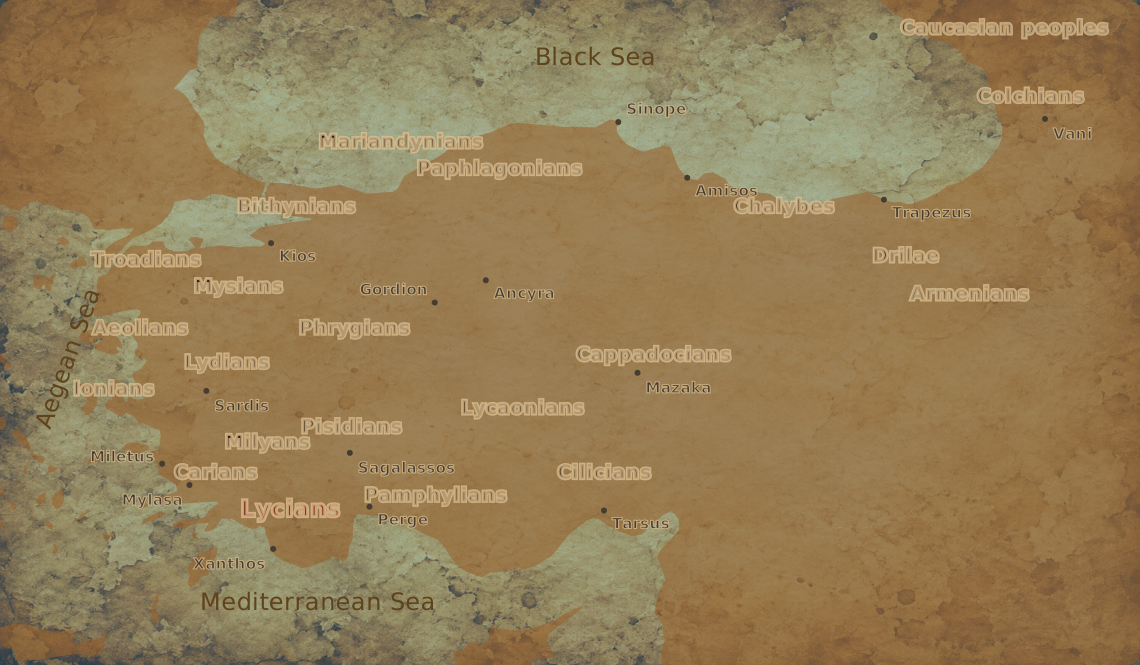
Valleys opening to the sea
Lycia occupied the mountainous south-western corner of Anatolia, where steep country descended towards bays and fertile coastal valleys. The Xanthos valley supported one of its principal concentrations of settlement. Elsewhere, difficult terrain divided communities while maritime routes connected them with the Aegean and the wider eastern Mediterranean.
The region's cities were rooted in an Anatolian culture with its own language and writing. Lycian inscriptions named rulers, commemorated the dead and recorded public decisions. Greek also became increasingly important, providing another means through which local dynasts and communities could address people beyond their homeland.
The tombs made family standing conspicuous. Rock-cut façades imitated the forms of timber buildings; sarcophagi and pillar monuments raised the dead above ordinary ground. Their position within the landscape carried a household's name and claims into the future. Death offered an occasion to display continuity, wealth and the right to be remembered.
Xanthos and the coming of Persia
The Persian conquest had left a terrible story attached to Xanthos. Herodotus recounts that, when Harpagus invaded in the sixth century BC, the Xanthians fought against a much larger army and were driven back into their city. They gathered their households and possessions in the citadel, set it alight and made a final attack in which the fighting men perished.
In his telling, a small number of families absent at the time survived, while later inhabitants included newcomers. The city lived on beneath the memory of an act of collective destruction. When Alexander approached nearly two centuries later, Xanthos chose submission instead of repeating that resistance.
Persian rule did not erase local dynastic life. Leading families retained resources, issued coinage and built monuments whose imagery could combine regional, Greek and Persian forms. Their position depended on relations with other rulers as well as on the power they exercised at home.
Erbinna's monument
One of the most spectacular expressions of that world was the Nereid Monument at Xanthos, generally associated with the early-fourth-century ruler Erbinna, known in Greek as Arbinas. Its appearance recalled a Greek temple, but it served as a dynastic tomb. Architecture, sculpture and an elevated setting proclaimed the standing of the household it commemorated.
The sculpted scenes include warfare, the taking of a city, tribute and banqueting. They show a ruler's power through several activities: military success, reception of others and the ceremonial display of rank. The monument brought these claims together for viewers approaching the tomb.
Greek artistic forms did not require a Lycian patron to abandon his own identity. They furnished a prestigious language through which he could represent authority. In the same country, inscriptions in Lycian preserved local names and obligations. The surviving monuments reveal patrons choosing among the resources available to them.
A sanctuary speaking three languages
Near Xanthos stood the Létôon, associated with Leto and her children Apollo and Artemis. Worship at the sanctuary connected communities with a sacred centre whose importance extended into public affairs. Decrees and monuments placed decisions before the gods and the people who came to honour them.
A trilingual inscription from the years immediately before Alexander records the establishment of a cult under Pixodarus, the Hecatomnid ruler governing Caria and Lycia. Lycian and Greek versions set out the local arrangements, while an Aramaic text expressed the satrap's official sanction. The monument joined civic action to provincial authority on the same stone.
The decree gives unusual substance to the institutions behind the dynastic monuments. Religious observance required a priest, funding and recognised arrangements. The sanctuary was a place where such provisions could be made enduring and public. Language itself reflected the political setting: local society, Greek communication and an imperial administrative tradition met in one document.
People and inheritance
Herodotus was struck by a Lycian practice of identifying descent through the mother's line. His description made family affiliation an important feature of the people he presented to Greek readers. It placed the household, its recognised ancestry and the status of its children at the centre of an account of local custom.
The monuments offer another view of the importance of lineage. Tombs could carry names and prohibitions, protecting the resting places of particular families. A ruler's ambitions might extend across a valley or towards a neighbouring city, but his memory was anchored in a monument built for those entitled to share it.
These attachments helped local identity endure through changes of sovereign. Persian satraps and Macedonian kings could claim the country while its inhabitants continued to recognise their cities, sanctuaries and households. Authority reached people through those established relationships.
Soldiers and ships
Lycians had participated in the wars of the Persian monarchy long before Alexander. Herodotus includes fifty Lycian ships in Xerxes' fleet in 480 BC. He describes their crews with bows and javelins, goatskin coverings, caps adorned with feathers, and curved blades and daggers. The account places regional equipment within a naval force assembled from many peoples.
The dynastic sculptures of the fourth century present a broader martial display. Shields, helmets and fighting scenes formed part of elite representation, while images of siege and submission connected local rulers with the conduct of organised war. The ability to command men and withstand rivals supported the wealth displayed in their tombs.
The coast and the highlands offered different military settings. Harbours could support ships; a narrow inland approach could protect a stronghold; cultivated land could become vulnerable to raiders descending from neighbouring heights. A community's defence depended on more than the walls immediately surrounding it.
Phaselis and the upland frontier
During Alexander's advance, representatives from Phaselis came with a golden crown and a request for friendship. He subsequently helped the city capture a fort held by Pisidians who had been damaging the lands worked by its inhabitants. The new conqueror's army could become an instrument in a conflict already familiar to the people of the coast.
Alexander also entered Milyas in the depth of winter. Arrian explains that this upland country, associated geographically with Greater Phrygia, paid tribute to Lycia under an arrangement of the Persian king. The campaign followed a political landscape shaped by earlier imperial decisions, extending beyond the immediate coastal cities.
Submission therefore had practical consequences for neighbours. A city accepting Alexander might receive help against an enemy; upland communities could face a new claimant to the revenues previously demanded in the Great King's name. The march changed the balance between places whose relationships had developed before the Macedonians arrived.
After the winter campaign
Alexander continued east towards Pamphylia and then inland. Lycia had provided ports, agreements and a passage along the southern coast. Its acquisition formed part of the wider effort to make Persian sea power less effective while the decisive royal armies still had to meet.
After his death, Lycia entered the contested settlement of the provinces. Antigonus held it with Greater Phrygia and Pamphylia, drawing the region into the struggles of the successors. The later Lycian cities would develop further forms of cooperation, including the famous federal league of Hellenistic and Roman times.
At the moment of conquest, the country already possessed a rich political history of its own. Erbinna's tomb, the decrees at the Létôon and the choices made before Alexander linked ambition to enduring places. The new king acquired a coastline whose cities had learned to express local authority within the reach of greater powers.
Sources
Ancient narratives and inscriptions
- Herodotus, Histories, I.173–176; VII.92.
- Arrian, Anabasis, I.24.
- André Dupont-Sommer, “La stèle trilingue récemment découverte au Létôon de Xanthos : le texte araméen”, CRAI 118.1 (1974), pp. 132–149.
Archaeology and historical geography