






Carians
Ada's adopted son
When Alexander entered Caria in 334 BC, Ada came to meet him with an offer that joined a fortress to a family relationship. Driven from power, she still held Alinda. She placed it at his disposal and adopted the Macedonian king as her son. Alexander accepted the relationship, confirmed her possession of the stronghold and eventually restored her authority over Caria.
The encounter gave the conquest a local partner. Ada belonged to the dynasty that had transformed Caria during the fourth century. Her return promised continuity with an established ruling house, while Alexander supplied the force capable of overcoming those who had displaced her. Beyond the battle between Macedonia and Persia lay a Carian struggle over inheritance, legitimacy and the survival of a dynasty.
Between the interior and the islands
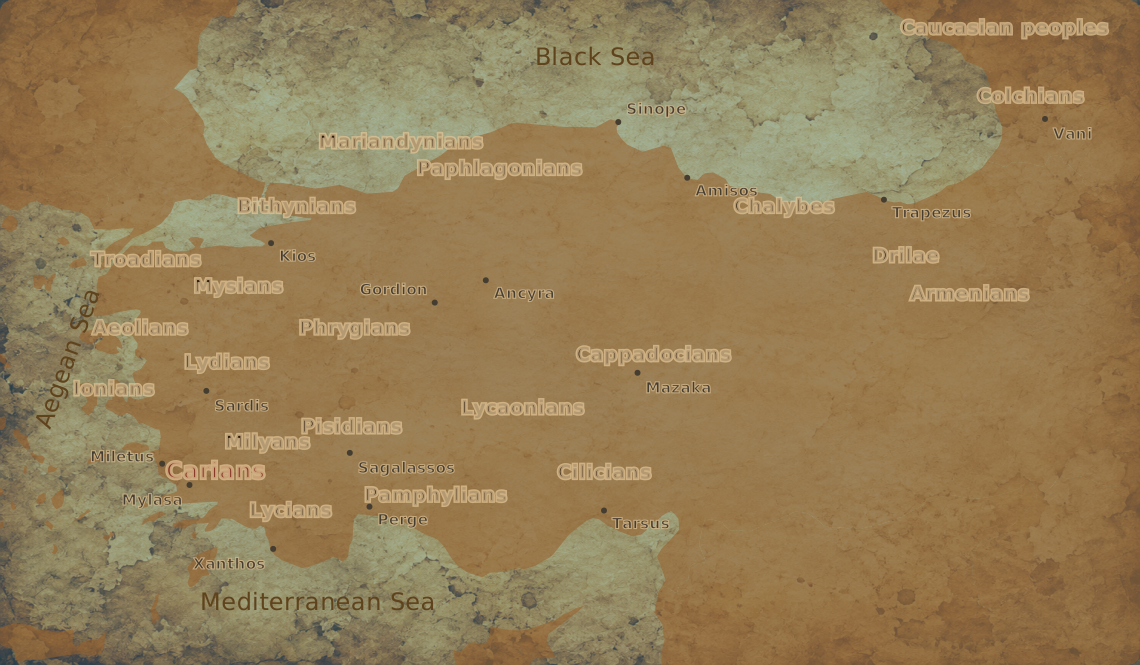
Caria occupied south-western Anatolia, where a deeply indented coast opened towards the islands of the Aegean. Peninsulas, harbours and coastal cities connected it with maritime trade and warfare. Inland, Mylasa and the surrounding valleys belonged to a landscape of settlements, sanctuaries and routes towards Lydia and Phrygia.
The country sustained several overlapping traditions. Carian was spoken and written alongside the increasing use of Greek. Cities on the coast could participate fully in Greek cultural life while remaining within the political world of Caria. Herodotus, himself a native of Halicarnassus, wrote in Greek about a region whose communities remembered different accounts of their own origins.
His discussion of the Carians sets their own claim to be indigenous against a tradition deriving them from the islands. He also records the sanctuary of Carian Zeus at Mylasa as a focus of shared identity. Such affiliations gave people ways to recognise kinship and belonging across the divisions between individual cities.
Soldiers far from home
Carian military service had a long history beyond Anatolia. Alongside Ionians, Carians entered the service of Egyptian rulers, creating communities whose language left traces far from their homeland. Their reputation as soldiers was part of the movement of armed men across the eastern Mediterranean.
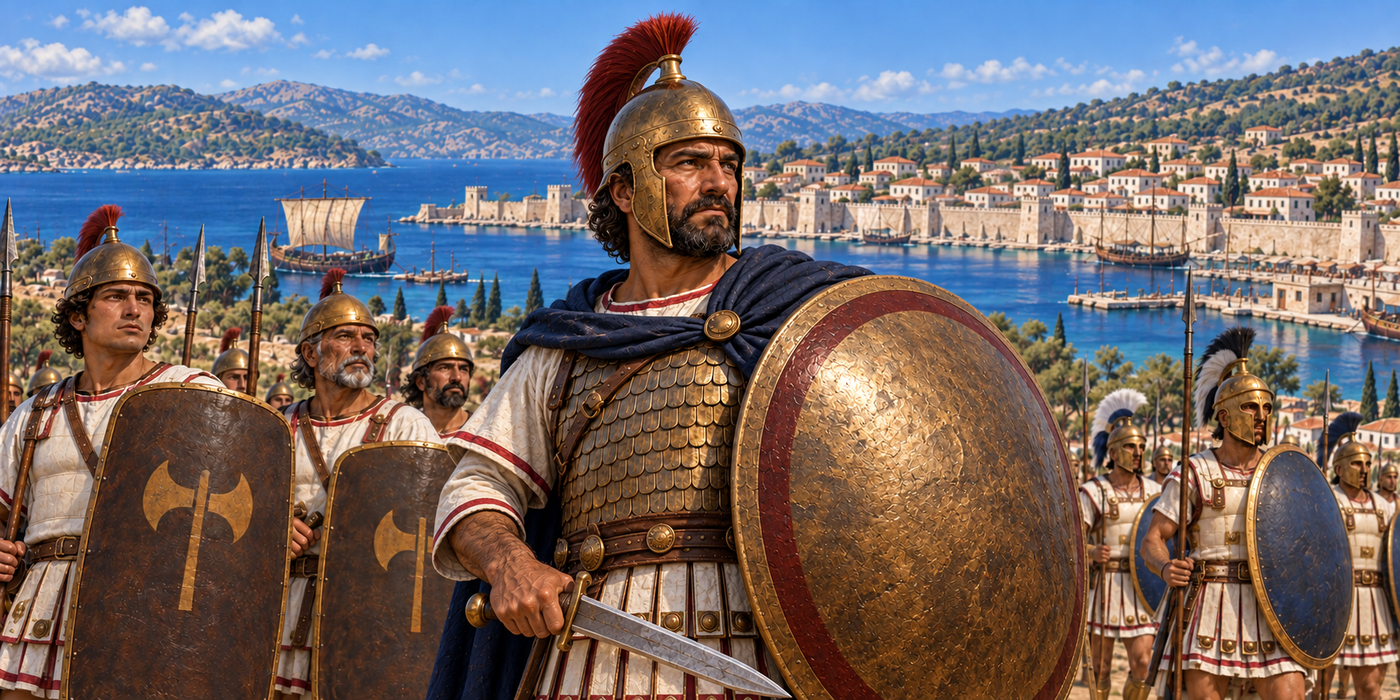
Herodotus attributed several developments in military display to the Carians, including helmet crests and devices on shields. In his account of Xerxes' fleet in 480 BC, Carian crews carried equipment broadly resembling that of the Greeks, with curved blades and daggers among their weapons. Their ships placed them within a Persian naval undertaking of enormous scale.
For men serving abroad, a connection to Caria could coexist with obedience to a foreign employer. The same pattern remained visible during Alexander's campaign, when Carian troops and Greek mercenaries could hold a fortress on behalf of Persia. Recruitment and service bound the region to wars fought across the empire.
The house of Hecatomnus
In the early fourth century BC, Hecatomnus established the dynasty that would dominate Caria before Alexander. His family ruled within the Persian imperial order while developing a powerful regional base. Royal recognition and local authority reinforced one another, allowing the dynasty to pursue interests that reached well beyond one city.
Mausolus, who succeeded him, made Halicarnassus a magnificent centre of power. The city faced the sea, giving the dynasty a setting from which to intervene in Aegean affairs. His reign combined the resources of an Anatolian ruler with the monumental language and artistic connections of the Greek world.
The tomb associated with Mausolus and his wife and sister Artemisia became the most celebrated expression of that ambition. Its scale, architecture and sculpture made it one of the wonders of the ancient world. The ruler's name would eventually supply a word for monumental tombs themselves. In Caria, the building asserted a family's standing at a time when its power still depended on living successors.
Zeus at Labraunda
In the mountains near Mylasa, the sanctuary of Zeus at Labraunda offered another setting for dynastic display. Mausolus and Idrieus sponsored major works there during the fourth century. Terraces, monumental buildings and dining facilities transformed a sacred place into a conspicuous expression of patronage.
The approach along the sacred way brought worshippers into a landscape shaped by the ruling family. Feasting and religious observance could gather people beneath buildings bearing the marks of benefaction. Authority was made visible through generosity to a sanctuary whose significance extended beyond a private household.
The sanctuary also formed part of a defended landscape. Fortifications around Labraunda and its approaches belonged to the same broad programme of Hecatomnid investment. Sacred prestige, communication and security met in a place through which the dynasty could present itself to Carian communities.
A family divided
After Mausolus and Artemisia, power passed to Idrieus and then Ada. The dynasty's marriages had kept authority within a tightly connected family, but close kinship did not prevent conflict. Pixodarus displaced Ada, leaving her with Alinda while he controlled the wider country.
Pixodarus strengthened his position through his daughter's marriage to the Persian Orontobates. When Pixodarus died, Orontobates took over with the Great King's backing. Ada's claim therefore stood against a ruler connected to the family by marriage and supported by Persian authority. Alexander's arrival gave her an opportunity to overturn that settlement.
For the Macedonian, an alliance with Ada provided more than a secure height. She could represent a recognised dynasty to people whose obedience could not be obtained merely by defeating a Persian army elsewhere. Her adoption of Alexander turned cooperation into a publicly intelligible family bond.
The walls of Halicarnassus
Halicarnassus presented a different obstacle. Orontobates and Memnon of Rhodes prepared to hold the city for Darius. Memnon had an important command in the Persian war effort, and the defenders included Greek mercenaries alongside Persian troops. Ships in the harbour supported a position Alexander could not simply isolate from the sea.
The king brought siege equipment against strong walls. Attacks and sorties followed, with the defenders seeking to destroy the machinery threatening them. The struggle was fought around the works as well as at breaches, where a local success might preserve the city or expose it to assault.
The siege also demonstrated the limits of courage without control. Arrian recounts an incident in which two Macedonian soldiers, drinking together, challenged one another to approach the wall. Their venture drew other men into a growing fight. An army organised for a deliberate siege could find itself committed to combat by the behaviour of a few individuals.
Fire and withdrawal
As the walls weakened and losses mounted, the defenders decided to abandon much of the city. During the night they set fire to a wooden tower, stores and nearby buildings. The flames spread, announcing a withdrawal whose destruction threatened civilians as well as military positions.
Alexander brought troops forward when he learned what was happening. Arrian records an order to spare Halicarnassians found in their houses. The Persian forces withdrew into separate strongholds, including Salmacis and the island position of Arconnesus. Capturing the main city had not removed every defended point.
Alexander chose to leave forces behind rather than spend further time reducing them himself. Halicarnassus had suffered heavily, and a garrison under Ptolemy was charged with the continuing military task. The king could move on while the final struggle for control remained with others.
A Carian settlement
Ada received authority over Caria under Alexander. Her restoration linked the new regime to the dynasty whose buildings and sanctuaries already shaped the country. The arrangement combined Macedonian military supremacy with a local ruler's standing. It offered a way to secure obedience without replacing every familiar relationship at once.
Memnon continued the Persian struggle in the Aegean after leaving Caria, threatening Alexander's rear through naval operations. The fall of Halicarnassus had secured an important coastal centre, but it had not destroyed the maritime resources of Darius. The war for the islands and the coast continued while Alexander marched towards greater battles inland.
For Caria, the conquest closed one phase of a family struggle and opened another period under external kings. Its identity remained visible in sanctuaries, language and the memory of its rulers. Ada's fortress, Mausolus' tomb and the terraces of Labraunda expressed different forms of the same political world: a country whose leading families could serve an empire, compete within it and seek their own survival when it fell.
Sources
Ancient narratives
- Herodotus, Histories, I.171; VII.93; II.152–154 on Carians in Egypt.
- Arrian, Anabasis: I.20, I.21, I.22, I.23.
Archaeology and historical studies
- “Caria”, Encyclopaedia Iranica.
- British Museum, Mausoleum of Halikarnassos.
- Swedish Research Institute in Istanbul, Labraunda excavations; Labraunda archaeological project, the monumental sanctuary.
- François Sabbathier, Dictionnaire pour l'intelligence des auteurs classiques grecs et latins, “Ada”, daughter of Hecatomnus.