






Pisidians
The heights above Alexander
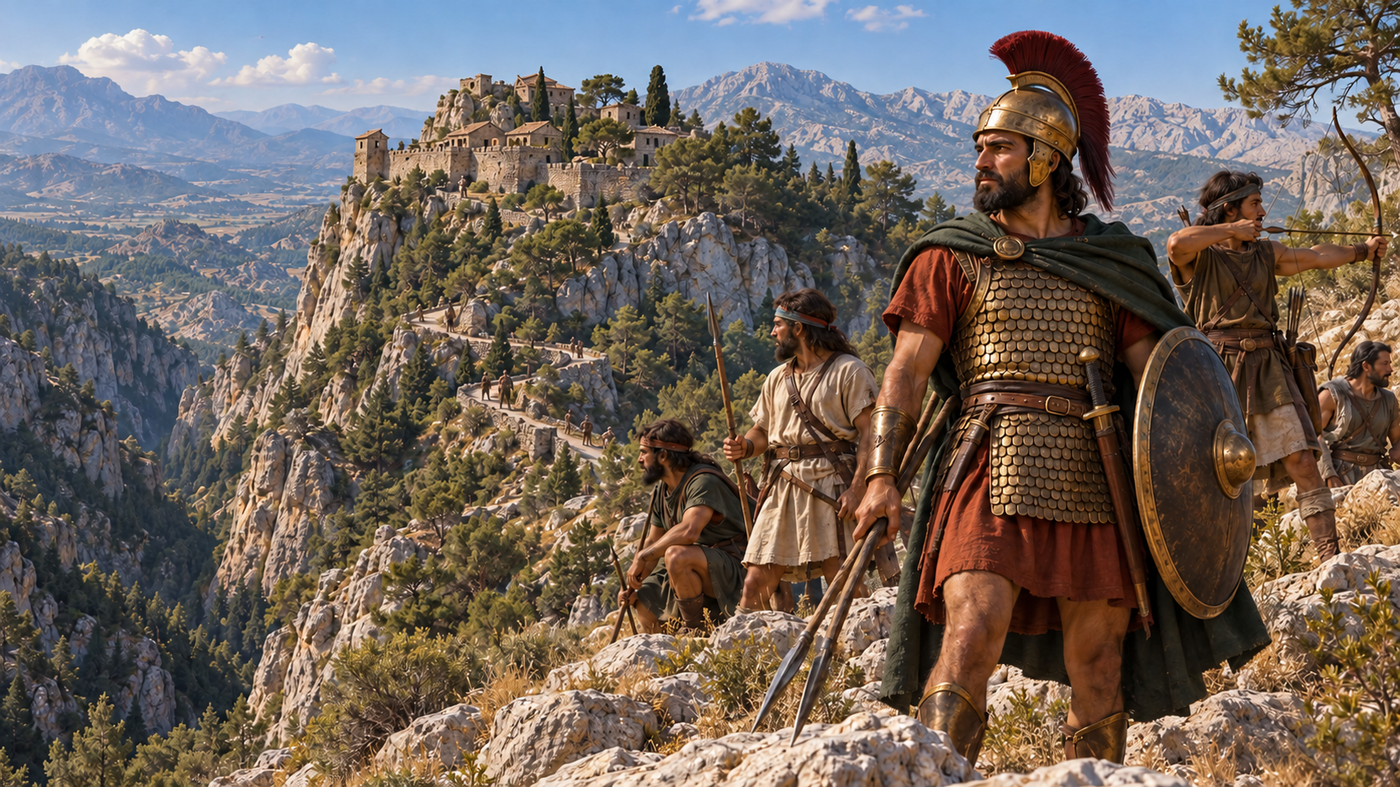
When Alexander turned inland from Pamphylia in 333 BC, the people of Termessos occupied the heights commanding his route. The mountains narrowed the road into a passage that a small force could close. Before the Macedonian king could continue towards Phrygia, he had to dislodge men fighting within sight of their own city.
He secured the passage, but Termessos itself remained beyond his immediate grasp. Nearby Selge chose friendship with him, while Sagalassos prepared to fight. In a short stretch of the campaign, three Pisidian communities made three different decisions. Each was responding to the arrival of the same conqueror through the circumstances and rivalries of its own country.
Above the coastal plain
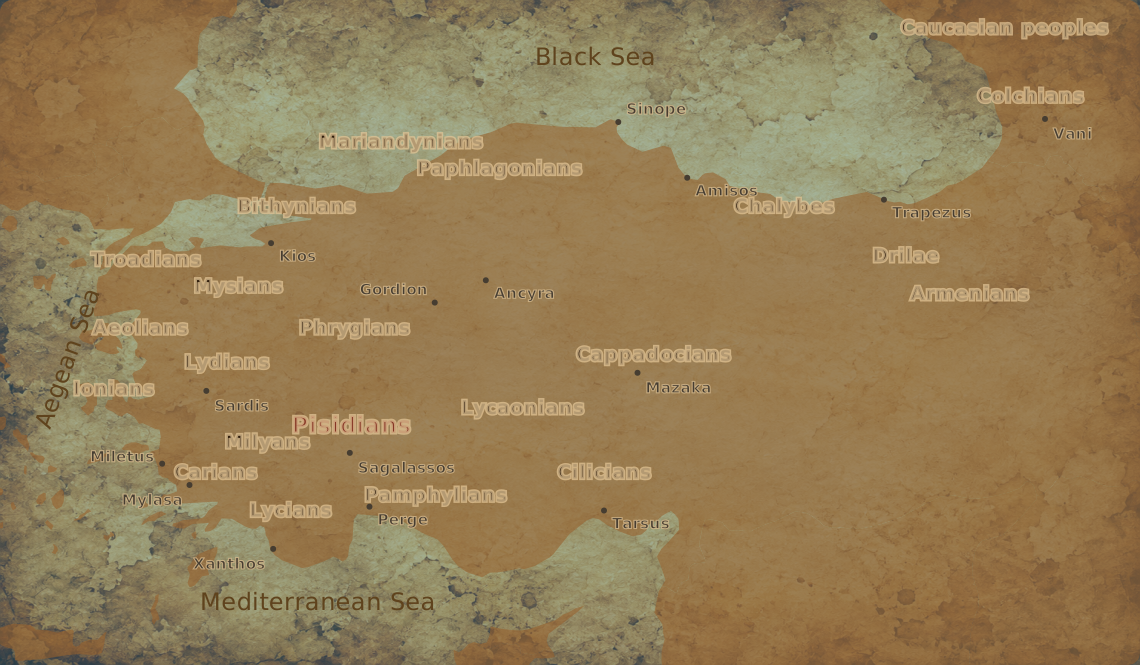
Pisidia occupied the western Taurus and the country north of Pamphylia. Wooded ridges, upland valleys, lake basins and cultivable plains formed a varied interior behind the Mediterranean coast. Routes towards Phrygia crossed a landscape where access to water, passes and productive land could determine the fortunes of a settlement.
The heights offered powerful defensive positions. They also required inhabitants to maintain connections with lower ground and neighbouring districts. Fields, herds and routes could lie beyond the protection of a town. A community might survive behind difficult approaches while finding its resources exposed to an enemy who held the surrounding country.
Archaeological research around Sagalassos and nearby Düzen Tepe reveals a substantial history of settlement before the Macedonian conquest. Houses, production areas and agricultural landscapes stood behind the brief appearances of Pisidian fighters in Greek narratives. The mountains contained established communities with their own resources and ambitions.
The reach of Persian governors
Pisidia entered the history of the Achaemenid Empire through recurring attempts to impose obedience. In 401 BC, Cyrus the Younger announced a campaign against Pisidian troublemakers while assembling the army with which he would challenge Artaxerxes II. The pretext was credible enough to conceal the greater undertaking for part of the march.
For a governor, the uplands could present both a military problem and an opportunity to demonstrate usefulness to the king. A successful expedition might protect routes or punish raids. Yet the need for renewed campaigns showed how difficult it was to make a single operation produce lasting control.
Datames, a formidable commander in the first half of the fourth century, also fought Pisidians. Nepos describes a campaign in which his son Arsidaeus was killed, followed by Datames' effort to confront the enemy before news of the disaster weakened his army. The struggle combined the dangers of difficult country with the personal losses of a commander whose family served alongside him.
Rivals within the mountains
The relationship between Termessos and Selge shaped Alexander's progress. Arrian identifies their long hostility as the reason Selgian envoys approached him. The arrival of a powerful outsider offered Selge a chance to obtain an ally against a regional enemy. A shared Pisidian identity did not oblige neighbouring cities to take the same side.
Elsewhere, Termessians assisted Sagalassos against the invader. Local military cooperation could therefore operate at the same time as local rivalry. The decisions of one community altered the risks faced by another: an agreement might leave a neighbour isolated, while reinforcements could turn resistance into a more substantial undertaking.
These relationships made diplomacy part of the campaign's immediate military setting. Alexander could accept friends, bypass a costly objective and fight a different opponent within the same region. For the communities involved, the question was how his presence would change the balance of power after the main army had moved on.
The passage at Termessos
At the mountain gates near Termessos, Alexander initially brought his army to a halt. According to Arrian, most of the defenders then withdrew to their city, leaving a guard on the heights. The king advanced against that reduced force with archers, javelin troops and lighter infantry. Missiles drove the guards from their position, opening the passage.
Holding the road did not give him the city. Its lofty position made a rapid capture unattractive, and he would not spend the time required for a serious siege. Termessos survived the encounter as a place he had passed rather than taken.
For the defenders, terrain had preserved an important advantage even after the loss of the immediate position. For Alexander, the route mattered more than the prestige of reducing every stronghold. He accepted Selge's alliance and continued towards Sagalassos.
The fight for Sagalassos
The Sagalassians occupied a hill in front of their settlement, joined by Termessian allies. Alexander's cavalry could contribute little on the broken ground. He had to rely on infantry: archers and Agrianians ahead of his right, Thracian javelin troops ahead of the left, and the Macedonian formations behind them.
The defenders struck the advancing force from favourable ground. Arrian describes the archers being driven back before the arrival of heavier troops steadied the assault. The Pisidians fought at close quarters, then withdrew through country they knew better than their pursuers. Alexander took Sagalassos, but the rough terrain prevented an effective chase.
The battle cost the Macedonians men, including Cleander, commander of the archers. It also demonstrated the danger of treating lightly equipped defenders as an insignificant obstacle. A difficult approach could expose the foremost attackers before the main formation reached them. The eventual victory depended on bringing the infantry through that danger.
Life behind the battles
The fame of these confrontations can obscure the settlements they were fought to protect. Work in the territory of Sagalassos has traced communities, farms and patterns of production reaching back before Alexander. The nearby plateau of Düzen Tepe preserves a large pre-Hellenistic settlement, part of a changing local landscape rather than an empty stage waiting for a Greek city to appear.
Water and cultivable ground were as consequential as a defensible hill. The inhabitants needed places to live through the seasons and land that could support them. Upland security and agricultural opportunity did not always coincide, encouraging decisions about where households and settlements should concentrate.
The monumental Sagalassos familiar from later antiquity grew over subsequent centuries. In Alexander's time, the region's communities already possessed the capacity to resist, negotiate and organise resources. Their later development expanded those foundations within a world increasingly shaped by Hellenistic kings.
A conquest still contested
Alexander continued against other Pisidian strongholds, taking some by force and accepting the submission of others. The campaign opened his way into Phrygia. It left a mixed inheritance: allies who had gained his friendship, defeated communities and places whose defences had persuaded him to move on.
Later resistance in the southern Anatolian uplands again demanded the attention of Macedonian commanders. Diodorus recounts the death of Balacrus, Alexander's governor in Cilicia, at the hands of the Larandians and Isaurians. After Alexander's death, Perdiccas brought the royal army against these communities. His account of their destruction shows how fiercely the struggle over obedience could continue around the Taurus.
Pisidia's experience of the conquest was shaped by choices made town by town. Selge found an ally; Termessos preserved its walls; Sagalassos lost a battle and was taken. The mountains made each encounter its own problem, requiring the conqueror to decide where to fight and the inhabitants to decide what survival demanded.
Sources
Ancient narratives
- Arrian, Anabasis, I.27; I.28.
- Xenophon, Anabasis, I.1–2.
- Cornelius Nepos, Datames, 6.
- Diodorus Siculus, Library of History, XVIII.22.
Archaeology and historical geography
- Sagalassos Archaeological Research Project, KU Leuven, history of the city and region.
- Marc Waelkens and the Sagalassos team, Düzen Tepe field report (2008); Alexander's Hill field report (2003).
- François Sabbathier, Dictionnaire pour l'intelligence des auteurs classiques grecs et latins, “Pisidie”.