






Colchians
Gold beside the Black Sea
At Vani, in the second half of the fourth century BC, a warrior was buried with spearheads, daggers, arrows and pieces of defensive equipment. A coin of Philip II of Macedon accompanied him. Another grave of the same broad period held an extraordinary gold headdress, its openwork filled with animals and birds. While Alexander's armies were overturning the Persian Empire, powerful households in Colchis displayed their standing through possessions that joined local workmanship to a wider world.
To Greeks, this was already the country of the Golden Fleece. Jason, Medea and King Aeetes had made its name familiar long before most visitors could have described its settlements. Behind the heroic destination lay a living country at the eastern end of the Black Sea, connected by rivers, mountain routes and maritime trade with its neighbours.
The Phasis and the Caucasus
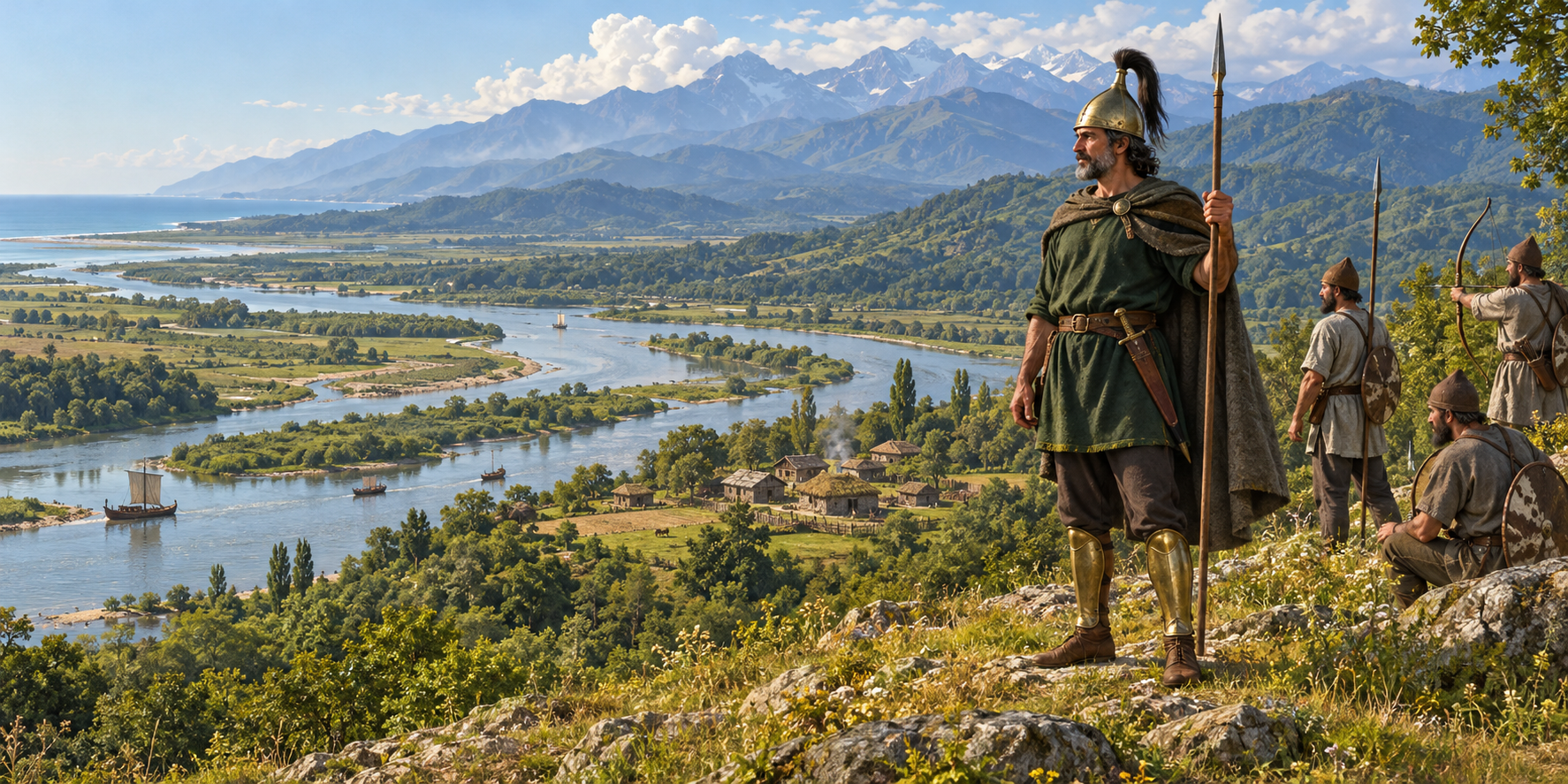
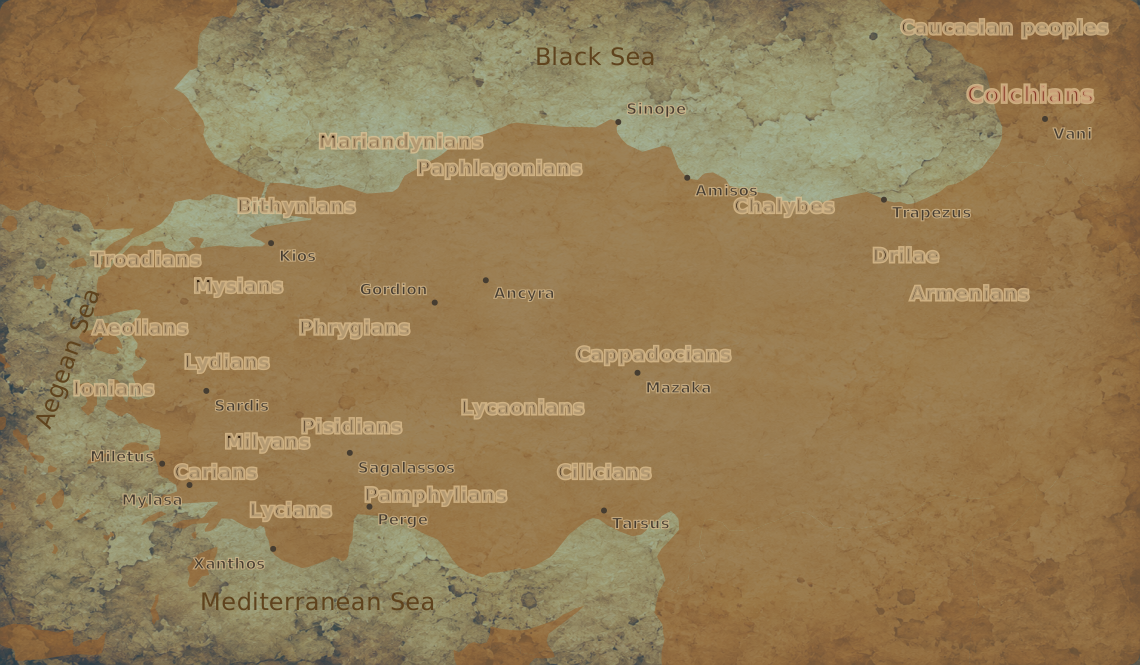
The heart of Colchis lay in what is now western Georgia, beneath the Caucasus and around the lowlands of the Phasis, the modern Rioni. Rivers led inland from the sea towards cultivated valleys and the approaches to the mountains. The name also extended in Greek writing along parts of the south-eastern Black Sea coast, where communities lived between steep uplands and coastal settlements.
Strabo later described a country rich in timber, flax, hemp and wax, with materials useful for shipbuilding and seaborne exchange. Such resources gave the shore and its river mouths a value beyond the romance of distant gold. The same waters that carried foreign visitors offered routes through which local produce and imported possessions could circulate.
Geography brought different communities into contact without making their interests identical. Greek settlements such as Phasis and Dioscurias belonged to coastal networks; inland centres and mountain peoples had their own connections. A city trading by sea might need the goodwill of neighbours whose farms supplied it, while those neighbours could find foreign vessels useful for selling goods or obtaining prized objects.
A kingdom in heroic memory
In the Argonautic story, Aeetes guarded the Golden Fleece and imposed terrible tasks upon Jason. Medea, his daughter, made the hero's success possible, leaving her father's household for a future that Greek tragedy would turn into one of its darkest narratives. Colchis became the setting for a confrontation between royal power, divine ancestry, dangerous knowledge and a stranger's ambition.
The story gave the eastern Black Sea a place in the imaginative geography of Greece. The journey of the Argo crossed the familiar sea towards a royal household at its remote edge. Returning travellers could bring back tales of strange customs and rich possessions to audiences already prepared to recognise the name of Aeetes.
Strabo connected stories of the fleece with the collection of gold from mountain streams using fleeces. The explanation linked the legend to the resources of the Caucasus. Whatever route the myth had taken into Greek poetry, Colchian goldworking was a substantial craft, and its surviving products reveal the care with which local elites displayed wealth.
The households of Vani
Vani stood inland, within reach of the river plain. Its graves preserve a society capable of commissioning intricate ornaments and obtaining objects from distant workshops. The deceased could be surrounded by vessels, jewellery and other possessions associated with standing and ceremonial life. The richest burials also expose the harsh hierarchy behind that splendour: some contained accompanying people and animals sacrificed at the funeral.
The warrior in Grave 9, dated to approximately 350–325 BC, carried a varied collection of weapons into burial. Spearheads, daggers, arrowheads and remains of leg protection and a shield belonged to a martial display extending well beyond a single weapon. The Macedonian coin placed with him reached Colchis through networks that connected the region with the world in which Philip and Alexander fought.
The gold ornament from Grave 24 offers another view of those connections. Local craftsmen combined deer, lions and birds in an elaborate design whose comparisons reach towards neighbouring artistic traditions. The object belonged to a larger headdress, making the wearer conspicuous through a carefully arranged display of skill and precious material. Such possessions distinguished particular people within their own society.
On the edge of Persian power
Colchis stood near the northern reach of Achaemenid influence. Herodotus describes the Colchians and their neighbours sending boys and girls as gifts to the Persian king. He distinguishes these offerings from the regular assessments imposed on the provinces in his tribute catalogue. Behind the language of gifts lay a relationship with an empire capable of demanding people as well as goods.
Colchian soldiers also appear in his account of Xerxes' expedition against Greece in 480 BC. Their equipment included wooden helmets, small rawhide shields, short spears and knives. Their service carried men from the eastern Black Sea into a war whose objectives were set at the Persian court.
The region's relationship with the empire combined contact and distance. Persian objects reached local elites, while the mountains and the multiplicity of communities complicated direct control. Connections with the Great King did not require every valley to be governed in the same manner as the heartlands of an established satrapy. Local authorities remained essential to whatever obedience could be obtained.
When the Ten Thousand arrived
Around 400 BC, Xenophon's returning mercenaries encountered Colchians blocking a mountain approach near the south-eastern Black Sea. The Greeks advanced in separate columns, extending their wings until the defenders' line opened in the centre. Their success brought them through to villages and then towards Trapezus.
For the people in those villages, the appearance of the celebrated survivors meant an immediate demand for provisions. The army needed to eat, and armed foraging could strip a district. Trapezus received the Greeks and mediated with nearby Colchians, but the soldiers' stay still exposed the surrounding country to repeated raids.
The contrast between the army's relief at reaching a Greek city and the suffering of its neighbours runs through the episode. To the mercenaries, the coast promised recovery and a route home. To those displaced from their houses, it brought an occupying body of men who might depart only after consuming the available supplies.
The fortresses of the Drilae
As provisions became harder to obtain, guides from Trapezus directed a Greek expedition against the Drilae, their enemies in the uplands. These people defended difficult country with strongholds. They burned places they could not protect and concentrated people and supplies in a more formidable refuge.
The attacking light troops crossed a ravine and reached the fortification, where a trench, earthwork and timber defences stopped their rush. Retreat was dangerous on the narrow approach, and the main body had to intervene. Xenophon's account follows a foraging venture becoming a serious assault, with fire eventually opening a way through the position.
The Drilae belonged to the complex world around the eastern Pontic coast, where a Greek city could be friendly with one neighbour and hostile to another. Local guides could turn a foreign army towards an existing enemy. For communities in the hills, timber defences and difficult approaches offered protection, but also created places where an entire population might become trapped.
Beyond Alexander's march
Alexander did not conduct a campaign through Colchis. His advance across Anatolia turned south and east towards the decisive struggles with Darius, leaving the eastern Black Sea beyond his route. The political order of Colchis therefore did not pass through the same direct encounter with his army as Lydia, Caria or the cities of the southern coast.
Nevertheless, the region was already part of the interconnected world in which the conquest unfolded. Persian demands, Greek shipping, imported vessels and a Macedonian coin in a warrior's grave all linked it with powers beyond the Caucasus. News of falling kings and new armies could travel along routes used for exchange long before those armies approached the country itself.
In Colchis, the end of the fourth century belonged to local households as well as to the conquerors celebrated by Greek historians. Their rich burials preserve names less readily than splendour, but they leave an unmistakable record of standing, violence and belief. The land associated with Aeetes and Medea was inhabited by people whose own ambitions were expressed in fortified settlements, funeral ceremonies and finely worked gold.
Sources
Ancient narratives and geography
Archaeology and historical studies
- J. Paul Getty Museum and Georgian National Museum, The Golden Graves of Ancient Vani, particularly Graves 9 and 24.
- Fitzwilliam Museum, Georgian National Museum and ISAW, From the Land of the Golden Fleece; gold headdress ornament from Grave 24.
- Fridrik Thordarson, “Colchis”, Encyclopaedia Iranica; Bruno Jacobs, “Caucasus iii. Achaemenid Rule”.
- François Sabbathier, Dictionnaire pour l'intelligence des auteurs classiques grecs et latins, geographical notice “Colchide”.